In this article
Key Takeaways
- For a lean team, the best ABM software starts with tools priced under $100 a month or with a real free tier: Apollo.io (from $49/user/mo) for target-account prospecting, and RB2B (free, paid from $79/mo) and Leadfeeder (free, paid from €79/mo) for website visitor identification.
- HubSpot is the pick if you want ABM inside your CRM, though its account-based workflows only open up on Marketing Hub Professional at $800/mo.
- Enterprise ABM platforms like Demandbase and RollWorks were left out on purpose: they don't publish pricing, require a sales call, and assume a RevOps team you probably don't have yet.
Most account-based marketing advice assumes a full RevOps function, a six-figure platform, and a sales team large enough to run named-account plays by hand. Small teams don't work that way. The tools below were chosen because a two-to-ten person team can buy them with a credit card, set them up in an afternoon, and route the signals they generate into whatever CRM already runs the business.
How We Picked These Tools
We kept one filter above all others: a small team has to be able to start without a procurement process. Every tool here is self-serve, publishes its entry price (or offers a genuine free plan), and works without a dedicated ops hire. We verified each price directly on the vendor's own pricing page in September 2026, and we noted where a tool crosses into "you'll need a bigger budget" territory so the jump doesn't surprise you later.
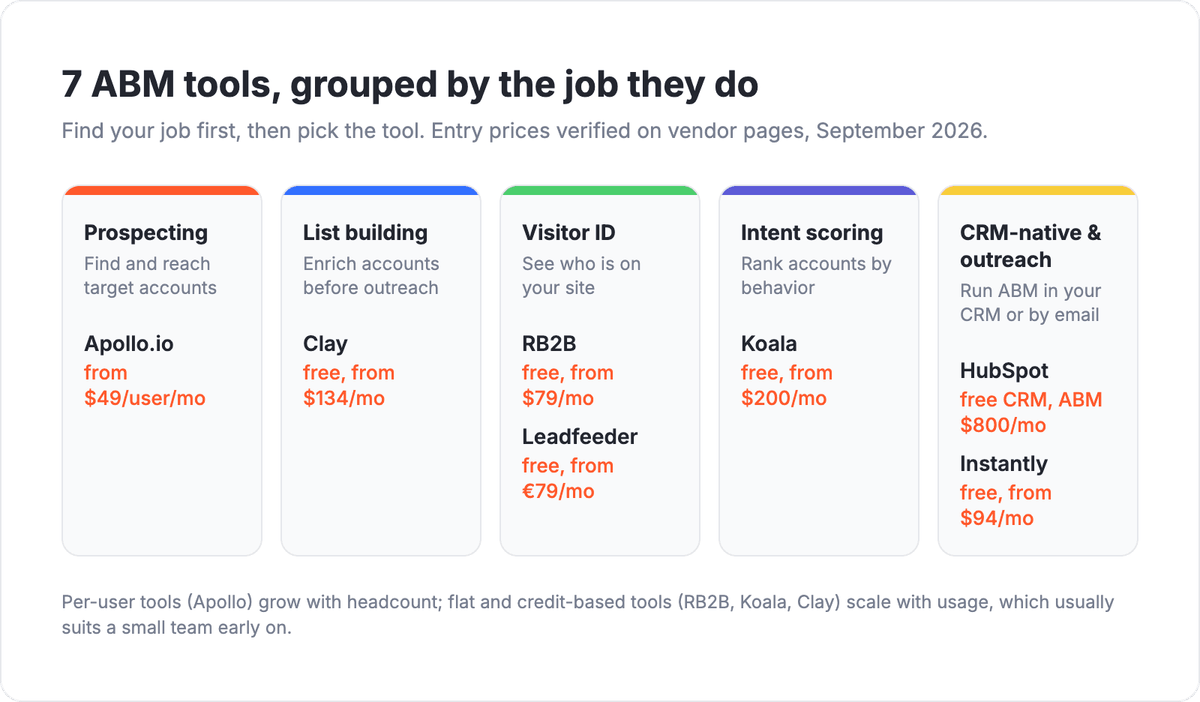
Account-based marketing for a small team is really three jobs: find the accounts worth targeting, spot when they show up on your site, and get that context in front of whoever handles the follow-up. The tools split cleanly along those lines, and the comparison table below maps each one to the job it does best.
ABM Software for Small Teams Compared
The table below maps each tool to the ABM job it does best, with the entry price and how it bills. Read it as a shortlist, then jump to the section for whichever job you need first.
| Tool | Entry price | Pricing model | Best for | CRM / integration |
|---|---|---|---|---|
| Apollo.io | $49/user/mo (annual) | Per user, free plan | Target-account prospecting and outreach | Native HubSpot, Salesforce; API |
| RB2B | Free, paid from $79/mo | Flat, by resolutions/mo | Person-level visitor ID pushed to Slack | Slack, Teams; webhooks on paid tiers |
| Leadfeeder (Dealfront) | Free Lite, from €79/mo | Flat, by identified companies | Company-level visitor ID into the CRM | Native CRM sync, webhooks |
| HubSpot | Free CRM; ABM at $800/mo | Tiered, seat-based | ABM run inside an all-in-one CRM | Native (it is the CRM) |
| Clay | Free, paid from $185/mo | Credit-based | Account list building and enrichment | Webhooks, API, HTTP |
| Instantly | Free tier, from $94/mo | Flat, bundle-based | Cold email outreach to target accounts | Webhooks, API |
Prices reflect each vendor's published rates as of September 2026. Per-user tools scale with headcount; flat tools scale with volume (resolutions, credits, or identified accounts), which usually works out cheaper for a small team.
Apollo.io: Target-Account Prospecting Without the Data Bill
Apollo.io earns its spot by collapsing three line items (a contact database, an email sequencer, and enrichment) into one subscription a small team can actually afford. The Basic plan runs $49 per user per month on annual billing, and there's a free plan with 900 credits a year to test the waters before you pay.
For account-based work, you build a target-account list by firmographic filters, pull verified contacts at those accounts, and run sequences without leaving the tool. Professional at $79 per user per month adds automated workflows and AI research if you want plays that fire on their own.
Apollo connects to HubSpot and Salesforce natively, so enriched contacts land in the CRM your reps already live in. If you run a different stack, you can route new contacts anywhere through Albato's no-code integration platform so a new target account triggers a task, a Slack ping, or a row in a sheet.
Apollo bills per seat, so keeping paid seats to the person who actually builds lists is the simplest way to hold the cost down on a small team.
💡 Tip. Apollo bills per seat, so a two-person team pays for two seats and no more. If only one person builds lists while others just view them, keep paid seats to the builder and export what the rest of the team needs.
RB2B: Free Person-Level Visitor ID
RB2B is the first tool to reach for when you have traffic but no idea who is behind it. Here is what its visitor feed looks like.
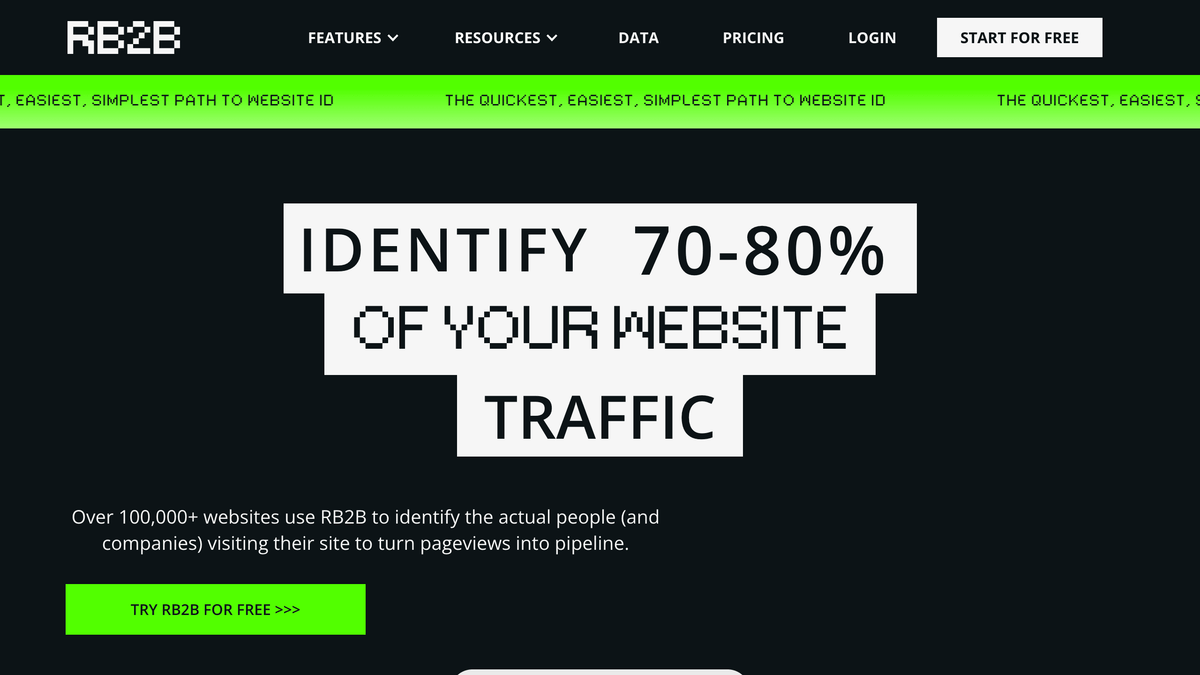
RB2B does one thing that used to cost thousands: it tells you which individual people from US companies visited your site, then pushes those profiles to Slack in near real time. The free plan is genuinely free at $0 a month with 150 monthly resolutions, and paid tiers start at $79 a month for 300 resolutions with Slack and Teams delivery.
That free tier is why RB2B fits a small team so well. You can watch anonymous traffic turn into named people without committing a cent, then upgrade only once the volume justifies it. The catch: RB2B is US-focused, so international traffic won't resolve.
Because the signal lands in Slack, the natural next move is turning a hot visitor into a CRM record or a task. RB2B's webhooks (on paid tiers) can feed a workflow that creates a deal or notifies the right rep the moment a target account shows up, instead of leaving the alert to scroll past in a busy channel.
⚠️ Important. RB2B's free plan identifies companies, not individuals. Person-level resolution (names, emails, LinkedIn) starts on the paid tiers. If your pitch to leadership rests on seeing named buyers, budget for Starter from day one.
Leadfeeder: Company-Level Visitor ID Straight Into the CRM
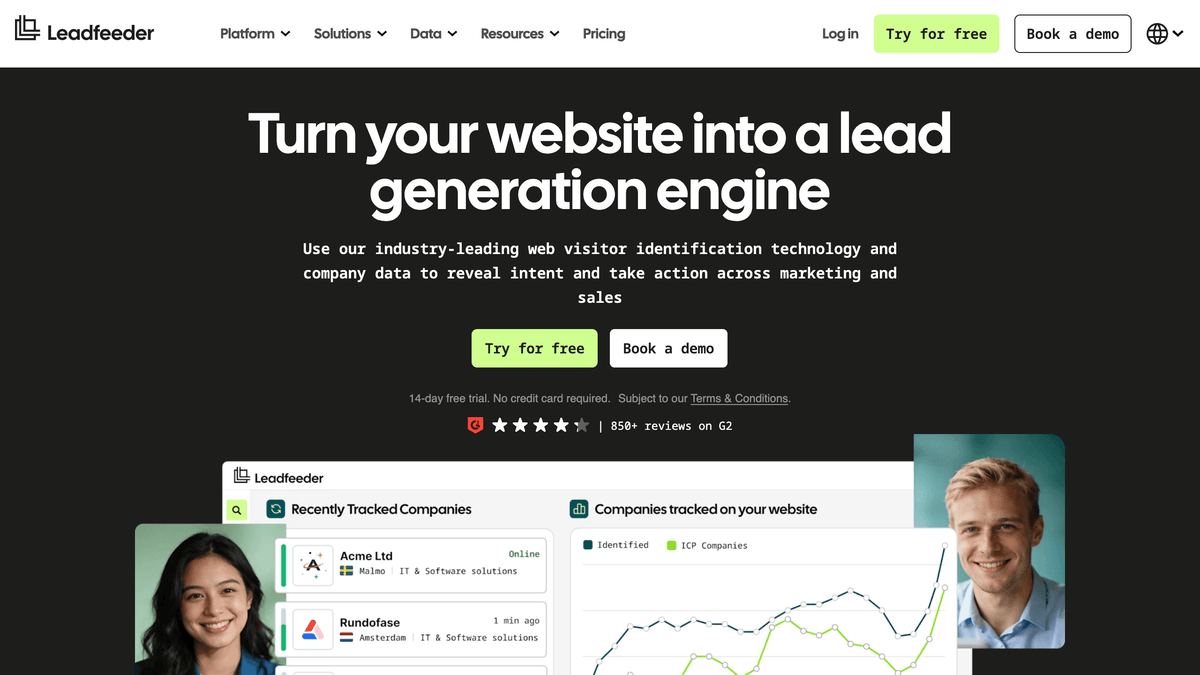
Leadfeeder, now part of Dealfront, answers a different question than RB2B: which companies are on your site, and are they worth a sales touch? It leans toward CRM sync rather than Slack alerts, which suits teams that run their pipeline out of the CRM rather than a chat channel. The free Lite plan shows your last 100 identified companies, and the Discover plan starts at €79 per month on annual billing.
Leadfeeder covers international traffic where RB2B stops, so if a meaningful share of your audience sits outside the US, it fills the gap. Discover adds real-time alerts and automated CRM outreach; the €369-per-month Activate tier layers on intent-signal filtering once you're ready to prioritize accounts by buying behavior.
The company-level view pairs well with a CRM sync that tags an account, updates a deal stage, or assigns an owner automatically. You can wire those moves through a no-code platform so a newly identified company doesn't just sit in a dashboard nobody checks.
HubSpot: ABM Inside the CRM You Already Run
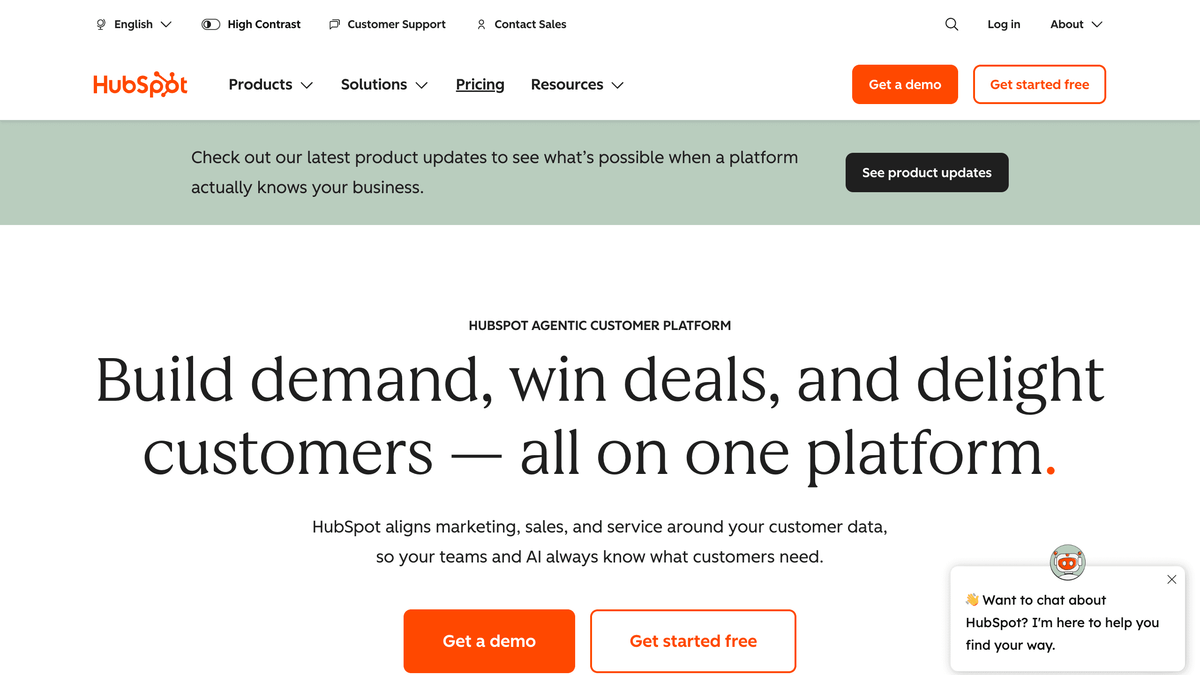
HubSpot is the answer when you'd rather run account-based plays inside your CRM than stitch three point tools together. Its free CRM costs nothing and covers contact management and basic email, which is where a lot of small teams start. The account-based marketing workflows, target-account tiers, and ABM reporting live in Marketing Hub Professional, which begins at $800 a month.
That $800 figure is the honest catch. HubSpot's dedicated ABM tooling is a Professional-tier feature, so the "cheap" version is really the free CRM plus manual list work, and the "real" version is a meaningful monthly commitment. For a small team, the call is whether consolidating tools into one platform is worth more than piecing together lower-cost specialists.
Where HubSpot shines is that everything is native: the CRM, the marketing automation, and the ABM reporting share one database, so there's no sync to maintain. When you do bring in outside signals, such as a visitor from RB2B, a no-code connector can drop them onto the right HubSpot record without custom code. Our best marketing reporting tools guide covers how to pull those cross-tool numbers into one view.
🔧 How it works. HubSpot's ABM features tag accounts into tiers (1, 2, 3) and let you build target-account lists that trigger workflows. The tiering is only on Professional; the free CRM stores the same account data but without the automated ABM layer on top.
Clay: Build and Enrich the Account List First
Clay sits one step before the outreach tools: it's where you build and enrich the target-account list that everything else runs on. It pulls data from dozens of sources, enriches accounts and contacts, and hands off a clean list to your CRM or sequencer. The free plan includes 500 actions a month, and the paid Launch plan starts at $185 a month, with 2,500 data credits and 15,000 actions included.
Clay's strength is flexibility. Rather than a fixed database, you compose exactly the enrichment you want (company size, tech stack, hiring signals) and let it fill in gaps across a whole list. For a small team, that means one person can assemble a genuinely targeted account list instead of buying a generic one.
Clay is credit-based, so cost tracks usage rather than seats, which is friendly to a team where one operator builds lists for everyone. It connects out through webhooks and API, so an enriched list can flow straight into the CRM, into Apollo for sequencing, or into a landing page and ad audience sync via a no-code layer.
Instantly: Cold Email to Target Accounts, Cheaply
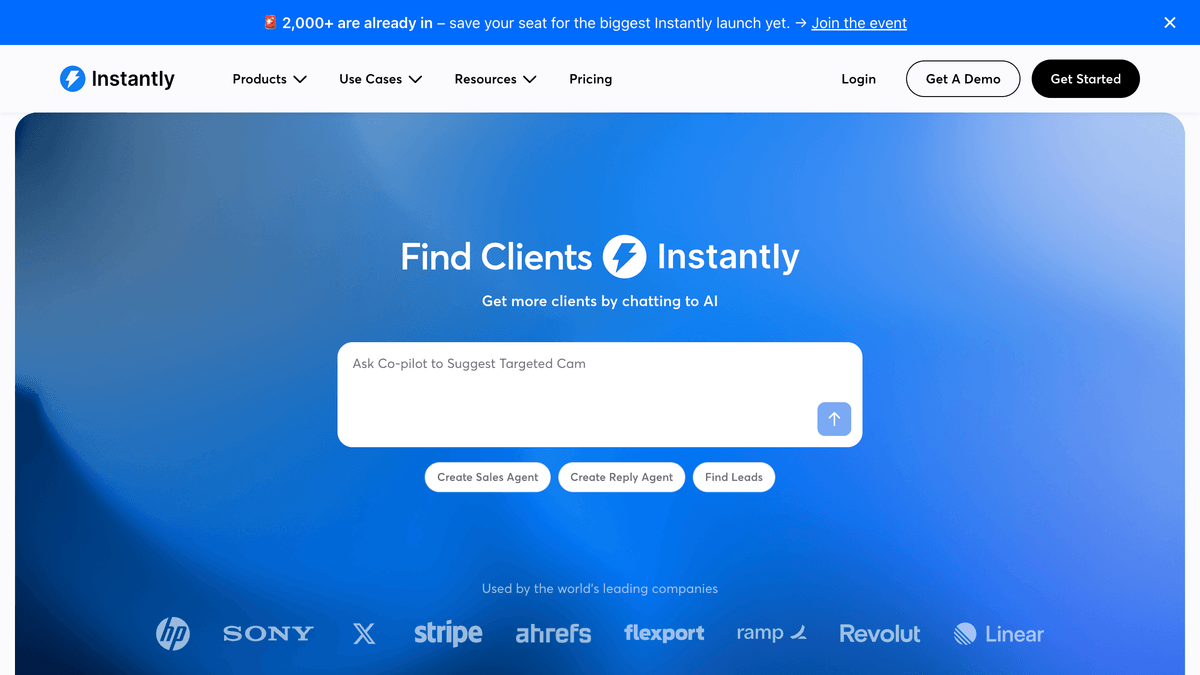
Instantly is the outreach engine for teams whose ABM motion runs on cold email to named accounts. It handles inbox warmup, sending across multiple mailboxes, and campaign management at a price a small team can absorb. The Starter bundle is $94 a month ($85 on annual billing), and there's a free tier to test sending before you commit.
The reason it belongs on a small-team list is deliverability without an enterprise contract. Instantly's warmup and rotation are built to keep target-account emails landing in the inbox, which is the part most DIY cold-email setups get wrong. Pair it with a list from Clay or contacts from Apollo, and you have a full prospect-to-send motion under a few hundred dollars a month.
Instantly connects through webhooks and API, so a reply or a positive signal can trigger a CRM update or a Slack alert automatically. That closes the loop: a warm reply from a target account becomes a task for the right person instead of an email someone forgets to log. Our social media management tools guide covers routing the same kind of engagement signal from social channels.
With the send motion covered, the last question is which of these tools to start with, and that comes down to the job you can't do today.
How to Choose ABM Software as a Small Team
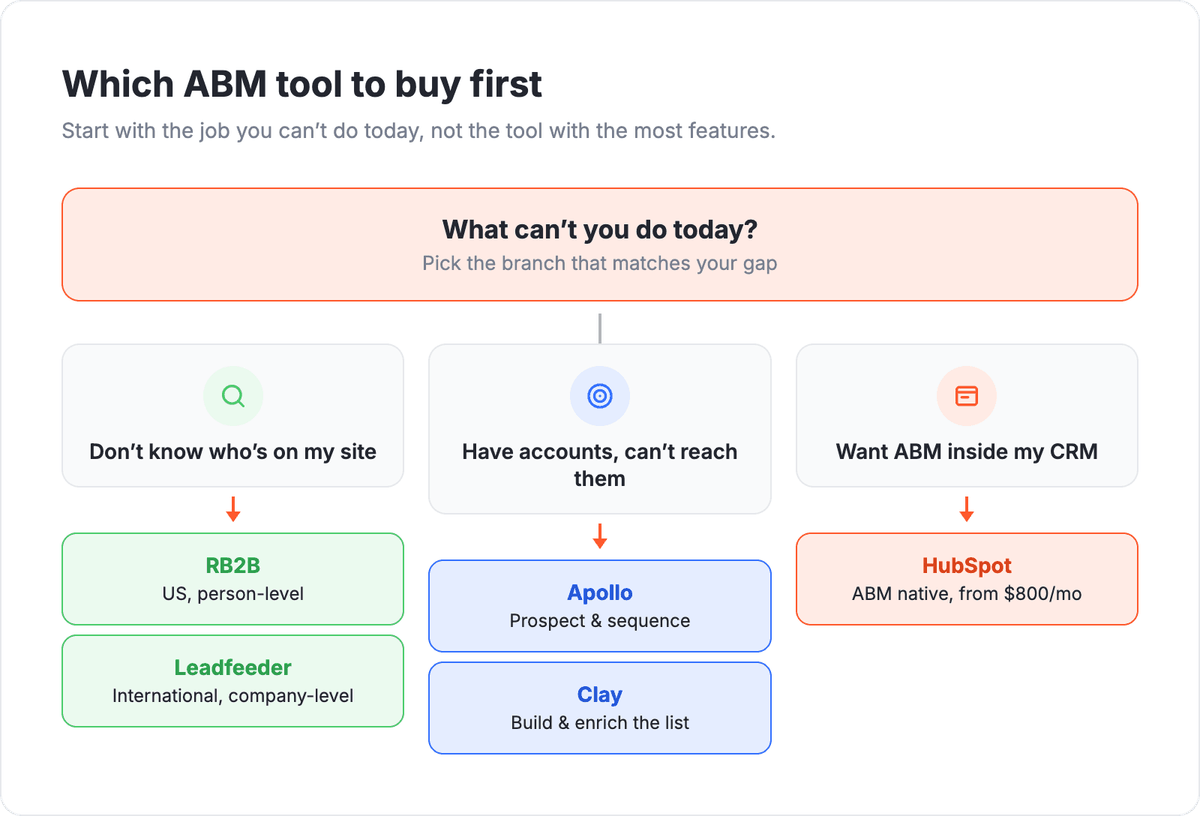
Start with the job you can't do today, not the tool with the most features. If you have traffic but don't know who's on your site, a visitor-ID tool (RB2B for US person-level, Leadfeeder for international company-level) is the first buy. If you have accounts but no way to reach them, prospecting (Apollo) or list-building (Clay) comes first. If you already run everything in a CRM and want ABM native, HubSpot consolidates the stack, at a Professional-tier price.
Watch the pricing model as closely as the price. Per-user tools like Apollo get expensive as the team grows; flat and credit-based tools like RB2B and Clay scale with usage instead, which usually favors a small team early on. And check the free tiers honestly: some (RB2B, Leadfeeder, Apollo) are real starting points, while others cap the useful features until you pay.
The one piece every option shares is that the signal has to reach the person who acts on it. A visitor alert, an intent score, or an enriched account is only worth the subscription if it lands in your CRM, your Slack, or your sequencer at the right moment. A no-code integration platform is what connects the ABM tool you pick to the stack you already run, without a developer.
Whichever tool you start with, Albato connects it to the rest of your stack on a free plan, no credit card and no developer required. Set up the first route in a few minutes and let the signals flow to where your team already works.
Still weighing which tool to start with? The FAQ below covers the questions small teams ask most before they buy.
FAQ
What is the best ABM software for a small team on a budget?
For a strict budget, combine Apollo.io (from $49 per user per month) for prospecting with RB2B's free plan for visitor identification. Both are self-serve, need no ops hire, and cover the two core ABM jobs without a five-figure contract.
Is HubSpot good for account-based marketing?
HubSpot is strong for ABM if you want it native to your CRM, but the account-based workflows and target-account tiers only become available on Marketing Hub Professional at $800 a month. The free HubSpot CRM stores account data but doesn't include the automated ABM layer.
Do I need a separate visitor identification tool for ABM?
If you have website traffic and want to run account-based plays, yes. Prospecting tools tell you who to target; visitor-ID tools like RB2B and Leadfeeder tell you which of those accounts are actually on your site right now, which is what makes outreach timely.
How much does ABM software cost for a small team?
Entry prices range from free (RB2B, Leadfeeder Lite, Apollo, and Clay all have free tiers) to around $79 to $200 a month for the first paid tier. Full CRM-native ABM through HubSpot Professional starts at $800 a month, which is the top of the small-team range.
How do I connect ABM tools to my CRM?
Some tools (Apollo and HubSpot) offer native CRM connections. For everything else, a no-code integration platform like Albato routes the signals (new accounts, visitor alerts, intent scores) into your CRM, Slack, or email tool without custom code.
Are enterprise ABM platforms like Demandbase worth it for a small team?
Usually not yet. Demandbase and RollWorks don't publish pricing, require a sales call, and assume a dedicated RevOps function. A small team gets more value from self-serve specialists it can buy today and grow out of later.