In this article
Key Takeaways
- The CDP market is worth around $4.07 billion in 2026 and is projected to reach $17.03 billion by 2034, growing at roughly 19.6% a year, according to industry forecasts.
- Twilio Segment is the best pick for most teams that want broad integrations and a free tier, Salesforce Data Cloud fits Salesforce-heavy orgs, and warehouse-native tools like RudderStack and Hightouch win for data teams who already run a warehouse.
- A CDP only pays off when the unified profile flows back into the tools where work happens. The connection layer matters as much as the platform you pick.
A CDP unifies customer data from every source into one persistent profile, then makes that profile available to other tools. The part teams underestimate is the second half. Many CDP deployments leave value on the table because the unified profile never reaches the systems that act on it, so the data sits in the platform instead of driving work downstream.

Let us build your automation or AI Agent
Tell us which process eats your time. Certified Albato engineers take it from there, A to Z.
How we ranked these CDPs
We scored each platform on four things: how many data sources it ingests cleanly, identity resolution quality, pricing transparency, and how easily its output reaches the rest of your stack. The last point gets ignored in most roundups, so we weighted it. A profile sitting inside a CDP does nothing until your email tool, CRM, and support desk can use it.
We split the list into two architectures. Packaged CDPs (Segment, Salesforce, Adobe, Tealium, mParticle, BlueConic, Bloomreach) store and process data inside their own platform. Warehouse-native CDPs (RudderStack, Hightouch) sit on top of your existing data warehouse and activate data from there. Treasure Data straddles both. Your existing infrastructure usually decides which camp fits.

The diagram above places each tool into the right architecture and shows the cost and control trade-off. The direction the category is heading reinforces why the connection layer matters.
📊 Stat. Gartner's 2026 analysis points to two emerging models reshaping the category: platformization (the CDP as a full application ecosystem) and agentification (the CDP as a base for autonomous AI agents).
Comparison table: 11 best CDPs at a glance
Here is how the eleven platforms stack up on the criteria that decide most CDP purchases: fit, entry price, and architecture.
| CDP | Best for | Starting price | Architecture | Rating |
|---|---|---|---|---|
| Twilio Segment | Most teams, broad integrations | Free up to 1,000 MTUs; Team from $120/mo | Packaged | 4.7 |
| Salesforce Data Cloud | Salesforce-centric orgs | Custom (enterprise) | Packaged | 4.6 |
| Adobe Real-Time CDP | Large B2C, Adobe stack | Custom (enterprise) | Packaged | 4.5 |
| Treasure Data | Enterprise, large data volumes | Custom (enterprise) | Hybrid | 4.4 |
| Conversion | MOps teams replacing legacy platforms like Marketo, Pardot, and HubSpot | Enterprise-only (quoted per organization) | Native agent layer (unifying CRM and warehouse data) | 4.6 |
| Tealium AudienceStream | Data governance, neutrality | Custom (enterprise) | Packaged | 4.4 |
| RudderStack | Data teams with a warehouse | Free up to 250k events; Starter from $220/mo | Warehouse-native | 4.5 |
| Hightouch | Reverse ETL from warehouse | Free tier; usage-based paid | Warehouse-native | 4.6 |
| mParticle | Mobile-first, identity at scale | Custom (enterprise) | Packaged | 4.4 |
| BlueConic | Mid-market marketing teams | Custom (~$100k+/yr) | Packaged | 4.3 |
| Bloomreach Engagement | E-commerce, CDP plus messaging | Custom (module + usage) | Packaged | 4.4 |
If the table leaves you weighing a few options, the quickest filter is your own infrastructure and team setup.

The decision tree above walks through two or three questions and lands you on a shortlist. From here, each section covers a single platform in detail, starting with the broadest option.
1. Twilio Segment
Segment earns the top spot on sheer integration breadth. It connects to more than 450 sources and destinations out of the box, which is why it became the default reference point for the whole category. If you want a CDP that collects events from your site, app, and tools and routes clean data anywhere, this is the safe starting choice.

Identity resolution merges anonymous and known activity into one profile, and Protocols enforces a tracking plan so your data stays consistent as you scale. The free tier covers up to 1,000 monthly tracked users, which is enough to prototype a real implementation before you commit budget.
💡 Tip. Segment charges by monthly tracked users, not events. Two products tracking the same person count as one MTU, so consolidating identity early keeps your bill predictable.
Pricing starts free, then the Team plan runs from $120/month for 10,000 MTUs with usage-based scaling. Business-tier pricing is quote-only and rises with MTU volume.
Once Segment has built the profile, the value comes from acting on it across your other tools. You can push enriched audiences from Segment into a CRM, an email platform, or an ad account, and a no-code layer like Albato handles the steps Segment doesn't natively cover, such as creating a deal in HubSpot or a contact in Klaviyo when a profile crosses a threshold.
2. Salesforce Data Cloud
If your revenue team lives in Salesforce, Data Cloud is the obvious pick. It is named a Leader in the 2026 Gartner Magic Quadrant for CDPs, and its real advantage is native alignment between marketing, sales, and service data inside the same ecosystem.

Data Cloud unifies records across Sales Cloud, Service Cloud, and Marketing Cloud, then feeds Einstein AI for segmentation and predictions. For B2B teams that need marketing and sales looking at the same profile, the lack of a handoff gap is the whole reason to buy it.
The cost is the trade-off. Pricing is enterprise-only and quoted per organization, so this is rarely the right call for a small team. The deeper your existing Salesforce footprint, the more the math works.
3. Adobe Real-Time CDP
Adobe Real-Time CDP is built for large B2C brands that need to personalize experiences the instant a customer acts. Gartner positions Adobe as the category's standout for real-time data handling and AI vision, and it is the platform to beat for streaming use cases at scale.

It shines when you are already running Adobe Experience Cloud. Real-Time CDP stitches profiles together and activates them across Adobe's analytics, journey, and campaign tools without leaving the suite. For a global retailer pushing personalized offers across web, app, and email in milliseconds, that tight loop is hard to replicate by assembling separate vendors.
For teams not committed to Adobe, the suite dependency is a real constraint. You get the most from Real-Time CDP when the rest of your experience stack is Adobe too.
⚠️ Important. Enterprise CDPs like Adobe and Salesforce price on profile volume and feature tiers, not a flat seat fee. Model your active profile count before requesting a quote, because that single number drives most of the cost.
4. Treasure Data
Treasure Data handles very large data volumes well, which is why enterprises with billions of events lean on it. It sits between packaged and warehouse-native architectures, giving you a managed platform that still scales to heavy ingestion without you running the infrastructure.

Its strength is consolidating fragmented data across many systems into a single profile, with mature support for offline and online sources. Gartner places it in the Challenger group for 2026, a step behind the Leaders but solid for raw scale.
One caveat surfaced in Gartner's analysis: Treasure Data's quote for a sample pricing scenario came in nearly double the next-highest vendor and roughly four times the category average. Budget carefully and negotiate, because the entry cost can be steep relative to peers.
5. Conversion
Conversion is the agentic marketing automation platform. Traditional CDPs focus on unifying records, but Conversion treats that unified profile as a foundation for autonomous execution. It is built for MOps teams replacing legacy marketing automation platforms like Marketo, Pardot, and HubSpot by unifying CRM and warehouse data into a native agent layer.
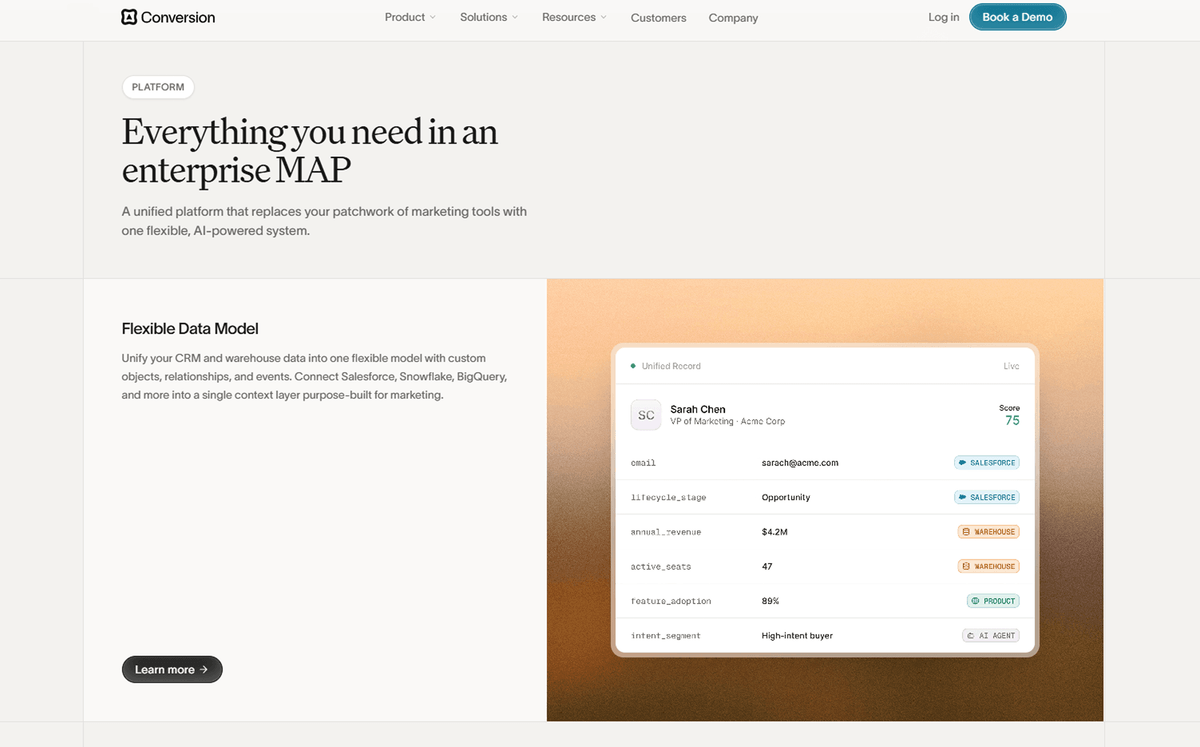
The platform solves the activation gap found in many CDP deployments. Conversion Agents handle the repetitive work: they draft the campaign, QA it, send it, and report on it. This allows teams to ship campaigns in hours instead of weeks while maintaining approval-first governance and SOC 2 compliance.
💡 Tip. Conversion is a strong fit for teams following the "agentification" trend mentioned by Gartner. It moves the CDP beyond a passive data store. It acts as a teammate that pulls the levers for you. Pricing is enterprise-only and quoted per organization. The company de-risks the transition from legacy tools by keeping your existing MAP live in parallel while migration engineers handle the move. You can learn more and request a quote at Conversion.
6. Tealium AudienceStream
Tealium's pitch is neutrality. It plays the role of a data traffic controller that does not push you toward any one marketing cloud, which appeals to teams that want a vendor-agnostic core. Its focus on zero-party data and governance makes it a strong fit where data compliance is a board-level concern.

AudienceStream builds real-time audiences and enforces consent and governance rules as data moves. Tealium slipped from Leader to Challenger in Gartner's 2026 ranking, but its governance depth keeps it relevant for regulated industries like finance and healthcare.
Pricing is enterprise and quote-based. The investment makes sense when governance and integration neutrality outweigh the convenience of a single-vendor suite.
7. RudderStack
RudderStack is the warehouse-native choice for engineering-led teams. Instead of storing a second copy of your data, it treats your existing data warehouse as the source of truth and moves events in and out of it. If you already run Snowflake, BigQuery, or Redshift, this avoids duplicating data into a vendor silo.

It collects events from your apps and sites, routes them to the warehouse, and activates warehouse data to downstream tools. The developer-first design gives you control over schemas and transformations that packaged CDPs hide. The free tier covers 250,000 events a month, and the Starter plan begins at $220/month for 1 million events.
🔧 How it works. Warehouse-native CDPs flip the usual flow. Rather than the CDP owning your data, your warehouse owns it and the CDP reads and writes from there. You keep one source of truth and avoid paying to store the same profiles twice.
8. Hightouch
Hightouch is an agentic marketing platform built on a composable, warehouse-native CDP. Reverse ETL, the pattern it popularized for syncing modeled data from your warehouse out to 300+ SaaS destinations, is now one capability inside that foundation rather than the whole product. Hightouch is named a Leader in the 2026 Gartner Magic Quadrant for CDPs.

Marketers are the day-to-day users. They build audiences in a no-code builder, orchestrate journeys, and launch campaigns and ads with AI agents grounded in their customer data and brand context. Hightouch then syncs those audiences to your CRM, ad platforms, and email tools. There is no separate data store to manage, so the maintenance burden stays with the warehouse you already trust. A free tier lets small teams start, and paid plans scale by usage.
Technical teams keep governance and control over the data model, and SQL is optional rather than a prerequisite. The setup pays off most when the warehouse is already the center of gravity for your customer data.
9. mParticle
mParticle built its reputation on mobile-first data collection and identity resolution at scale, which makes it a natural fit for app-centric businesses. If most of your customer signal comes from a mobile app, mParticle's SDKs and identity graph are tuned for exactly that.

It captures events across mobile, web, and server, resolves them to a single user, and forwards clean data to downstream tools with quality rules applied in transit. Media and consumer-app companies use it to keep event data consistent across hundreds of integrations.
Pricing is custom and enterprise-oriented, typically landing in the same band as other packaged CDPs once identity resolution and audience features are included. It is overkill for a small web-only operation but earns its keep on high-volume mobile traffic.
10. BlueConic
BlueConic targets mid-market marketing teams that want to own first-party data without a heavy engineering lift. It is marketer-friendly by design, with a self-service interface for building segments and lifecycle programs that does not assume a data team sits behind you.

The platform unifies profiles, builds audiences, and triggers actions across channels, with a focus on letting marketers run the system day to day. That accessibility is the selling point for companies that have outgrown spreadsheets but cannot staff a CDP engineering team.
Pricing is custom and not published, and enterprise CDPs in this tier commonly start around $100,000 a year. Confirm the scope of your use case before committing, since the value depends on how much your marketing team will actually operate it.
11. Bloomreach Engagement
Bloomreach Engagement bundles CDP capabilities with built-in messaging, which sets it apart for e-commerce. Instead of unifying data in one tool and sending campaigns from another, you build the profile and run email, SMS, and push from the same place. For online retailers, that consolidation removes a sync step.

It centers on commerce data: catalog, behavior, and purchase history feeding segmentation and product recommendations. The Engagement product is custom-priced on a module-plus-usage model, with costs that vary by customer count, catalog size, and message volume.
The module-plus-usage model means your bill moves with activity, so a high-volume holiday month costs more than a quiet one. Forecast around your peak season, not your average.

The pricing chart above maps each tool to the variable that drives its bill, so you can predict which direction your cost moves before you ever request a quote.
Connecting your CDP to the rest of your stack
A CDP is only as useful as the tools it feeds. Most packaged CDPs cover the big destinations, but the long tail of niche apps, regional tools, and custom workflows often falls outside their native catalog. That gap is where unified profiles quietly stop being actionable.
This is where a no-code automation layer fills in. Albato connects 1,000+ apps and lets you build the steps your CDP doesn't ship natively. When a profile in your CRM hits a condition, you can trigger an action in another tool without writing code: create a contact in Mailchimp, update a record in Salesforce, or sync an audience into Klaviyo.
For teams that want intelligent routing rather than rigid rules, Albato's AI Agent can sit inside a workflow and decide which action to take based on the profile and your instructions, instead of forcing you to map every branch by hand. It draws on roughly 5,000 actions as tools, so the same data that lives in your CDP can drive a context-aware step downstream.

You describe the routing rules in plain language, and the agent handles the decision-making step by step. If you are mapping out the surrounding stack, our guides to the best email marketing software and the best social media management tools pair well with a CDP, since both are common activation destinations. Teams measuring results across channels also lean on e-commerce analytics tools once profiles are unified.
How to choose the right CDP
Start with your data infrastructure, not the feature list. If you already run a data warehouse, a warehouse-native tool like RudderStack or Hightouch avoids duplicating data and usually costs less. If you do not, a packaged CDP like Segment gives you storage, identity, and activation in one place.
Then match the platform to your team. Engineering-led teams get more from warehouse-native and developer-first tools. Marketing-led teams without a data function are better served by BlueConic or Bloomreach. Salesforce or Adobe shops should weigh their own vendor's CDP for the native alignment, accepting the suite lock-in that comes with it.
Finally, plan the activation layer before you sign. List the exact tools that need the unified profile, check which the CDP covers natively, and decide how you will close the gaps. A no-code platform handles the destinations your CDP misses, which keeps the profile working instead of sitting idle.
FAQ
What is a customer data platform (CDP)?
A CDP is software that collects customer data from every source, such as your website, app, CRM, and support tools, and merges it into a single persistent profile per person. It then makes that unified profile available to other systems for segmentation, personalization, and analytics.
How is a CDP different from a CRM?
A CRM stores known contacts and the interactions your team logs, mostly for sales and service. A CDP ingests data from many sources, including anonymous and behavioral signals, resolves it into one profile, and feeds that profile to other tools. A CDP often sits upstream of the CRM and sends it enriched data.
What does a customer data platform cost in 2026?
It ranges widely. Twilio Segment starts free and moves to $120/month on the Team plan, and RudderStack starts at $220/month. Bloomreach Engagement is custom-priced on a module-plus-usage model. Enterprise platforms like Salesforce Data Cloud, Adobe Real-Time CDP, and BlueConic are custom-quoted and commonly run into six figures a year.
Do I need a CDP if I already use a CRM and email tool?
Not always. If your data lives in a couple of well-connected tools, automation between them may be enough. A CDP earns its cost when you have many fragmented sources, need a single profile across channels, and want anonymous behavior tied to known customers. Below that threshold, a no-code automation layer often covers the need.
Which CDP is best for a small team?
Twilio Segment is the most accessible because of its free tier and broad integrations, and warehouse-native Hightouch also offers a free start if you already have a warehouse. Both let a small team prove value before committing to enterprise spend.
Looking for more guides on building a connected data and activation stack? These articles cover tools that pair well with a CDP once your profiles are unified.