In this article
Key Takeaways
- Minimum Code and Goodspeed build Bubble apps themselves and rebuild them on Next.js and Supabase: Minimum Code quotes 6 to 8 weeks for an MVP-sized app, and Goodspeed publishes budgets from $8,000.
- Invental moves Bubble, Framer, Webflow and Wix products into code one route at a time behind a reverse proxy, while the old app keeps serving users. Scroll and FullCode also take Webflow sites, and FullCode's Bubble packages start at $1,975, the lowest published migration price here.
- Bubble exports data but no code and no password hashes, so every plan needs a login switch.
Bubble's manual says it directly: "there's no way of exporting your application as code", so a team that moves off the platform rebuilds the application logic, and Bubble offers to help export the design. The same ownership page says your data and your app's design belong to you, while Bubble owns the code that runs the app.
How do the 7 Bubble to code migration agencies compare?
These seven agencies start their migration work from different places. Minimum Code and Goodspeed build on Bubble; Invental, Scroll and FullCode migrate products from several no-code tools including Webflow; and Brainhub and Inigra are product studios with a published Bubble case or a fixed-price rescue package for no-code and AI-built prototypes.
| Agency | Moves products from | Target stack named on its site | Published proof | Published timeline and price |
|---|---|---|---|---|
| Minimum Code | Bubble | Next.js + Supabase | Process and FAQ; no named migration case on the service page | MVP-sized app 6 to 8 weeks; live production app 3 to 6 months; fixed-scope proposal after assessment |
| Goodspeed | Bubble | React, Next.js; Next.js + Supabase + Vercel in about 80% of its migrations | Anonymous worked example: 23 backend workflows rewritten in a 10-week migration | $8,000 to $15,000 (4 to 6 weeks) up to $35,000 to $60,000 (14 to 20 weeks) |
| Invental | Bubble, Framer, Webflow, Wix | Next.js or Remix, TypeScript, Postgres | Migration playbook; Bubble builds for House of Pitch and a fintech dashboard; case studies on request | One-week discovery, two-week sprints; price on request |
| Scroll | Bubble, FlutterFlow, Webflow, plus AI-built projects | Next.js, Supabase, PostgreSQL; Payload for Webflow sites | ProtectUs: full exit from Bubble | Bubble app 2 to 4 months; Webflow site 3 to 8 weeks; fixed quote after scoping |
| FullCode | Bubble, Webflow, Adalo, FlutterFlow, PowerApps | Next.js, Node.js, PostgreSQL + Prisma | Anonymous case studies | Standard from $1,975 (2 to 5 weeks); Premium from $7,500 (4 to 8 weeks) |
| Brainhub | Bubble (one published case) | React, Node.js, Next.js | Networking platform case: 4 experts, 10 months | On request |
| Inigra | Lovable, Bubble, Replit | Next.js or React, Node.js or Python, PostgreSQL | Anonymized cases in its migration guide | Bubble app from £2,000 (about 2 weeks); rescue package £2k to £20k+ (2 to 8 weeks) |
We copied each timeline and price from the agency's own site on October 27, 2026: Invental and Brainhub print no price, while Minimum Code and Scroll send a fixed quote after their assessment or scoping.
What can you export from Bubble, and what do you have to rebuild?
You can export your Bubble database as CSV, JSON or NDJSON files, one data type at a time, and read or sync records through the Data API. You cannot export code, so workflows, privacy rules, plugins and pages are rebuilt in the new stack, and files come out as links that still point to Bubble's storage.
| Part of the app | What Bubble gives you | What the new build has to do |
|---|---|---|
| Database records | Export per data type from Data, App data; download link by email | Map each data type to a table; date interval fields arrive as text such as "2 days" |
| Live data during the move | Data API, off by default, enabled per data type, privacy rules apply | Run a sync script while both apps are live |
| Files and images | The field stores only the file's URL; files sit on S3 | Download every file and upload it to the new storage |
| Workflows | The Workflow API can trigger backend workflows from outside | Rewrite the logic as server functions or API routes |
| Privacy rules | Server-side rules for who sees what | Rebuild as row-level security or server checks |
| Plugins | Some bring their own file storage or paid third-party APIs | Replace with a library or a direct API call |
| Pages and design | No code export; Bubble offers help exporting the design | Rebuild the interface |
| User passwords | Hashes are hidden, even from the app developer | Plan a reset, magic link or log-in-once move |
Bubble's export guide gives one example of why the data map needs care: a date interval stored as 172,800,000 milliseconds exports as "2 days". The files guide adds that Development and Live have separate file storage, and that private files inherit the privacy rules of the record they belong to, so a download script has to authenticate for them.
💡 Tip
Run one test export of your largest data type before the first agency call. Exports share a scheduler with API workflows, so a busy app can wait in the queue, and the file shows exactly what the agency will receive, including the format of date intervals and file links.
How do you move Bubble users to a new app without losing their passwords?
You cannot copy Bubble passwords into a new app, because Bubble stores only password hashes and its user accounts guide says the password field is invisible, even to you as the app developer. Users either set a new password at cutover, sign in once through a magic link, or move over the first time they log in.
A reset email is the simplest path: at cutover every user gets a link to set a password in the new app. A magic link is the gentler version: practitioners on Bubble's forum describe sending a temporary login link from the new app first and asking users to confirm a password afterwards.
The log-in-once path keeps users from noticing the move. The new app sends the email and password a user types to a Bubble backend workflow with the "Log the User in" action, which returns a token when they match, and the new app then saves its own hash. Auth0 calls this automatic or trickle migration, where users move the first time they log in and do not need to reset. Bubble has to stay live for the whole window, and anyone who never logs in during it still needs a reset email at the end.

Users who signed up with Google or Facebook never set a Bubble password, so they simply sign in with the same provider again, as long as the new app supports it.
Which Bubble agencies also migrate apps to code?
Minimum Code and Goodspeed are Bubble build agencies that now rebuild apps in code, mostly on Next.js and Supabase. Both start with an inventory of what the Bubble app does today, both keep the Bubble app live during the rebuild, and both publish timelines.
1. Minimum Code: an audit that can end with "stay on Bubble"
Minimum Code calls itself a Gold-certified Bubble agency, and its migration service moves Bubble apps to Next.js and Supabase. Every project starts with an assessment that ends in one of three recommendations: migrate, refactor inside Bubble or do nothing. The team says plenty of clients leave with a plan to stay, because a lot of the pain founders blame on Bubble comes from how the app was built.

When the answer is to migrate, Minimum Code sets up the target schema, the auth model and the data migration scripts before it rebuilds any feature, then moves the app module by module while the live Bubble app keeps running. Before the switch, it dry-runs the data migration and tests under real conditions. The code lives in your GitHub, deployed to your own Vercel and Supabase accounts.
Minimum Code estimates roughly 6 to 8 weeks for an MVP-sized app and usually 3 to 6 months for a live production app with real users and integrations. The price comes as a fixed-scope proposal after the assessment, and the project ends with 30 days of free support. Its FAQ says integrations such as Stripe, SendGrid and Slack get rebuilt in code, so bring a list of every API Connector call to the assessment.
2. Goodspeed: Bubble builders that publish migration budgets
Goodspeed builds products on Bubble and says it is Bubble's Agency of the Year. Its Bubble to code service rebuilds an app in React, Next.js or whatever stack the client needs, starting with a discovery phase that reverse-engineers every workflow, database table, plugin and API connection into a technical inventory and a migration plan.
A migration guide on Goodspeed's site, dated April 20, 2026, prints its budgets. Simple apps such as internal tools and admin dashboards cost $8,000 to $15,000 over 4 to 6 weeks, mid-complexity SaaS costs $18,000 to $35,000 over 8 to 12 weeks, and complex marketplaces or multi-tenant platforms cost $35,000 to $60,000 over 14 to 20 weeks. The guide says about 80% of its migrations land on Next.js, Supabase and Vercel.
The worked example in the same guide took 10 weeks end to end: 23 backend workflows were rewritten as serverless functions, and users moved over 5 days in cohorts of 500. Goodspeed includes four weeks of hypercare in every migration, and its guide advises against migrating yet if the app has fewer than 1,000 active users and still works.
Which studios move products off Bubble, Webflow and other no-code tools?
Invental, Scroll and FullCode migrate products from several no-code platforms, and all three take Webflow as well as Bubble. Each runs the old and new apps side by side during the move, and each describes its cutover method on its own site.
3. Invental: a reverse proxy that moves one route at a time
Invental's full-stack rebuilds service moves products running on Bubble, Framer, Webflow or Wix into code without downtime. Its migration playbook, published in April 2026, puts a new Next.js or Remix app in front of the existing product through a reverse proxy, and for the first few weeks all traffic still goes to the old stack.
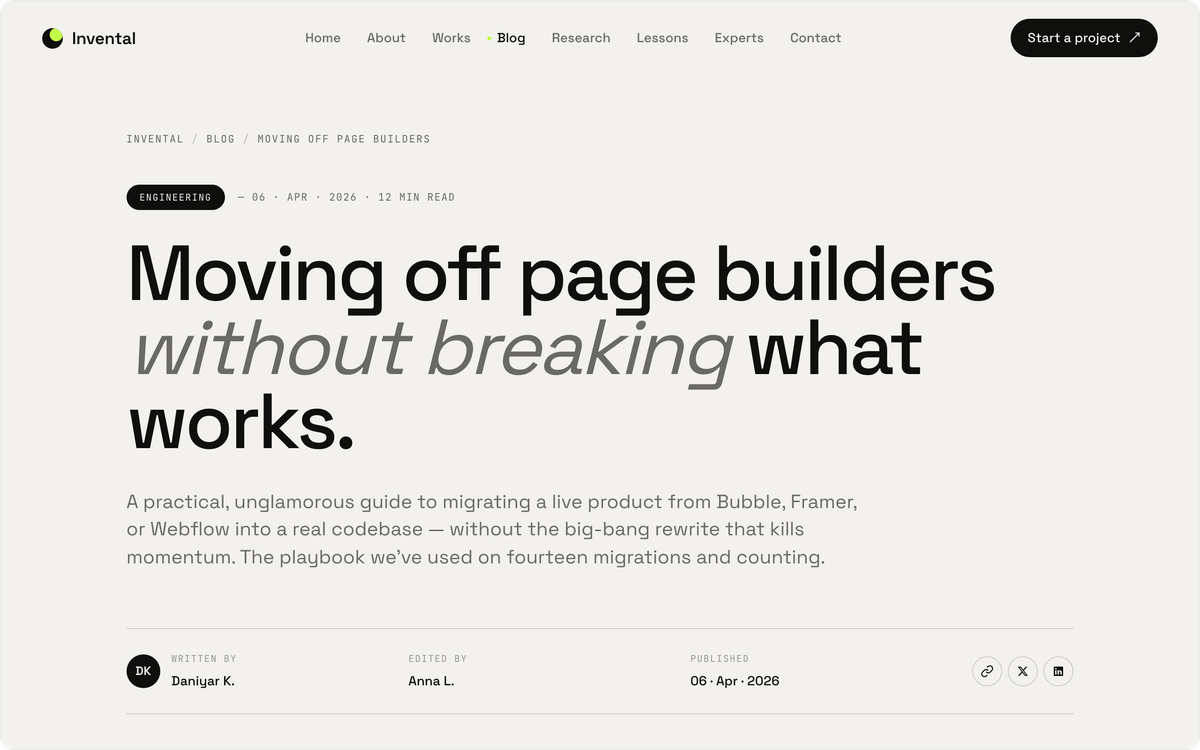
Invental then runs three phases. In Shadow, the new stack double-writes data and double-reads for parity checks while the old one serves every response. In Shift, routes move one at a time behind feature flags that roll back in under sixty seconds, and in Sunset the old platform stays read-only for two more months. The data comes first, mapped into a clean Postgres model before any page moves, and every live URL has to resolve in the new system.
Invental's own Bubble work includes a Bubble web app with a Framer site for House of Pitch and a settlements dashboard that kept its Bubble front end while a Directus backend took over reporting. Neither is a full exit from Bubble, and case studies come on request, so ask for the migration closest to your app. Discovery takes one week, sprints run two weeks, and prices come on request.
4. Scroll: a reverse spec before any code is written
Scroll says it has a no-code past, with builds on Bubble, Webflow, FlutterFlow, WeWeb, Airtable and Retool, and its migration offer moves products off Bubble, FlutterFlow and Webflow. The method has five published steps: an audit of workflows, data, integrations and running costs (1 to 2 weeks), a reverse spec (1 to 2 weeks), a target stack and plan with a fixed quote (1 week), a module-by-module migration (1 to 3 months) and a full exit.
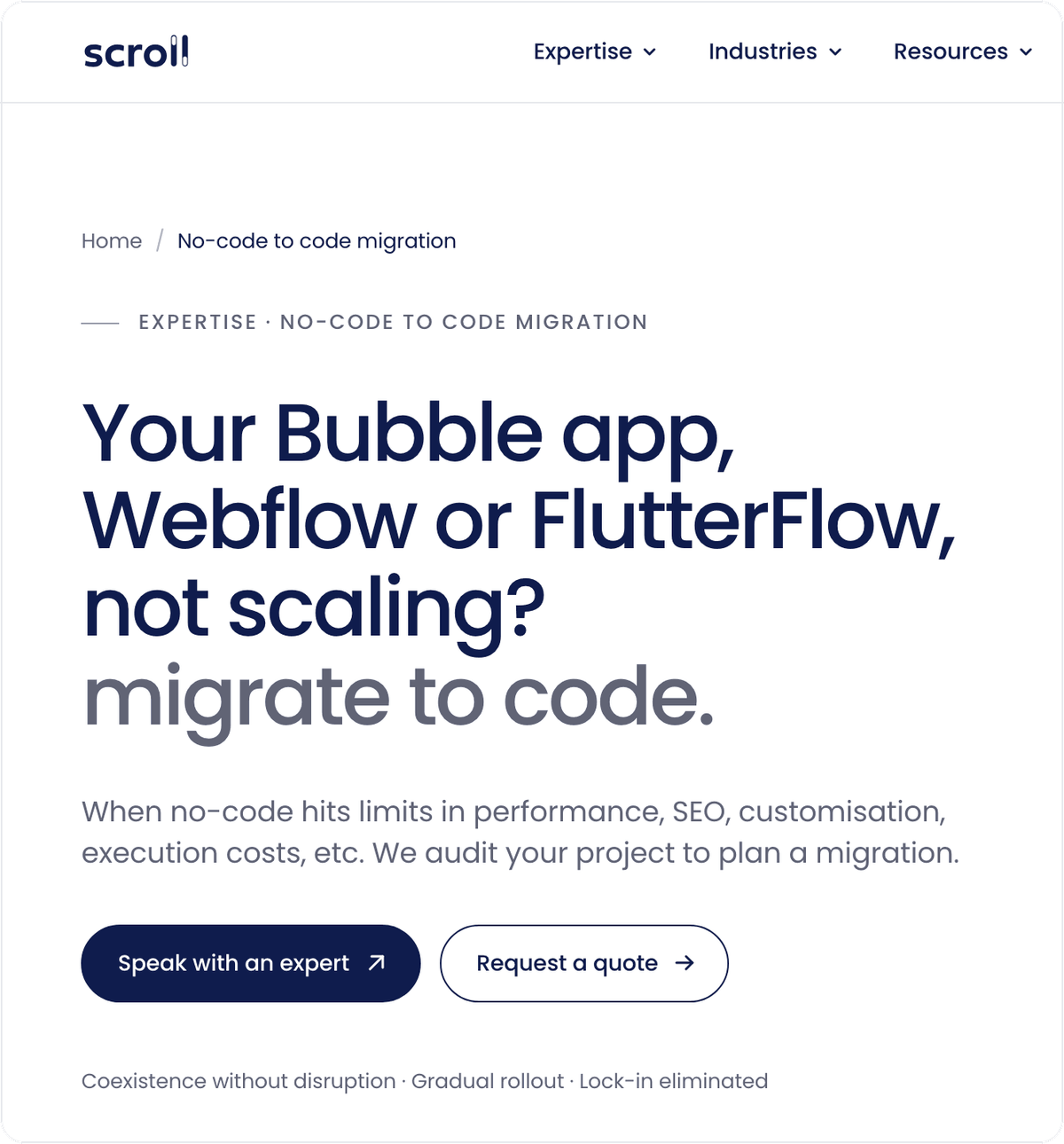
The reverse spec rebuilds the functional documentation from the existing Bubble, Webflow or FlutterFlow app and checks it with the business owners, so obsolete features do not get migrated. That step matters most when nobody on your team can say what every workflow does.
Scroll estimates 2 to 4 months for a Bubble app and 3 to 8 weeks for a Webflow site moving to Payload and Next.js. Its ProtectUs case took an IoT app in production on Bubble, with Arduino-connected devices, to Next.js, Supabase and PostgreSQL step by step, ending in a full exit from Bubble. A free written audit of a no-code app arrives within 48 hours, and training on the target stack is included.
5. FullCode by Yo! No Code: a published map from Bubble parts to code
FullCode, a service of Yo! No Code, publishes how each Bubble part becomes code. Every data type becomes a Prisma model on PostgreSQL, privacy rules become row-level security, every workflow becomes a typed Server Action, and plugins are rewritten as npm dependencies. Data moves through an idempotent CSV and API sync from Bubble to Postgres, with daily delta loads.
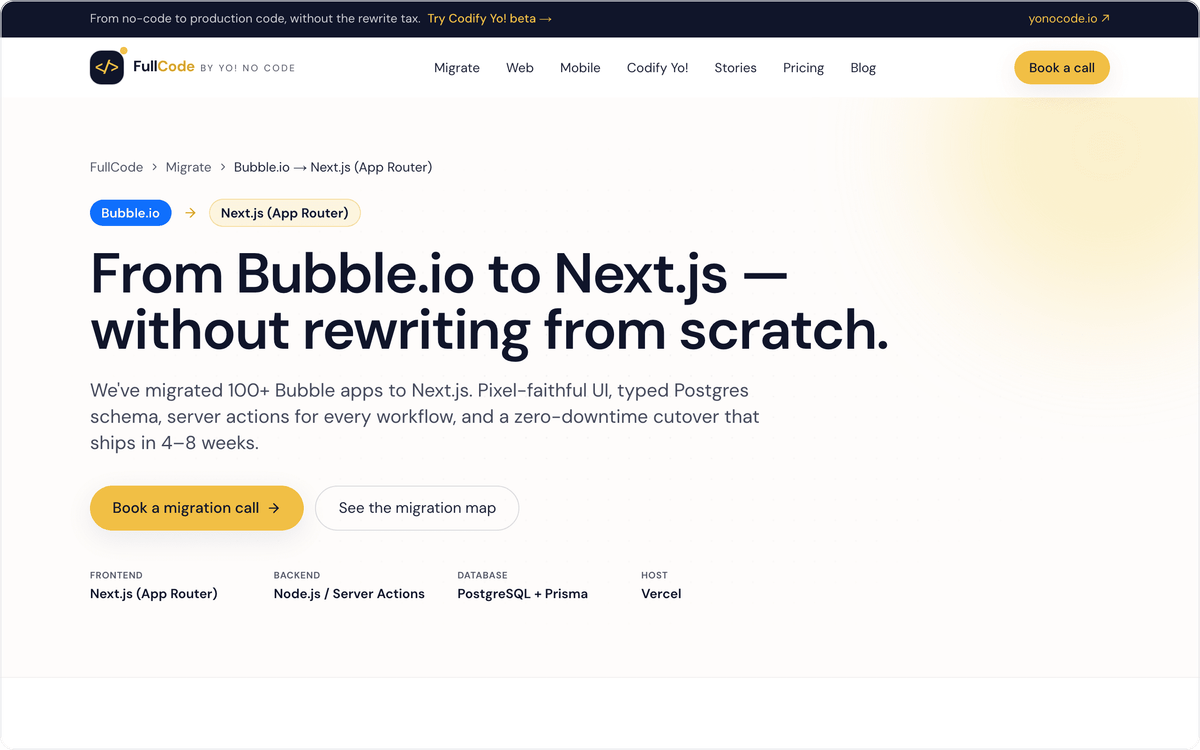
During FullCode's parallel run, power users work in the new app while everyone else stays on Bubble. Cutover is a DNS change, a final delta sync and a freeze on writes to Bubble, with a rollback plan ready. FullCode also migrates from Webflow, Adalo, FlutterFlow and PowerApps, and offers a partial migration for only the backend, the public site or one module.
Packages have fixed prices. Standard starts at $1,975 for single-product apps under 30 screens with up to 25 workflows (2 to 5 weeks), Premium starts at $7,500 and adds custom integrations (4 to 8 weeks), and Enterprise is quoted (6 to 12 weeks). The case studies on FullCode's site carry no client names, so ask for a reference call with a client whose app is close to yours in size.
Which product studios show a Bubble migration case or rescue no-code prototypes?
Brainhub and Inigra are general product studios. Brainhub publishes a case study of a Bubble MVP rebuilt as a web app, and Inigra sells a fixed-price package for moving Lovable, Bubble and Replit prototypes into code.
6. Brainhub: a Bubble MVP rebuilt together with a redesign
Brainhub has no dedicated Bubble migration page, but one of its published case studies covers the whole job: a networking platform for public sector professionals whose MVP was built in Bubble and had already proved its product-market fit. The project goals were to migrate that MVP to a more scalable solution, keep developing the app, improve the user flow, and rebrand and redesign the system.
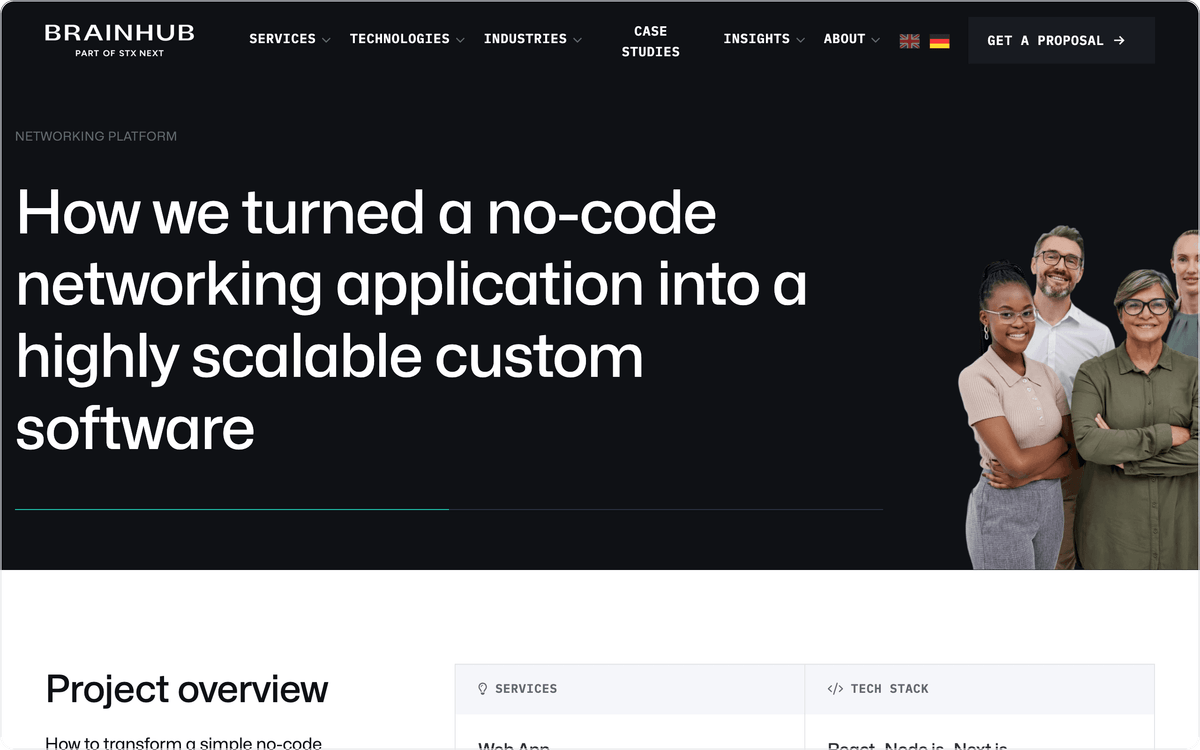
The rebuild used React, Node.js and Next.js, with 4 experts over 10 months, and a discovery workshop produced a plan for the first iterations, which the team then built incrementally. The case also names a cost Bubble teams should expect: because the old app was built in a no-code platform, there were no Figma designs to adapt, which created design debt.
Brainhub lists legacy app modernization among its services and publishes no prices. Of the seven, it is the one whose published case pairs the migration with a full redesign in a single project.
7. Inigra: fixed-price moves for Bubble, Lovable and Replit apps
Inigra sells a Vibe-code to Production package that turns a vibe-coded or no-code prototype built in Lovable, Bubble or Replit into a product the client fully owns, for £2k to £20k+ over 2 to 8 weeks. A code review on its own starts from £500. In its 2026 migration guide, Inigra says it has moved apps off Lovable, Bubble, Replit, Webflow and Adalo, and that some clients kept their front end while others took a full rebuild.
The guide prices a Bubble move to Next.js and Postgres from £2,000 and about 2 weeks for a simple app, a standard SaaS at £5,000 to £9,000 over 3 to 5 weeks, and a complex platform at £9,000 to £15,000+ over 6 to 8 weeks. It also ranks what breaks after cutover, starting with authentication and then webhooks, because every webhook receiver URL changes on cutover day.
Inigra's usual stack is Next.js or React on the web, Node.js or Python on the backend and PostgreSQL, and support after launch runs on an optional retainer from £1,000 a month.
Which agencies can rebuild a Webflow site in custom code?
Scroll, Invental and FullCode from this list rebuild Webflow sites in code. Scroll moves them to Payload and Next.js in 3 to 8 weeks with a full 301 redirect plan, Invental lists Webflow among the platforms it migrates, and FullCode maps Webflow sites to Next.js. Webflow exports more than Bubble does, though the CMS content does not come with the code.
Webflow's code export gives you HTML, CSS, JavaScript and assets, and only on paid Workspace plans. CMS content, user accounts, Ecommerce, form processing, site search, password protection, code components and every locale except the primary one stay behind, and exported Collection lists show their empty state.
The CMS content travels separately. CMS Collections export to CSV, and Webflow's guide to moving CMS content notes that reference and multi-reference fields have to be re-linked by hand after a CSV import. For scripted moves, the Webflow Data API lists collection items up to 100 per request.
Existing 301 redirects can be exported as a CSV from Site settings, Publishing, 301 redirects, which gives the agency the old redirect list to carry into the new site. If you want a redesign that stays on Webflow, our list of Webflow and Framer agencies covers that route.
How do you make a vibe-coded MVP production-ready?
A vibe-coded MVP is ready for production once a senior engineer has reviewed its authentication and secrets, access rules, data model, deploys and rollback, and the team has fixed what would break first. The AI builders make the code easy to take out, which is what lets a developer review it outside the tool.
What the AI app builders let you take with you
Lovable syncs a project to GitHub or downloads the codebase from Project settings, Bolt downloads a project as a zip file, and v0 connects a project to a GitHub repository and pushes changes through pull requests. Lovable's own security documentation says its scanning tools "do not replace a thorough security review" and that misconfigured row-level security rules are a common cause of data leaks. Replit publishes its own security checklist for vibe-coded apps. Bubble's Universal Import runs the other way, bringing code exported from Lovable, v0, Base44, Replit or Claude into Bubble.
⚠️ Important
Lovable handles passwords differently from Bubble. Its database export includes users' accounts and password hashes, but not storage files, edge function code, secrets, sign-in provider settings or API keys, so those are set up again at the destination.
Who reviews AI-built code before launch
Three agencies on this list sell this work separately from a full migration. Invental's vibe-coded MVP review has a senior engineer read the AI-built code before real users and payments arrive. The review covers auth and secrets, the data model, and deploys and rollbacks, and it ends in a short, ordered fix list instead of a rewrite.
Scroll's takeover offer covers projects built with Lovable, Bolt, Claude Code, v0 and Cursor, with an audit, a diagnosis and a recovery plan. Inigra's Vibe-code to Production package covers Lovable and Replit prototypes as well as Bubble ones.
What should you check before you sign a Bubble migration contract?
Before you sign, get six things from the agency in writing: the data map, the login plan, where access rules will live, the parallel run and cutover plan, the redirect map, and who owns the code and accounts after launch.
- Data map. One row for every Bubble data type and field, with its new table and column. Check the fields Bubble exports in an unusual shape: date intervals as text, file fields as URLs, and private files that need authenticated downloads.
- Login plan. Which password path the agency uses, what the email to users says and when it goes out, and which social sign-in providers the new app has to support.
- Access rules. Where each Bubble privacy rule ends up, as row-level security in the database or a check on the server.
- Parallel run and cutover. How long both apps run, how data stays in sync in the meantime, and the rollback plan. Martin Fowler's strangler fig pattern, which replaces a system piece by piece, makes "both investment and returns occur gradually and visibly". Your custom domain keeps pointing to Bubble until you change the DNS records at your registrar.
- Redirect map. A list of old URLs and the new URL for each. Google's site move guide says 301 redirects do not lose PageRank, recommends keeping them generally at least a year, and warns of temporary ranking swings during the move.
- Ownership and support. The repository and hosting accounts in your name, plus the support window after launch: 30 days at Minimum Code, four weeks of hypercare at Goodspeed, a first-quarter retainer at Invental, and 30, 60 or 90 days by package at FullCode.
⚠️ Important
A Bubble agency warned on Bubble's forum in May 2026 that a plan to "export the Bubble JSON, give it to Claude, and ask it to rebuild the app" tends to go badly, and that a new app often carries the same technical debt as the old one. Ask each agency what it will change in the data model as well as what it will copy.
Four of these agencies describe their cutover step by step, and all four keep the Bubble app live until the switch. They move users in different units: Invental by route, Minimum Code by module, FullCode by user group and then one DNS change, and Goodspeed's example in cohorts of 500 users.

Which integrations keep working after the app leaves Bubble?
Integrations that run in an automation platform outside the app survive a migration, because only the trigger at the start of each flow has to change. Albato runs such flows without code across 1,000+ apps, and its Bubble connector starts them on the triggers "Thing created" and "Workflow created".
The agency rebuilds the app in code, while the flows between your app and the CRM, Slack or a spreadsheet can stay in a tool the ops team edits without a developer. Our Bubble connection guide walks through linking the Bubble account.
💡 Tip
Ask the agency to keep the field names of your Bubble data types in the new app's webhook payloads, such as email, plan and signup date. Every flow you rebuild after cutover can then map the same fields it used before.
Keep a daily record of new Bubble entries during the parallel run
While both apps run, a flow on the Bubble trigger "Thing created" can copy every new record into a row through the Google Sheets action "Create/update a row". The sheet gives you a daily count to compare with the new database before each module switches over.
The same trigger can alert the team's migration channel through the Slack action "Send message to a private channel". For a log-in-once password move, the Bubble action "Update Thing" can mark each user as migrated once the new app reports that user's first login through a webhook.
Point the same flows at the new app after cutover
After the switch, the new app sends its events to Albato's Webhook trigger "Incoming webhook", and the flows behind it run the same actions as before: HubSpot "Create or update contact" for new signups and a Slack message for paid orders. Our Albato webhook guide shows where to find the URL the new app posts to.

If the new backend runs on PostgreSQL, Albato's PostgreSQL connector can also write rows into it with "Create new rows", for example leads from a form tool your marketing team keeps. Our explainer on how API integrations work covers the webhook and API basics behind these flows.
Rebuild the flows one business event at a time, in the same order the agency moves the routes, and switch each Bubble trigger off only after its webhook version has run for a few days.
FAQ
How much does it cost to migrate a Bubble app to custom code?
Published prices on this list start at $1,975 for FullCode's Standard package and £2,000 for a simple Bubble app at Inigra. Goodspeed's guide runs from $8,000 to $15,000 for a simple app up to $35,000 to $60,000 for a complex platform. Minimum Code, Scroll and Invental quote after an assessment or scoping, and Brainhub publishes no prices.
Should I migrate off Bubble or fix the app first?
Several agencies on this list advise checking that first. Minimum Code's assessment can recommend a refactor inside Bubble, Invental's playbook says to stay on the builder while the product is still finding its shape, and Goodspeed's guide advises waiting below 1,000 active users if the app works. Bubble also lets a web project add a native mobile app that shares the same database and backend workflows.
Can an agency keep the Bubble front end and rebuild only the backend?
Yes. Invental did this for a settlements dashboard, keeping the Bubble interface the finance team used and moving reporting to a Directus backend. FullCode sells a partial migration for only the backend, the public site or one module, and Inigra says some of its clients kept their front end.
Which of these agencies also build an MVP from scratch?
Minimum Code builds web apps on Next.js and Supabase from scratch, and Goodspeed builds products on Bubble. Invental builds web apps on React, Next.js, TypeScript and Postgres and offers dedicated rates for venture studios, and Inigra's Web MVP package costs £5k to £20k+ with delivery in 3 to 10 weeks.
The Bubble trigger can start logging new records today, while the agency is still mapping your data.
At cutover, the same account takes the webhook from the new app.