
In this article
Key Takeaways
- The best AI agents for finance operations in 2026 are Ramp (spend and procurement), Brex (expense automation with a free tier), BILL (AP and AR for SMBs), Vic.ai (autonomous invoice processing), Tipalti (global mass payouts), Nanonets (usage-based document extraction), HighRadius (enterprise accounts receivable), and Booke.ai (bookkeeping firms).
- Pricing splits into two camps: card-linked platforms with free or low per-user plans (Ramp, Brex, BILL from $49/user), and quote-based enterprise systems where annual platform fees run into the tens of thousands, from roughly $15,000 a year for smaller Tipalti deployments up to six-figure custom contracts (Tipalti, Vic.ai at about $25,000, HighRadius on outcome-based pricing).
- Manual data entry still dominates accounts payable work, which is why finance teams are moving from rules-based automation to autonomous agents this year.
Most finance AI tools were sold as OCR and rules engines a year ago. In 2026 the category flipped: a large share of AP teams still key invoices by hand, and vendors now market agents that read a bill, code it, match the PO, and route it for approval on their own. That autonomy is what separates the eight tools below.
How we picked these tools
We selected finance AI agents that are in production with real customers, publish or disclose current pricing, and cover a distinct finance-ops job: accounts payable, accounts receivable, spend management, or bookkeeping. Tools that only do passive data extraction without decision-making were left out. Every price below traces to the vendor or a review source from the last twelve months.
The point of an AI agent, versus a fixed automation, is that it decides the next step instead of waiting for a rule you wrote. A Policy Agent flags an out-of-policy expense without a human writing that condition. An AP agent picks the right general-ledger code from the invoice text. That difference is why enterprise finance leaders are moving budget toward agentic systems this year.
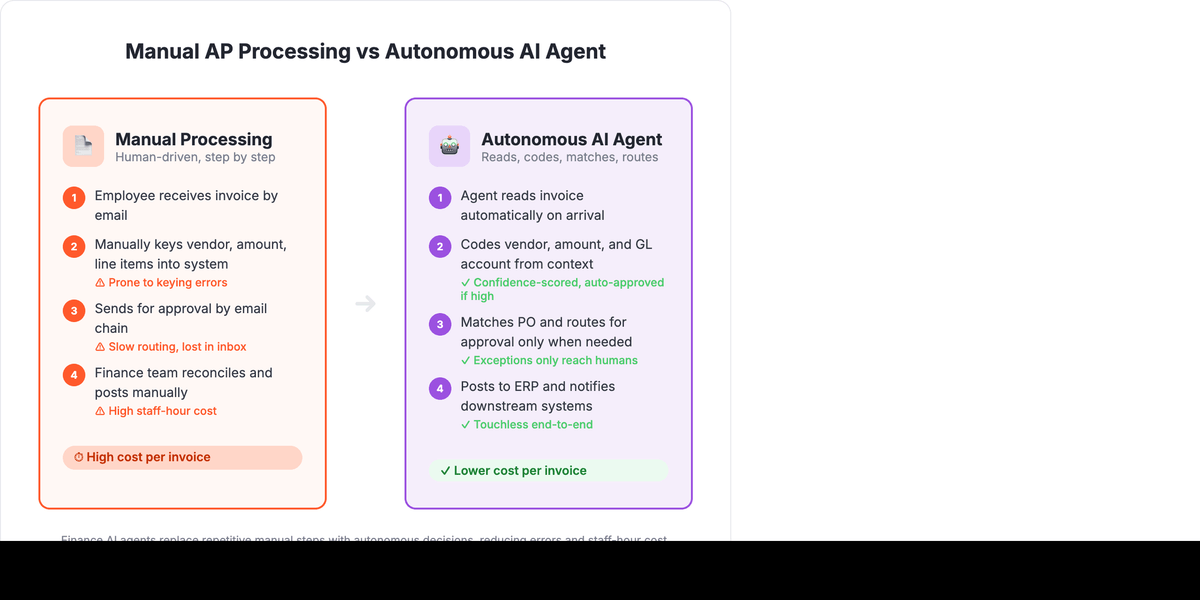
📊 Stat. Processing an invoice by hand is slow and error-prone: someone keys in the vendor, the amount, and every line item, then routes it for approval by email. That manual cost, in staff hours and mistakes, is exactly what an AP agent is built to remove.
The cost gap is stark once you put the numbers side by side. Handling an invoice manually runs several dollars in staff time, while an agent-driven flow brings that down to roughly the price of a coffee refill per invoice.
Comparison table: 8 best AI agents for finance operations
| Tool | Best for | Key AI capability | Pricing | Albato integration |
|---|---|---|---|---|
| Ramp | Spend and procurement ops | Policy, AP, and accounting agents that review and code autonomously | Free plan; paid tiers custom | Connect Ramp data to CRM and accounting |
| Brex | Expense automation on a free tier | AI assistant files expenses, fetches receipts, writes memos | Free Essentials; Premium $12/user/mo | Sync spend to your stack |
| BILL | AP and AR for SMBs | AI agents code invoices, collect W-9s, reconcile | Essentials $49/user/mo; Corporate $89/user/mo | Push bills and payment status to CRM |
| Vic.ai | Autonomous invoice processing | Touchless AP with confidence-scored auto-approval | Custom (AWS example ~$25,000/yr) | Route processed invoices to your ERP feed |
| Tipalti | Global and mass payouts | AI line-item extraction plus multi-way PO matching | Platform fee from ~$15,000/yr | Connect payout events to notifications |
| Nanonets | Flexible, usage-based extraction | Per-block AI extraction and workflow agents | Free Starter ($200 credits); usage-based | Feed extracted data into any app |
| HighRadius | Enterprise accounts receivable | 190+ agents across order-to-cash and treasury | Outcome-based (pay on KPI gains) | Sync AR outcomes to reporting tools |
| Booke.ai | Bookkeeping firms | AI categorization and client-query automation | Business $129/business/mo | Link books to client-facing tools |
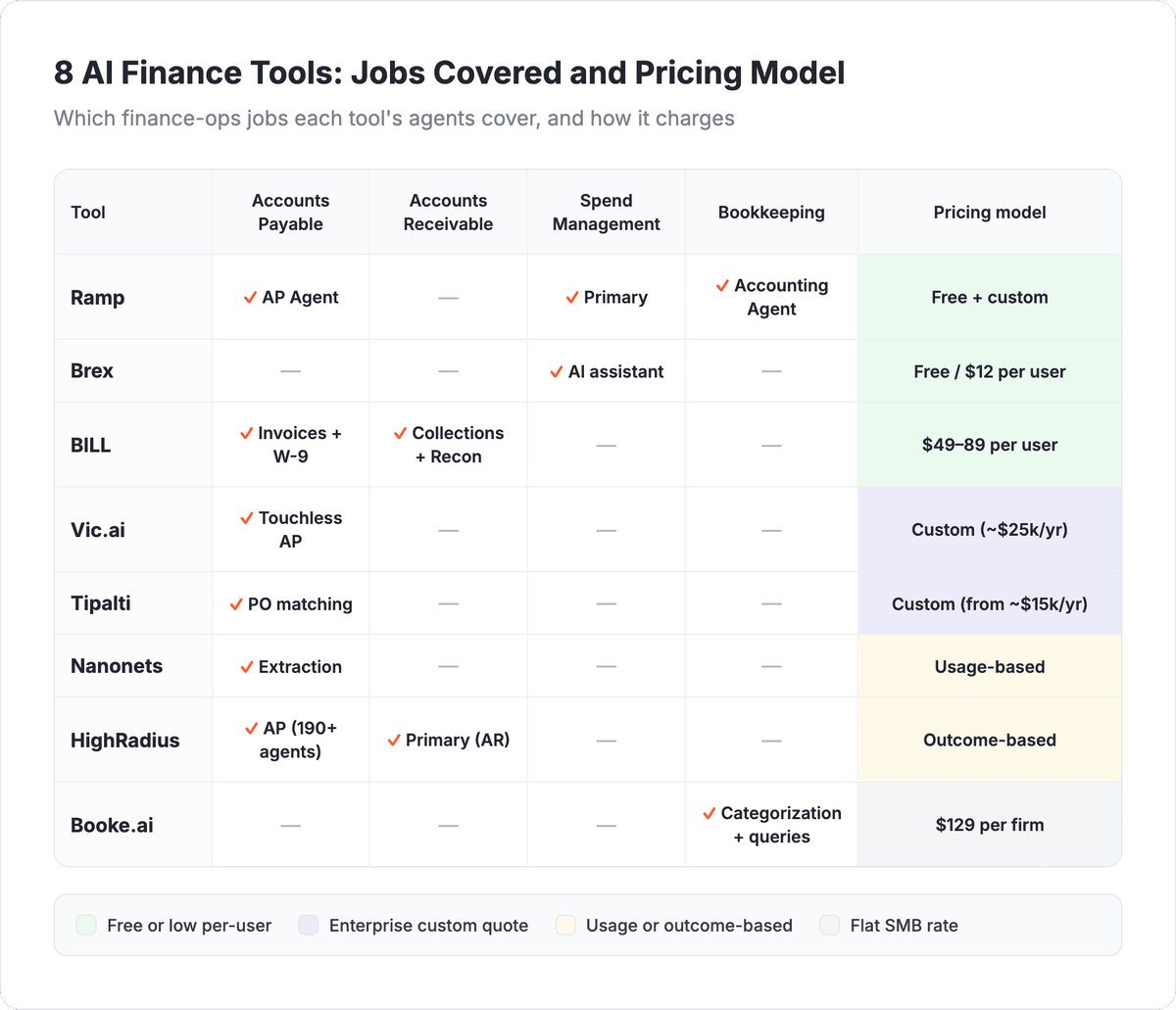
The table lists each tool row by row, but it helps to see how they cluster by job and by pricing tier. The map below groups the eight tools onto the four finance-ops jobs and marks which pricing model each one runs on.
Ramp: the spend platform that turned agents loose on procurement
Ramp went from a corporate card to a full finance-ops platform faster than anyone in the category, and its 2026 push is a fleet of agents that run buying end to end. In April 2026 it launched agents that triage employee purchase requests, source vendors, review contract terms, and run compliance checks together, so a request becomes a purchase order without a procurement analyst driving each step.
The three agents finance teams run
The three agents finance teams run most are the Policy Agent, the AP Agent, and the Accounting Agent. The Policy Agent reviews expenses and flags violations by risk level. The AP Agent handles invoice OCR and line-item coding. The Accounting Agent generates custom reports on request. The scale behind this is real: Ramp crossed $1 billion in annualized revenue and serves more than 70,000 customers.
Here is the Ramp product surface finance teams work in day to day.
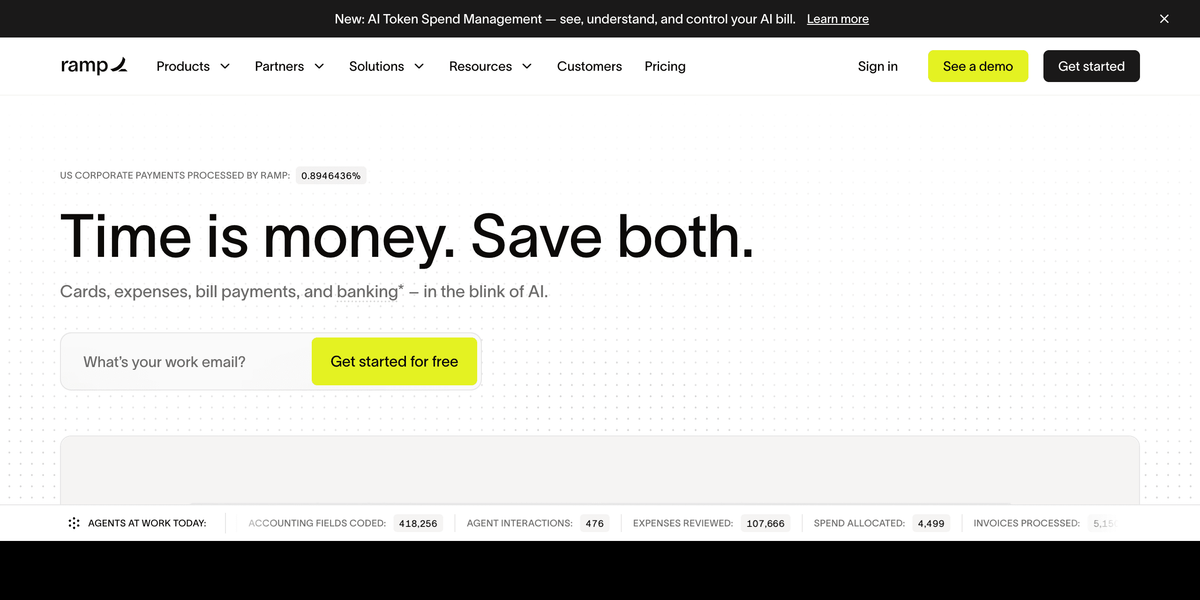
Ramp keeps a free plan, which is rare among tools this capable, and quotes paid tiers based on scale. The platform now processes over $200 billion in annualized purchase volume, a sign of how much finance teams are consolidating onto it.
💡 Tip. If you already run a card program elsewhere, Ramp's free tier is a low-risk way to test the Policy Agent against your own expense history before you migrate anything.
Where Ramp stops is the rest of your stack. Its agents live inside spend and procurement, so the numbers they produce still need to land in your CRM, your data warehouse, and whatever your revenue team uses. That handoff is where Albato Automate fits, moving approved-spend and vendor records out of Ramp and into the systems that never see them otherwise.
Brex: the free tier that automates expenses first
Brex earns its spot for a different reason than Ramp: its free Essentials plan does real AI expense work at zero commercial risk. The free Essentials tier is subject to eligibility, but it lets a small finance team run an AI assistant that files expenses for employees, fetches receipts, writes memos, and even submits reimbursements automatically.
For teams that outgrow the free plan, Premium runs $12 per user per month, with Enterprise custom-quoted. The audit agent is the standout: it watches company spend against your internal processes and sorts potential violations by risk level, which is the kind of continuous review a human controller cannot do transaction by transaction.
The Brex interface below shows the expense-automation product that runs on that free tier.
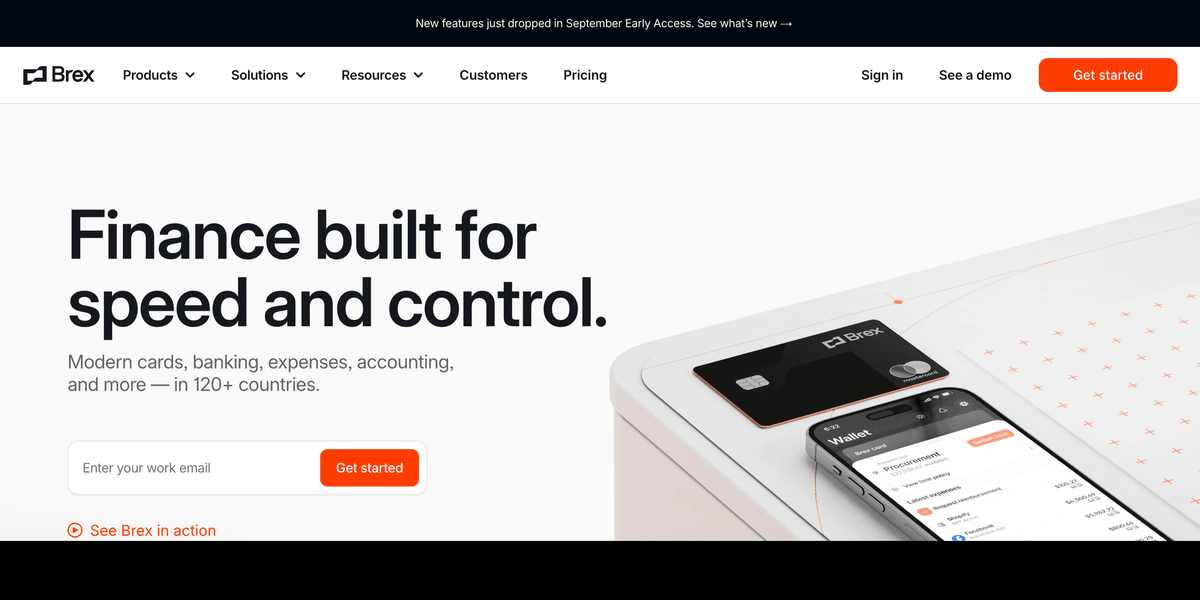
Brex is strongest when expense volume is high and headcount is growing, because the assistant absorbs the receipt-chasing and memo-writing that scale badly with people. It is less of a fit if your core problem is accounts payable rather than employee spend.
BILL: AP and AR agents built for the SMB stack
BILL (formerly Bill.com) is the pragmatic pick for small and mid-sized businesses that need both sides of the ledger. Its AI agents autonomously code invoices, collect W-9s, and reconcile transactions, which is a step past the data extraction most SMB tools stop at. The Essentials plan is $49 per user per month and covers bill entry, approval workflows, ACH, card, and check payments, plus AI-assisted invoice coding.
Move up to Corporate at $89 per user per month and you add advanced integrations and procurement. Payment fees sit on top: standard ACH runs $0.59 and checks $1.99 per transaction, so the real monthly cost depends on how you pay vendors.
The BILL product screen below shows the AP and AR interface built for smaller finance teams.
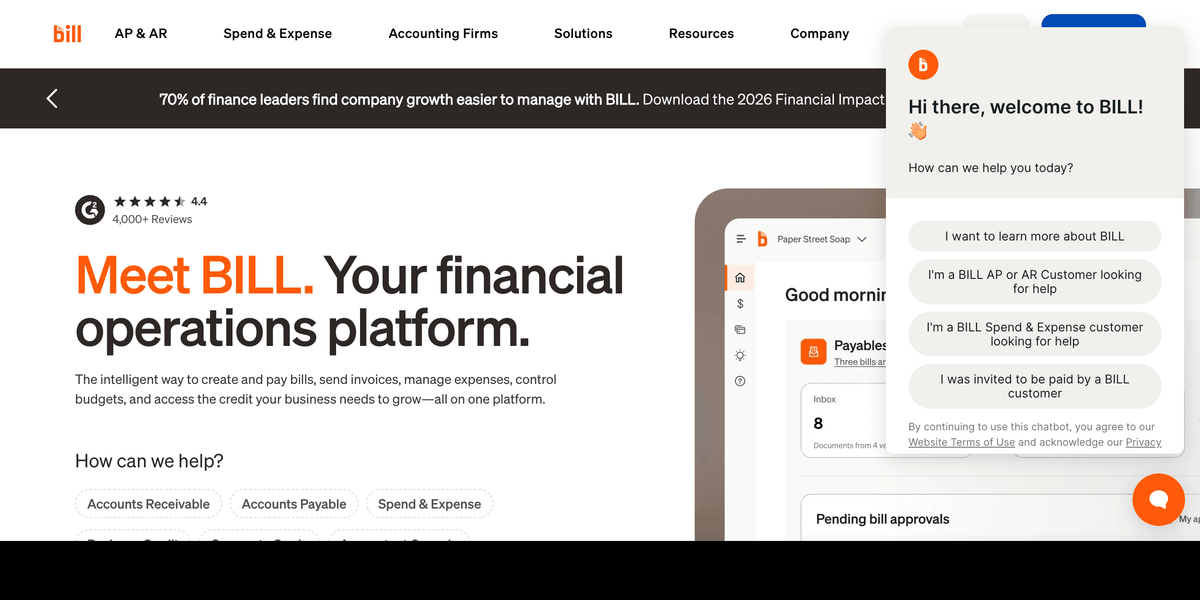
BILL connects natively to accounting systems, and it pairs well with a broader automation layer when you want bill status or vendor data to reach tools BILL does not integrate with directly.
⚠️ Important. BILL's per-user pricing rewards small approval teams but punishes wide ones. If ten people need to touch a bill, model the seat count before you sign, because Corporate at $89 a seat adds up faster than the sticker suggests.
Vic.ai: touchless invoice processing that scores its own confidence
Vic.ai is built for one job and does it with less human touch than anyone else: autonomous accounts payable. Instead of suggesting a code and waiting, it processes invoices end to end and assigns a confidence score, so high-confidence bills flow through without review and only the uncertain ones reach a person. That is the definition of a touchless AP rate, and it is why mid-market and enterprise finance teams pick it.
Pricing is custom and volume-based, tied to invoice count, active ERP integrations, and the modules you enable. Its AWS Marketplace AP module lists a $25,000 twelve-month contract, which is a useful reference point since Vic.ai does not publish rates. It is not built for firms processing under 100 invoices a month.
The Vic.ai interface below shows how the tool positions its autonomous AP workflow.
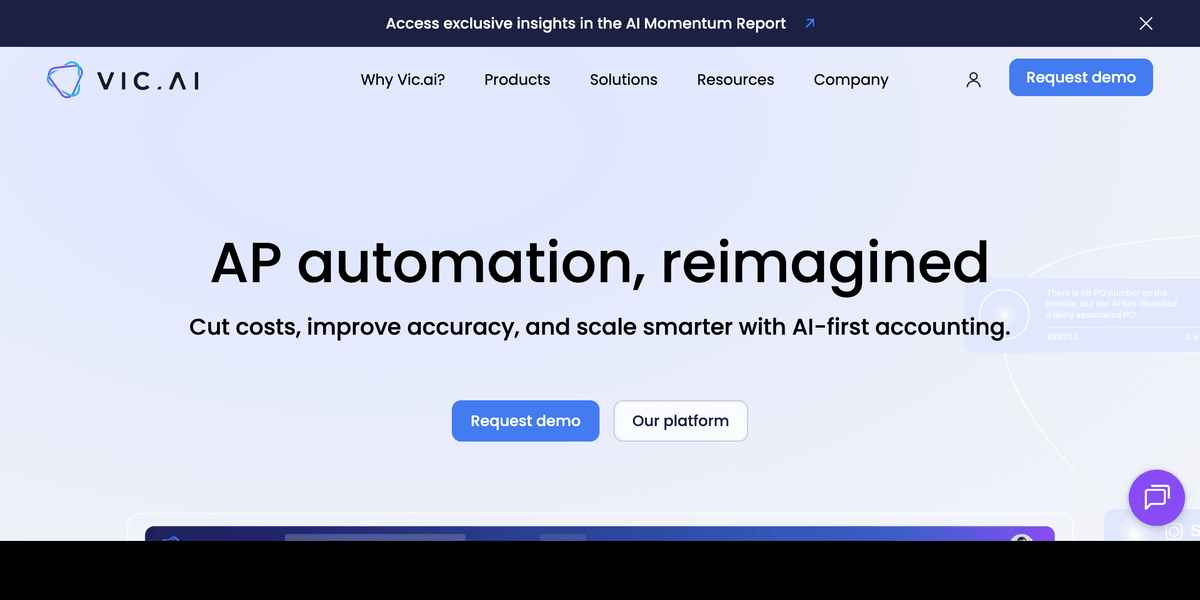
The trade-off with a specialist like Vic.ai is that it lives inside AP. Its clean, coded invoice data is valuable to teams outside finance, and getting it there is an integration task, not a Vic.ai feature.
Tipalti: the payout engine for global finance operations
Tipalti stands out when your problem is paying a lot of people in a lot of countries. Its AI extracts line items and runs multi-way PO matching, but the reason global finance teams choose it is the payout infrastructure underneath: mass international payments, tax compliance, and entity handling that generalist AP tools do not touch.
That capability carries a real floor. Tipalti's annual platform fee runs from around $15,000 for smaller deployments and scales into six figures for enterprise setups with global payouts. A real-world year-one cost for global payout at 500 invoices a month with 30-plus international wires runs $25,000 to $40,000 including implementation, so it is a commitment, not a trial.
The Tipalti product screen below shows the global-payout platform in action.
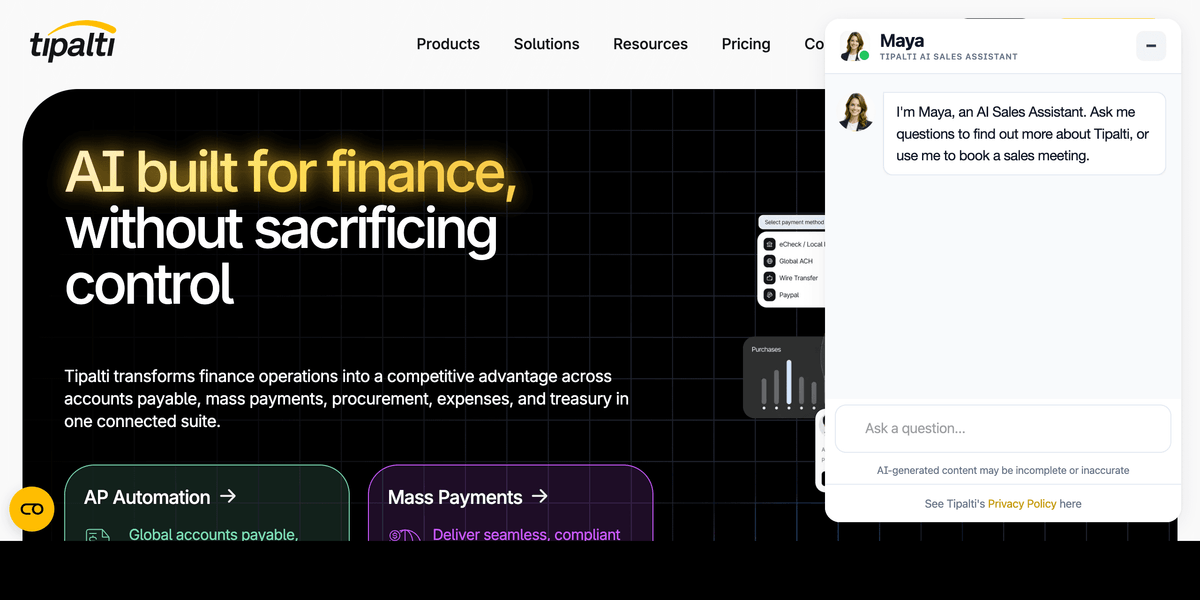
Choose Tipalti when cross-border payout complexity is the pain. If you pay domestic vendors from one entity, its power is overkill and its floor is hard to justify.
Nanonets: usage-based agents for teams that hate seat pricing
Nanonets takes the opposite pricing philosophy to the enterprise crowd, and that is its whole appeal. It meters by workflow block instead of by seat: $0.02 for simple operations, $0.10 for standard AI, and $0.30 for complex extraction. A typical invoice runs four to six blocks, so full processing lands under $2 per invoice.
The free Starter tier includes $200 in credits, which is enough to run a real pilot before committing. Above that, a quote-based Growth plan offers volume discounts and Enterprise runs on custom contracts. This model suits teams whose volume is spiky or hard to predict, since you pay for what you process rather than a fixed number of seats.
The Nanonets interface below shows the usage-based extraction product finance teams pilot with those credits.
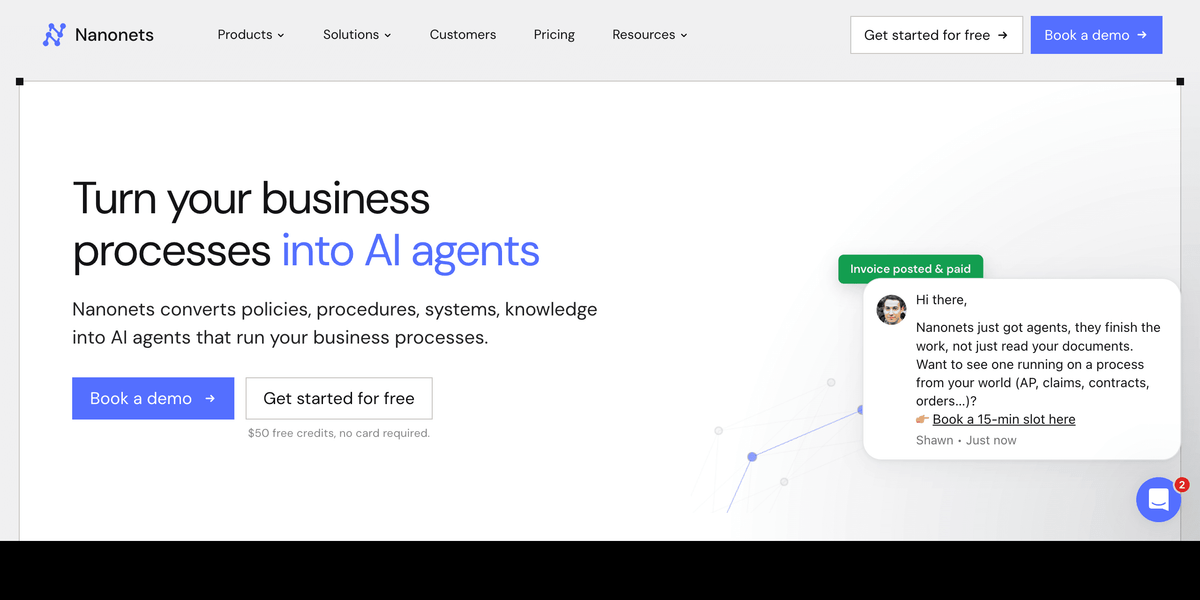
Nanonets is more of a flexible extraction and workflow engine than a full AP suite, so pair it with your accounting system rather than expecting it to replace one.
HighRadius: the enterprise agent platform for accounts receivable
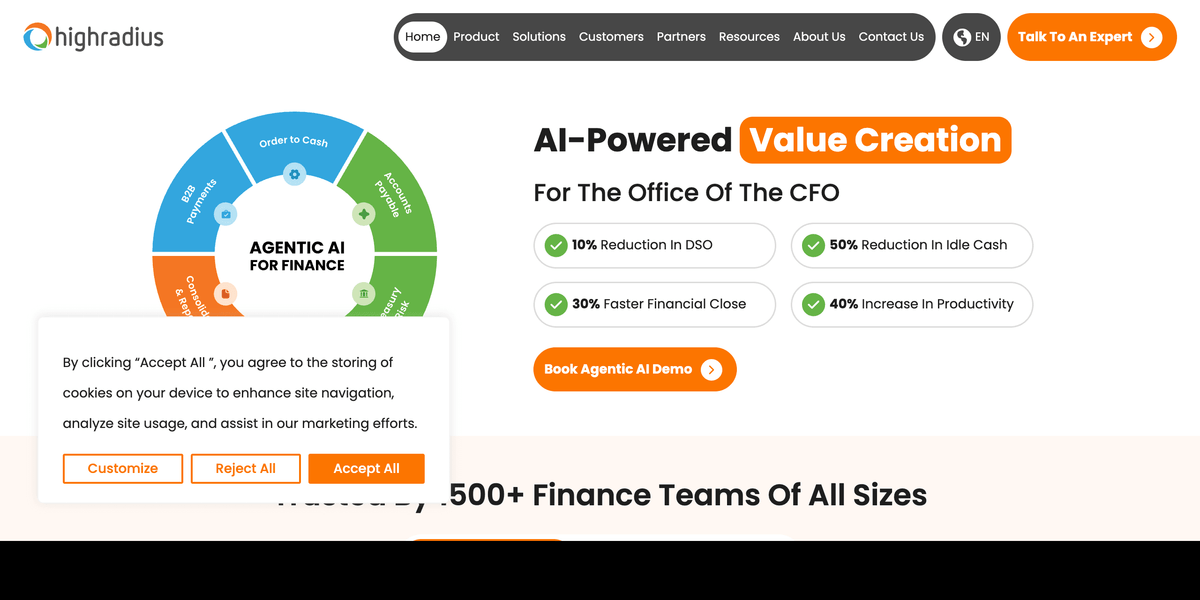
HighRadius is the answer when the finance-ops problem is getting cash in the door at enterprise scale. Its platform runs 190-plus agents across order-to-cash, close and reconciliation, consolidation, AP, B2B payments, and treasury, so it is less a single tool than a control layer for the office of the CFO. On the receivables side, it automates collections, cash application, credit management, and deductions.
The 2026 pricing model is the interesting part. HighRadius moved to outcome-based pricing, where you pay when the agents hit mutually agreed KPI targets, with no upfront fee. It reports cutting DSO by over 10% across 1,500-plus enterprises, and tying cost to that improvement lowers the risk of a large AR automation bet.
The HighRadius platform screen below shows the enterprise receivables and treasury surface.
This is an enterprise commitment with an enterprise implementation. Mid-market teams that need AR help without a platform migration will find it heavier than they want.
Booke.ai: the agent built for bookkeeping firms
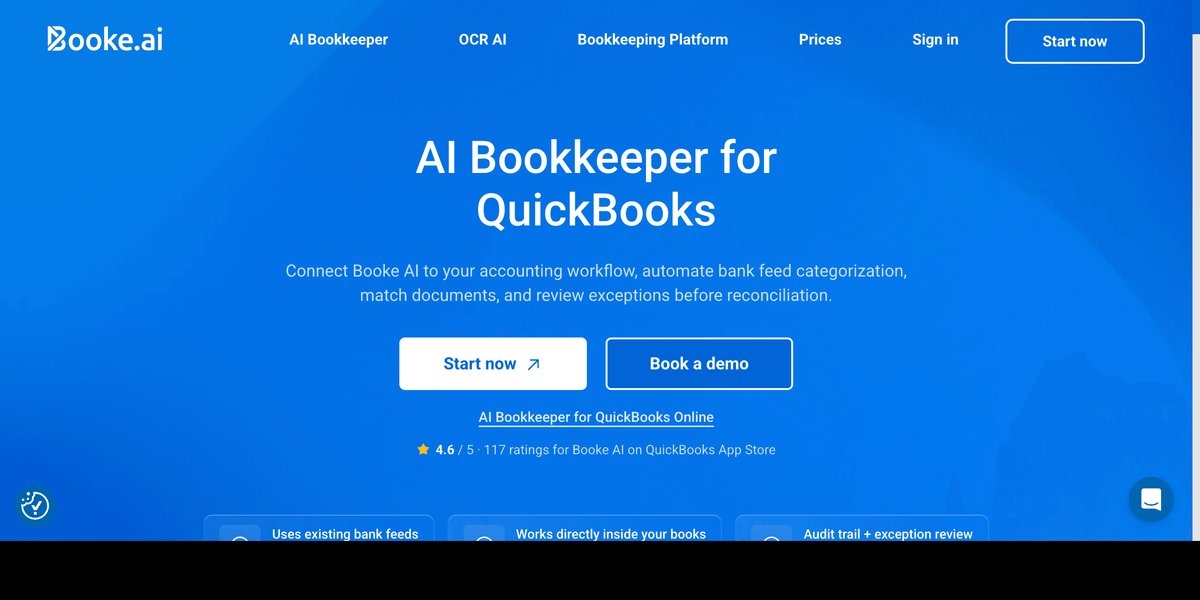
Booke.ai serves a niche the enterprise tools ignore: accounting and bookkeeping firms running many client books at once. It sits on top of QuickBooks Online and Xero, uses AI to categorize transactions, and automates the back-and-forth client queries that consume a bookkeeper's week. For firms, that query automation is often worth more than the categorization itself.
Pricing is $129 per business per month on the self-serve Business plan, with firm-level rates by request. That is straightforward compared to the quote-based enterprise tools, which fits how small firms actually buy.
The Booke.ai product screen below shows the bookkeeping-firm interface for managing many client books.
Booke.ai connects to the two ledgers most firms already use, and its data becomes more useful when it flows into the client-communication and reporting tools a firm runs alongside its books.
Build your own finance agent with Albato AI Agent
If none of these tools fit a specific gap, or you want an agent that touches your own apps directly, Albato ships its own AI Agent as a step inside any automation. It reads the data from a previous step and decides which action to run on its own, instead of you wiring fixed conditions and branches by hand. You describe the task in plain language, add instructions, and connect the actions the agent is allowed to call.
The agent is built from four blocks: a model that makes the decisions, instructions written in natural language, tools that are actions from your connected apps, and optional memory for conversational flows. The model runs on Albato's own proprietary engine (not disclosed) or an external provider you connect, and the agent can pull from around 5,000 actions as tools.
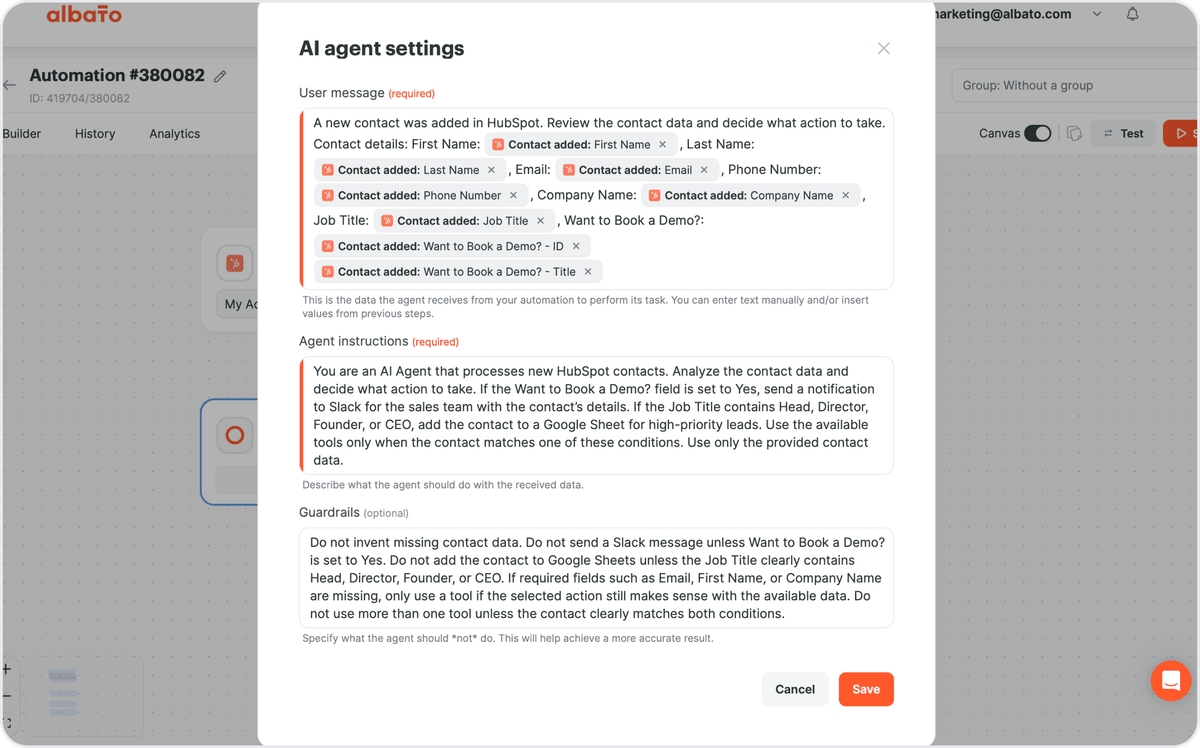
The setup screen below shows where you write those instruction fields in plain language.
For finance ops, this closes a scenario the specialist tools leave open: invoice data validation and enrichment. A trigger fires when a new invoice or vendor record lands, the agent checks the fields, fills the ones it can from the instructions, and routes the result to the right place. It can also handle finance notifications, sending a Slack or email alert to the right channel based on the content, and update CRM or accounting records contextually rather than by a rigid rule.
Setup takes minutes, not an implementation project. Add the agent as an action after a trigger, pick a model, write three short instruction fields (user message, agent instructions, and guardrails), then connect the tools. On any field in an action you can turn on "Let the AI agent decide" so the agent fills it from context instead of a fixed mapping.
The field-mapping screen below shows the "Let the AI agent decide" option applied per field.
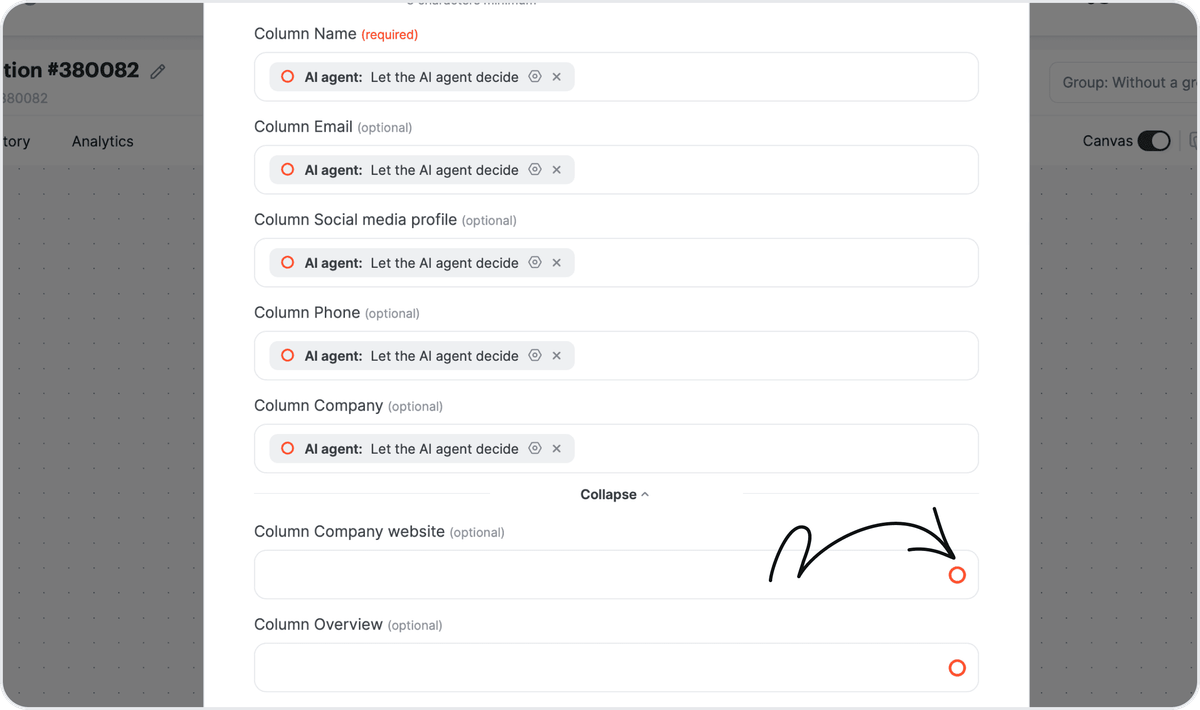
The screen above shows the agent filling each action field for itself through the "Let the AI agent decide" option. For any single field you can still hand the agent a fixed value or a short instruction, so you keep control where it matters and let the agent handle the rest.
Governing and costing the finance agents you run
Once you have three or four agents making decisions about money, the next problem is control. Which agents are running, who can change them, what they are allowed to touch, and what the model calls are costing per team. Finance leaders are the ones who feel this first, and 2026 saw a new category form around AI's untracked costs.
This is where a control plane matters more than another agent. Albato Runtime lets you govern the AI agents you build and track LLM costs across teams, so an autonomous finance workflow does not turn into shadow spend you find at the end of the quarter.
🔧 How it works. A control plane sits above your agents rather than inside one. It logs which agent ran, enforces who can edit it, and attributes model cost back to a team, the finance-ops equivalent of an approval trail for automated decisions.
How to connect any finance AI tool to the rest of your stack
The gap every tool on this list shares is the same: they are excellent inside their lane and blind outside it. Ramp does not update your CRM. Vic.ai does not tell your revenue team a vendor was paid. That is not a flaw in the tools, it is the reason an integration layer exists.
Albato is that layer, and it is not a competitor to these systems. It connects them. When BILL codes an invoice, Albato can push the vendor and amount into HubSpot. When Tipalti pays a contractor, Albato can post a message to the right Slack channel and log the event in your accounting sheet. It works through native connectors to QuickBooks, Xero, and 1,000-plus other apps, so the outputs your finance agents produce stop dying inside a single platform.
If you are still choosing which finance stack to run, our guide to iPaaS platforms covers how the integration layer underneath all of this works, and the step-by-step AI agent checklist walks through building one from scratch.
FAQ
A few questions come up every time a finance team weighs an AI agent against its current process. Here are the ones worth settling before you buy.
What is an AI agent for finance operations?
An AI agent for finance operations is software that reads finance data and decides the next action on its own, rather than following fixed rules you wrote. In practice that means reading an invoice and coding it, reviewing an expense against policy, or matching a payment to an open receivable without a human driving each step. The difference from older automation is autonomy: the agent chooses, instead of waiting for a condition.
How much do AI finance agents cost in 2026?
Pricing splits in two. Card-linked platforms like Ramp and Brex offer free tiers, with Brex Premium at $12 per user per month and BILL Essentials at $49 per user per month. Enterprise systems are quote-based: Tipalti's annual platform fee runs from around $15,000 for smaller deployments, Vic.ai runs custom (its AWS Marketplace AP module lists $25,000 a year), and HighRadius uses outcome-based pricing tied to KPI gains. Match the model to your volume rather than the sticker.
Can I connect these finance AI tools to my CRM and accounting software?
Yes, through an integration platform. Most finance AI agents work inside their own lane and do not natively update your CRM, data warehouse, or every accounting tool. Albato connects these systems with native connectors to QuickBooks, Xero, and 1,000-plus apps, so an invoice coded in one tool can update a deal in your CRM or trigger a notification automatically.
Which finance AI agent is best for a small business?
For most small businesses, BILL or Brex is the practical starting point. Brex has a free Essentials tier for expense automation, and BILL covers both accounts payable and receivable at $49 per user per month. Bookkeeping firms managing many client books are better served by Booke.ai at $129 per business per month, since it automates client queries on top of categorization.