In this article
Key Takeaways
- Early rollouts faced setbacks, but recent models now aim for over 90% accuracy in production environments.
- Voice AI agents in 2026 feature real-time conversations, autonomous workflow execution, and natural turn-taking capabilities.
- Human oversight and failsafe features are still vital for preventing catastrophic voice AI failures.
- Production readiness depends on clearly defined tasks and measurable outcomes rather than natural-sounding conversations alone.
Voice AI is rapidly becoming a common integration in business workflows, especially customer support. The large-scale appeal is fueled by the shift from reactive voice assistants to proactive AI agents that perform tasks autonomously. While early deployments revealed operational limitations, ongoing developments in real-time reasoning, speech recognition, natural turn-taking, and autonomous execution are making AI voice agents increasingly production-ready.
The Reality of Early Voice AI Deployment
McDonald’s ended its IBM partnership on drive-thru voice AI in 2024 after a multi-year run in which the technology struggled with order accuracy.
A little over a year later, Taco Bell reconsidered its AI-powered drive-throughs for similar issues.
It is clearly not enough to have a customer-facing voice AI system that has indistinguishable human voices and speech characteristics but is unable to completely understand the needs of target customers or fulfill orders.
In both voice AI use cases and many others, it makes sense for businesses to reconsider their use of AI voice agents and restrategize, especially when they fail to complete set tasks effectively or make more mistakes than they were meant to resolve.
Essentially, businesses must look beyond demos and conduct thorough tests to determine AI agent reliability and operability over time before deployment.
Such may have been McDonald’s approach, which, in September 2026, unveiled the relaunch of its drive-through voice AI system, Archy, with a 90+% accuracy rate after multiple real-life tests.
What Has Genuinely Improved in Voice AI?
Modern AI agents can, in real time, engage in complex conversations with customers, reason through multi-turn dialogues, understand their needs, and take actions based on those conversations without human intervention.
In practice, this translates to several core capabilities:
- Real-time speech: Modern AI voice systems can effectively hold conversations in real time without unnecessary breaks in flow, thereby greatly reducing total latency. This is unlike older voice AI systems, which struggled with real-time conversations because they were a blend of multiple models and steps, requiring that a user’s speech be first transcribed and then analyzed before a response can be generated and pushed from text to audio.
- Natural turn-taking and contextual understanding: Older generations often struggled with processing flow in human speech and may be unable to follow through when interrupted or interrupt a user mid-sentence. However, the current generation of AI voice systems has stronger processing capabilities that allow them to pause mid-sentence when a user interrupts, then use their assessment of new input to understand the prevailing context and respond accordingly when the user pauses again.
- Autonomous execution: Voice AI has gone from largely being isolated frontend agents to also having access to external and backend workflows, allowing them to simultaneously hold conversations and execute operations.
Additionally, the voice AI agents of 2026 are increasingly enabled with multilingual capabilities and improved speech recognition accuracy. For businesses integrating them into their workflow, there remains a need to acknowledge that these pockets of advancement do not necessarily translate to overall reliability.
Where Voice AI Is Already Delivering Value
Businesses seeking to boost and sustain operational efficiency and effectiveness must look beyond the aesthetic appeal of implementing “cool” voice AI agents.
Functionality and accuracy must be prioritized when considering AI voice agents.
Essentially, how well does the agent execute routine customer support tasks, call routing, appointment scheduling, transcription, or other narrowly defined transactions?
The lessons learned from past high-profile rollouts failing in real-world conditions have helped in building stronger, more structured voice AI systems that can help business managers provide impressive answers to the above questions.
For context, customer satisfaction reached 92.6% at dedicated AI restaurants where voice AI handled 81% of orders from start to finish, according to QSR Magazine’s 2026 report.
xAI’s Grok Voice 3.0 is reported to handle millions of conversations in Tesla vehicles daily, helping customers with simple tasks like answering emails and more complex tasks like booking dinner.
Note. While a high task completion rate shows strong potential, escalation protocols must be implemented to prevent voice agents from exacerbating customer issues where they lack proper contextualization or possess limited authority to execute.
Where the Technology Still Breaks Down
Outside structured environments, voice AI agents often struggle in operational environments where customers may make unusual requests, be in a noisy place with lots of background chatter, or need support not covered in their training data.
In such scenarios, some conversational AI systems may find it difficult to stay on track or convey their responses effectively.
Being able to effectively focus on the primary user while listening through noise, as well as handling turn-taking and interruptions, remains one of the voice AI implementation challenges and arguably why voice AI in 2026 remains tougher to deploy than text-based agents.
Noise and Linguistic Variability
Although voice AI agents are extensively trained for different environments, speaking paces, tones, and accents, real-world scenarios are unscripted and unstructured. The outcome is voice agents struggling with multiple voices at the user’s end, or even breaks in speech due to a pause or low connectivity, and accents not covered during training.
Such was the case in Rotherham, where an AI GP receptionist struggled to understand some variations of Yorkshire accents dominant in the locale. To resolve the issue, patients were given the option to opt out of talking to the AI agent.
Non-Linear Conversations
Many agents still find it difficult to track context, especially when the conversation is multi-directional.
Suppose a caller changes their mind mid-sentence and continues their request in another direction, makes a request with too many variables involved, or provides conflicting instructions. An agent could be torn on what part of the speech it should focus on, the task to execute, or if it even makes sense to execute any of the tasks.
There is hardly a scenario where a human would have accepted an order for 18,000 water cups at a drive-through. However, that was nearly the situation when a drive-through AI was about to process such an order before a human intervened.
These voice AI use cases re-emphasize the need for businesses to have fallback pathways when implementing conversational AI agents. In the absence of a fallback pathway, patients would have been extremely frustrated, and the drive-through’s system could have crashed trying to process 18,000 orders.
The Metrics That Separate Production Readiness from Hype
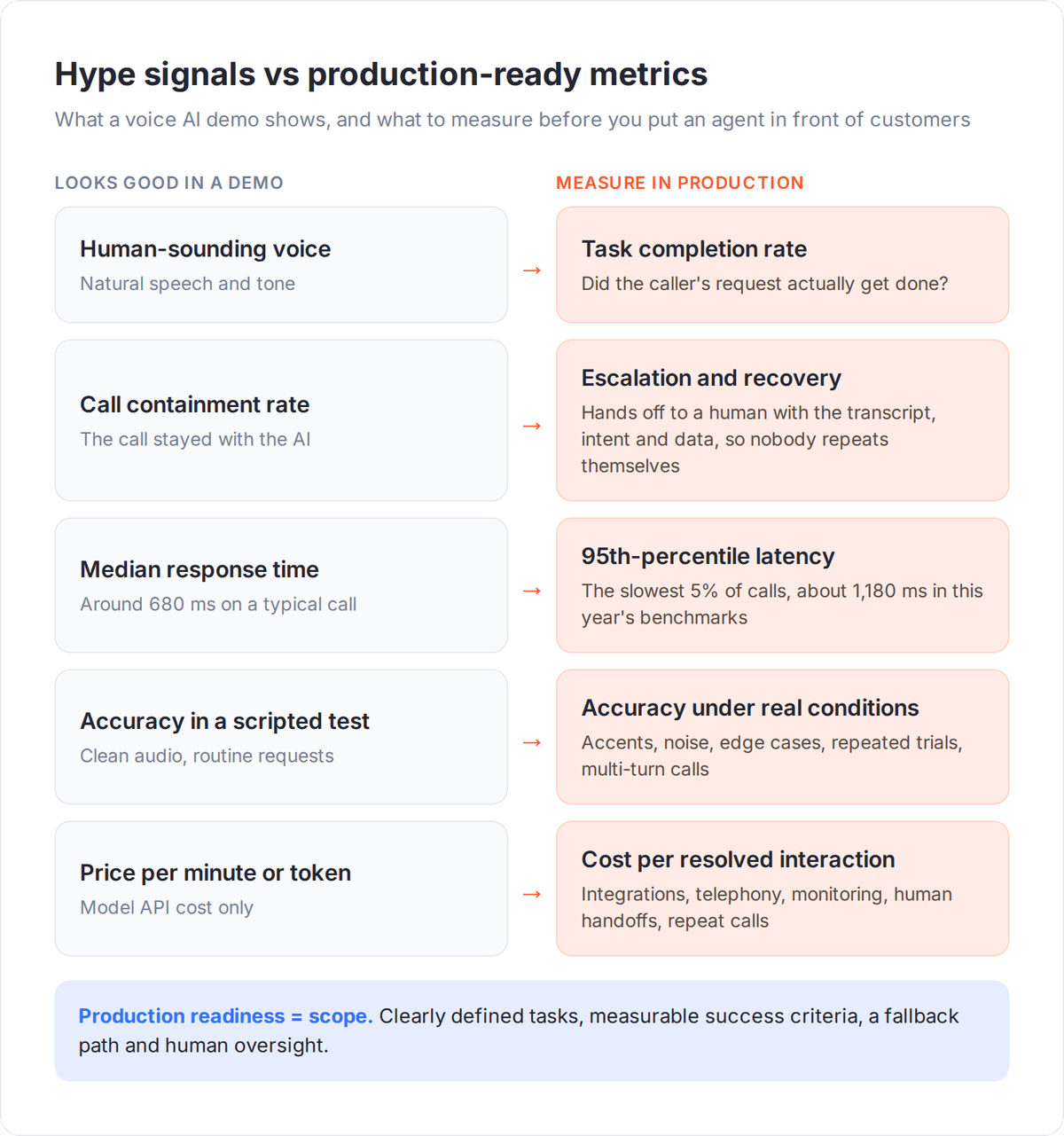
The following voice AI performance metrics can help businesses distinguish production-ready voice AI from hype.
Task Completion Rate Versus Containment Rate
A critical error to avoid when deploying AI is assuming that the ability to contain calls within the AI system without human intervention is a primary indicator of success.
For businesses, call containment rate primarily indicates that, fundamentally, an AI voice agent can handle calls. However, focus should be directed to how well the call was handled and if the agent is able to complete a customer’s request successfully.
Roundtrip Latency, Not Just Model Speed
Pre-implementation, voice agents must be assessed against their ability to maintain a natural flow during conversations, while accounting for context awareness, interruptions, turn-taking, speech recognition, text-to-speech generation, and network delays.
Evaluation should prioritize the 95th-percentile latency and not average response times. What happens during the slowest 5% of measured calls is a reflection of what customers could experience in real-world scenarios, and may mar a customer’s perception of the business.
For context, the voice AI benchmark for total latency sits at about 680 ms at the median, and 1,180 ms for the 95th percentile.
Basically, businesses should aim for calls to be as smooth as calling people overseas through specialized calling apps, while targeting total latency at or below the benchmark figures.
Accuracy and Consistency Under Real-World Conditions
To enhance and ensure accuracy and consistency in real-world scenarios, businesses should evaluate performance across the following:
- Applicable varieties of accents, dialects, languages, and noisy environments.
- Routine requests as well as unexpected edge cases.
- Repeated trials of the same task.
- System approach and response to cascading failure.
- Multi-turn and ambiguous interactions.
Successful Escalation and Error Recovery
A production-ready voice AI agent should have enough context awareness to immediately identify the type of tasks it can complete and the ones it should transfer to a human agent.
More importantly, it should be able to detect emotional cues as a result of repeated corrections or rising customer frustration, and appropriately route the call for human assistance. In measuring human escalation rate, teams must account for the completeness of the transcript, the stated intent, and extracted information transferred by the agent, ensuring that the final output doesn’t require the customer to repeat information.
Cost per Resolved Interaction
To get a complete view of cost per resolved interaction, businesses must look beyond the model API costs per token or costs per minute.
Broader and more accurate estimation also accounts for the cost of integrations, telephony, orchestration, monitoring, and human intervention spread across all calls.
Pro Tip. When calculating the true cost per resolved interaction, also account for users who called twice for the same issue, as well as repeated calls from users who hung up due to frustration or unresolved issues.
At the macro level, the scorecard should connect all these performance metrics to successful outcomes, user experience, operational cost, and risks.
Conclusion: Production Readiness Is a Question of Scope
The narrative around AI agents often suggests they will either entirely replace humans at contact points or turn out to be fads. In reality, and as with most other phenomena, operational reality and, hence, balance lie in the middle.
As voice AI is becoming increasingly autonomous and effective, businesses must have a fallback strategy and maintain human oversight in AI systems. They must acknowledge that at the operational level, production readiness is fundamentally a matter of scope management, and that success is more likely when deployments have clearly defined tasks and measurable success criteria.
FAQ
What are the key total latency benchmarks for voice AI in 2026?
The median total response latency benchmark for voice AI in 2026 is ~680 milliseconds. The 95th-percentile latency is benchmarked at roughly 1,180 milliseconds.
Why is containment rate a misleading metric for evaluating voice AI?
Containment rate only measures whether a call was completed within the voice AI system without human intervention. It doesn’t tell if a customer’s request was resolved effectively or if they ended the call in frustration. Completion rate is a more meaningful metric.
How can businesses determine if a voice AI system is production-ready?
Production readiness depends on well-defined measurement criteria and operational scope in real-world conditions. Some performance metrics for effective evaluation include task completion rate, total latency, cost per resolved interaction, escalation rate, recovery rate, and accuracy and consistency under real-world conditions.
Want to see how AI agents handle support work beyond voice? These guides cover scoping, metrics and the most common rollout mistakes.