In this article
Key Takeaways
- Postmark fits apps that send mostly transactional email, and Brevo puts transactional and marketing email in one account with 300 free emails a day. Amazon SES has the lowest per-email price for teams on AWS, and Resend includes 50,000 emails in its $20 Pro plan.
- UniOne suits a startup with small volume: four months of free sending at 6,000 emails a month, and a Standard plan from $6 a month for 10,000 emails.
- Mailgun and Amazon SES can send from an EU region, and Brevo keeps its servers in the EU.
SendGrid now gives new accounts a 60-day trial capped at 100 emails a day, and its Essentials plan starts at $19.95 a month. Five of the eight alternatives in this list charge $15 to $20 for their first paid plan, two start under $10, and Amazon SES bills $0.10 per 1,000 emails.
How do the 8 SendGrid alternatives compare?
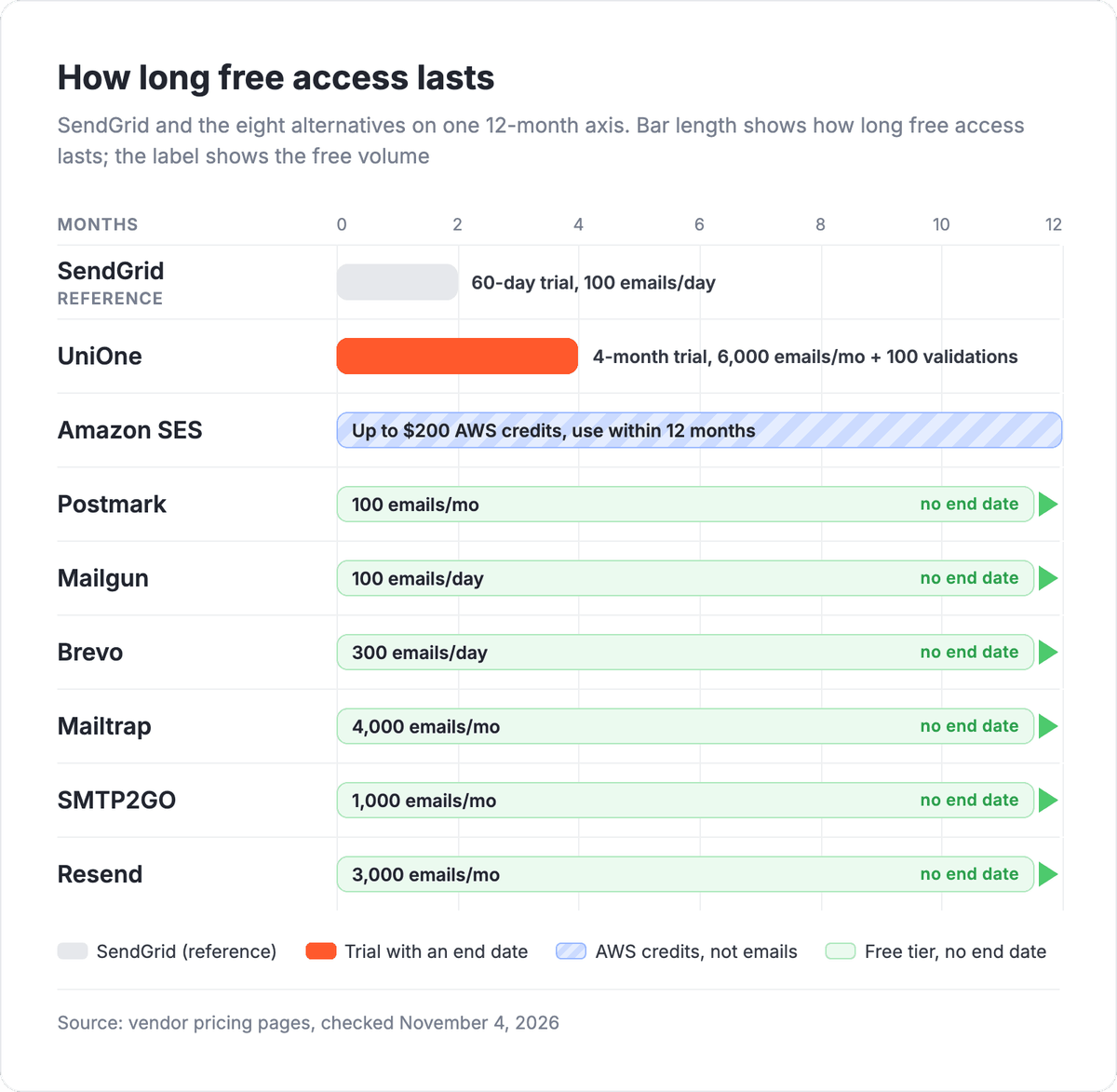
The eight SendGrid alternatives differ most in how free access works and what the first paid plan costs. Six keep a permanent free tier, UniOne gives a 4-month trial, and Amazon SES offers AWS Free Tier credits instead of a free plan.
| Tool | Best for | Free tier | Entry paid plan | Extra emails | Albato connector |
|---|---|---|---|---|---|
| Amazon SES | Teams already on AWS | No free plan; up to $200 in AWS Free Tier credits for new AWS customers | Pay as you go: $0.10 per 1,000 emails (à la carte) | Same per-email rate | No |
| Brevo | Transactional and marketing email in one account | 300 emails/day, no time limit | Starter $9/mo from 5,000 emails ($8.08 billed yearly) | Plans priced by email volume | Yes |
| UniOne | Startups with small volume that want a long trial | 4-month trial: 6,000 emails/mo and 100 email validations | Standard from $6/mo for 10,000 emails | $0.75 or less per 1,000 | Yes |
| Postmark | Apps that send mostly transactional email | 100 emails/mo, never expires | Basic $15/mo for 10,000 emails | $1.80 per 1,000 (Basic) | Yes |
| Mailgun | Developers who want a US or EU region | 100 emails/day | Basic $15/mo for 10,000 emails | From $1.80 per 1,000 (Basic) | No |
| Mailtrap | Testing and sending from one vendor | 4,000 emails/mo, 150/day | Basic $15/mo for 10,000 emails | $1.00 per 1,000 (Basic) | No |
| SMTP2GO | SMTP relay with phone support | 1,000 emails/mo, 200/day | Starter $15/mo for 10,000 emails | $1.20 per 1,000 | No |
| Resend | Developers who need 50,000 emails on the first plan | 3,000 emails/mo, 100/day | Pro $20/mo for 50,000 emails | $0.90 per 1,000 | No |
All prices: US dollars, monthly billing unless noted, taken from vendor pricing pages on November 4, 2026.
What should a startup compare when leaving SendGrid?
A startup leaving SendGrid should compare four things: how long free access lasts, what the first paid plan includes at its real monthly volume, where email data can be stored, and whether the new provider connects to the CRM and other apps it already uses. Price per 1,000 emails matters less at 10,000 emails a month than the gap between a $6 plan and a $20 plan.
The free tier type decides how long you can test. A permanent free tier, like Brevo's 300 emails a day, keeps a staging environment running for months at no cost, while a trial or AWS credits end on a fixed date.
If you want a broader comparison, our ranking of transactional email services covers ten platforms, including SendGrid itself and Mailchimp Transactional.
💡 Tip
Export SendGrid's suppression lists (bounces, unsubscribes and spam reports) before you close the account, and import them into the new provider. Otherwise the first send from the new account can go to addresses that already bounced or asked to stop receiving email.
Which SendGrid alternatives cost less than $10 a month to start?
Amazon SES, Brevo and UniOne start below $10 a month. SES charges per email, Brevo sells volume tiers from $9, and UniOne pairs a 4-month trial with a Standard plan from $6.
1. Amazon SES: per-email pricing inside AWS
Amazon Simple Email Service (SES) has no monthly plan on its à la carte pricing: outbound email costs $0.10 per 1,000 emails, plus $0.12 per GB of attachments sent, with no contract and no upfront commitment.
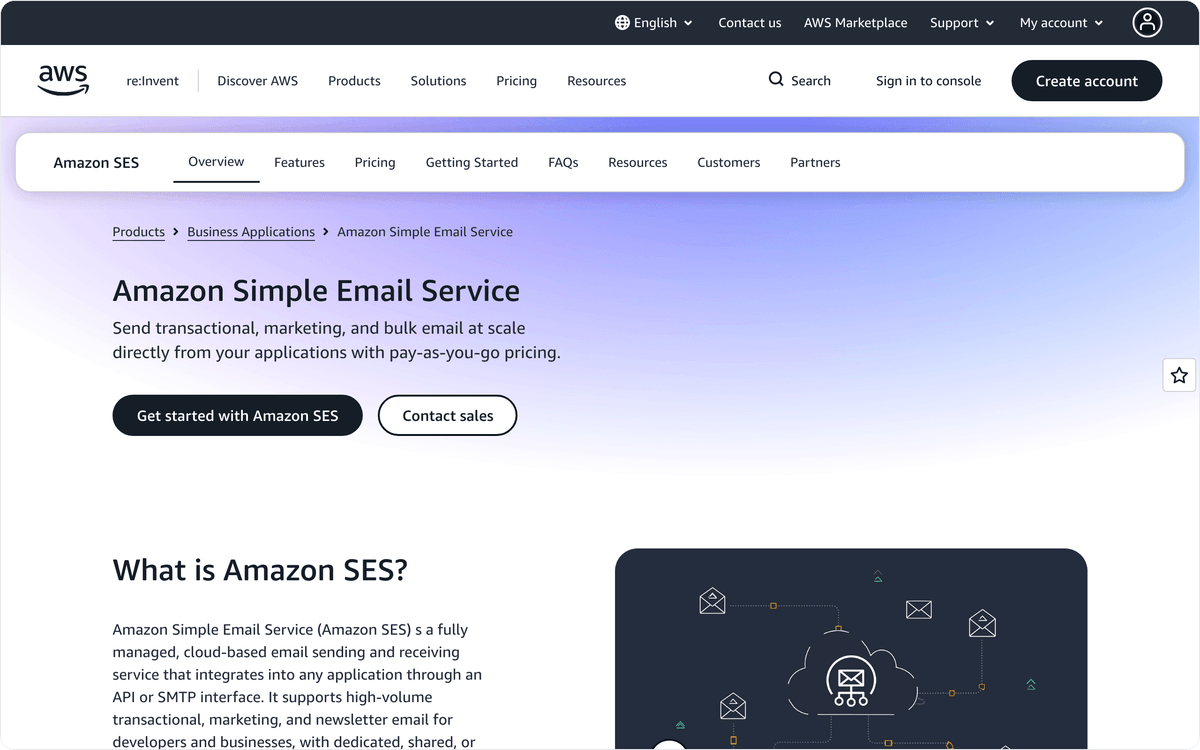
SES runs inside AWS, so a team that already hosts its app there keeps sending, credentials and billing in the same account. AWS has also added plans: from July 21, 2026, new SES accounts start on Essentials at $0.16 per 1,000 emails, and you can switch to à la carte at any time. Pro costs $0.22 per 1,000 plus a fixed $105 per account per region a month.
Best for: teams on AWS that want the lowest per-email price in this list and can do the setup in the AWS console.
Pricing: SES has no free plan. New AWS customers get up to $200 in AWS Free Tier credits that also apply to SES; the AWS free plan lasts 6 months after account creation, and the credits must be used within 12 months.
2. Brevo: transactional and marketing email in one account
Brevo sends real-time email, SMS and WhatsApp messages through an SMTP relay and an API, and the same account runs newsletters and marketing campaigns. A startup that wants receipts and a monthly product update to come from one vendor does not need a second tool.
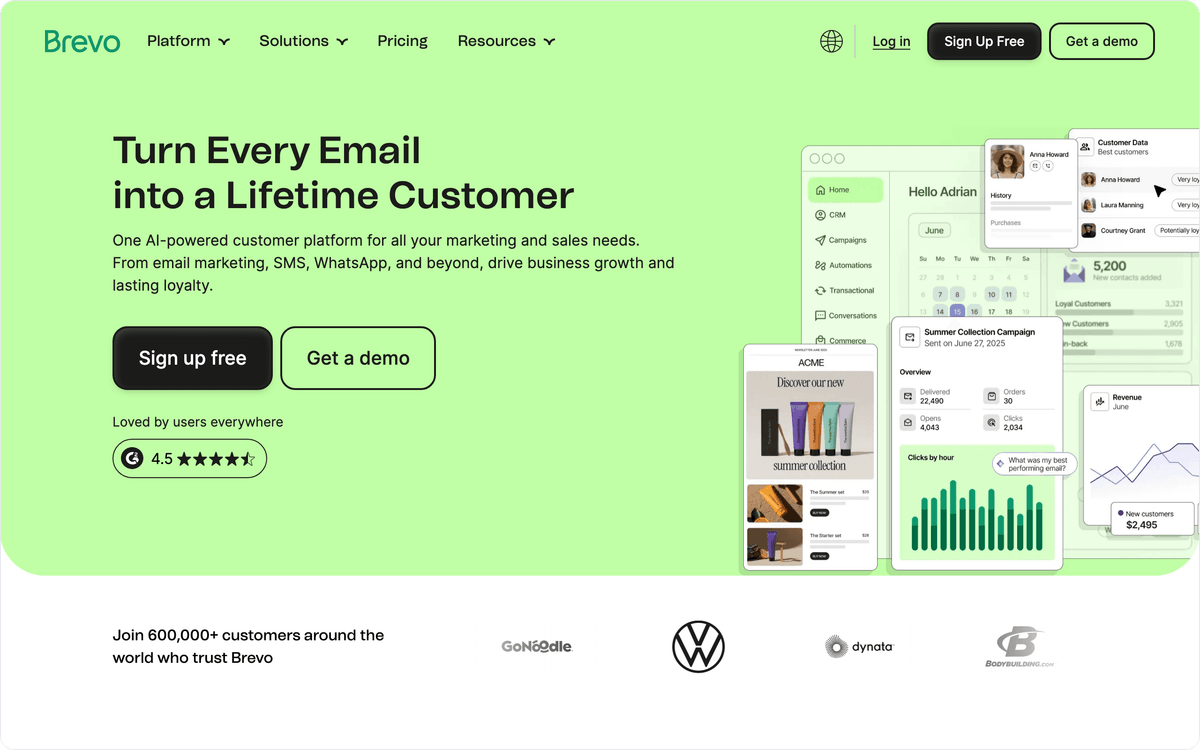
Paid plans are priced by the number of emails, with no daily sending limit and no expiration date on the emails you buy. Brevo's site lists 150+ integrations with tools such as Shopify, WordPress and Stripe.
Best for: startups that send receipts, newsletters and SMS from a single account.
Pricing: the free plan costs nothing forever, needs no credit card and sends up to 300 emails a day once Brevo approves the account for sending. Starter costs $9 a month from 5,000 emails, or $8.08 a month billed yearly. Standard costs $18, or $16.17 billed yearly.
3. UniOne: Email API and SMTP, free for the first four months
UniOne is an Email API and SMTP service for transactional and marketing emails. Its free trial runs for four months, which gives a small product time to go live and grow before the first invoice.
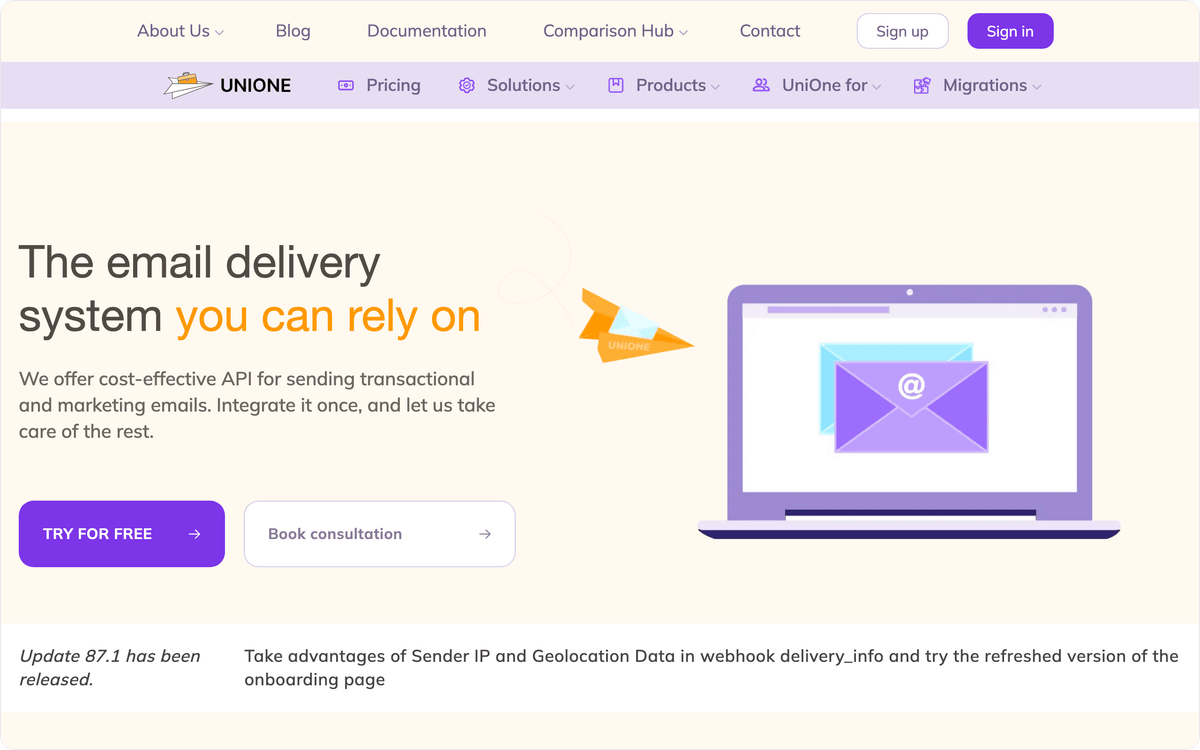
For building messages, UniOne offers a library of 200+ ready-made templates and two editors, one drag-and-drop and one AI-powered for HTML. For developers, it adds webhooks, SPF, DKIM and DMARC records for domain authentication, an email validation API and dedicated IPs, and it lists GDPR compliance.
Best for: startups with small volume that want several months to test sending before they pay.
Pricing: UniOne's trial is free for four months and covers 6,000 emails a month plus 100 email address validations. On the Standard plan, 10,000 emails cost from $6 a month, and every extra 1,000 emails over the plan costs $0.75 or less.
Which SendGrid alternatives start at $15 to $20 a month?
Postmark, Mailgun, Mailtrap and SMTP2GO charge $15 a month for 10,000 emails on their first paid plan, and Resend charges $20 for 50,000. All five keep a free tier, so a developer can wire up the API before anyone pays.
4. Postmark: separate streams for transactional and bulk email
Postmark focuses on transactional email sent from apps and puts bulk and broadcast messages into separate message streams. Password resets and a product newsletter can go out from one account without sharing a stream.
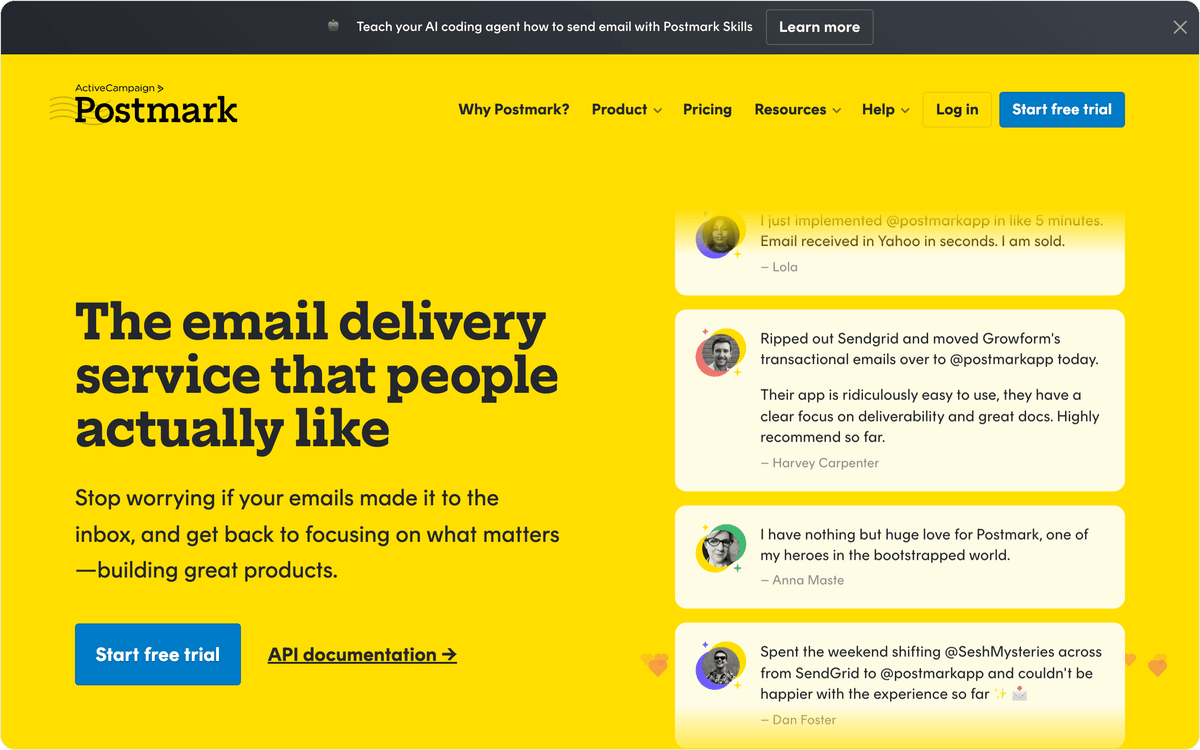
Responsive email templates come with a template editor and an import tool, and event webhooks report what happens to each message. Basic includes 5 custom sending domains, unlimited emails per day and 45 days of data retention. Inbound email processing comes with Pro at $16.50 a month, which also cuts the price of extra emails to $1.30 per 1,000.
Best for: apps whose email is mostly transactional, with broadcasts kept in a separate stream.
Pricing: the free Developer plan includes 100 emails a month, never expires and allows no overages. Basic costs $15 a month at 10,000 emails, and each extra 1,000 emails costs $1.80. Platform costs $18 a month.
5. Mailgun: one account, US or EU region
Mailgun lets one account send email through the US or the EU, and its service is hosted in both regions so your data can stay in the region you choose. That choice matters to a startup whose first customers are in Europe.
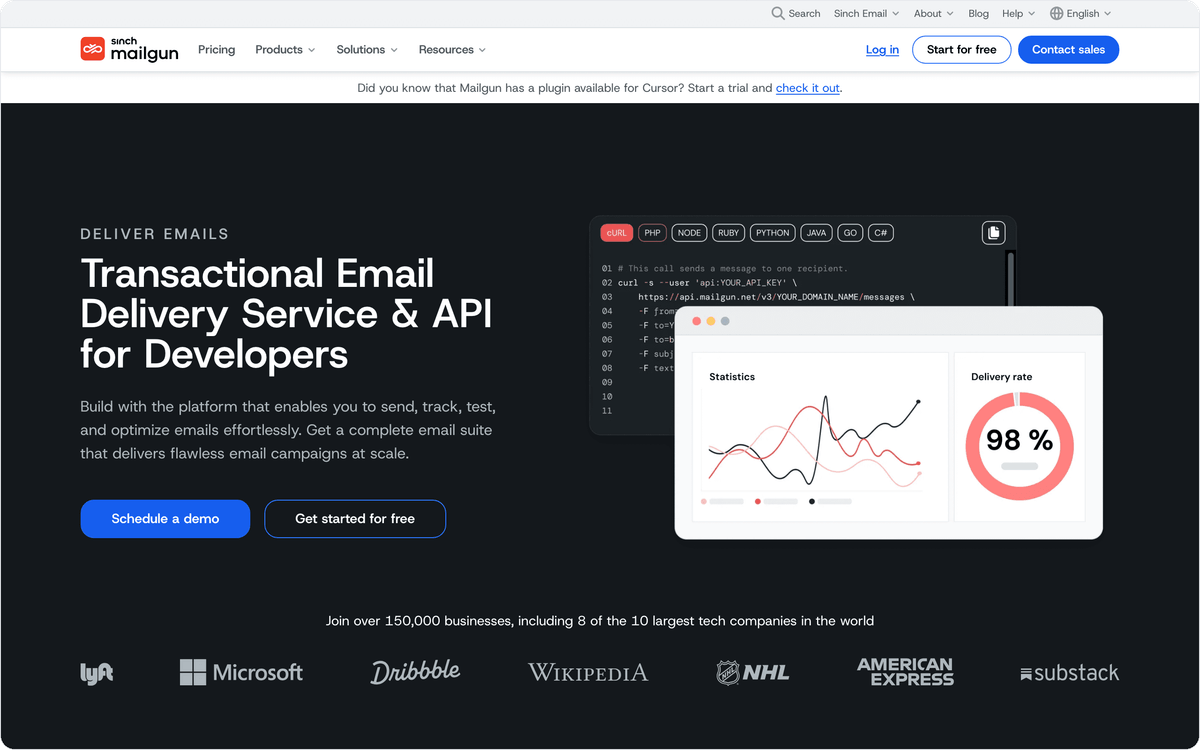
Every plan includes APIs and SMTP relay plus tracking, analytics and webhooks. Mailgun also sells email validation, where 100 checks cost from $1.20, which helps before you import an old contact list into a new product.
Best for: developers who want an email API with validation and a choice of US or EU region.
Pricing: the free plan sends 100 emails a day and keeps logs for 1 day. Basic costs $15 a month for 10,000 emails, with extra emails from $1.80 per 1,000. Foundation is free for the first month, then $35 a month for 50,000 emails, and Scale is $90 a month for 100,000 after a free first month.
6. Mailtrap: a testing sandbox and sending from one vendor
Mailtrap sells an Email Sandbox for testing emails next to its Email API/SMTP product for sending them. The two are sold separately, so a team can start with sending only and add the sandbox when staging needs it.
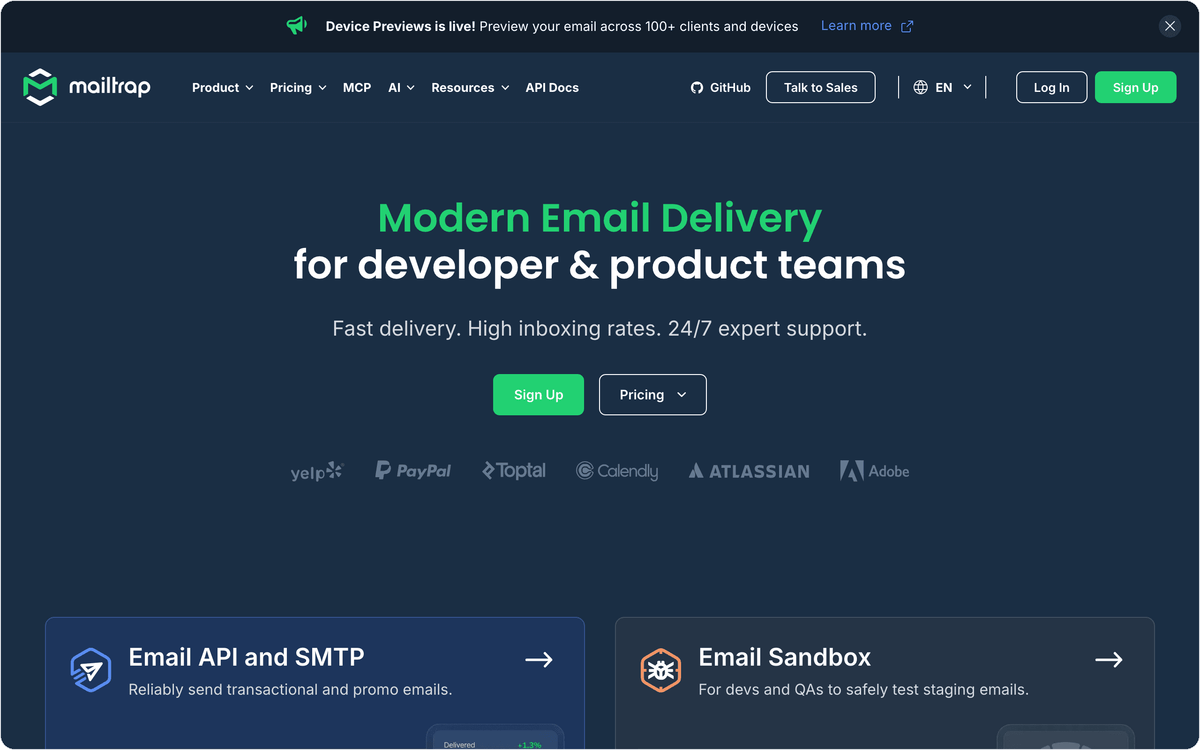
The sending product's free plan already includes API and SMTP relay, inbound email, webhooks, templates, a bulk stream, open tracking and SPF, DKIM and DMARC. Free accounts are limited to 1 user, 1 domain and 3 days of email logs.
Best for: dev teams that test emails in a sandbox before sending them from the same vendor.
Pricing: the free plan includes 4,000 emails a month with a cap of 150 a day, and no credit card is required. Basic costs $15 a month for 10,000 emails, $20 for 50,000 or $30 for 100,000, with extra emails at $1.00 per 1,000. Business costs $85 a month for 100,000 emails.
7. SMTP2GO: SMTP relay with phone support on paid plans
SMTP2GO sends transactional and promotional email over an API or an SMTP relay. Its paid plans add chat and phone support to ticket support from the first tier, which helps a small team without an email specialist.
Starter includes 30 days of email reporting, subaccount management and SMS messaging. For developers, SMTP2GO publishes API documentation with a section on webhooks.
Best for: teams that send over SMTP relay and expect phone support from the first paid plan.
Pricing: the free plan covers 1,000 emails a month, up to 200 a day, with 5 days of reporting, and no credit card is required. Extra emails are not permitted on the free plan. Starter costs $15 a month for 10,000 emails, with extra emails at $1.20 per 1,000.
8. Resend: 50,000 emails on the first paid plan
Resend's Pro plan includes 50,000 emails for $20 a month, the largest volume on an entry paid plan in this list. The service is built for developers and handles transactional sends as well as marketing email.
You can send from North American, South American, European and Asian regions to cut delivery latency. Pro includes 10 domains, 5 webhook endpoints and no daily email limit. Automations cost $0.0015 a run, and the first 10,000 runs are free.
Best for: developers who expect tens of thousands of emails a month soon after launch.
Pricing: the free plan includes 3,000 emails a month, up to 100 a day, on 3 domains. Pro costs $20 a month for 50,000 emails, with extra emails at $0.90 per 1,000, and Scale costs $90 a month for 100,000.
⚠️ Important
Several free tiers stop at the limit instead of billing you. Postmark's free plan allows no overages, SMTP2GO's free plan does not permit extra emails, and Mailtrap offers no overage on its free plan. Move to a paid plan before a launch or a bulk import, or password resets can stop going out.
How much does a SendGrid alternative cost at 10,000 and 50,000 emails a month?
At 10,000 emails a month, UniOne's Standard plan costs $6, Postmark, Mailgun, Mailtrap and SMTP2GO cost $15, and Amazon SES costs about $1 at its à la carte rate (10,000 × $0.10 per 1,000, our calculation). Brevo's Starter plan begins at $9 for 5,000 emails, and Resend's Pro plan at $20 already covers 50,000.
At 50,000 emails a month, Mailtrap Basic and Resend Pro cost $20, SendGrid Essentials starts at $19.95, and Mailgun Foundation costs $35 after a free first month. Amazon SES comes to about $5 at the à la carte rate, again by our calculation.
Dedicated IPs cost extra or come with higher plans on several of these services. Amazon SES charges $24.95 a month for each standard dedicated IP, Mailtrap includes one from its Business plan at $85 a month, and SMTP2GO includes one on Professional at $75 a month for 100,000 emails.
Which SendGrid alternatives can keep email data in the EU?
Brevo, Mailgun and Amazon SES give you an EU option that you can check on their own sites. Brevo is a company registered in Paris, and its data security page says its servers are located in the EU. Mailgun hosts its service in both the US and the EU, and your data can remain in the region you choose. Amazon SES runs in EU AWS Regions, including Frankfurt, Ireland, Paris, Milan, Spain and Stockholm.
Mailjet, which is not ranked in this list, says it runs EU-based data centers. Resend can send from a European region, but its documentation says account data, including email metadata and logs, stays in the United States whichever sending region you pick. For Postmark, Mailtrap and SMTP2GO, we found GDPR or privacy pages but no statement of EU company registration or EU data storage, so ask their sales teams before you sign a data processing agreement.
How do you connect a SendGrid alternative to the rest of your stack?
You connect an email API to your CRM, spreadsheets and team chat by building flows in Albato, where an email event or a new record in one app starts an action in another without code. Albato connects 1,000+ apps, with native connectors for UniOne, Postmark, Brevo and SendGrid among the tools in this article.
Flows from Postmark, Brevo and UniOne
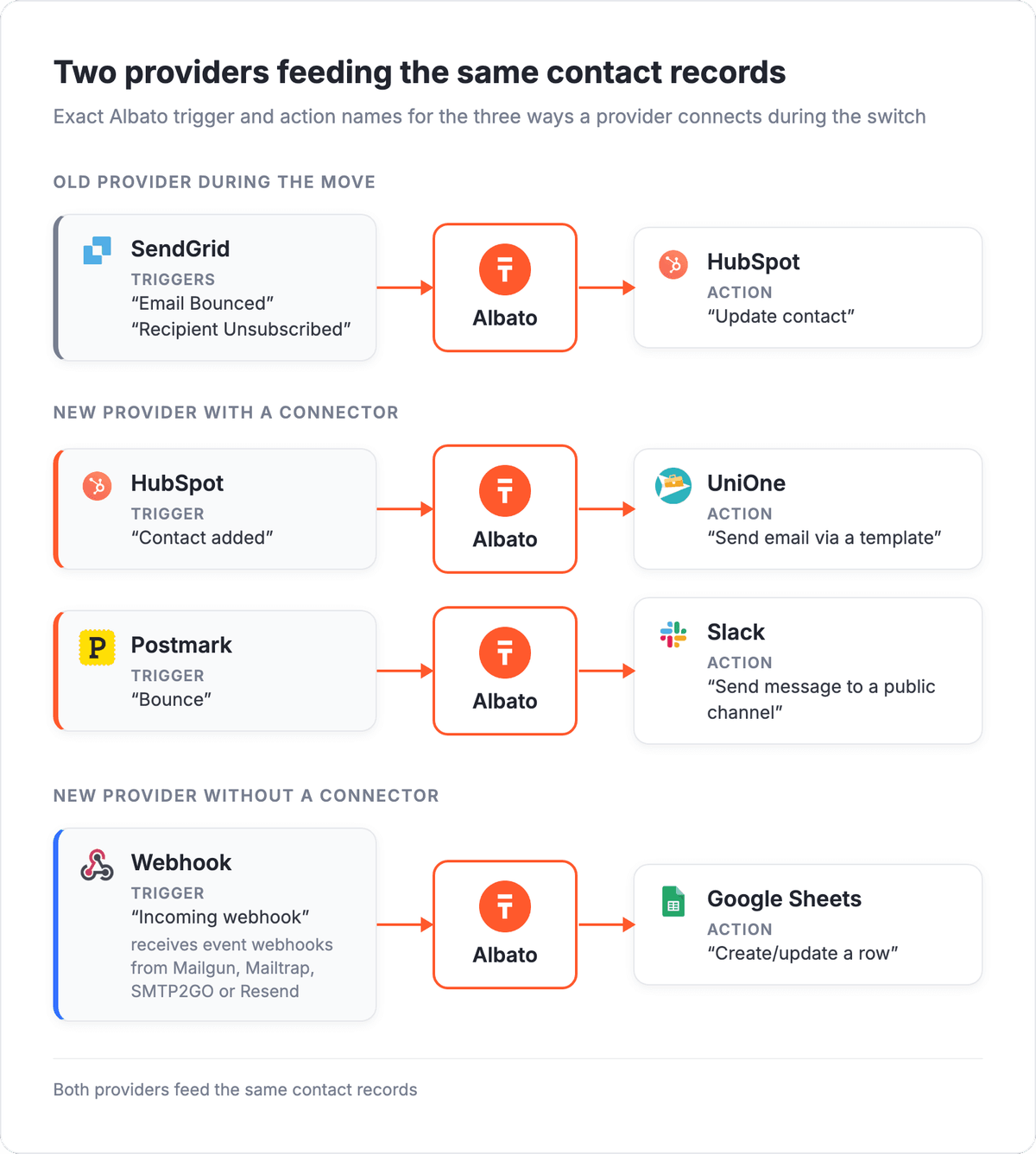
The Postmark connector has six triggers, including "Bounce", "Spam Complaint" and "Message Delivery". A "Bounce" can update the contact in HubSpot with "Update contact" and send an alert to Slack with "Send message to a public channel". Brevo starts flows on "Contact created" and "Contact updated", and its action "Send transactional email" sends a message from another app's trigger.
The UniOne connector works as an action. "Send Email" or "Send email via a template" sends a message when something happens in another app, for example "New row created" in Google Sheets or "Contact added" in HubSpot.
Albato's Free plan covers 5 active automations with up to 2 steps each, enough for a Postmark bounce sent to a Slack channel.
Keep SendGrid running during the switch
The SendGrid connector lets the old account keep reporting while the new provider takes over sending. SendGrid triggers such as "Email Bounced", "Spam Report" and "Recipient Unsubscribed" can keep updating HubSpot contacts during the cutover, while the new provider's action, such as Postmark "Send single Email" or Brevo "Send transactional email", sends new mail.
When the new provider has handled a full week of signups and receipts, turn off the SendGrid flows and keep the same HubSpot actions on the new provider's triggers.
Connect Mailgun, Mailtrap, SMTP2GO, Resend and Amazon SES
Mailgun, Amazon SES, Mailtrap, SMTP2GO and Resend have no Albato connector, so their events reach Albato through a webhook. The Webhook app's trigger "Incoming webhook" gives a flow its own URL. Mailgun, Mailtrap, SMTP2GO and Resend all list webhooks, so you paste that URL as an endpoint and each event they send starts the flow.
🔧 How it works
Amazon SES does not post events straight to a URL. It publishes sending events to AWS services such as Amazon SNS or Amazon EventBridge, so an SES setup needs that AWS step before events can reach a webhook.
To send email from a flow through a provider without a connector, the HTTP Request/Outgoing webhook action "Send request" calls the provider's API. The rest of the flow, such as "Create/update a row" in Google Sheets or "Update contact" in HubSpot, works the same for every provider.
Start with bounces on signup and password-reset emails, since a bounced address there belongs to a user who cannot log in.
FAQ
What are some good SendGrid alternatives?
Good SendGrid alternatives include Postmark, Mailgun, UniOne, Amazon SES, Brevo, Mailtrap, SMTP2GO and Resend. They fall into two price groups: Amazon SES, Brevo and UniOne start below $10 a month, and Postmark, Mailgun, Mailtrap, SMTP2GO and Resend start at $15 to $20. Mailtrap also sells a testing sandbox, and SMTP2GO adds phone support on its paid plans.
Which SendGrid alternatives work well for startups?
For a startup with small volume, UniOne gives four free months at 6,000 emails a month, and its Standard plan costs from $6 a month for 10,000 emails. Brevo's free plan sends 300 emails a day with no end date, Mailtrap's free plan 4,000 a month and Resend's 3,000 a month. If you expect 50,000 emails a month soon, Mailtrap Basic and Resend Pro both cost $20.
Can you suggest SendGrid alternatives based in the EU?
Brevo is a company registered in Paris with servers in the EU. Mailjet says it runs EU-based data centers. Mailgun and Amazon SES offer EU regions: Mailgun can keep your data in its EU region, and Amazon SES can run in EU AWS Regions such as Frankfurt, Ireland and Paris.
Is there a free alternative to SendGrid?
Six services in this list keep a free tier with no end date: Postmark (100 emails a month), Mailgun (100 a day), Brevo (300 a day), Mailtrap (4,000 a month), SMTP2GO (1,000 a month) and Resend (3,000 a month). UniOne has a free trial of 4 months, and Amazon SES has no free plan but accepts AWS Free Tier credits.
How do you switch from SendGrid to another email API?
You verify your sending domain with the new provider (SPF, DKIM and DMARC records), replace the API key or SMTP credentials in your app, and import SendGrid's suppression lists so bounced and unsubscribed addresses stay excluded. Running both providers in parallel for a week lets you compare results, and Albato's SendGrid connector can keep updating contacts from the old account during that week.
Pick the provider first, then connect its events to the app your team already checks every day.
If you run two email providers during the move, one Albato flow per provider can update the same HubSpot contact, so nobody has to check two dashboards.