In this article
Key Takeaways
- Top picks by scenario: Klaviyo for Shopify-first stores that want predictive segmentation, Omnisend for multi-channel email plus SMS, ActiveCampaign when you need marketing automation and a sales CRM in one, Brevo for large lists that send infrequently, Kit for creators selling digital products, and HubSpot for stores that run email inside a full CRM.
- E-commerce email returns an average of $36 for every $1 spent, the highest-ROI channel available to online sellers.
- Abandoned cart sequences recover a meaningful share of lost carts, with top-performing stores reaching $3.65 revenue per recipient per message. Free tiers range from 250 contacts (Klaviyo, Omnisend) to 10,000 subscribers (Kit).
The email marketing software market is projected at $13.72 billion in 2026, yet most online stores still run their email tool in isolation from their CRM, helpdesk, and ad platforms. That disconnect leads to duplicate contacts, missed re-engagement windows, and attribution gaps that make your revenue data unreliable.

Let us build your automation or AI Agent
Tell us which process eats your time. Certified Albato engineers take it from there, A to Z.
How We Selected These Tools
We evaluated over 25 email marketing platforms and narrowed the list to 11 based on four criteria:
- E-commerce integration depth. Does the tool natively connect to Shopify, WooCommerce, BigCommerce, or Magento? Can it pull order data, product catalogs, and customer events in real time?
- CRM and data sync. Can you push subscriber behavior to your CRM, or pull deal stages into your email segments? We checked both native integrations and third-party sync through Albato.
- Automation sophistication. Beyond basic drip sequences: does it support behavioral triggers, conditional branching, and predictive send-time optimization?
- Pricing transparency. We flagged platforms that bury costs behind "contact us" walls or charge separately for essential e-commerce features like abandoned cart flows.
Quick Comparison
| Tool | Best For | Starting Price | Free Plan | Albato Connector | E-commerce Native |
|---|---|---|---|---|---|
| Klaviyo | Shopify-first stores | $45/mo (Email) | 250 contacts | Klaviyo connector | Shopify, WooCommerce, BigCommerce |
| Omnisend | Multi-channel (email + SMS) | $16/mo (Standard) | 250 contacts | Omnisend connector | Shopify, WooCommerce, BigCommerce, Wix |
| ActiveCampaign | Automation + CRM combo | $15/mo (Starter) | 14-day trial | Activecampaign connector | Shopify, WooCommerce, BigCommerce |
| Mailchimp | SMBs getting started | $13/mo (Essentials) | 500 contacts | Mailchimp connector | Shopify, WooCommerce, Squarespace |
| Brevo | Unlimited contacts on budget | $9/mo (Starter) | 300 emails/day | Brevo connector | Shopify, WooCommerce, PrestaShop |
| Drip | Revenue attribution | $39/mo | 14-day trial | Drip connector | Shopify, WooCommerce, BigCommerce |
| GetResponse | All-in-one with webinars | $19/mo (Starter) | 500 contacts | Getresponse connector | Shopify, WooCommerce, Magento |
| MailerLite | Budget-friendly stores | $10/mo (Growing) | 500 subscribers | Mailerlite connector | Shopify, WooCommerce |
| Kit (ConvertKit) | Creators selling products | $39/mo (Creator) | 10,000 subscribers | Convertkit connector | Shopify (limited) |
| HubSpot | Enterprise CRM + email | $15/mo (Starter) | 1,000 contacts | Hubspot connector | Shopify, WooCommerce, BigCommerce |
| Sendoso | Brands integrating physical touchpoints and personalized gifts into the digital customer journey | Custom tiered plans (Platform fee + cost of gifts and shipping) | No | No | Integrates with existing marketing stack for automated triggers |
The sections below break down each tool in detail, starting with why it earns its rank and where it fits your stack.
💡 Tip
The "Albato Connector" column shows how many triggers and actions each tool supports through Albato. More triggers means more ways to start automated workflows when something happens in your email platform. More actions means more ways to push data into it from your other tools.
The 11 Best Email Marketing Tools for E-commerce
1. Klaviyo
Klaviyo leads the ranking for Shopify-first stores that want predictive segmentation and revenue attribution built in.

Klaviyo has become the default email platform for Shopify stores, and the reason is straightforward: it pulls every order, product view, and cart event from your store in real time, then lets you build segments from that data without any manual tagging.
What makes it stand out for e-commerce: Klaviyo's predictive analytics engine calculates expected customer lifetime value, churn risk, and next order date for each subscriber. You can build automations around these predictions, not just past behavior. For a store with 5,000+ active customers, this means your win-back and VIP campaigns run on actual data instead of arbitrary time delays.
The platform handles both email and SMS from a single interface. You can trigger an abandoned cart email, then follow up with an SMS if the email goes unopened, all within the same automation flow. Revenue attribution ties every dollar back to the specific email or SMS that drove the purchase.
Albato integration: Klaviyo connects to Albato with Klaviyo connector, covering profile creation, list management, event tracking, and subscriber search. If you need to sync Klaviyo subscriber data with a CRM that Klaviyo does not natively support, Albato bridges that gap. For example, you can push new Klaviyo profiles into Pipedrive or sync purchase events to Google Sheets for custom reporting.
Pricing: Free up to 250 active profiles and 500 emails/month. Paid Email plans scale with your active profile count, starting around $30/mo for 500 to 1,000 profiles and $45/mo once you cross 1,000. Email plus SMS runs higher, and the Marketing Analytics add-on starts at $100/mo.
Verdict: The strongest option for Shopify-first stores that want data-driven email and SMS from a single dashboard. Pricing scales steeply above 5,000 contacts, so track your active profile count carefully.
⚠️ Important
Klaviyo's free plan caps at 250 profiles, which is generous for testing but you will outgrow it quickly if you are running an active store. Plan your budget for the $45/mo Email tier once you cross that threshold.
2. Omnisend
Omnisend earns its spot for stores that want email and SMS managed from one e-commerce-native workflow.

Omnisend was built exclusively for e-commerce, and that focus shows in the pre-built automation workflows it ships with. Abandoned cart, post-purchase follow-up, browse abandonment, and cross-sell sequences come ready to activate with your store data already mapped.
What makes it stand out for e-commerce: The platform calculates revenue attribution at the campaign, automation, and individual message level. You can see exactly which subject line variant generated more revenue, not just more opens. The product recommender engine pulls from your catalog and order history to suggest items in emails, and it updates those recommendations dynamically based on inventory changes.
Omnisend supports email, SMS, and web push notifications from a single workflow builder. For stores running promotions across multiple channels, this eliminates the need to stitch together separate tools. The contact-based pricing counts both subscribers and non-subscribers who received automated messages, so review your billable contacts regularly.
Albato integration: Omnisend connects through Albato with Omnisend connector: Create or Update Contact and Send Customer Event. This covers the most common sync scenario, pushing customer data from external systems into Omnisend for segmentation and targeted campaigns.
Pricing: Free up to 250 contacts (500 emails/month). Standard starts at $16/mo with email credits equal to 12x your contact count. Pro starts at $59/mo with unlimited emails, and since May 2026 SMS credits are available on the Pro plan (credits equal to your plan price).
Verdict: Best for mid-market e-commerce stores that want pre-built workflows, multi-channel campaigns, and granular revenue attribution without configuring everything from scratch.
3. ActiveCampaign
ActiveCampaign stands out when you need marketing automation and a sales CRM working from the same contact record.

ActiveCampaign combines email marketing with a built-in CRM that tracks deals through pipeline stages, making it one of the few platforms where your marketing and sales data live in the same system without third-party sync.
What makes it stand out for e-commerce: The automation builder supports conditional logic with site tracking, event triggers, and deal-based conditions. You can build a workflow that sends an abandoned cart email, checks if the customer opened a support ticket in the last 7 days, and routes the contact to a sales rep if the cart value exceeds $500. Few email platforms offer that level of cross-functional automation natively.
Site tracking captures page visits and product views on your store, feeding that behavior directly into your segments and automations. The predictive sending feature analyzes each contact's open history and delivers emails at the time they are most likely to engage.
Albato integration: ActiveCampaign connects to Albato with Activecampaign connector, making it one of the deepest integrations in Albato's catalog. You can trigger workflows when a contact unsubscribes, a deal moves stages, or a campaign starts sending. Actions cover contact creation, deal management, tag assignment, and automation enrollment. This level of depth means you can build complex cross-platform workflows without leaving Albato's visual builder.
Pricing: Starter at $15/mo, Plus at $49/mo, Pro at $79/mo (all for 1,000 contacts, billed annually), with Enterprise pricing above that. Monthly billing runs higher, and pricing scales with your list size. No free plan, but a 14-day trial is available.
Verdict: The best choice if your store needs marketing automation and sales CRM in one tool, especially when your team is routing high-value leads between marketing and sales.
📊 Stat
Automated emails account for just 2% of total email sends but drive 41% of email orders, according to Omnisend's ecommerce benchmark data. ActiveCampaign's automation builder is purpose-built for those multi-step flows.
4. Mailchimp
Mailchimp remains the familiar starting point for smaller stores that want an all-in-one marketing suite.

Mailchimp is the most widely recognized email marketing platform, and for small e-commerce stores selling through Shopify, WooCommerce, or Squarespace, it covers the basics well: email campaigns, landing pages, audience management, and reporting in a single dashboard.
What makes it stand out for e-commerce: The Standard plan ($20/mo for 500 contacts) opens up multi-step automations with branching logic, predictive segmentation, and send-time optimization. These are features that used to require enterprise-tier plans on other platforms. The product recommendations engine pulls from your store catalog and past purchase data to personalize email content automatically.
Mailchimp's Content Optimizer analyzes your email copy against industry benchmarks and suggests improvements before you send. For store owners who write their own emails without a dedicated copywriter, this catches readability issues and subject line problems that would otherwise hurt engagement.
Albato integration: Mailchimp connects to Albato with Mailchimp connector, covering new subscribers, campaigns, list management, tagging, and event tracking. A common use case is syncing your CRM contacts to Mailchimp lists automatically, so your email audiences always match your sales pipeline.
Pricing: Free plan allows 500 contacts and 1,000 emails/month (with Mailchimp branding). Essentials starts at $13/mo (500 contacts, 5,000 emails). Standard at $20/mo (500 contacts, 6,000 emails). Premium at $350/mo (10,000 contacts). Pricing scales with contacts.
Verdict: Solid for stores under 5,000 contacts that need a familiar, well-documented platform. Costs climb quickly once your list grows past 10,000, so compare per-contact pricing against dedicated e-commerce tools at that scale.
5. Brevo
Brevo suits large lists that send infrequently, since it prices by email volume rather than contact count.

Brevo (formerly Sendinblue) prices by email volume instead of contact count, which makes it one of the most cost-effective options for stores with large subscriber lists that send infrequently, like seasonal businesses or stores with monthly promotions instead of daily campaigns.
What makes it stand out for e-commerce: Every plan, including the free tier, supports unlimited contacts. You pay only for the number of emails you send. For a store with 50,000 subscribers that sends two campaigns per month, Brevo's Starter plan at $9/mo covers 5,000 emails, while a competitor charging per contact would bill $200+ for the same list size.
The platform includes a built-in CRM, transactional email engine, and SMS marketing. Transactional emails (order confirmations, shipping notifications, password resets) route through the same platform as your marketing campaigns, so you manage one sender reputation instead of two.
Albato integration: Brevo connects through Albato with Brevo connector, handling contact creation, updates, transactional email sends, and custom API requests. If you need to trigger a transactional email from an external event (a form submission in Typeform, a payment in Stripe), Albato makes that connection without code.
Pricing: Free plan includes 300 emails/day (about 9,000/month) and unlimited contacts. Starter at $9/mo (5,000 emails). Standard at $18/mo (adds automation, A/B testing, and higher volumes). Pricing scales with email volume, not contacts.
Verdict: The best pick for stores with large lists and low send frequency. The volume-based model saves money compared to per-contact pricing. Automation capabilities on the Standard plan are solid but not as deep as Klaviyo or ActiveCampaign.
💡 Tip
If your store sends transactional emails (order confirmations, shipping updates) through a separate service, consolidating them into Brevo alongside your marketing emails simplifies your tech stack and protects your sender reputation. Splitting transactional and marketing emails across providers is a common cause of deliverability issues.
6. Drip
Drip is aimed at e-commerce brands that want deep revenue tracking without running a separate CRM.

Drip positions itself as the email marketing platform for e-commerce brands doing $1M to $50M in annual revenue, and its feature set reflects that focus: deep store integrations, revenue attribution at the workflow level, and visual automation building without the CRM complexity.
What makes it stand out for e-commerce: Revenue attribution in Drip ties every dollar of tracked revenue to the specific email, workflow, or campaign that influenced the purchase. You can compare the performance of your abandoned cart sequence against your post-purchase upsell flow in terms of actual revenue generated, not proxy metrics like open rates.
The platform includes pre-built e-commerce playbooks for Shopify, WooCommerce, and BigCommerce that come configured with best-practice timing and segmentation. The visual workflow builder supports conditional splits, delays, parallel paths, and integration triggers. Drip gives every customer a single plan with all features included, so you never run into a feature gate when your list grows.
Albato integration: Drip connects to Albato with Drip connector, the deepest trigger set of any email tool in this ranking. Triggers fire on subscriber creation, deletion, email engagement, campaign participation, and marketing subscription changes. This makes Drip particularly useful as the starting point for cross-platform workflows: when someone clicks a link in a Drip email, you can update their CRM record, notify your sales team in Slack, or add a tag in your helpdesk.
Pricing: Starts at $39/mo for up to 2,500 contacts with unlimited email sends. 5,000 contacts costs $89/mo. 10,000 contacts costs $154/mo. All features included on every plan. 14-day free trial available.
Verdict: Best for established e-commerce brands that want precise revenue attribution and deep workflow automation without managing a separate CRM. The $39/mo entry point is higher than some competitors, but every feature is included from day one.
7. GetResponse
GetResponse packs email, automation, and landing pages into one tool for stores building funnels end to end.

GetResponse bundles email marketing with landing pages, webinars, and a website builder, making it an option for stores that want to consolidate marketing tools rather than managing separate subscriptions for each channel.
What makes it stand out for e-commerce: The Ecommerce Marketing plan ($119/mo) includes abandoned cart recovery, product recommendations, transactional emails, and advanced promo codes. The webinar feature is unique among email marketing platforms, and it integrates directly with your email automations. You can run a product demo webinar, then automatically segment attendees into a follow-up email sequence based on how long they stayed.
For stores running paid promotions, the built-in conversion funnel builder creates landing pages, signup forms, and post-signup email sequences in a connected workflow. If your store also handles invoicing and payment sync, GetResponse's automation can trigger follow-up emails based on payment status updates from your accounting tool. The AI email generator drafts campaigns from a prompt and optimizes subject lines based on your audience's historical engagement.
Albato integration: GetResponse connects through Albato with Getresponse connector (New Contact). While the connector is basic, it covers the most common sync need: adding contacts from external sources into GetResponse lists. For deeper workflows, GetResponse's native integrations with Shopify and WooCommerce handle most e-commerce data sync directly.
Pricing: Free plan for 500 contacts and 2,500 newsletters/month. Starter at $19/mo (1,000 contacts). Marketer at $59/mo (marketing automation + webinars). Ecommerce Marketing at $119/mo (full e-commerce features). Pricing scales with contacts.
Verdict: A strong choice for stores that also run webinars, product launches, or educational content as part of their sales funnel. The all-in-one approach saves on tool subscriptions but comes at a higher price point for e-commerce features.
8. MailerLite
MailerLite is the budget-friendly pick for stores that want clean automation and Shopify or WooCommerce sync.

MailerLite offers one of the most generous free plans in the category and keeps paid pricing consistently lower than most competitors, which makes it a practical choice for new stores watching their marketing budget.
What makes it stand out for e-commerce: The Growing Business plan at $10/mo includes unlimited emails, automations, A/B testing, and the ability to sell digital products directly through MailerLite. For stores selling e-books, courses, or downloadable templates alongside physical products, this eliminates the need for a separate digital commerce tool.
The automation builder supports triggered sequences based on subscriber activity, form submissions, and e-commerce events. MailerLite's interface is noticeably cleaner than most competitors, which reduces onboarding time for small teams without a dedicated email specialist.
Albato integration: MailerLite connects to Albato with Mailerlite connector, covering subscriber management, group assignment, campaign creation, and subscriber lookup. You can automate adding new customers from your CRM or payment processor into specific MailerLite groups, then trigger targeted email sequences without manual list management.
Pricing: Free plan for up to 500 subscribers and 12,000 emails/month. Growing Business at $10/mo (unlimited emails). Advanced at $20/mo (adds custom HTML editor, advanced website features). Enterprise pricing available for 100K+ subscribers.
Verdict: Best for stores under 5,000 subscribers that need clean email automation at the lowest possible cost. The feature set is more limited than dedicated e-commerce platforms like Klaviyo or Omnisend, but the pricing is hard to beat.
🔧 How it works
MailerLite integrates with Shopify and WooCommerce to pull product data and purchase history into your email campaigns. If your store uses a less common platform, Albato can bridge the gap by syncing customer events from any of 1,000+ connected apps into MailerLite's subscriber lists.
9. Kit (ConvertKit)
Kit fits creators selling digital products who care more about audience growth than storefront features.

Kit, formerly ConvertKit, was originally built for creators (bloggers, podcasters, course sellers) and its strengths still lean toward that audience. For e-commerce businesses that sell digital products, subscriptions, or course bundles, Kit offers a simpler alternative to full-featured e-commerce email platforms.
What makes it stand out for e-commerce: Kit's free Newsletter plan supports up to 10,000 subscribers, the most generous free tier in this ranking. The visual automation builder connects email sequences with product purchases, tag assignments, and subscriber actions. The built-in commerce features let you sell digital products and paid newsletters directly through Kit, collecting payments and delivering content without an external storefront.
The subscriber scoring system on the Creator Pro plan ($79/mo) ranks contacts by engagement level, helping you identify your most active buyers for VIP campaigns or exclusive offers. The newsletter referral system rewards subscribers who bring in new signups, turning your email list into a growth channel.
Albato integration: Kit connects to Albato with Convertkit connector, covering purchase events, subscriber activation, tag management, sequence enrollment, and form subscriptions. If you sell courses on Teachable or Thinkific and need to sync student data into Kit for email sequences, Albato handles that connection.
Pricing: Free Newsletter plan for up to 10,000 subscribers (limited to broadcasts and landing pages). Creator at $39/mo for 1,000 subscribers (adds automations, sequences, integrations). Creator Pro at $79/mo (adds subscriber scoring, referral system, advanced reporting). Annual billing saves about 16%.
Verdict: The best option for creators and digital product sellers who need email marketing with built-in commerce. Not the right fit for stores selling physical products through Shopify or WooCommerce, where Klaviyo or Omnisend will serve you better.
10. HubSpot
HubSpot is for stores that would rather run email inside a full CRM than bolt one on later.

HubSpot's email marketing sits inside its broader CRM platform, which means your email campaigns, contact records, deal pipelines, customer support tickets, and website analytics all share the same database. For stores with sales teams that work alongside their marketing operations, this eliminates the data silos that cause duplicate outreach and missed follow-ups.
What makes it stand out for e-commerce: The Marketing Hub includes email, ads, landing pages, forms, and automation in a single subscription. For e-commerce, the Shopify and WooCommerce integrations sync order data, customer records, and product information into HubSpot's CRM, where your sales and support teams can access it alongside marketing engagement data.
The free CRM plan supports 1,000 contacts and basic email marketing, making it accessible for stores that want to start building their CRM infrastructure before investing in paid tiers. The Professional tier (from $800/mo on annual billing) adds advanced automation, A/B testing, and predictive lead scoring. This pricing puts it out of reach for most small stores, but for mid-market and enterprise e-commerce operations, the consolidation of marketing, sales, and service in one platform justifies the cost.
Albato integration: HubSpot connects to Albato with Hubspot connector, the deepest integration in Albato's entire catalog. You can trigger workflows from contact updates, deal stage changes, form submissions, email events, and more. Actions cover contact management, deal creation, email sending, list management, and custom object handling. For stores that use HubSpot as their CRM but a specialized tool for email campaigns, Albato keeps both systems synchronized.
Pricing: Free CRM plan with 1,000 contacts and basic email. Starter from $15/mo per seat. Professional from $800/mo on annual billing (2,000 marketing contacts, full automation, plus a one-time onboarding fee). Enterprise from $3,600/mo (10,000 contacts). E-commerce features require the Professional tier or higher.
Verdict: Best for stores that need their email marketing to feed into (and pull from) a full CRM with sales, service, and analytics tools. Overkill for stores that only need email campaigns, and the Professional tier pricing reflects that breadth.
📊 Stat
For retail and e-commerce senders specifically, email returns roughly 45 dollars per dollar spent, above the cross-industry average. Running email inside a full CRM like HubSpot means that return is attributed against the same contact records your sales and support teams already work from.
11. Sendoso
Sendoso bridges the gap between digital marketing and physical experiences, allowing ecommerce brands to send personalized gifts and direct mail as easily as an email.
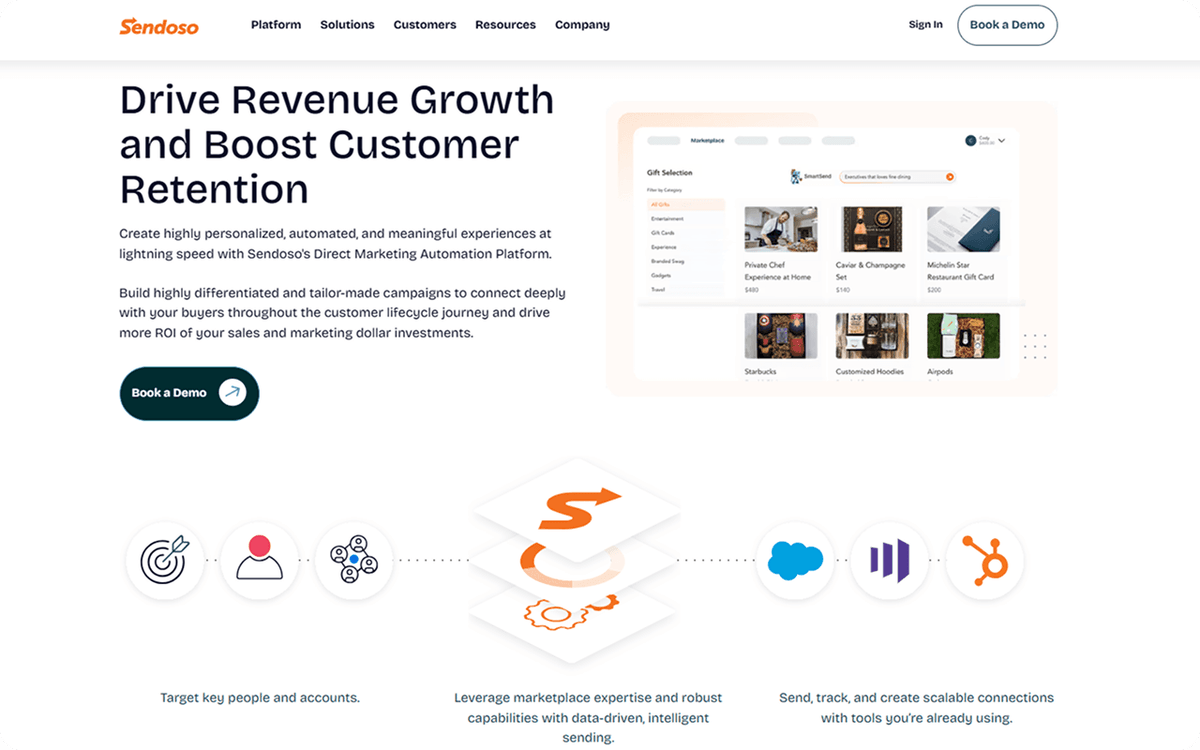
While most ecommerce tools focus on the inbox, Sendoso helps brands stand out by integrating physical touchpoints into the customer journey. By connecting to your marketing stack, you can automate the delivery of handwritten notes, branded swag, or local treats based on triggers like loyalty milestones or high-value orders.
What makes it stand out for e-commerce: The platform’s "SmartSend" AI and the new AI Agent, Oso, identify the most impactful gifts and the best times to send them. This data-driven approach ensures that every physical gesture effectively nurtures relationships, leading to significantly higher retention rates than digital-only campaigns.
Sendoso manages the entire logistics chain through its global fulfillment network, removing the burden of inventory management. You also get full visibility into ROI, tracking how physical sends correlate with increased sales and customer loyalty.
Pricing: Sendoso offers tiered plans, including flexible options for growing teams and advanced plans for enterprise operations. Costs include a platform fee plus the price of gifts and shipping.
Verdict: The premier choice for brands looking to humanize their marketing and build real-world connections. Learn more at Sendoso.
How to Choose the Right Email Marketing Tool for Your Store
The right tool depends on three things: your store's size, your team's technical comfort, and how many other tools you need your email platform to talk to.
If you are starting out (under 1,000 subscribers): MailerLite or Kit's free plans give you room to build your list and test automations without a monthly bill. Mailchimp's free plan works too, but the contact limit is tighter. If you are also setting up lead capture forms that feed into your CRM, pair your email tool with a form builder early so subscriber data flows cleanly from day one.
If you run a growing Shopify store: Klaviyo or Omnisend are the practical choices. Both pull store data natively and offer e-commerce-specific automation templates. Klaviyo goes deeper on predictive analytics; Omnisend is simpler to set up and costs less at the same contact tier.
If your team handles both marketing and sales: ActiveCampaign or HubSpot give you email plus CRM in one tool. ActiveCampaign is significantly cheaper and more accessible for small teams. HubSpot makes sense when you have a dedicated sales team that needs deal tracking alongside marketing automation.
If you have a large list but send infrequently: Brevo's volume-based pricing saves money compared to per-contact models. You store all your contacts for free and pay only when you send.
If you sell digital products or courses: Kit was built for exactly this scenario. The built-in commerce features and generous free plan make it the easiest entry point for creators.
Making Your Email Stack Work Together
None of these tools operate in isolation. Your email marketing platform needs to exchange data with your store, CRM, helpdesk, ad platforms, and analytics tools. Native integrations cover the most common connections, but every store eventually hits a scenario where two tools do not talk to each other directly.
That is where an integration platform fits in. Albato connects over 1,000 apps and lets you build automated workflows between your email tool and the rest of your stack without writing code. Need to push Klaviyo subscriber data into a CRM that Klaviyo does not natively support? Want to trigger a Drip email sequence when a payment processes in Stripe? Those connections take minutes to set up in Albato's visual builder.
Every tool in this ranking connects to Albato. The comparison table above shows the trigger and action counts for each, so you can evaluate how deeply each platform integrates before committing.
FAQ
Common questions online sellers ask when choosing an email marketing tool for their store.
What is the best email marketing software for Shopify stores?
Klaviyo is the most widely used email platform among Shopify merchants because it natively syncs every order, product view, and cart event without third-party plugins. Omnisend is a strong alternative if you want a simpler setup with multi-channel support (email, SMS, push) at a lower price point. Both platforms offer pre-built automation templates designed specifically for Shopify store workflows.
How much does email marketing software cost for e-commerce?
Entry-level plans range from free (MailerLite, Kit, Mailchimp) to $15-45/month for basic paid tiers. E-commerce-specific features like abandoned cart recovery, product recommendations, and revenue attribution typically require mid-tier plans in the $40-120/month range. Costs scale with your contact count or send volume. Brevo is the exception: it charges by email volume and allows unlimited contacts on every plan, making it cheaper for stores with large lists.
Can I connect my email marketing tool with my CRM?
Most email platforms offer native integrations with popular CRMs like HubSpot, Salesforce, and Pipedrive. For CRMs without a native connection, an integration platform like Albato bridges the gap. Albato supports all 10 tools in this ranking and connects them with over 1,000 apps, so you can sync subscriber data, purchase events, and engagement metrics between your email tool and CRM without writing API code. If your store also runs on conversational channels, the same approach extends to WhatsApp business automation for e-commerce, where order updates and abandoned cart reminders trigger automatically alongside your email flows.
Do I need a separate tool for transactional emails?
Not necessarily. Brevo, GetResponse, and HubSpot include transactional email engines alongside their marketing email features. Running both through the same platform simplifies sender reputation management and keeps all your email analytics in one dashboard. If your current tool does not support transactional emails, you can use Albato to trigger transactional messages from store events through a dedicated service like SendGrid or Mailgun. Email also works best when paired with scheduling software that feeds your sales pipeline, so booked demos and discovery calls land in your CRM the moment a recipient clicks through.
Which email marketing tool is cheapest for a store with a large list?
Brevo is usually the cheapest for large lists because it charges by email volume, not contact count. A store with 50,000 subscribers that sends two campaigns a month pays for the emails sent rather than the size of the list, so the Starter plan at $9/mo can cover it. Per-contact tools like Klaviyo or Mailchimp bill on your total contacts, which climbs fast past 10,000. MailerLite and Kit also offer generous free tiers if your list is under 500 and 10,000 respectively.
Keep building your e-commerce stack with these related guides.