In this article
Key Takeaways
- Storyblok and Prismic are the best headless CMS picks when marketers build pages. Both have visual editors, with paid plans from $90.75 a month (Storyblok Growth) and $10 a month (Prismic Starter), billed annually.
- Contentstack and Contentful suit enterprise marketing teams. Sanity, Strapi and Hygraph give product teams the most control, with Sanity Growth at $15 per seat and Strapi free to self-host.
- Flotiq is the only one of the eight with a native Albato connector. The other seven reach a CRM through webhooks and Albato's Incoming webhook trigger.
A headless CMS stores content and delivers it through an API to any website, app or channel, while a traditional CMS also renders the pages. Traditional systems still dominate: W3Techs counts WordPress on 39.5% of all websites in October 2026.
How we picked these headless CMS platforms
We selected eight headless CMS platforms that a marketing or product team can start on without a sales call. Each one had to publish self-serve pricing, offer a free plan or self-hosted edition, and send webhooks when content changes. Webhooks matter because they are how a CMS tells your CRM, email tool or Slack that something was published.
We grouped the platforms by who runs them day to day. Storyblok and Prismic are built for marketers who assemble pages from blocks in a visual editor. Contentstack and Contentful serve enterprise marketing teams with workflows and personalization. Sanity, Strapi and Hygraph give developers and product managers control of the content model and the API. Flotiq gets its own group because of how it connects to Albato.
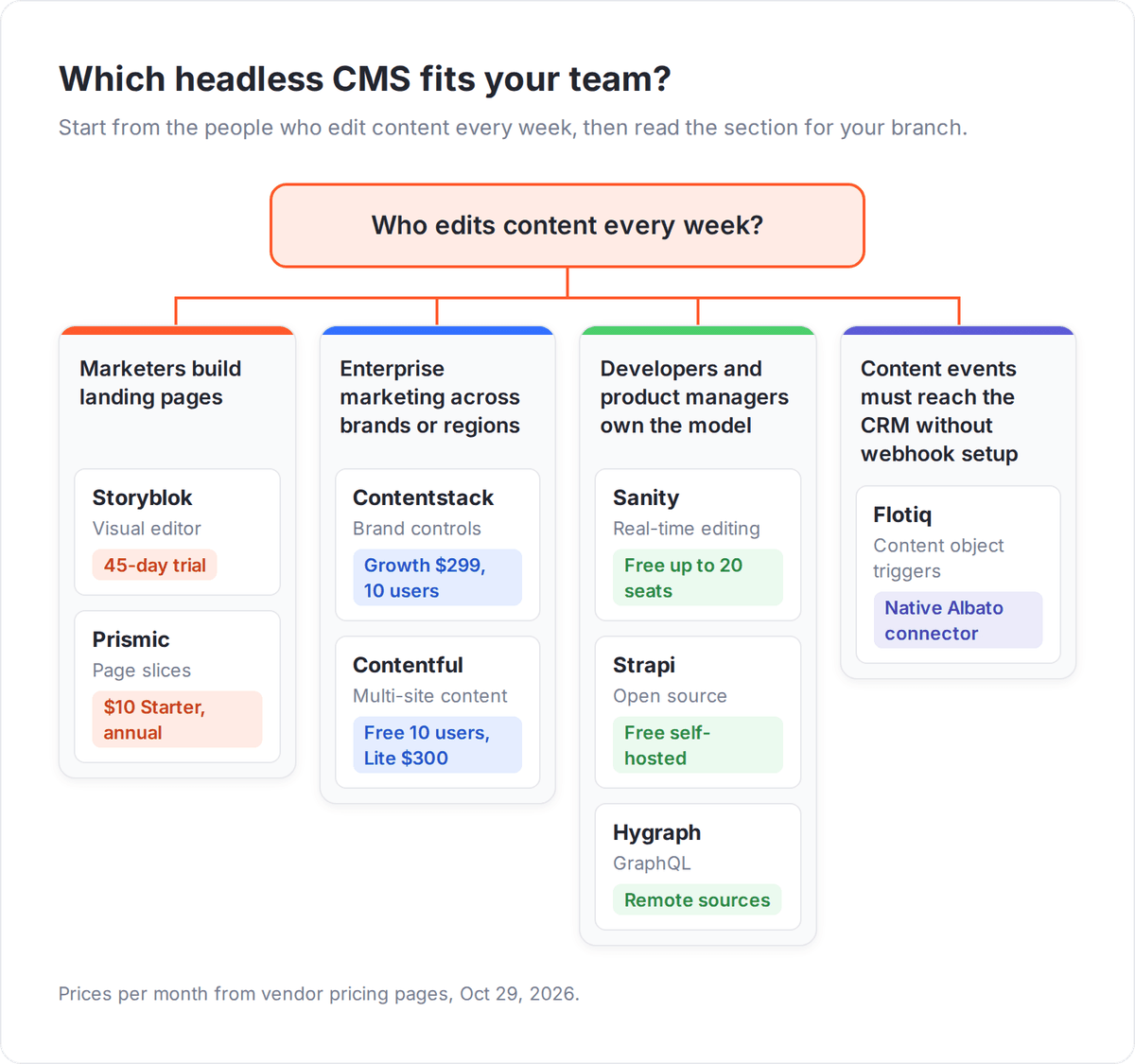
Prices come from each vendor's official pricing page as of October 29, 2026, and are per month.
Headless CMS platforms compared
The entry paid plan is each vendor's cheapest paid tier, and every platform also has a free plan or a free self-hosted edition.
| Platform | Who runs it day to day | Best for | Entry paid plan | Free option | Albato route |
|---|---|---|---|---|---|
| Storyblok | Marketers in a visual editor | Marketing sites built from components | Growth $90.75/mo billed annually ($99 monthly), 5 seats | Free Starter (1 seat), 45-day trial | Webhooks |
| Prismic | Marketers working with page slices | Small teams launching landing pages | Starter $10/mo billed annually, 3 users | Free (1 user) | Webhooks |
| Contentstack | Enterprise marketing teams | Brand-governed content with AI agents | Build $29/mo, 3 users; Growth $299/mo, 10 users | Free (3 users) | Webhooks |
| Contentful | Enterprise marketing and product teams | Large multi-site content operations | Lite $300/mo, 20 users | Free (10 users) | Webhooks |
| Sanity | Product and developer teams | Custom content models with real-time editing | Growth $15/seat/mo | Free (up to 20 seats) | GROQ-powered webhooks |
| Strapi | Developers who self-host | Open-source code and own infrastructure | Cloud Starter $35/project/mo billed monthly | Free self-hosted (MIT license) | Webhooks |
| Hygraph | Product teams on GraphQL | Combining content with data from other APIs | Growth $199/mo billed annually ($299 monthly), 10 seats | Free Hobby (3 seats) | Webhooks |
| Flotiq | Small teams wiring content to sales and marketing | Content events in the CRM without webhook setup | Basic $37/mo billed yearly, 3 members | Free (2 members) | Native connector |
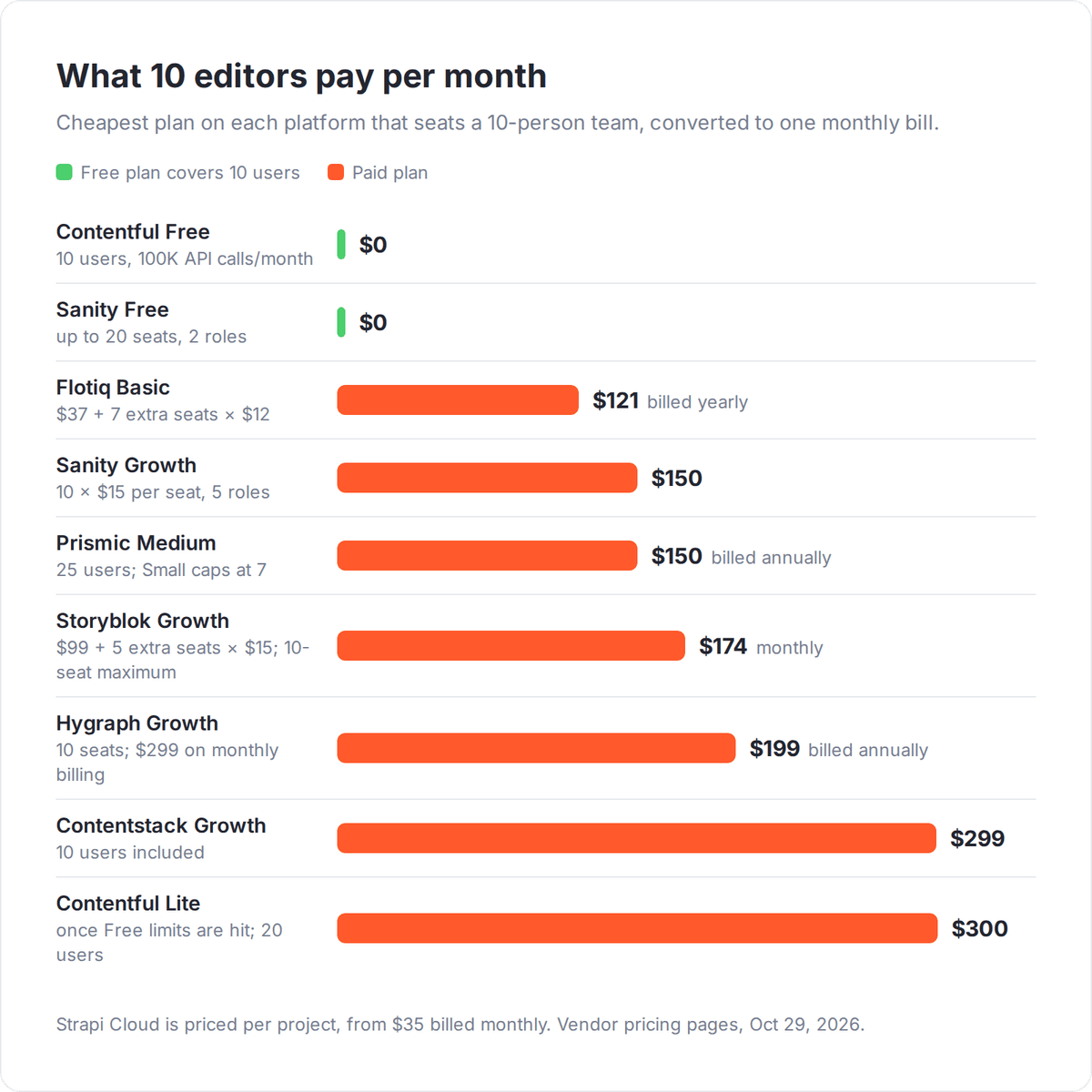
Pricing models differ more than headline prices suggest. Sanity charges per seat, while Storyblok, Contentstack Growth and Flotiq include a set number of seats and charge for each extra one. Contentful and Hygraph sell plans with a fixed number of users. Strapi Cloud charges per project, and Prismic charges per repository with a user cap on each tier.
Which headless CMS is best when marketers build the pages?
Storyblok and Prismic are the best headless CMS platforms for teams where marketers build pages themselves. Both let editors assemble pages from developer-made components and preview them before publishing. Developers set up the components once, and marketing launches new landing pages without filing a ticket.
Storyblok: visual editing with a 45-day trial
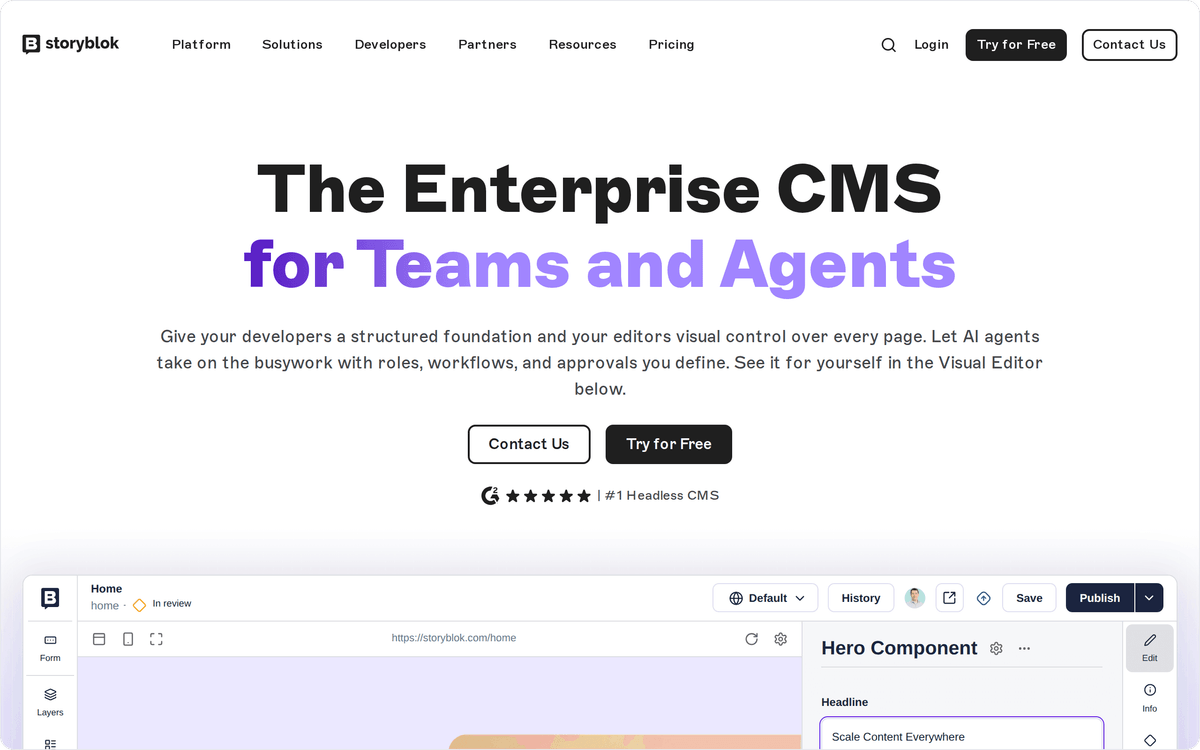
Storyblok is built around its Visual Editor, where an editor clicks a block on a live preview of the page to open it in the editor and sees each change in real time. Paid self-serve plans add SEO meta tags, single story scheduling and integrations like Shopify. The custom Premium and Elite plans add native A/B testing and AI SEO.
Storyblok webhooks fire on workflow events as well as story, asset and release events. A story that reaches a review stage can post to the Incoming webhook trigger in Albato's Webhooks app, which then messages the reviewer in Slack.
Starter is free for 1 seat (up to 2) and 100k API requests a month. Growth costs $99 a month, or $90.75 billed annually. It includes 5 seats, takes up to 10 at $15 per extra seat and allows 1M API requests. Growth Plus costs $349 a month, or $319.91 billed annually, with 15 seats and 10 locales.
💡 Tip
Storyblok's 45-day free trial runs on Growth Plus. If you plan to buy Growth, test with the 2 locales Growth includes, because extra locales on Growth are paid add-ons.
Prismic: page slices at the lowest entry price
Prismic gives marketers reusable page sections called slices, which developers build once and editors combine into new pages in the Visual Page Builder. Every plan, including Free, has unlimited documents, types and assets, so Prismic limits teams by users and locales rather than by content volume.
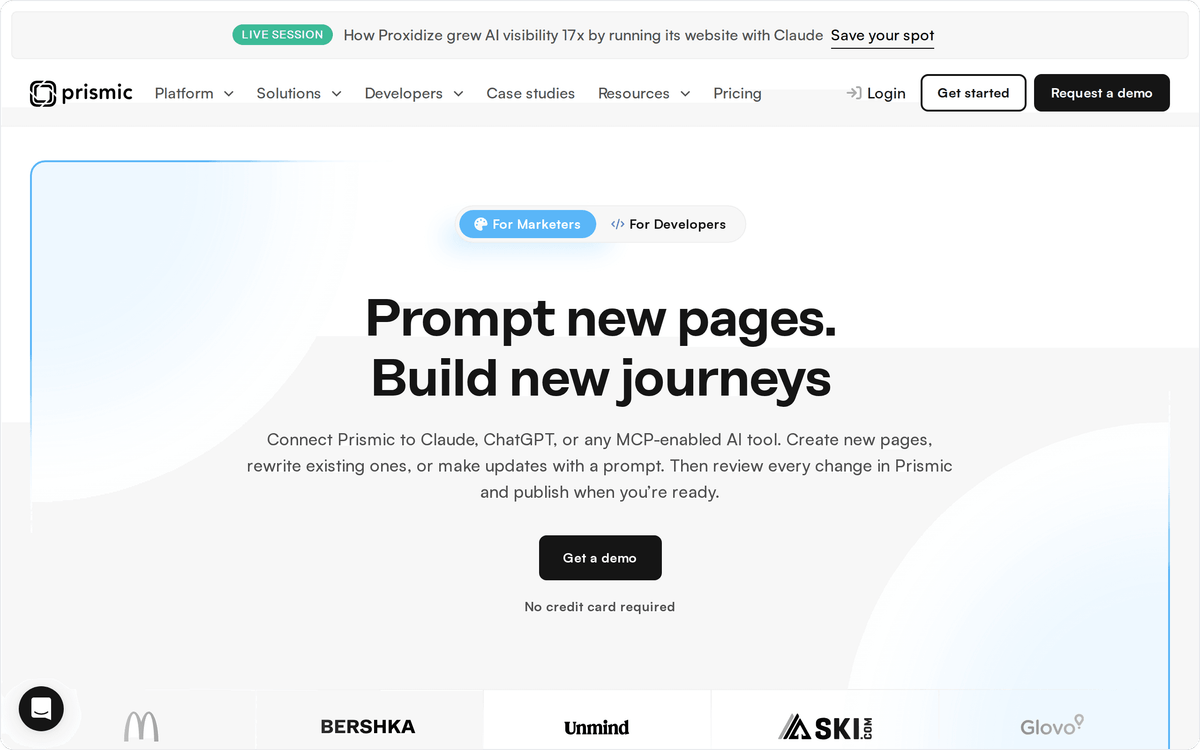
Prismic sends a webhook when a page is published or edited. Through Albato's Incoming webhook trigger, each published landing page can add a row to a Google Sheets launch tracker. The same tracker can feed a content refresh workflow that flags pages due for an update.
Prismic prices each repository and bills annually. Starter costs $10 a month for 3 users, Small $25 for 7 users, Medium $150 for 25 users with user roles, and Platinum $675 for unlimited users. The Free plan covers 1 user and 2 locales and includes 4 million API calls a month with no overages.
Which headless CMS suits enterprise marketing teams?
Contentstack and Contentful are the strongest headless CMS choices for enterprise marketing teams that run many sites, brands or regions. Both add workflows, roles and personalization on top of the content model. Both also have free plans, so a team can model its content before the first sales call.
Contentstack: AI agents and brand controls on every tier
Contentstack includes Agent OS, its AI agents for content operations, and Brand Kit, its brand-aware AI, in every tier, Free included. The Visual Editor also comes with the headless CMS from the Free plan. On top of the CMS, Contentstack sells a Data Cloud for adaptive experiences, and its product line includes the Lytics customer data platform and Personalization.
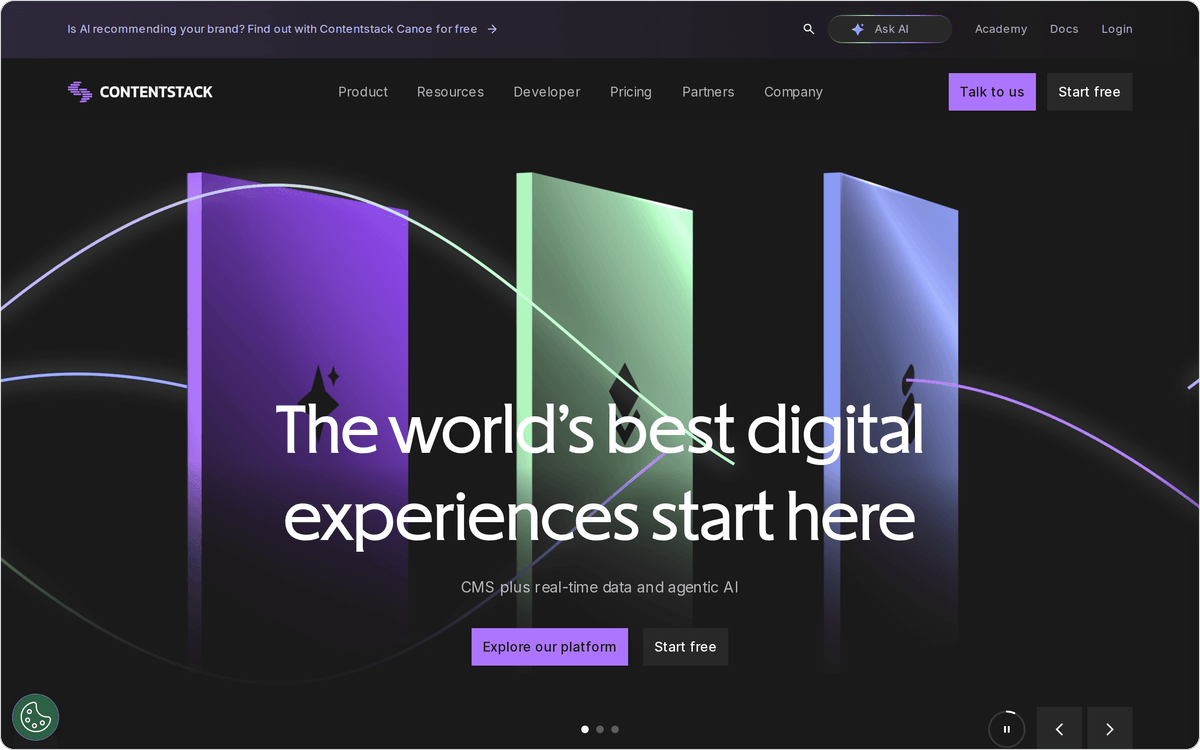
Contentstack webhooks send real-time HTTP callbacks to third-party apps. An entry publish event can reach Albato's Incoming webhook trigger and notify the campaign owner in Slack.
The Free plan costs $0, needs no credit card and covers 3 users, 100K API calls a month and 10 content types. Build costs $29 a month and adds a custom domain and 250K API calls, but it keeps the 3-user limit. The next step for a larger team is Growth at $299 a month, with 10 users included, $25 per extra user, 1M API calls, custom workflows and 2 custom roles.
Contentful: a 10-user free plan, then a $300 step
Contentful's Free plan seats 10 users, the second-largest hosted free plan in this list after Sanity's 20 seats, so a full marketing team can test structured content before buying. Enterprise adds unlimited API calls, up to a 99.99% uptime SLA and compatibility with Contentful Personalization, Studio and AI Actions. Personalization is sold separately through sales, starting with 100K monthly active profiles and unlimited A/B tests.
Contentful sends webhooks on events such as publish and unpublish. Through Albato's Incoming webhook trigger, an unpublished entry can create a HubSpot task with the entry ID, so the page owner can update the links and campaigns that pointed to it.
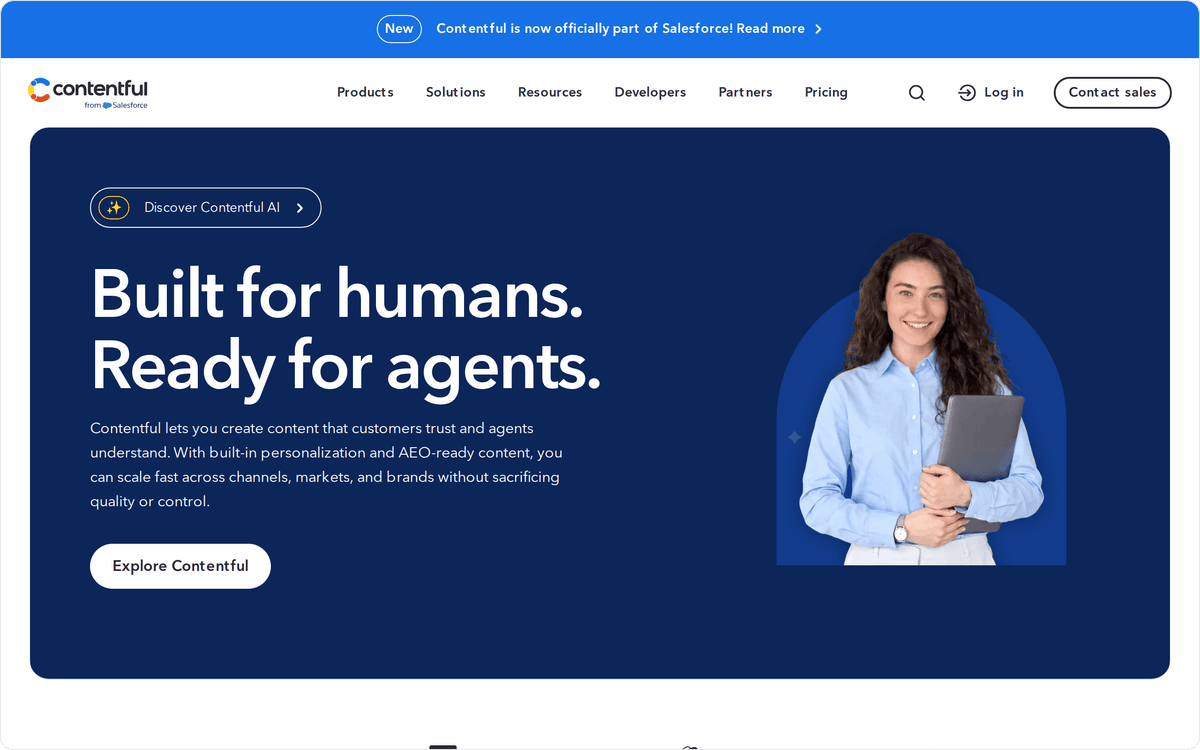
Lite costs $300 a month for 20 users, 3 locales and 1M API calls, with scheduled publishing, comments, task management and live collaboration. The Free plan stops at 2 roles, 2 locales and 100K API calls a month.
⚠️ Important
Contentful has no self-serve plan between Free and Lite. A team that outgrows 100K API calls a month or needs a third locale moves straight to $300 a month.
Which headless CMS gives product teams the most control?
Sanity, Strapi and Hygraph give product teams the most control over the content model and the API. Developers define content types in code or schema, choose how content is queried and decide where it is delivered. That suits apps, documentation and product catalogs as well as marketing sites.
Sanity: real-time editing priced per seat
Sanity stores content in a hosted real-time database and lets developers configure Sanity Studio, the editing app, which Sanity hosts for free on every plan. Editors get live previews and visual editing on the Free plan, and developers query content with GROQ or GraphQL.
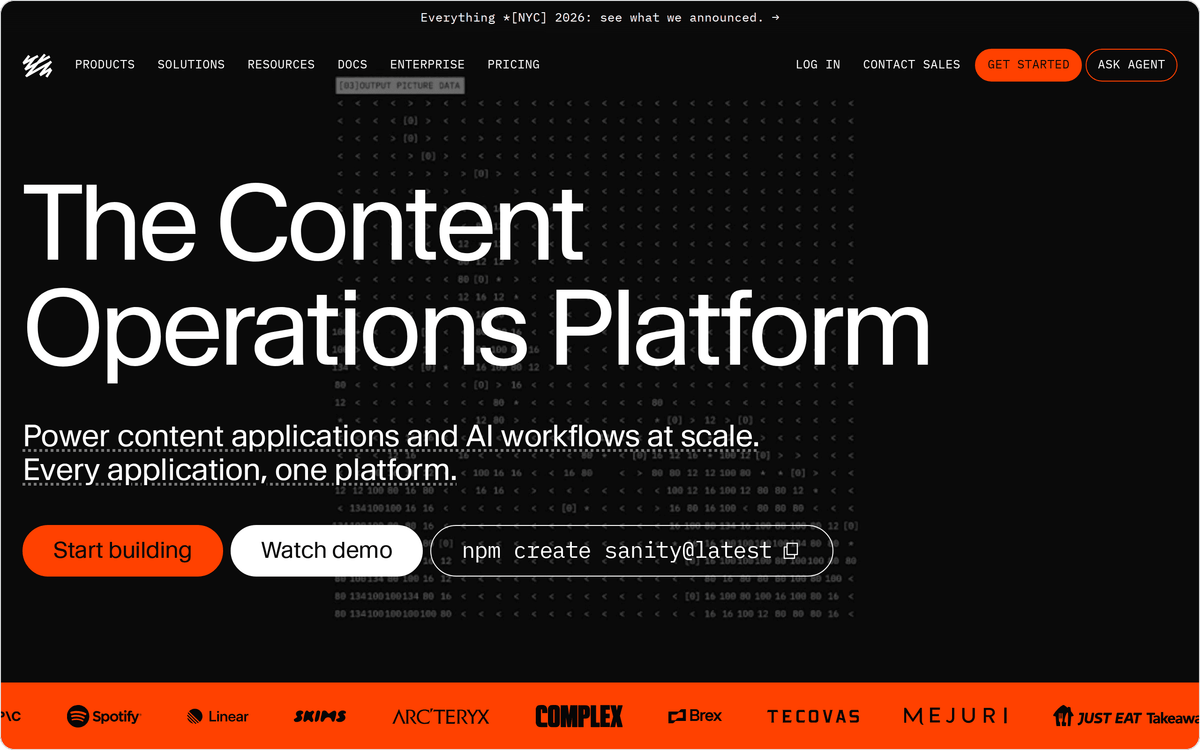
Sanity includes 2 GROQ-powered webhooks on Free and 4 on Growth. Each one can feed a separate Albato scenario through the Incoming webhook trigger. One can add new product pages to a Google Sheets catalog while another posts new blog posts to Slack.
Growth costs $15 per seat a month for up to 50 seats, with 5 roles, private datasets, comments, tasks, scheduled drafts and AI Assist. The Free plan covers up to 20 seats, 2 roles and 10k documents. Add-ons on Growth include an increased quota for $299 a month and dedicated support for $799 a month.
Strapi: open source and free to self-host
Strapi is an open-source headless CMS under the MIT license, so a team can install it on its own servers for free and change the code. It suits product teams that already have developers and hosting, and it keeps content data in your own infrastructure.
Strapi works with Albato in both directions. Strapi webhooks notify Albato's Incoming webhook trigger when content changes. The Send request action of Albato's HTTP Request app can create entries through Strapi's API, so a product update from another system can arrive as a new entry.
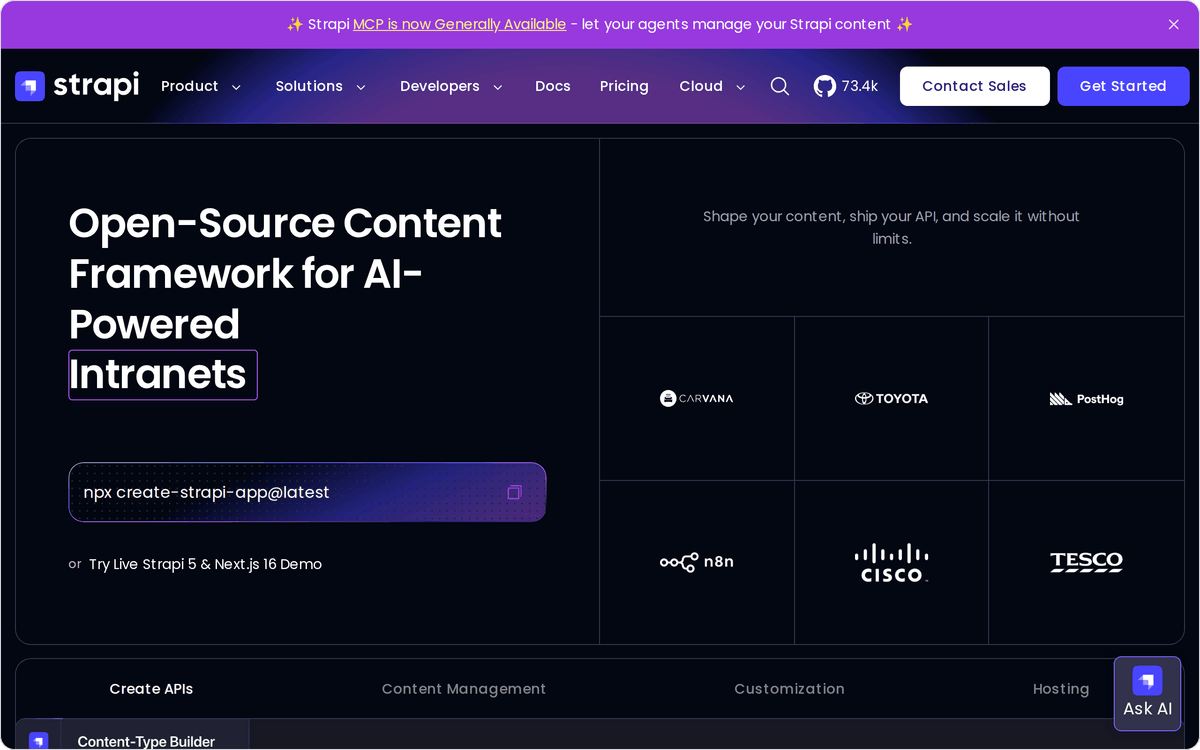
The self-hosted Community edition is free. On monthly billing, Strapi Cloud Starter costs $35 per project a month with 100k API requests. Pro costs $90 with 1M requests and weekly backups, and Business $450 with 10M requests, daily backups and a 99.9% uptime SLA. Yearly billing lowers each of these prices.
⚠️ Important
a Strapi Cloud Starter project sleeps when idle, so the first visit after a quiet period loads slower. Pro is the first Cloud plan that stays always on.
Hygraph: GraphQL and content from other APIs
Hygraph is a headless CMS that serves content through a GraphQL API and can pull data from other APIs into the same content graph through remote sources. One query can then return editorial content together with data from a product or pricing system.
Hygraph includes 5 webhooks on Hobby and 10 on Growth. A product team can send each published release note to Albato's Incoming webhook trigger and post it to the support team's Slack channel.
Hobby is free for 3 seats, 2 locales, 1,000 entries and 500,000 API calls. Growth costs $199 a month billed annually, or $299 billed monthly, with 10 seats, 3 locales, 10,000 entries, 1 remote source and 14-day version retention. More remote sources, scheduled publishing and SSO are on Enterprise.
Which headless CMS connects to Albato natively?
Flotiq is the only headless CMS of the eight with a native Albato connector, so a marketing team can send content events to a CRM or email tool without configuring webhooks. Its Free plan covers 2 team members, 1,000 objects and 20 object types, which suits a team that wants content events in the CRM before it needs a large content model.
Flotiq: native Albato triggers for content objects
Flotiq organizes content as typed content objects and serves them through an API, with scoped API keys on paid plans. Paid plans also raise the limits on add-ons: Basic includes 20 webhooks and 5 official plugins, and Growth 50 webhooks and 10 plugins.
In Albato, Flotiq has three triggers, Content object created, Updated content object and Deleted content object, and two actions, Create new content object and Custom API request. A new case study entry can create a HubSpot task for the sales team, and a form submission can become a Flotiq content object for review. Albato's help center explains how to connect Flotiq to Albato.
Basic costs $37 a month billed yearly for 3 team members, 10k objects and 300k API calls. Growth costs $114 a month billed yearly for 6 members and 100k objects. Extra seats cost $12 each, and both paid plans start with a 14-day trial without a credit card.
Which content events should reach your CRM and marketing stack?
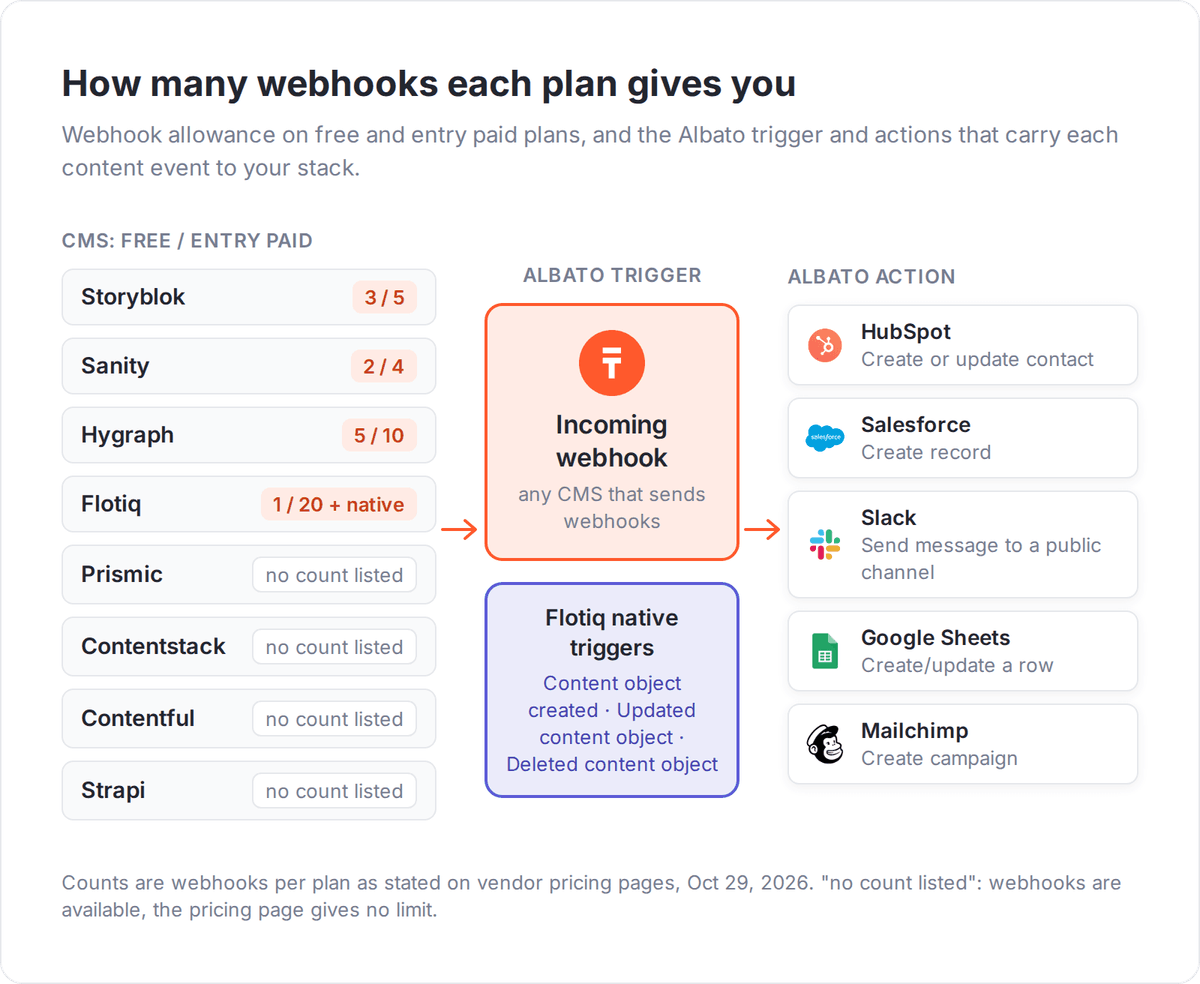
Publish and update events are the ones worth sending to a CRM, because they tell sales, social and email teams that new content exists. A headless CMS sends them as webhooks to an automation platform, which maps the content fields to CRM, email or chat actions. In Albato, that route starts with the Incoming webhook trigger for seven of the eight platforms here and with native triggers for Flotiq.
🔧 How it works
A webhook pushes a content change to Albato at the moment it happens, while an API request pulls or writes data when a scenario runs. Albato's Incoming webhook trigger handles the first, and the Send request action of the HTTP Request app handles the second, for example to write a draft entry back into the CMS.
Depending on the platform, the webhook carries the entry's fields, such as title and slug, or only its ID. With an ID, the Send request action can fetch the full entry through the CMS API. Albato maps those fields to actions in HubSpot, Salesforce, Slack or Google Sheets, for example Create or update contact in HubSpot or Create/update a row in Google Sheets.
Which flows are worth building first?
Three flows make a good first set:
- Publish alert. A published Contentful or Storyblok entry posts its title and slug to the campaign's Slack channel, so sales and social teams can share the page the same day. It needs only one webhook and one Slack action.
- Case study to sales. A new case study in Flotiq or Sanity creates a HubSpot task for the account owner, so sales can use the story in open deals.
- Newsletter draft. A published blog post in Strapi creates a draft campaign in Mailchimp with the title and link, ready for an editor to review.
Teams that publish to many channels can also combine AI and automation to adapt each post for LinkedIn and email.
Which headless CMS should your team test first?
Marketers who build pages should start the Storyblok trial and compare it with Prismic's $10 Starter. Enterprise marketing teams that need workflows and personalization can put Contentstack Growth at $299 next to Contentful Lite at $300, after checking whether either free plan fits the content model.
Product teams with developers should test Sanity's free plan for 20 seats and Strapi's self-hosted edition. Hygraph belongs on the shortlist if content has to combine data from other APIs. If getting content events into a CRM without webhook setup is the priority, Flotiq's free plan comes with the native Albato connector.
A landing-page rebuild on two shortlisted platforms shows which one needs fewer developer hours before marketing publishes on its own.
FAQ
What is the best headless CMS?
Storyblok is the best headless CMS for marketers who build pages visually, with paid plans from $90.75 a month billed annually. Sanity is the best for product teams, at $15 per seat a month on Growth with a free plan for up to 20 seats. Contentstack and Contentful lead for enterprise marketing teams.
Is there a free headless CMS?
Yes. Seven of the eight platforms have a free hosted plan, and Strapi's Community edition is open source and free to self-host. Sanity's free plan seats up to 20 users and Contentful's 10, while Prismic, Storyblok, Contentstack, Hygraph and Flotiq cap their free plans at 1 to 3 users.
What is the difference between a headless CMS and a traditional CMS?
A traditional CMS such as WordPress stores content and renders the website pages in one system. A headless CMS stores and structures content and delivers it through an API, so developers build the front end separately and reuse the same content on websites, apps and other channels.
How much does a headless CMS cost?
Paid entry plans in this list run from $10 a month for Prismic Starter to $300 a month for Contentful Lite. Sanity charges $15 per seat and Contentstack Build costs $29. Strapi Cloud starts at $35 per project billed monthly, Flotiq Basic at $37 billed yearly, Storyblok Growth at $90.75 billed annually and Hygraph Growth at $199 billed annually. Upper tiers cost more, such as Strapi Cloud Business at $450 billed monthly and Prismic Platinum at $675, and enterprise plans are custom.
Can a headless CMS connect to HubSpot or Salesforce?
Yes. Flotiq connects to Albato natively, and Contentful, Sanity, Contentstack, Storyblok, Strapi, Hygraph and Prismic send webhooks that Albato's Incoming webhook trigger receives. Albato then creates or updates contacts in HubSpot, records in Salesforce or rows in Google Sheets from the content fields.