In this article
AI agent security for SaaS is the set of controls that decide what an autonomous agent can touch, which secrets it can see, and how each action gets recorded. Picture an agent that just updated the wrong customer's billing record because a document it read told it to. The core rule that prevents this is simple: an agent that acts on a user's HubSpot, Stripe, or Salesforce data should never hold the raw token for those accounts, and every call it makes should be scoped and logged. Get that wrong and one prompt injection turns your helpful agent into a data-exfiltration tool.
This is the technical layer underneath the broader embedded iPaaS security checklist that SaaS buyers evaluate. That guide covered what to ask a vendor. This one goes deeper into the mechanics: how a credential proxy keeps tokens away from the model, how to scope tool permissions per agent, why per-action audit logs matter for compliance, and when to run the whole thing on-prem with a local model. If you are adding AI agents that act to your product, this is the security work that has to ship alongside them.
Key takeaways:
- An agent should operate on a credential ID, not a raw token. Albato's Secure Credential Proxy keeps API keys and access tokens out of the LLM entirely, and executes every request through a managed proxy.
- Granular tool permissions limit each agent to specific apps and endpoints, and every action is logged for full auditability.
- On-prem deployment with a local or self-hosted model lets you keep agent data inside your own environment to meet data residency rules.
- Albato is SOC 2 Type 2 certified and GDPR compliant, with AES-256 encryption at rest and TLS in transit.
What is AI agent security for SaaS
AI agent security for SaaS is the practice of controlling the credentials, permissions, and deployment of autonomous AI agents that read and write data across a user's connected apps. It matters because an agent, unlike a chatbot, takes actions: it updates CRM records, sends messages, moves money, and touches production systems on the user's behalf. It differs from ordinary API security because the agent decides at runtime which tools to call, so the guardrails have to sit around the tools themselves, not just the network edge.
Three questions define whether an agentic feature is safe to embed in your product. Can the agent see raw secrets, or only a reference to them? Is each agent limited to the exact actions it needs, or can it call anything? And can you prove, after the fact, what every agent did and when? A production-grade setup answers all three with a credential proxy, scoped permissions, and per-action logging. The rest of this guide walks through each one.
Albato Embedded is a white-label embedded iPaaS that lets SaaS companies add 1,000+ native integrations and a production-ready agentic layer to their product without building the security plumbing from scratch. The controls below ship with it.
How a secure credential proxy keeps tokens away from the LLM
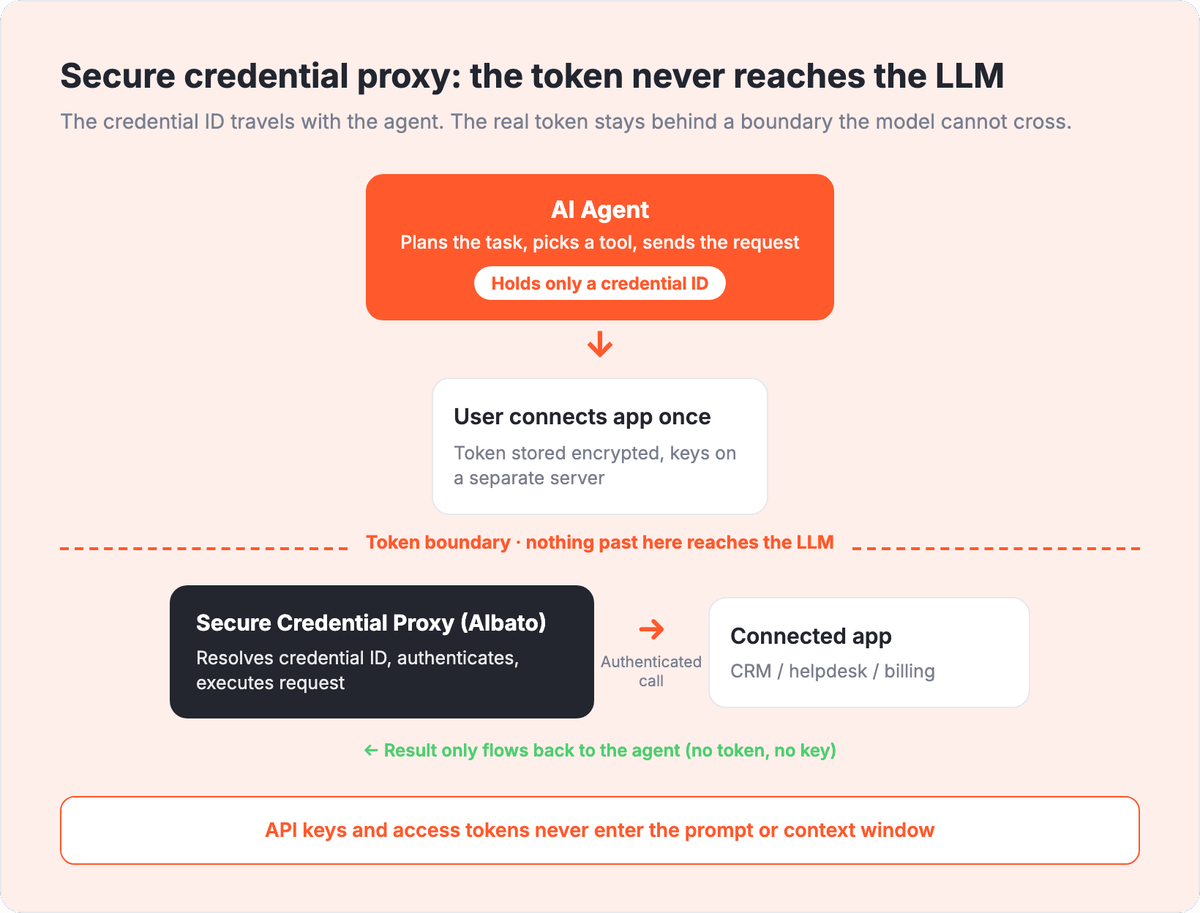
Of every control in AI agent security, a secure credential proxy does the most, because it removes the model from the blast radius of a leaked secret. The pattern: the agent never receives an API key or access token. It works with a credential ID, a reference that points to the real secret stored elsewhere. When the agent decides to call an app, it hands the credential ID and the intended action to the proxy, and the proxy performs the authenticated request.
Here is the flow in Albato's Secure Credential Proxy. The user connects an app once, and the token is stored encrypted, with decryption keys held on a separate secure server. The agent plans a task and picks a tool, say "create a deal in the CRM." It passes the credential ID, not the token, to Albato. Albato resolves that ID inside the managed proxy, authenticates against the app, executes the request, and returns only the result to the agent. The raw token never enters the prompt, the model's context window, or any log the model can read.
Why this matters for your product: large language models are probabilistic and susceptible to prompt injection. If a malicious instruction hides inside a document the agent reads, and the agent holds a live Salesforce token in its context, that token can be coaxed out. With a credential proxy, there is nothing to coax out. The worst an injected prompt can do is request an action, and that request still runs through your scoped permissions and audit trail. This is the same principle behind Albato's MCP layer, where agents reach 1,000+ apps through one standardized endpoint instead of juggling individual API credentials.
Granular tool permissions: scope what an agent can call
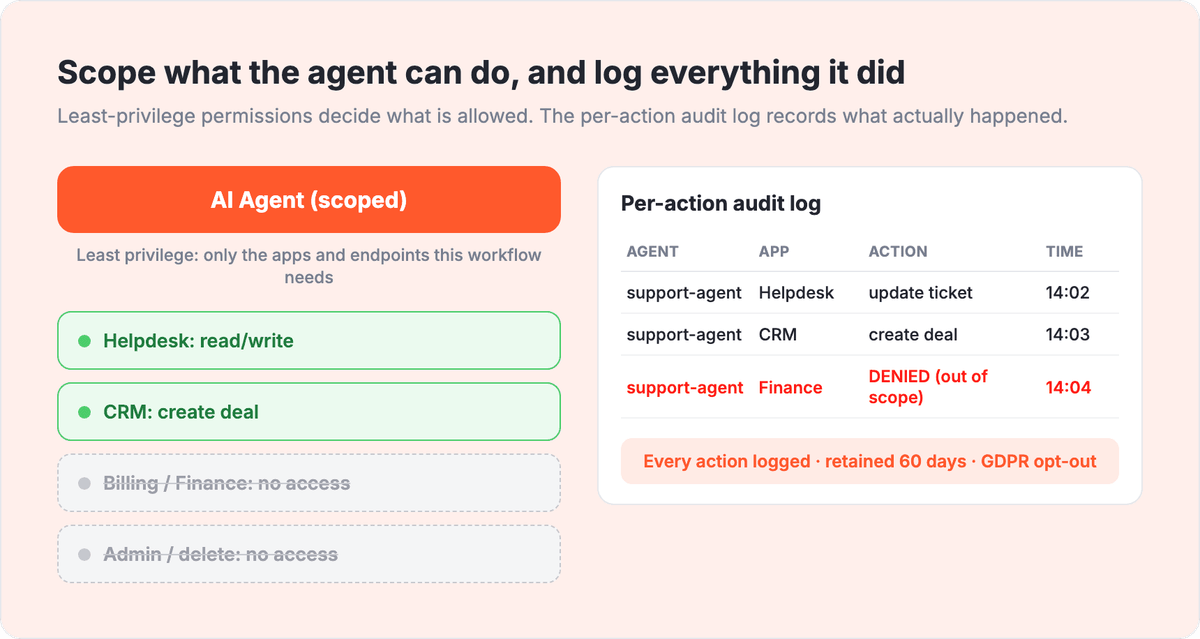
Granular tool permissions decide the set of apps, endpoints, and actions a given agent is allowed to touch. The default should be least privilege: an agent gets exactly the tools its job requires and nothing more. A meeting-notes agent that turns a Zoom transcript into project tasks needs write access to one PM tool. It has no business calling your billing system, and a well-scoped agent literally cannot.
With Albato, you grant each AI agent explicit permissions to call specific apps and endpoints. That scoping is where a lot of real-world risk gets contained. Consider three common failure modes and how permission scope handles them:
- Over-broad access: an agent built for support triage is also wired to the finance stack. Scope it down to the helpdesk and CRM only, and a compromised prompt can't reach finance.
- Silent scope creep: someone reuses an existing agent for a new workflow and it quietly inherits old permissions. Explicit per-agent grants force a review each time.
- Unbounded write actions: an agent that can update records can also mass-update or delete them. Limit it to the specific endpoints the workflow needs.
Permissions answer "what can this agent do." Audit logs answer "what did it actually do." Every agent action in Albato is logged, which turns an abstract permission model into something you can inspect. That combination of scope plus record is what a technical buyer in an embedded iPaaS security review actually wants to see.
Per-action audit logs and why compliance needs them
Per-action audit logging records every call an agent makes: which agent, which app, which action, and when. This is not optional polish. For SOC 2, GDPR, and most enterprise procurement reviews, "we can't tell you what the agent did" is a failed answer. An audit trail is how you investigate an incident, satisfy a data subject request, and prove to a customer's security team that agent behavior is observable.
Albato logs every agent action and retains automation logs for 60 days, with a GDPR opt-out available. Underneath, the platform runs on AES-256 encryption at rest and TLS in transit, on AWS multi-zone infrastructure, and is SOC 2 Type 2 certified with independent penetration testing. For an embedded product, that means the compliance posture your customers ask about is inherited from the platform rather than rebuilt by your team.
The practical payoff shows up in enterprise deals. When a prospect's security reviewer asks how you contain an agent that misbehaves, you can point to three concrete things: the agent never held the credential, its permissions were scoped to a named set of endpoints, and every action it took is in a log you can produce. That is a far stronger position than "the model is usually well-behaved."
If you want to see how these controls fit together in a live embedded setup, a walkthrough is the fastest way.
On-prem and local-model deployment for data residency
On-prem deployment runs the agent runtime and its model inside your own environment, so agent data never leaves infrastructure you control. This is the answer to data residency and strict compliance requirements, common in healthcare, finance, the public sector, and any customer bound by regional data rules. A cloud-only agent that ships user data to a third-party model endpoint is a non-starter for those buyers.
Albato Embedded supports deploying AI agents on-prem and running them on your own local or self-hosted large language models. That covers the two hard requirements security teams raise: keep the data in-region, and keep the model under our roof. Because the agents are also model-agnostic, you can assign a different LLM per workflow, OpenAI, Anthropic, Gemini, your own model, or Albato AI built in, and match each step to its cost, quality, and compliance needs. Albato AI is Albato's own built-in model; the underlying engine is proprietary and not disclosed.
Not every workflow needs on-prem. The point is that the choice sits with you and your customer, not with the platform. Here is how the two deployment options compare on the criteria security teams actually weigh:
| Criterion | Cloud deployment | On-prem / local model |
|---|---|---|
| Where data lives | Albato-managed cloud (AWS, multi-zone) | Your own environment |
| Model options | OpenAI, Anthropic, Gemini, own, or Albato AI | Your local or self-hosted LLM |
| Data residency control | Region-managed by Albato | Full, in your infrastructure |
| Best fit | Most SaaS teams and standard workflows | Regulated industries, strict residency rules |
Human-in-the-loop gating for high-impact actions
Human-in-the-loop gating routes an agent's high-impact decisions to a person for approval before the action runs. Some actions carry real consequences: issuing a refund, deleting records, sending an executive-facing email. For those, "the agent decided" is not enough. A human checkpoint keeps the automation fast for routine work while putting a person in front of the actions that would hurt if they went wrong.
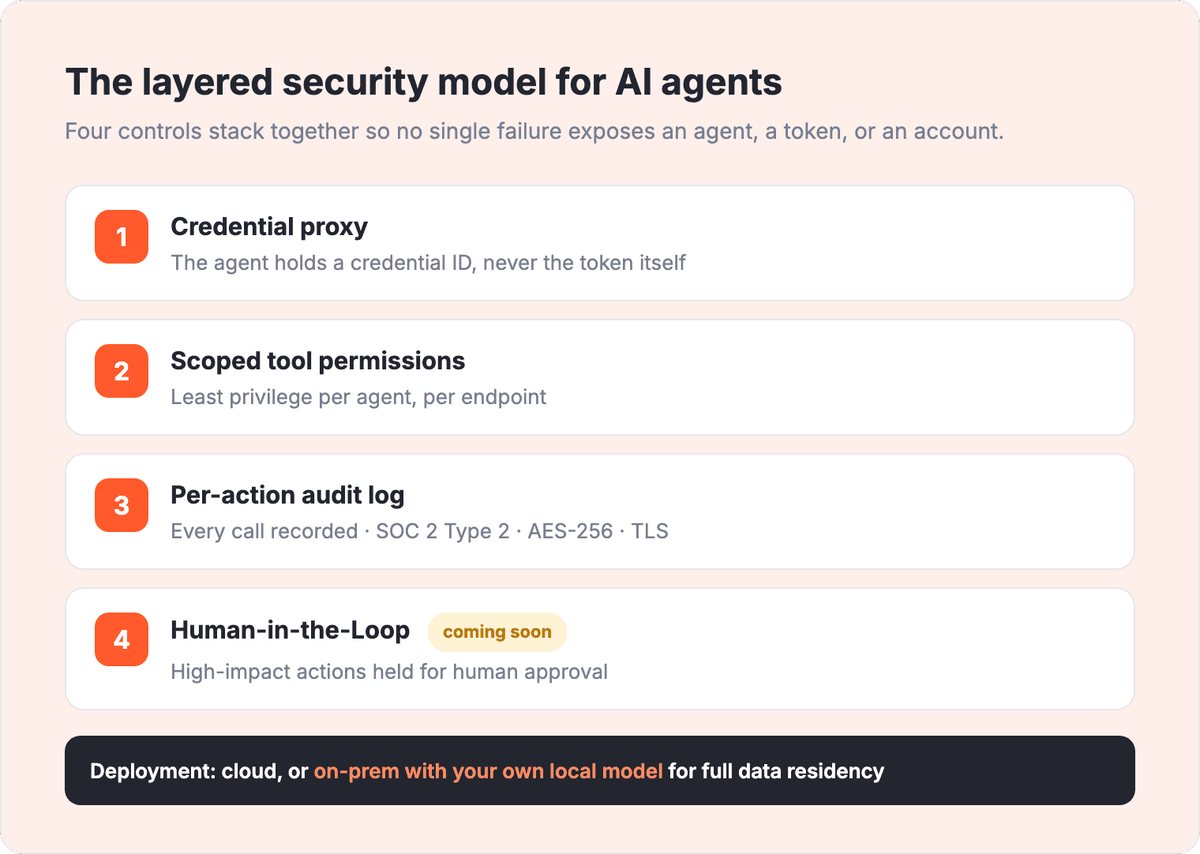
In Albato Embedded, Human-in-the-Loop is on the roadmap and marked as coming soon. The planned behavior: route selected agent actions to a reviewer in Slack or email for approval, without interrupting the rest of the workflow. A related capability, Grounded Decisions, is also coming soon; it will let an agent query a knowledge base or trusted external sources to gather current context before it acts. We flag both as not yet shipped so you can plan around what exists today versus what is coming.
Even before that ships, the two controls already in production, the credential proxy and scoped permissions, do most of the heavy lifting. Human review adds a final gate on the small set of actions where the cost of a mistake is high. Together they give you a layered model: limit what the agent can reach, keep secrets out of the model, log everything, and hold the riskiest actions for a human.
When Albato Embedded is the right choice for secure agents
Albato Embedded fits when you want to ship white-label AI agents that act across your users' tools, and you need the security controls to be production-grade on day one rather than a later project. That is the common case for a SaaS team whose customers already ask about SOC 2, data residency, and audit trails before they will turn an agent loose on their data.
It is a strong fit if you are building agentic features across many apps: the same runtime reaches 1,000+ connected applications for sales, support, HR, marketing, and finance, so one security model covers every department instead of a new integration project per use case. It is also the right call when you would otherwise spend months building a credential vault, a permission system, and an audit pipeline in-house. Those are exactly the pieces that come built in.
There is a monetization angle too. Most software vendors now either charge separately for AI features or reserve them for premium tiers rather than giving them away in the base plan. Secure, embedded agents are the kind of feature you can put in a higher plan, which turns the security work into a revenue driver rather than a cost center. For the full build-versus-buy picture, see the white-label AI integration layer guide.
Frequently asked questions
What is AI agent security for SaaS?
It is the set of controls governing what an autonomous AI agent can access, which credentials it can use, and how its actions are recorded. In practice that means keeping raw tokens away from the model, scoping each agent to specific apps and endpoints, logging every action, and choosing where the agent and its model run.
How does a secure credential proxy work?
The agent never receives an API key or access token. It works with a credential ID that points to the real secret stored encrypted elsewhere. When the agent calls an app, it passes the credential ID to a managed proxy, which resolves it, authenticates, executes the request, and returns only the result. The token never enters the model's context, so a prompt injection has nothing to steal.
Can I control what an AI agent is allowed to do?
Yes. With Albato Embedded you grant each agent explicit permissions to call specific apps, endpoints, and actions, following least privilege. Every action the agent takes is logged, so you get both a permission boundary and a full audit trail.
Can AI agents run on-prem or on our own model?
Yes. Albato Embedded supports on-prem deployment and self-hosted or local LLMs, so agent data stays inside your environment for data residency and compliance. Agents are also model-agnostic, letting you pick a different LLM per workflow.
Does Albato hold my users' credentials safely?
Credentials are stored encrypted, with decryption keys on a separate secure server, and the raw values never reach the LLM. Albato is SOC 2 Type 2 certified and GDPR compliant, with AES-256 encryption at rest and TLS in transit.
Ship agents your customers can trust
Autonomous agents are moving from demo to default in SaaS, and the products that win the enterprise deals will be the ones that can answer the security questions without flinching. The mechanics are not mysterious: keep secrets in a credential proxy, scope every agent to least privilege, log each action, and let customers run the whole thing on their own infrastructure when they need to. What is hard is building all of that yourself while also shipping the rest of your product.
Albato Embedded gives you a white-label agentic layer with those controls already in place, running on a platform that serves 250,000+ users and processes 250M+ transactions a month. You embed it once, choose your models, define permissions, and your users get agents that act across 1,000+ apps under your brand. The security posture comes along for the ride.
See how the Embedded agentic layer works and what it takes to ship secure agents your customers trust.