In this article
When you embed a third-party integration platform inside your product, its security becomes your security. Your users connect their CRM, their payment processor, their support inbox through a vendor most of them will never see. If that vendor mishandles a token, the breach lands on your brand, not theirs. So the security review of an embedded iPaaS matters as much as its connector count, and it should happen before the contract, not after the incident.
This guide gives SaaS buyers a concrete checklist for evaluating embedded iPaaS security: how credentials are isolated, which certifications actually mean something, how data flows through the platform, and what changes once AI agents start acting on your users' data.
What embedded iPaaS security means
Embedded iPaaS security is the set of controls that protect user credentials, data, and actions when a SaaS company embeds a third-party integration platform inside its own product. It covers how connection tokens are stored and isolated, how data moves through the platform, which compliance certifications the vendor holds, and who can trigger actions on connected accounts. It differs from evaluating a standalone tool like Zapier: your users never leave your product, so your company inherits the vendor's security posture and answers for it during your own audits and enterprise deals.
That inheritance is the core reason to look closely. An embedded iPaaS runs under your brand, which means your customers judge its failures as yours. A single misconfigured OAuth flow or a leaked API key sits on your incident report, not the vendor's.
Key takeaways:
- Third-party involvement in breaches reached 48% of all breaches in the latest Verizon DBIR, up 60% year over year, so vendor security is now a primary attack surface.
- Credential isolation is the single most important control: each end user's tokens must be encrypted and separated so one tenant can never reach another's connections.
- SOC 2 Type 2 and GDPR compliance are baseline requirements for enterprise deals, not differentiators. Ask for the actual report, not a logo.
- AI agents add a new layer to evaluate: whether raw credentials reach the model, how tool permissions are scoped, and whether every agent action is logged.
- Albato Embedded is a white-label embedded iPaaS with per-user credential isolation, SOC 2 Type 2 certification, GDPR compliance, and a Secure Credential Proxy that keeps tokens away from AI models.
Why embedded iPaaS security is a buyer problem, not a vendor problem
The math has shifted. In the latest Verizon Data Breach Investigations Report, breaches involving a third party reached 48% of all breaches, a 60% increase year over year. Attackers no longer need to break into your product directly. They break into a vendor you trusted and ride the connection inward.
For a SaaS company, an embedded integration layer is exactly that kind of connection, multiplied across every customer. Each end user hands over live credentials to Salesforce, Stripe, HubSpot, or Slack. Those credentials sit somewhere, protected by controls you did not build and may not fully understand. When an enterprise prospect sends you a security questionnaire, the questions about your integration subprocessor are yours to answer.
This is why the security review belongs at the evaluation stage. A vendor that stores tokens loosely, skips independent audits, or cannot explain its data handling will surface as a liability during your own compliance work. The cost of finding that out after go-live is a re-platforming project, not a checkbox.
The embedded iPaaS security checklist
Use these criteria to compare vendors on equal footing. Each one maps to a question you can ask directly in a demo or a security review.
The criteria that matter most:
- Credential isolation. Are each end user's tokens encrypted and separated so no tenant can reach another's connections? Ask how isolation is enforced, not just whether it exists.
- Encryption. Is data encrypted at rest and in transit? Confirm the standards, such as AES-256 at rest and TLS 1.2 or higher in transit.
- Compliance certifications. Does the vendor hold SOC 2 Type 2 and comply with GDPR? Request the current report, not a badge on a marketing page.
- Data handling. Does the platform read, analyze, or reuse the data flowing through connectors, or only pass it through? A clear "pass-through only" policy limits your exposure.
- Deployment options. Can the platform run on-premise or use self-hosted components for strict data-residency requirements?
- Access and audit logging. Is there a record of who accessed what and when? Logs are what turn an incident into an investigation instead of a guess.
- Penetration testing. Does an independent third party test the platform regularly, and will the vendor share a summary?
- AI agent controls. If the platform runs AI agents, do raw credentials reach the model, and are agent actions permission-scoped and logged?
The checklist above works best as a single artifact you can carry into a demo, so here it is as a scannable graphic you can screenshot and score each vendor against.
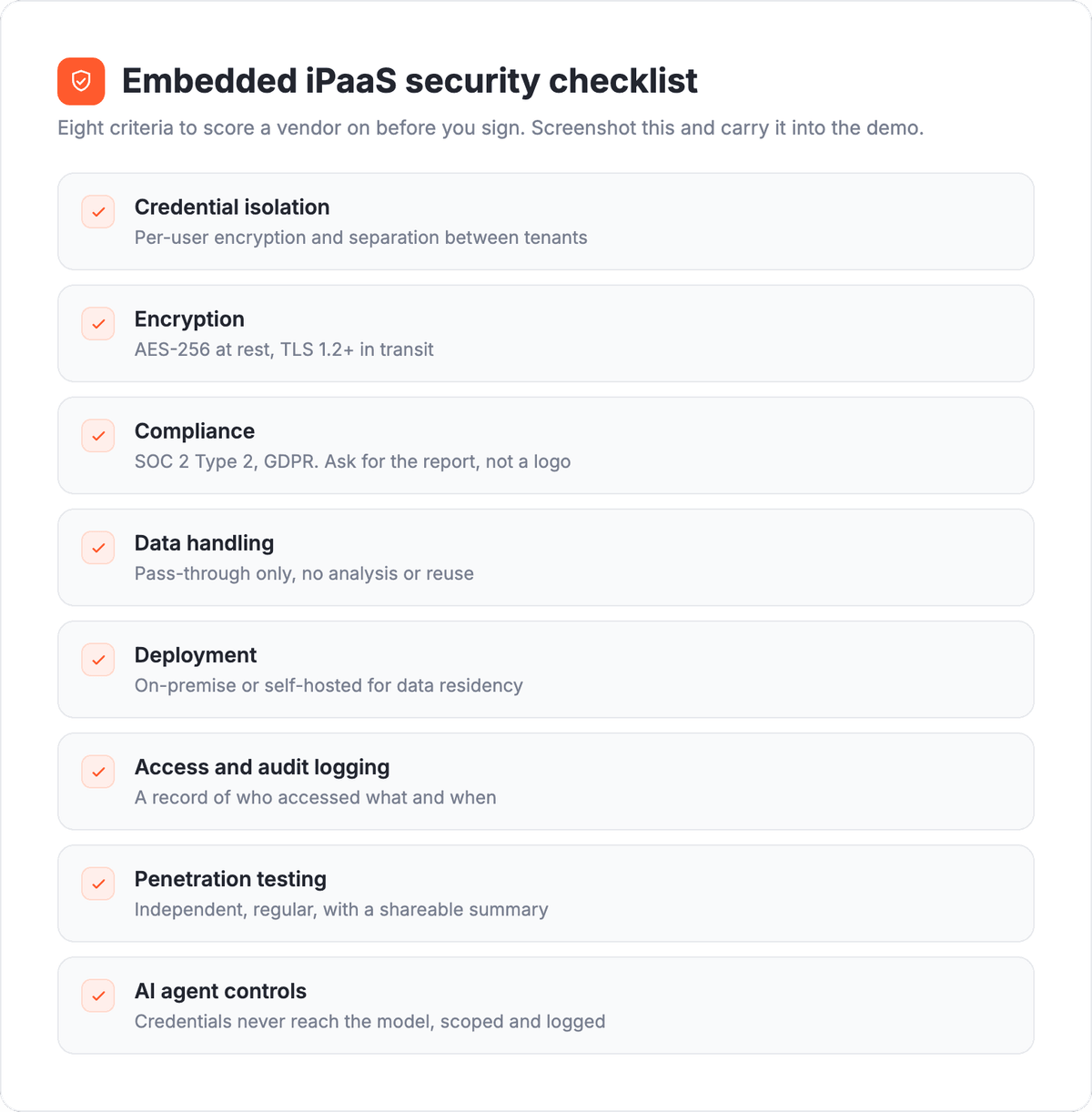
Each criterion carries different weight depending on your buyers. A fintech SaaS selling to banks will lead with certifications and data residency. A product-led tool selling to SMBs may prioritize credential isolation and encryption. Rank them for your own deals before the demo.
Credential isolation: the control that matters most
Credential isolation determines whether one customer's breach can become every customer's breach. In an embedded model, thousands of end users connect their own accounts through the same platform. If those credentials share storage without strict separation, a single flaw exposes all of them at once. Proper isolation means each user's tokens are encrypted and scoped so no tenant, and no other user, can reach connections that are not theirs.
Ask the vendor two specific questions. First, where are decryption keys held relative to the encrypted credentials? Keeping keys on a separate secured server, rather than beside the data, limits what a single compromised system can expose. Second, how is per-user separation enforced in the connection layer, so a request authenticated as one user can never resolve another user's connection?
Albato Embedded stores credentials encrypted, with decryption keys held on a separate secure server and access restricted to a limited set of authorized employees. Each end user's connections are isolated at the user level, which is what makes a multi-tenant embedded deployment safe to sell into regulated buyers.
Certifications: what SOC 2 and GDPR actually tell you
SOC 2 Type 2 and GDPR are the two certifications enterprise procurement teams check first, and they mean different things. Understanding the difference keeps you from accepting a weaker signal than you think you are getting.
SOC 2 has two report types. A Type 1 report confirms that controls are designed correctly at a single point in time. A Type 2 report confirms those controls actually operated effectively across a period, usually several months to a year. Type 2 is the stronger signal because it shows the vendor lived by its controls, not just documented them. When a vendor says "SOC 2 certified," ask which type and ask for the report date, since an audit from two years ago tells you little about today.
GDPR compliance addresses a separate question: what the platform does with personal data. The signal you want is that the platform processes data only to run automations and does not analyze, mine, or reuse it for any other purpose. Combined with data-residency options, that policy is what lets you sell into the EU without inheriting a compliance gap.
Albato Embedded is SOC 2 Type 2 certified with annual audits and is GDPR compliant, and it does not analyze or use the data flowing through connectors. It is also PCI compliant, with payments handled through Stripe so no card data is stored, and it is pursuing ISO 27001 certification.
How data actually flows through an embedded iPaaS
Understanding the data path tells you where your exposure sits. In a well-designed embedded iPaaS, the platform authenticates a connection, moves data between apps to run an automation, and stores as little as possible along the way. The two questions that define your risk are what the platform retains and for how long.
A typical secure flow works like this:
- The end user authorizes a connection through a white-labeled OAuth page, and the platform receives a token, not a raw password.
- The token is encrypted and stored, with decryption keys held separately from the encrypted data.
- When an automation runs, the platform uses the token to move data between apps in real time.
- Execution logs are retained for a limited window for troubleshooting, then discarded.
The four steps above are easier to hold in your head as a single path, with the retention window called out where it belongs at the end.
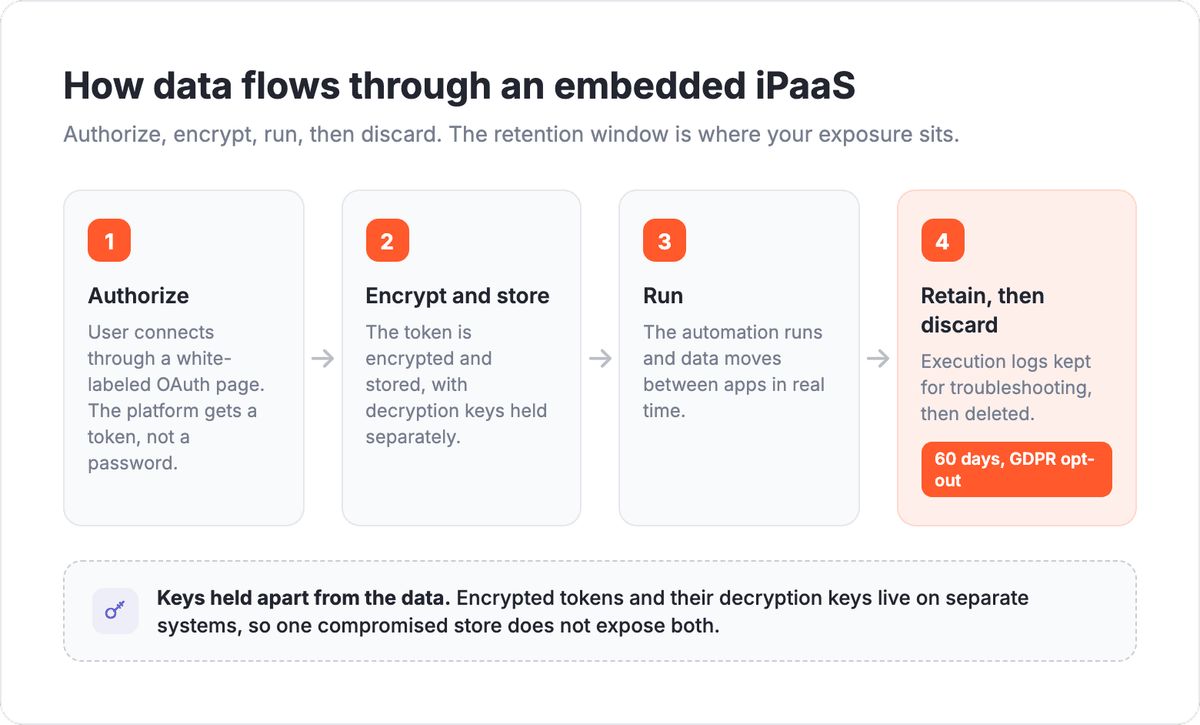
The retention window is worth a direct question. Albato Embedded retains automation logs for 60 days with a GDPR opt-out available, runs on AWS with a multi-zone deployment across two availability zones, and restricts hosting access to VPN-only. Those are the kinds of specifics a security reviewer wants, and a vendor that cannot answer them quickly is a vendor whose data handling you should not assume.
For a deeper look at how isolation works when you serve many tenants at once, our guide on multi-tenant MCP architecture covers tenant boundaries, OAuth lifecycle, and audit logging in detail.
Comparing evaluation criteria across buyer types
Not every security criterion carries equal weight for every SaaS company. The table below maps the main criteria to the buyer segments where each one becomes a deal-breaker, so you can prioritize your review.
| Security criterion | What to verify | Highest priority for |
|---|---|---|
| Credential isolation | Per-user encryption and separation; keys stored apart from data | Every buyer, especially multi-tenant SaaS |
| SOC 2 Type 2 | Current report, not a logo; ask for the audit date | Mid-market and enterprise sellers |
| GDPR and data handling | Pass-through only; no analysis or reuse of connector data | Companies selling into the EU |
| On-premise deployment | Self-hosted or on-prem options for data residency | Fintech, healthcare, regulated industries |
| AI agent controls | Credentials never reach the model; scoped permissions; audit logs | Anyone shipping AI-driven automations |
The pattern is consistent: credential isolation and certifications are universal, while deployment and AI controls become decisive as your buyers get more regulated. Score each vendor against your own buyer profile rather than a generic list. If you want to see how one platform answers each row, a walkthrough is the fastest way to compare.
AI agents change the embedded iPaaS security picture
AI agents introduce a security question that did not exist a year ago: what does the model see, and what can it do? An agentic workflow can read a support ticket, decide what to do, and then act by updating a CRM record or sending a message. That means an AI model now sits inside the data path, and the two risks to evaluate are whether the model ever handles raw credentials and whether its actions are constrained and logged.
The first risk is credential exposure. If an agent needs to call Salesforce, does the underlying model receive the Salesforce token? It should not. A secure design keeps credentials away from the model entirely, letting the agent reference a connection without ever seeing the secret behind it. Albato Embedded's Secure Credential Proxy does exactly this: the agent works with a credential ID, and the actual token and keys never reach the LLM.
The proxy is easier to picture as a flow, where the credential stays on one side of a boundary and the agent only ever holds a reference.
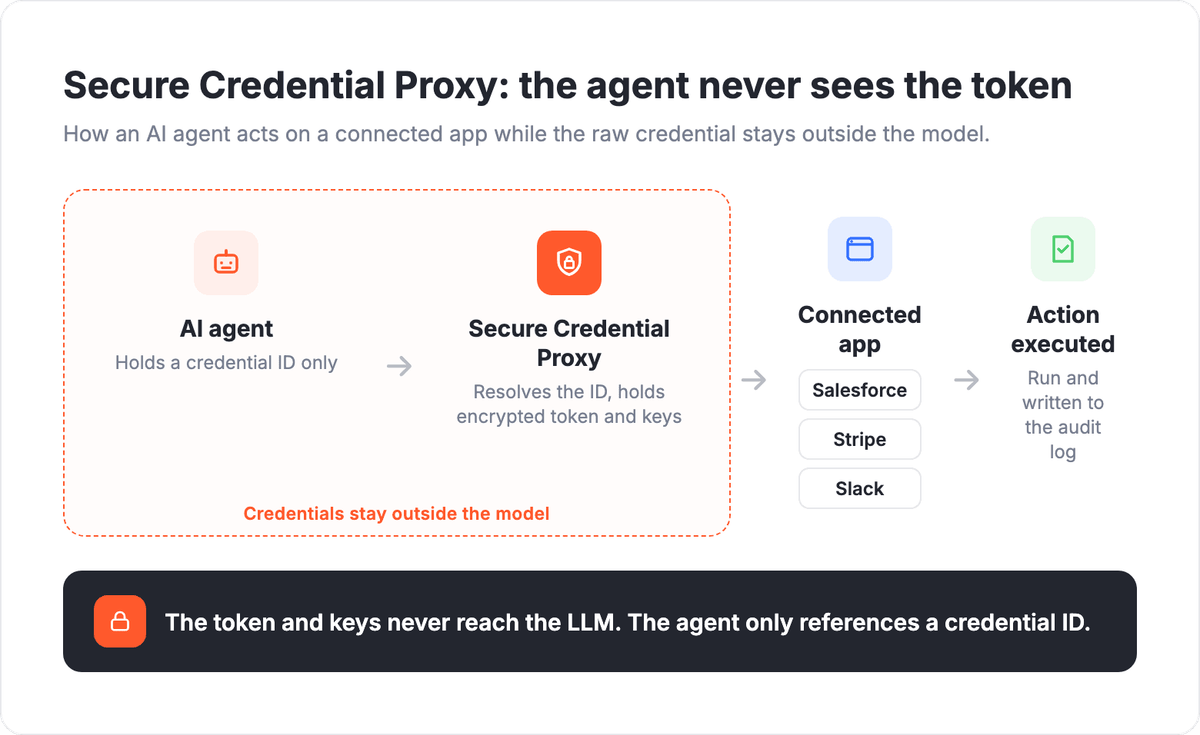
The second risk is uncontrolled action. An agent that can call any app and take any action is a liability. What you want is granular tool permissions, so each agent is granted explicit rights to call specific apps or update specific records, with full auditability of every action it takes. Albato Embedded provides both, and it is model-agnostic, so a partner can run any LLM per workflow, including OpenAI, Anthropic, its own model, or Albato's built-in option. For strict data-residency needs, agents and Copilot can be deployed on-premise with self-hosted LLMs.
When Albato Embedded is the right choice on security
Albato Embedded fits SaaS companies that need to pass enterprise security reviews without building an integration platform in-house. It is a white-label embedded iPaaS that lets SaaS companies add 1,000+ native integrations to their product, and its security posture is built for buyers who sell into regulated or enterprise accounts: SOC 2 Type 2 certification, GDPR compliance, AES-256 encryption at rest, TLS 1.2 or higher in transit, per-user credential isolation, and on-premise deployment options for strict data residency.
It is the right choice when your prospects send security questionnaires you currently struggle to answer, when you need integrations live in about 30 to 45 days rather than a multi-quarter build, and when you are adding AI agents and need credentials kept away from the model. If your product has no external buyers with formal security requirements, a lighter integration approach may be enough. The value of embedded iPaaS security shows up precisely when someone else audits you.
Teams like TimelinesAI added native integrations to their platform on this foundation, reducing onboarding friction for their users, and the security controls came with the platform rather than as a separate project.
Frequently asked questions
What is embedded iPaaS security?
Embedded iPaaS security is the set of controls that protect user credentials, data, and actions when a SaaS company embeds a third-party integration platform inside its own product. It covers credential isolation, encryption, compliance certifications, data handling, and audit logging. Because the platform runs under your brand, its security posture becomes yours.
What certifications should an embedded iPaaS have?
At a minimum, look for SOC 2 Type 2 and GDPR compliance, since enterprise procurement teams check both first. SOC 2 Type 2 confirms controls operated effectively over a period, which is stronger than a Type 1 point-in-time report. PCI compliance and ISO 27001 add value depending on your industry.
How is credential isolation enforced in an embedded iPaaS?
Each end user's tokens are encrypted and scoped so no tenant can reach another's connections, with decryption keys held on a separate secure server rather than beside the encrypted data. Ask the vendor how per-user separation is enforced in the connection layer and where keys are stored relative to the credentials they protect.
Do AI agents in an embedded iPaaS see user credentials?
They should not. In a secure design, the AI model works with a credential reference rather than the raw token, so secrets never reach the model. Albato Embedded's Secure Credential Proxy passes a credential ID to the agent while keeping the actual token and keys away from the LLM, and every agent action is permission-scoped and logged.
How is embedded iPaaS security different from evaluating a tool like Zapier?
With a standalone automation tool, your users leave your product and hold their own accounts, so the vendor's security is separate from yours. With an embedded iPaaS, users stay in your product and you inherit the vendor's security posture, which means its controls appear in your own audits and enterprise deals.
Seeing the controls in practice beats reading a spec sheet. A demo walks through credential isolation, compliance, and AI agent security against your specific buyers' requirements.
Explore related guides on embedded iPaaS, multi-tenant isolation, and integration platforms below.