In this article
If you want your product's AI agents to take real actions in other apps, you need an MCP server, and the next decision is who runs it. A managed MCP server is hosted, secured, and scaled by a provider, so your team ships tool access without operating infrastructure. A self-hosted MCP server runs on your own machines, giving you full control over data and deployment while your team owns the maintenance.
For most SaaS teams, that split decides two things: how fast you reach production and how much engineering time the choice consumes over the next two years. The right answer depends on your compliance needs, your team's capacity, and whether your product is multi-tenant.
Albato Embedded is a white-label embedded iPaaS that gives SaaS companies a hosted, managed MCP server across 1,000+ apps, with self-hosted and on-prem deployment available for the accounts that need it. This guide walks through the three factors that actually drive the decision: control and data residency, engineering cost and maintenance, and speed to production with multi-tenant isolation. It also covers when self-hosting is the right call, because for some teams it is.
Key takeaways
- A managed MCP server is hosted and operated by a provider, so a SaaS team can expose tool access to AI agents in weeks instead of building and running the server themselves.
- Self-hosting an MCP server makes sense when you have strict data residency rules, an existing platform team, and a need for on-prem deployment. It costs engineering time to build and maintain.
- The three deciding factors are control and data residency, engineering cost and maintenance, and speed to production plus multi-tenant isolation.
- Multi-tenant SaaS raises the bar for self-hosting: you have to build per-tenant credential isolation and OAuth handling yourself, which is where most in-house MCP projects stall.
- Albato Embedded offers a hosted, white-label MCP server across 1,000+ apps, with self-hosted and on-prem deployment available for enterprise, so the choice is not a permanent lock-in.
What is a managed MCP server
A managed MCP server is a Model Context Protocol server that a third-party provider hosts, secures, and scales, so your AI agents connect to external tools through a single endpoint without your team operating any servers. It matters because building an MCP server that handles authentication, rate limits, and updates across dozens of apps is a standing engineering commitment, not a one-time project. It differs from self-hosting in one way that shapes everything else: with a managed server, the provider owns uptime, patching, and connector maintenance, while you own the product experience on top.
The Model Context Protocol, introduced by Anthropic in late 2024, is an open standard that lets AI models call external tools and data sources through a consistent interface. An MCP server is the component that exposes those tools. A "remote MCP server" is simply one that runs over the network rather than as a local process on the same machine as the model, which is the deployment model any production SaaS needs.
Managed MCP servers are sometimes sold as "MCP as a service" or "MCP hosting." The label varies, but the arrangement is the same: someone else runs the server and you consume it through an API. For a deeper primer on the protocol itself, see our explainer on what MCP means for AI integration.
Managed vs self-hosted MCP server: quick comparison
The two approaches diverge across seven practical dimensions. This table maps them so you can see the trade-off at a glance before reading the detail below.
| Dimension | Managed MCP server | Self-hosted MCP server |
|---|---|---|
| Who operates it | Provider hosts, patches, and scales | Your team runs and maintains it |
| Time to production | Days to weeks | Weeks to months |
| Maintenance burden | Provider handles connector and API updates | Your team owns every update and outage |
| Data residency / on-prem | Provider-controlled, on-prem on enterprise tiers | Full control, any region or on-prem |
| Multi-tenant isolation | Built in per tenant | You design and build it |
| Cost model | Subscription or usage-based fee | Engineering salaries plus infrastructure |
| Best for | Teams shipping agent features fast | Teams with strict compliance and a platform team |
The table shows the pattern most teams land on: a managed MCP server trades some control for speed and lower operational load, while self-hosting trades speed for control. The rest of this guide unpacks which trade is right for your situation. Our breakdown of MCP vs native API integrations covers the layer beneath this choice.
Factor 1: control and data residency
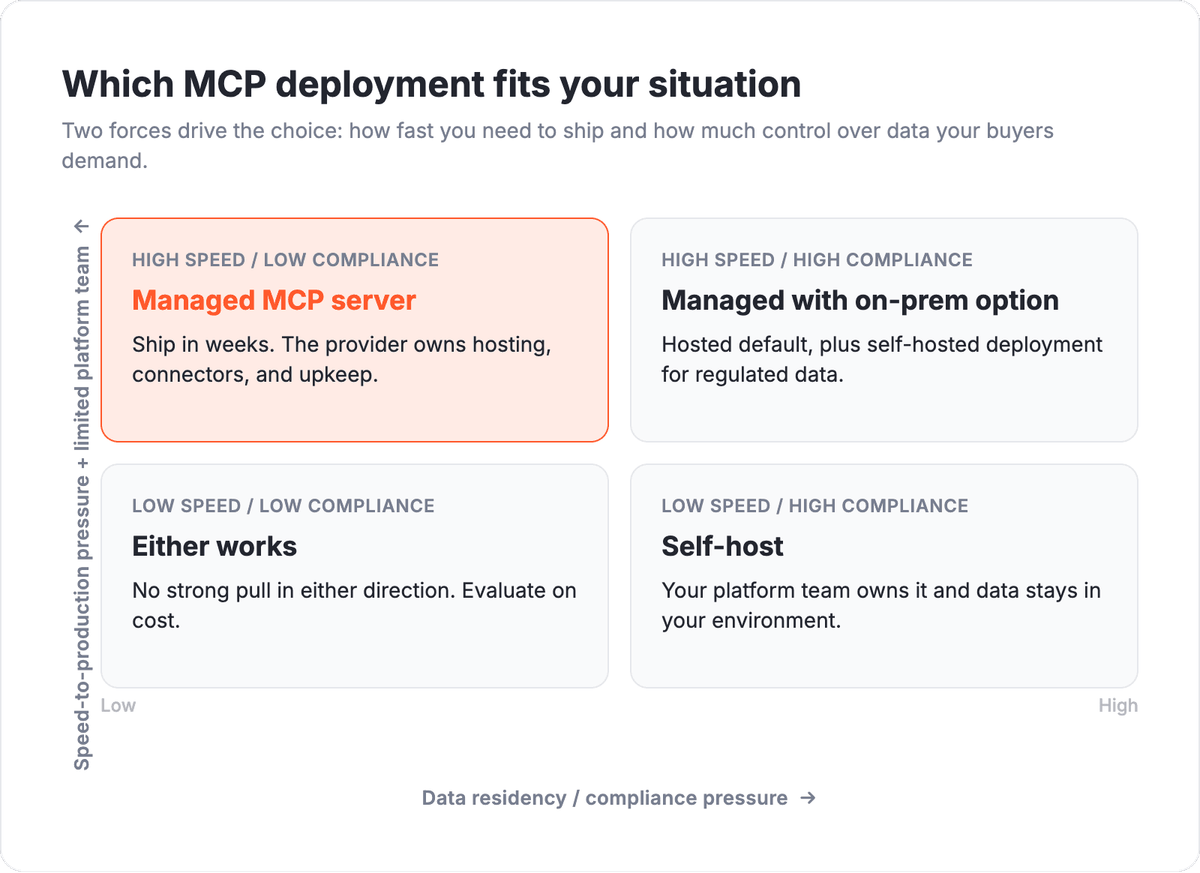
Control is the strongest argument for self-hosting. When you run the MCP server yourself, sensitive data and credentials stay inside your own environment, and you can pin the deployment to a specific region to satisfy GDPR, HIPAA, or a customer's contractual data-residency clause. If your buyers routinely demand that no third party touches their data, self-hosting removes an objection before it comes up.
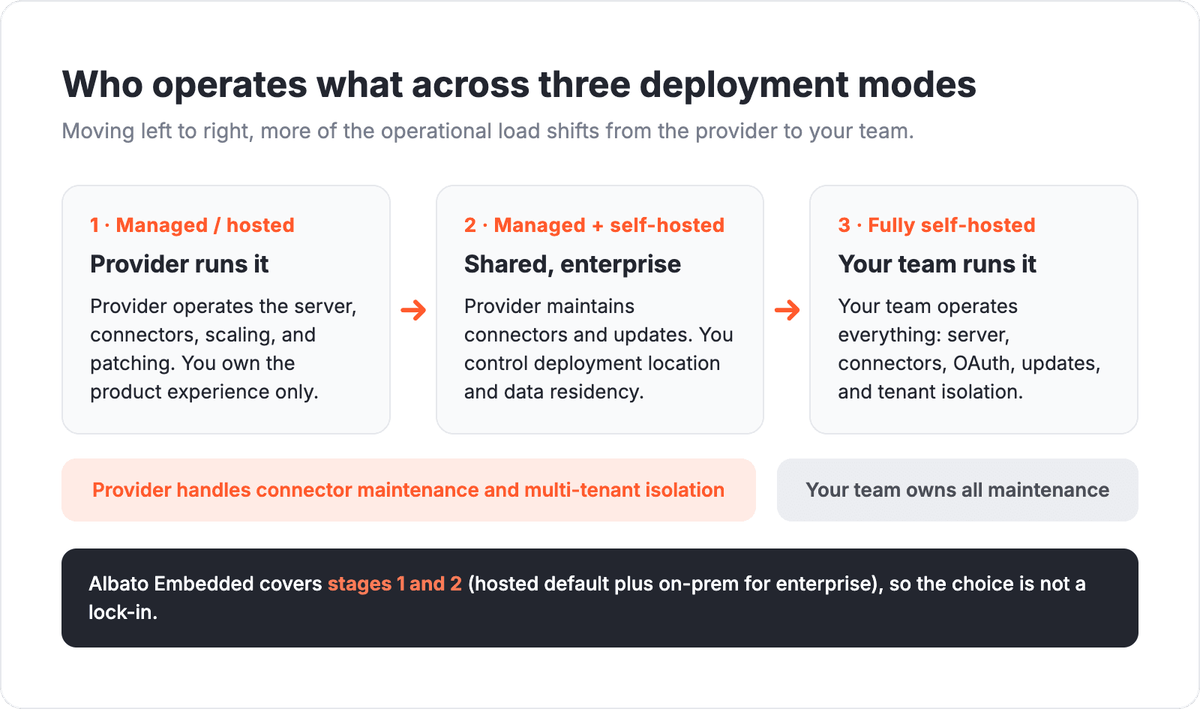
Managed MCP servers used to cede this ground entirely, but that has changed. The relevant question now is whether the managed provider also offers on-prem or self-hosted deployment for the cases that need it. That combination lets you run most workloads on the hosted server and place the regulated ones on infrastructure you control.
A second control concern is credential handling. In an agent workflow, the risk is that tokens and API keys leak into model prompts or logs. Albato Embedded addresses this with a Secure Credential Proxy: customer credentials, API keys, and access tokens never reach the LLM, and agents work only with a credential ID while Albato executes each request through a managed proxy. On the deployment side, Albato Embedded can run on-prem and on self-hosted LLMs for organizations with strict data residency and compliance requirements. That is the point of this comparison. A managed option that also covers self-hosting is not an either-or lock-in.
Factor 2: engineering cost and maintenance
The cost of a self-hosted MCP server is not the server. It is the standing engineering time to build connectors, handle OAuth for every app, keep up with breaking API changes, and stay on call when a downstream provider changes a rate limit at 2 a.m. Each connected app is a small integration project, and each one degrades over time as vendors ship updates.
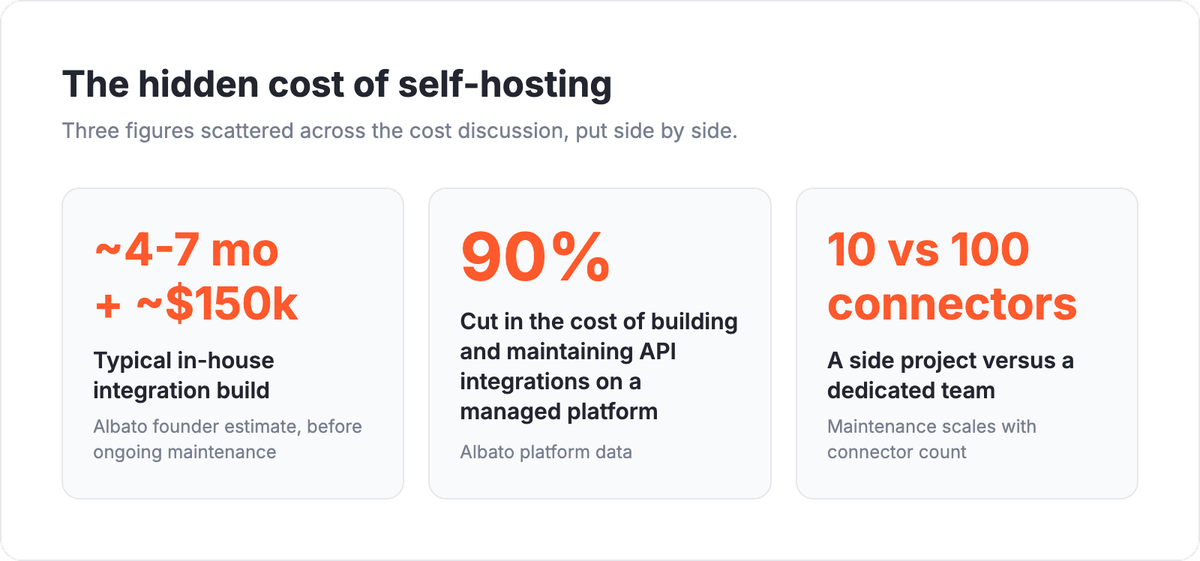
Building integrations in-house has a real number attached to it. Albato's founder estimates a typical in-house integration effort at roughly four to seven months and around $150,000 before you account for ongoing maintenance. A managed MCP server converts that capital-and-headcount expense into a predictable subscription, and the provider absorbs connector upkeep. Albato reports a 90% cut in the cost of developing and maintaining API integrations for teams that move this work to its platform.
The maintenance point compounds with scale. Ten connectors is a side project. A hundred connectors across a growing customer base is a dedicated team that does nothing else. This is where the build vs buy calculation for integrations usually tips toward buying for teams whose core product is not integration infrastructure.
Factor 3: speed to production and multi-tenancy
A managed MCP server reaches production fastest because the connectors, authentication, and scaling already exist. You point your agents at one endpoint and start shipping. Albato Embedded exposes its full catalog of 1,000+ apps as a single standardized MCP endpoint, so your agents get access to actions across every connected app without individual API credentials or schemas to manage per app.
Multi-tenancy is where self-hosting gets genuinely hard. In a single-tenant internal tool, you can wire up one set of credentials and move on. In a multi-tenant SaaS, every customer needs isolated credentials, isolated OAuth grants, and a guarantee that Tenant A's agent can never touch Tenant B's data. Building that isolation layer correctly, and proving it stays correct as you add tenants, is a substantial project on its own. Our guide to multi-tenant MCP for SaaS covers the architecture in depth.
A managed MCP server built for embedded use handles this by design, with per-tenant isolation and OAuth managed for you. That is the practical reason most SaaS teams choose a managed server for a multi-tenant product: the hard part is already solved and tested across many customers.
When to self-host an MCP server
Self-hosting is the right choice when specific conditions line up. It is not a default, and it is not a fallback for teams that "want more control" in the abstract. Choose to self-host when:
- You operate under data-residency rules that forbid a third party from processing customer data, and no managed provider offers a qualifying on-prem option.
- You already run a platform or infrastructure team that can own the MCP server as part of its remit, not as an extra.
- Your integration surface is small and stable, so connector maintenance stays manageable.
- Your product is single-tenant or internal, which removes the multi-tenant isolation burden.
If two or more of these hold, self-hosting can be the correct decision. If none hold, self-hosting usually means a team spends months rebuilding infrastructure that a managed provider offers off the shelf, and then spends the following years maintaining it.
When to choose a managed MCP server
Choose a managed MCP server when speed to production, breadth of connectors, or multi-tenant isolation matter more than running the infrastructure yourself. This is the majority case for SaaS teams adding agent features to a product that already has customers. A managed MCP server is the right call when:
- You want AI agents shipping tool actions in weeks, not after a multi-quarter build.
- Your product is multi-tenant and you need per-tenant credential and OAuth isolation without building it.
- You need broad app coverage now, not a connector library you grow one integration at a time.
- Integration infrastructure is not your core product, and engineering time is better spent elsewhere.
The strongest position is a managed MCP server that also offers self-hosted and on-prem deployment for the accounts that require it. You get the speed of a hosted server for the common case and a compliant path for the regulated one, without committing to either extreme permanently. Compare this against running your own gateway in our piece on the MCP gateway pattern for SaaS.
How Albato Embedded fits both ends
Albato Embedded is a white-label embedded iPaaS that lets SaaS companies add 1,000+ native integrations and a ready-made agentic layer to their product without building the infrastructure. For MCP specifically, it exposes the entire connector catalog as one unified, white-label MCP server, so your AI agents reach actions across 1,000+ apps through a single endpoint.
On the managed side, Albato hosts, secures, and scales the server, handles per-tenant isolation and OAuth, and keeps connectors current as vendor APIs change. The agent layer is model-agnostic: you can run OpenAI, Anthropic, Gemini, your own model, or Albato AI per workflow, and Albato AI runs on a proprietary model that is not disclosed. On the control side, enterprise deployment can run self-hosted and on-prem, with self-hosted LLM support for strict data-residency needs. That is what makes the managed-versus-self-hosted question less binary with Albato: the same platform covers the hosted default and the self-hosted exception, so you are not locked into one deployment model.
Albato's platform data gives a sense of the operational scale behind the managed option: 250,000+ users, 1,000+ apps, and 250M+ transactions processed monthly across the platform.
Frequently asked questions
What is a managed MCP server?
A managed MCP server is a Model Context Protocol server that a provider hosts, secures, and scales for you. Your AI agents connect to external tools through it without your team running or patching any infrastructure. The provider owns uptime and connector updates, and you build your product experience on top.
Managed vs self-hosted MCP server: which is better?
Neither is universally better. A managed MCP server wins on speed to production, connector breadth, and built-in multi-tenant isolation. A self-hosted MCP server wins on control and data residency. Most SaaS teams choose managed unless strict compliance rules or an existing platform team push them toward self-hosting.
What is a remote MCP server?
A remote MCP server runs over the network rather than as a local process on the same machine as the AI model. Any production SaaS needs a remote setup so agents can reach the server from anywhere. Managed MCP servers are remote by definition, since the provider hosts them.
Can you self-host an MCP server for a multi-tenant SaaS?
Yes, but it is a substantial project. You have to build per-tenant credential isolation, isolated OAuth grants, and guarantees that one tenant's agent can never access another tenant's data. This isolation layer is the part of self-hosting that most often stalls multi-tenant projects, which is why many teams choose a managed server built for embedded use.
Is MCP-as-a-service secure?
It can be, depending on how the provider handles credentials. The key safeguard is keeping tokens and API keys out of the LLM. Albato Embedded uses a Secure Credential Proxy so credentials never reach the model, and agents work only with a credential ID while requests run through a managed proxy.
The bottom line
The managed-versus-self-hosted decision comes down to what your team should spend its time on. If integration infrastructure is not your product, a managed MCP server lets you ship agent features in weeks and leaves connector upkeep, scaling, and multi-tenant isolation to the provider. If you have strict data-residency rules and a platform team ready to own the work, self-hosting gives you the control those constraints require.
The most flexible answer is a platform that does both. A managed MCP server that also supports self-hosted and on-prem deployment lets you run the common case fast and place the regulated case on infrastructure you control, without a permanent commitment to either. As AI agents move from demos into shipped features, that flexibility is what keeps the decision from becoming a wall you hit later.
See how a hosted, white-label MCP server across 1,000+ apps works for your product, with self-hosted deployment available when you need it.