In this article
An MCP server has no sticker price. The cost is whatever it takes to build the thing, keep it running, and stop it from leaking one customer's data into another customer's agent. For a SaaS team, that number can land anywhere from a weekend side project to a six-figure engineering commitment that never really ends.
The Model Context Protocol itself is open and free, so the server looks like it should be cheap too. What costs money is everything around the protocol: the connectors, the authentication, the hosting, the tenant isolation, and the person who gets paged when a downstream API changes overnight.
Albato Embedded is a white-label embedded iPaaS that gives SaaS companies a managed MCP server across 1,000+ apps, billed by usage rather than by headcount, so most of the cost drivers below become a line item instead of a project.
What actually drives MCP server cost
MCP server cost is the total of what it takes to build the server, host it, secure it, and maintain it over time, plus the pricing of any managed platform you buy instead of building. The protocol is free. The engineering around it is not, and for a multi-tenant SaaS product the recurring maintenance usually costs more than the initial build.
Most teams price only the first line, the sprint to stand up a working server. Connector upkeep, security, and on-call time are what decide whether your MCP server is a fixed cost or a growing one.
The decision is now on most SaaS roadmaps. Forrester predicts that 30% of enterprise app vendors will launch their own MCP servers, so build versus buy is now a budget question, not just an architecture one.
Key takeaways:
- MCP server cost is not a license fee. It splits into development, hosting, security and multi-tenancy, and ongoing maintenance, and maintenance usually dominates.
- A multi-tenant SaaS MCP server built from scratch runs roughly $60,000 to $120,000 before maintenance, per industry estimates.
- AI coding tools make the first version of a connector cheap and fast, but per-customer auth, API changes, monitoring, and tenant isolation still carry the recurring cost.
- Buying converts that expense into a subscription or usage fee; Albato Embedded includes a managed MCP endpoint on Pro, from $5,000 per month. Build when the MCP server is your product and your connector set is small and stable.
The real cost of building an MCP server in-house
Building your own MCP server means owning five cost centers, and most estimates capture only the first.
Initial development. A basic MCP server that exposes a handful of tools to one client is genuinely small work. A production server that handles authentication, error recovery, schema validation, and dozens of connected apps is a different scale of project. Each connected app is its own small integration effort, with its own quirks and its own OAuth dance.
Multi-tenancy. The moment your server has to serve more than one customer, cost jumps. You need to isolate each tenant's credentials, tool definitions, and data so one customer's agent can never see another's. Getting that wrong is not a bug, it is a breach. The architecture patterns behind this, from row-level security to dedicated compute per tenant, are in our guide to multi-tenant MCP architecture, which puts a from-scratch multi-tenant build at $60,000 to $120,000.
OAuth and security. Every app your agents touch needs authentication, token refresh, and credential storage that a security review will actually pass. Add audit logging, rate limiting, and the work of keeping secrets out of the model's context, and this line grows fast for anything a paying customer relies on.
Hosting and operations. The server has to run somewhere, scale with agent traffic, and stay up. That means infrastructure spend plus monitoring, alerting, and incident response. Who runs the server, managed or self-hosted, is its own decision with its own cost profile.
Ongoing maintenance. Every connected app ships breaking changes, deprecates endpoints, and adjusts rate limits on its own schedule. Ten connectors is a side project one engineer can absorb. A hundred connectors across a growing customer base is a team that does nothing else. The maintenance cost scales with your connector count and your customer count at the same time.
Engineering time is the currency here, and it is not cheap. The U.S. Bureau of Labor Statistics reports a median annual wage of $133,080 for software developers, before benefits, equity, or the opportunity cost of pulling that person off your core product. A single dedicated engineer on integration upkeep is a six-figure recurring line before you count anyone else.
The infographic below collapses these five cost centers into one mental model and flags maintenance as the cost driver that keeps growing.
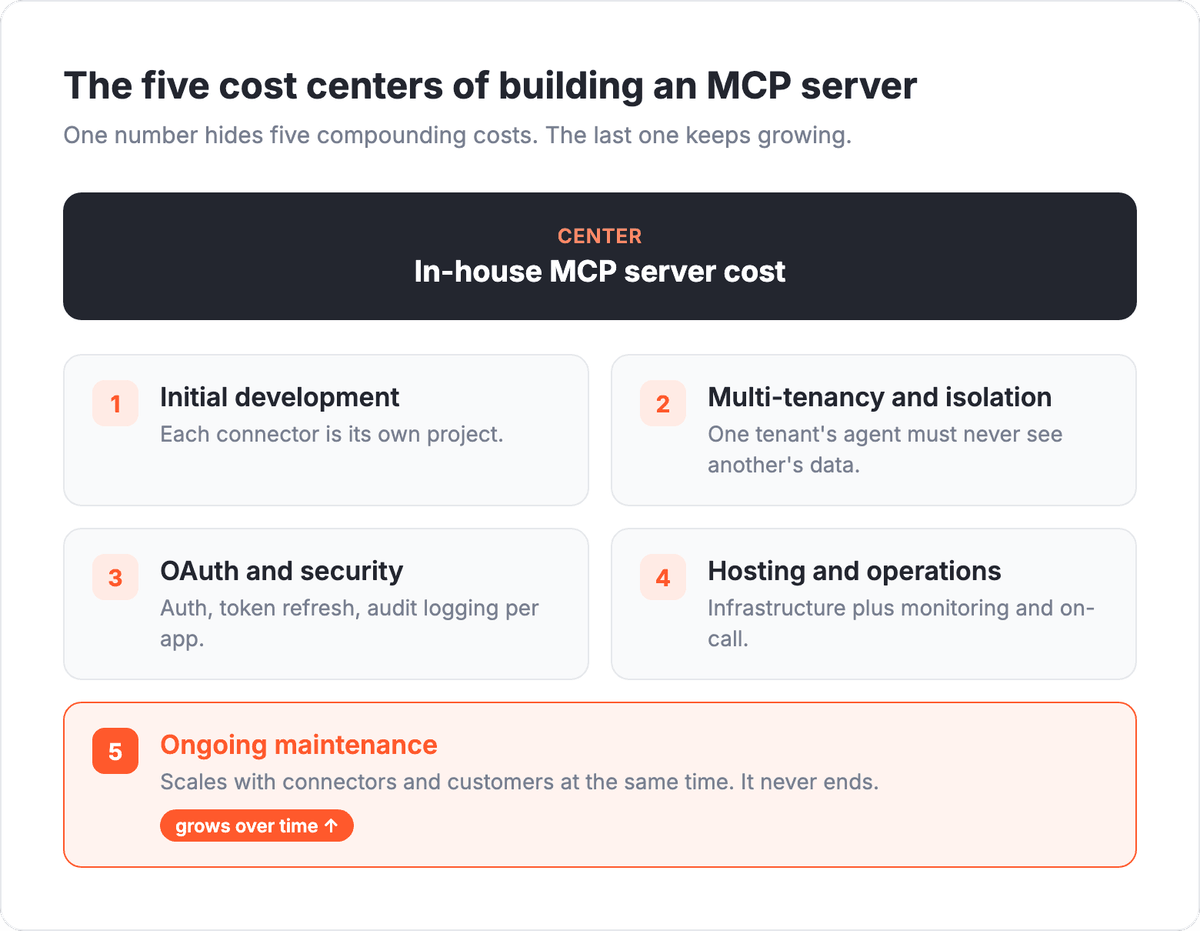
Each of these five centers compounds the others: more connectors means more OAuth surface, more hosting load, and more maintenance hours per month.
AI coding tools changed the build cost, not the maintenance cost
AI coding assistants such as Claude Code and Cursor have made the first version of an MCP connector cheap and fast to write, and that change is real. What they do not change is the work that starts after the connector ships.
The cost moved to the parts a demo never exercises:
- Per-customer authentication and token refresh, so each tenant's connection keeps working after its first token expires
- Third-party API changes such as renamed fields, deprecated endpoints, and new pagination rules
- Retries and failure handling when a downstream service times out or hits a rate limit
- Monitoring and alerting, so your team learns a connector broke before a customer does
- Permissions, so an agent can only do what that specific user is allowed to do
- Isolating each customer's data and credentials from every other customer's
Teams shipping AI features keep telling the same story. An integration built quickly with AI looks right in the demo, then starts failing a few weeks later on edge cases: an expired token, a second page of results nobody paginated, a rate limit that only appears under real traffic, a field the vendor renamed. The complaint is that something keeps breaking all the time and the fixes happen one by one. AI assistants help write each patch, but someone still has to notice, diagnose, and fix each failure for every connector, which is the case for giving an AI agent one MCP server, not fifty.
Build vs buy: cost across every dimension
The two paths differ in the shape of the cost, not just the total: who carries the risk and how the number behaves as you grow. A build is front-loaded capital plus a maintenance tail that never flattens, while a buy is a predictable operating expense whose volatility the provider absorbs.
| Cost dimension | Build in-house | Buy a managed / embedded MCP server |
|---|---|---|
| Initial development | Weeks to months of engineering; each connector its own project | Included in setup; no per-connector build |
| Multi-tenancy and isolation | Your team designs, builds, and tests tenant isolation | Handled by the platform out of the box |
| OAuth and security | Built and reviewed per app; audit logging on you | Managed authentication and credential handling included |
| Hosting and scaling | Your infrastructure spend plus operational load | Provider hosts and scales the endpoint |
| Ongoing maintenance | Scales with connector and customer count; never ends | Provider absorbs connector and API upkeep |
| Cost shape | Front-loaded capital plus a growing maintenance tail | Predictable subscription or usage fee |
| Time to production | Months | Weeks; Albato Embedded averages 30 to 45 days to go live |
| Who carries the risk | Your team owns uptime, breaches, and breakage | Provider owns platform uptime and connector updates |
The last two rows are the ones teams miss: buying moves the variance off your books, so a vendor's API change at 2 a.m. becomes the provider's problem, not your on-call engineer's.
What a managed or embedded MCP server costs
Managed MCP servers are priced in one of two ways, and the difference matters for how the cost scales with you.
The first is a flat or tiered subscription: a fixed monthly fee for the server and its connectors. The second is usage-based, where you pay for what your agents actually do. Some platforms combine a platform fee with a usage component, so the base is predictable and the variable part tracks real activity.
Albato Embedded uses the combined model, and the usage side is transaction-based. You pay only for successful actions, while API calls and triggers stay unlimited and unbilled. That keeps polling and retries from inflating a bill that has nothing to do with delivered value.
Here is where the managed MCP endpoint sits in the plans:
- Starter, from $3,000 per month. Includes 5M transactions per month and unlimited connectors, aimed at teams launching embedded integrations quickly. White-label and the Universal MCP endpoint are not on this tier.
- Pro, from $5,000 per month. Adds the Universal MCP endpoint, full white-labeling, a Headless API, AI Copilot, unlimited transactions under a fair use policy, and two custom connectors built by Albato each month.
- Enterprise, custom pricing (from $25,000 per month). Adds self-hosting, managed private cloud, data residency, uptime SLAs, and white-glove onboarding for teams with strict compliance needs.
For most SaaS products that want their agents to reach standard tools like CRMs, help desks, and billing systems, the managed MCP endpoint on Pro replaces the entire in-house build and its maintenance tail with one predictable line.
The chart below shows what this cost difference looks like over time: a build carries a spike up front and a tail that keeps rising, while a managed subscription stays flat.
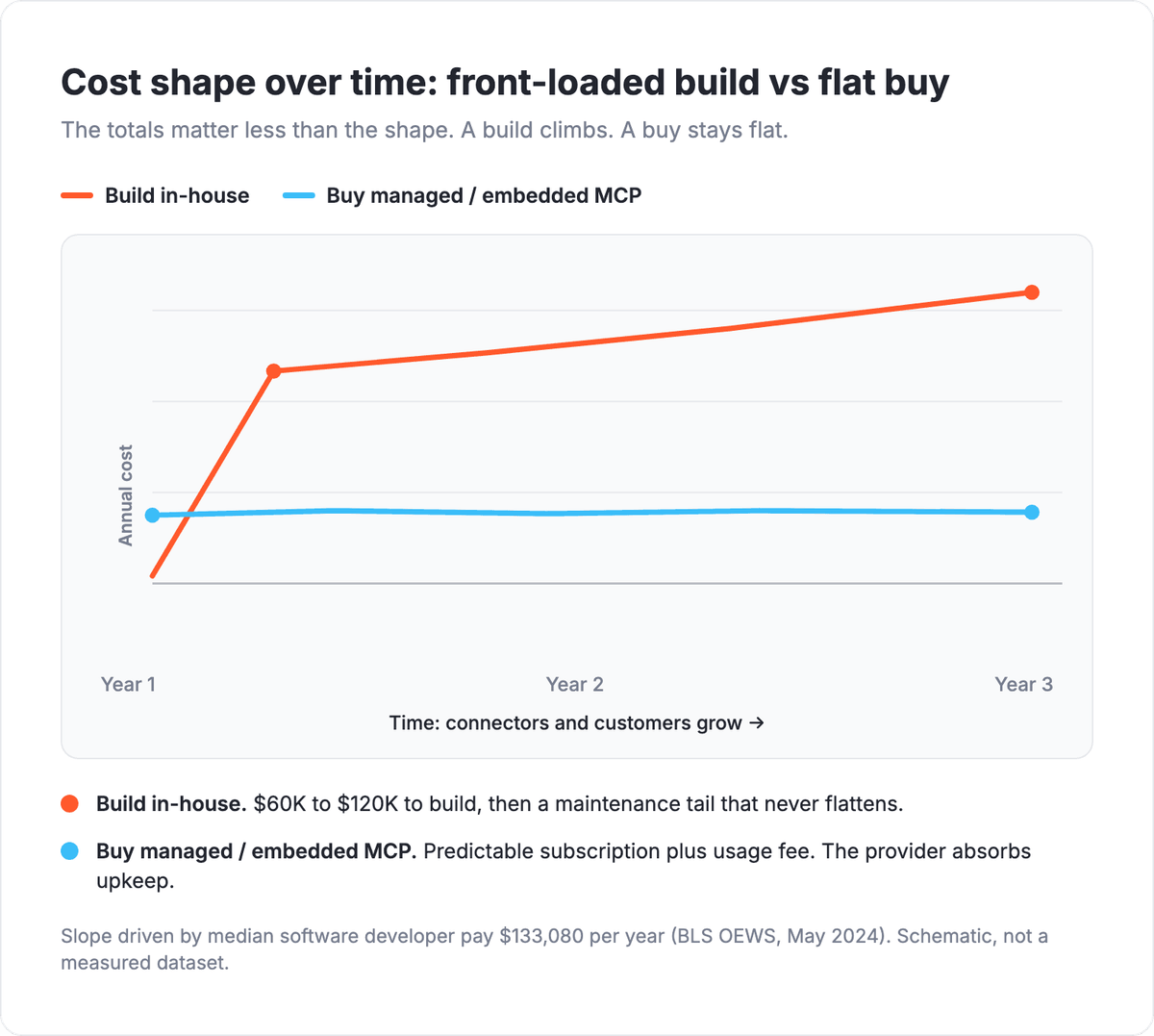
The slope of the build line comes from real labor costs: a median software developer earns $133,080 per year (BLS OEWS, May 2024), so the tail rises with every connector you add to the roster.
How to estimate your own MCP maintenance cost
The maintenance side of MCP server cost comes down to one formula you can run with your own numbers:
Yearly upkeep = connectors x hours per connector per month on fixes and API changes x engineer hourly cost x 12
For the hourly cost, the BLS median software developer wage of $133,080 a year divided by 2,080 working hours gives about $64 per hour. That is median wage before benefits and overhead, so your real loaded rate is higher and every result below is a floor.
The table uses example inputs, not measured data. Plug in your own connector count and the hours your team actually logs on fixes.
| Input | Example A | Example B |
|---|---|---|
| Connectors (example input) | 10 | 20 |
| Hours per connector per month (example input) | 4 | 8 |
| Maintenance hours per month | 40 | 160 |
| Hourly cost (BLS median wage) | $64 | $64 |
| Monthly upkeep | $2,560 | $10,240 |
| Yearly upkeep | $30,720 | $122,880 |
Example B's upkeep is more than double the starting price of Albato Embedded Pro, which includes the managed MCP endpoint and starts from $5,000 per month, or $60,000 over 12 months at the monthly rate. Those 1,920 hours a year are close to one full-time engineer at 2,080 hours. Starter, from $3,000 per month, does not include the MCP endpoint. At Example A's scale, in-house upkeep costs less than Pro on wages alone, so the answer depends on your connector count, how often those APIs change, and what that engineer would otherwise build. Neither in-house figure includes the initial build.
When building your own MCP server is worth it
Building is the right call in a specific case: when the MCP server is the product, not the plumbing. If your company's core value is the connectivity itself, or you have needs no platform can meet, the investment earns its keep.
Consider building when most of these are true:
- The MCP server exposes your own proprietary data or logic, and that access layer is a differentiator you sell.
- You have a small, stable set of connectors that will not sprawl, so maintenance stays a side project rather than a team.
- You have strict data residency or on-prem requirements and an existing platform team with capacity to own the infrastructure.
- Integration behavior is so specific to your domain that a general platform would fight you more than help you.
Even here, the honest budget includes the second year of maintenance, not just the launch sprint.
When buying a managed MCP server wins
For most SaaS teams, buying wins because their agents need to reach other companies' tools, not their own. Connecting to Salesforce, HubSpot, Slack, or Stripe is undifferentiated work, and every hour spent maintaining those connectors is an hour taken from the product customers pay for. The same logic decides the wider choice between in-house, unified API, or embedded iPaaS.
Buying makes sense when most of these are true:
- Your agents need to act across standard third-party SaaS apps rather than your own proprietary system.
- Integration infrastructure is not your core product, and engineering time is better spent elsewhere.
- Your connector list will grow with customer demand, which turns in-house maintenance into a scaling liability.
- You need to ship in weeks and want predictable cost instead of an open-ended build.
The financial case is concrete. Albato's founder estimates a typical in-house integration build at roughly four to seven months and around $150,000 before ongoing maintenance. Teams that move that work to the Albato platform report a 90% cut in the cost of developing and maintaining API integrations.
The decision grid below lets you self-assess in under a minute: which column describes your situation?
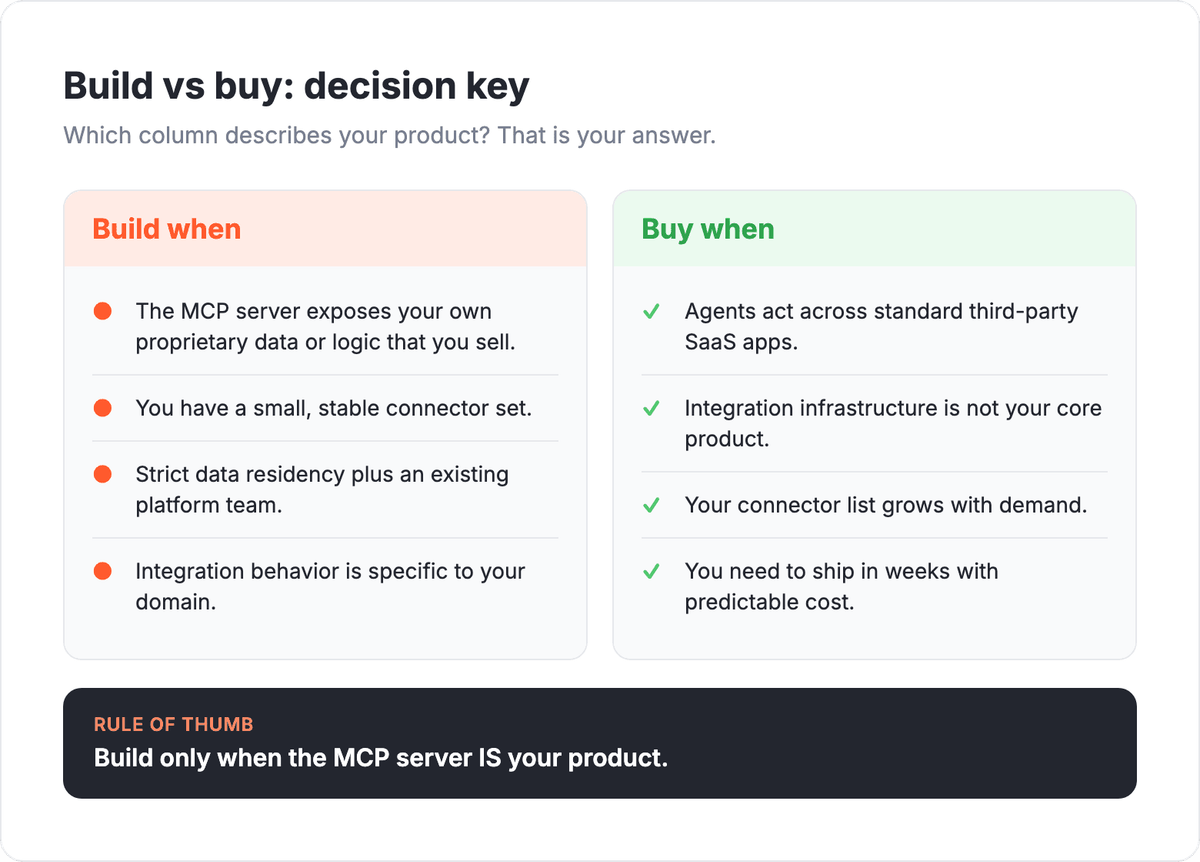
Most teams that look honestly at the grid land in the right column, because most SaaS products are not in the business of running integration infrastructure.
Where Albato Embedded fits as the buy option
Albato Embedded is the buy path for teams that want their product's AI agents to act across other apps without building and running the infrastructure themselves. It gives you a single managed MCP endpoint, called the Universal MCP Gateway, that exposes actions across 1,000+ connected apps with no individual API credentials or schemas for your team to manage.
Multi-tenancy, managed authentication, hosting, scaling, and connector upkeep are all handled on the Albato platform, which serves 250,000+ users and processes 250M+ transactions per month across its products. The white-label layer means your users see your brand, not Albato, and the transaction-based billing means you pay for successful actions rather than for seats or idle capacity.
The results teams get from skipping the build are measurable. RD Station saved $150,000 and raised retention 73%. Chatfuel cut delivery from two months to one week and reduced churn 25%. Climbo grew revenue 70%. None of them built an MCP server to get there.
Frequently asked questions
How much does an MCP server cost?
There is no single price, because the Model Context Protocol is free and the cost is in what surrounds it. Building a production-grade multi-tenant MCP server in-house runs roughly $60,000 to $120,000 before maintenance, plus ongoing engineering time. Buying converts that into a subscription or usage fee; on Albato Embedded, the managed MCP endpoint starts on Pro, from $5,000 per month.
Is it cheaper to build or buy an MCP server?
For most SaaS teams, buying is cheaper once you count maintenance, which grows with your connector and customer count. Buying moves that recurring cost and the risk of breakage onto a provider. Building can be cheaper when the MCP server is your core product and your connector set stays small and stable.
What are the main MCP server pricing models?
Managed MCP servers use a flat or tiered subscription, usage-based billing, or a platform fee plus a usage component. Albato Embedded uses the combined model with transaction-based usage, charging only for successful actions while API calls and triggers stay unlimited.
Can't we just build our MCP server with AI coding tools?
Yes, for the first version. AI coding assistants make a working connector fast and cheap to write. The cost sits in what comes after: per-customer auth and token refresh, third-party API changes, retries, monitoring, permissions, and tenant isolation, repeated for every connector for as long as you run the server. Multiply connectors by monthly maintenance hours per connector, engineer hourly cost, and 12 to price that upkeep.
Does an MCP server have a license cost?
No. The Model Context Protocol is an open standard with no license fee. Any cost labeled MCP server pricing is really the cost of building, hosting, and maintaining a server, or the subscription and usage fees of a managed platform that does that for you.
The bottom line
The cheapest MCP server on paper is often the most expensive one in practice, because the launch sprint is the part everyone prices and the maintenance tail is the part nobody does. Build when the server is your product and your connector set is small and stable. Buy when your agents need to reach standard SaaS tools and you would rather spend engineering time on what customers pay you for.
If buying is your path, Albato Embedded gives you a managed MCP endpoint across 1,000+ apps, white-label, with transaction-based billing and go-live in 30 to 45 days, so your agents can act without your team running the infrastructure underneath them.
See how the managed MCP layer works and what it would cost for your product.