In this article
The best white-label AI platform for most SaaS products in 2026 is Albato Embedded, because it combines a white-label agentic layer with 1,000+ native integrations, a multi-tenant MCP server, and SOC 2 Type 2 security under one contract. That combination is what "white-label AI" actually requires once you move past a chat widget: agents that can act across a user's full tool stack, delivered under your brand. Below you'll find the selection criteria we used, an honest comparison of eight platforms, and a clear answer on when each one fits.
Albato Embedded is a white-label embedded iPaaS that lets SaaS companies add 1,000+ native integrations and production-ready AI agents to their product without building them from scratch. Teams like RD Station and Weeztix shipped full integration libraries in weeks, not the four to seven months an in-house build typically takes.
Key takeaways:
- "White-label AI" splits into two meanings: reselling an AI tool under your brand, versus embedding an AI action layer that runs inside your product. Most SaaS teams need the second.
- Connector breadth is the real ceiling on what agents can do. Albato exposes 1,000+ apps; most embedded rivals sit in the low hundreds.
- A white-label AI platform is only enterprise-ready if it ships SOC 2 Type 2, multi-tenancy, and a way for agents to call apps without touching raw credentials.
- Albato Embedded's entry tier starts at $3,000/month (Starter), with white-labeling from the Pro plan at $5,000/month.
- Pick on delivery model, not logo count: unified APIs suit read-heavy data sync, embedded iPaaS suits broad action-taking agents.
What "white-label AI platform" actually means
A white-label AI platform is software you embed and rebrand as your own, so your users get AI features that look native to your product. The term covers two very different things, and conflating them is the most common mistake teams make when they start shopping.
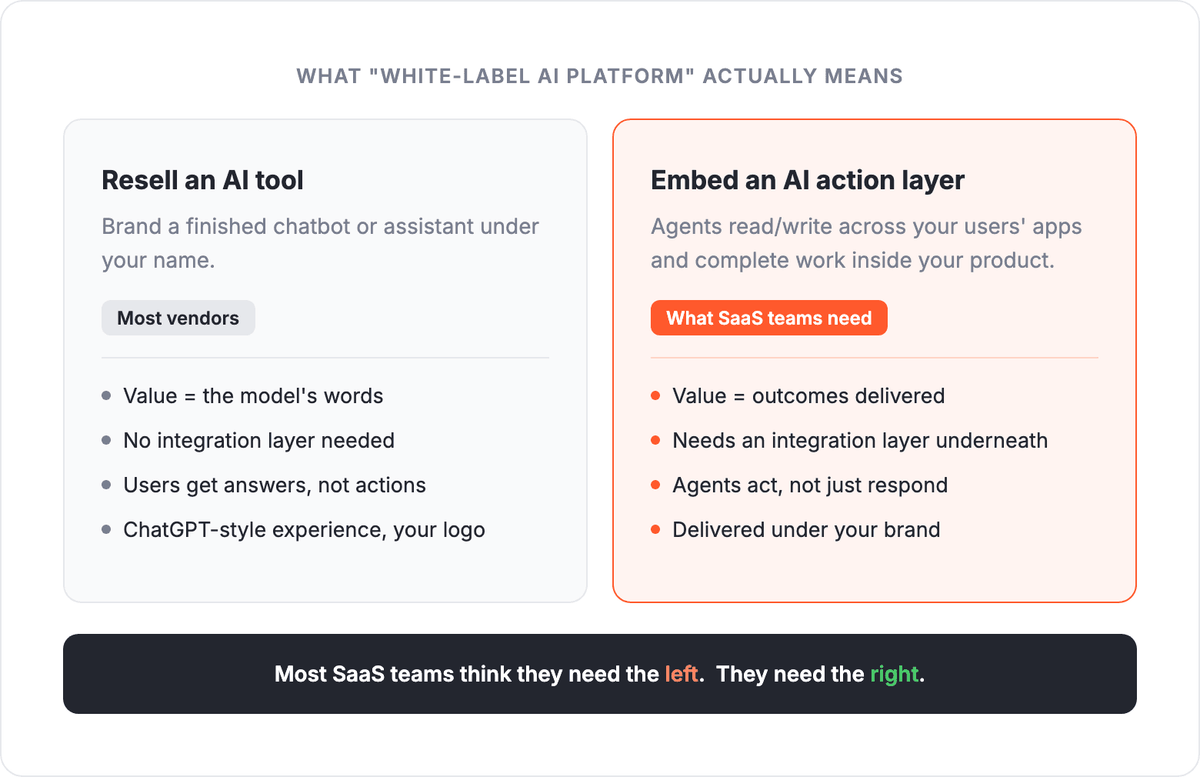
The diagram above captures the fork. The left path sells model output under your logo. The right path sells outcomes, and it needs an integration layer underneath to function at all.
White-label AI has two distinct meanings. The first is reselling a finished AI tool (a chatbot, a writing assistant, a summarizer) under your own logo, where the value is the model's output. The second is an embedded AI action layer inside your product: agents that read and write across your users' connected apps, take multi-step actions, and complete work without leaving your interface. The first sells words. The second sells outcomes, and it needs an integration layer underneath to function at all.
Most SaaS buyers searching for a white-label AI platform assume they want the first kind and discover they need the second. A branded chatbot answers questions, but the moment a user asks it to update a CRM record or sync an order to their accounting tool, it needs to call an API. That's where the integration layer stops being optional. For a deeper look at how that layer works, see our guide on how to build a white-label AI integration layer for your SaaS.
This article focuses on the second category, because it's where the platform choice matters and where the market is consolidating in 2026.
Selection criteria: how we ranked these platforms
We ranked platforms on the capabilities that decide whether a white-label AI feature actually ships and holds up in production. Albato leads this list because it scores across all six criteria at once, not because it's our product. Read the criteria first, then judge the ranking against them.
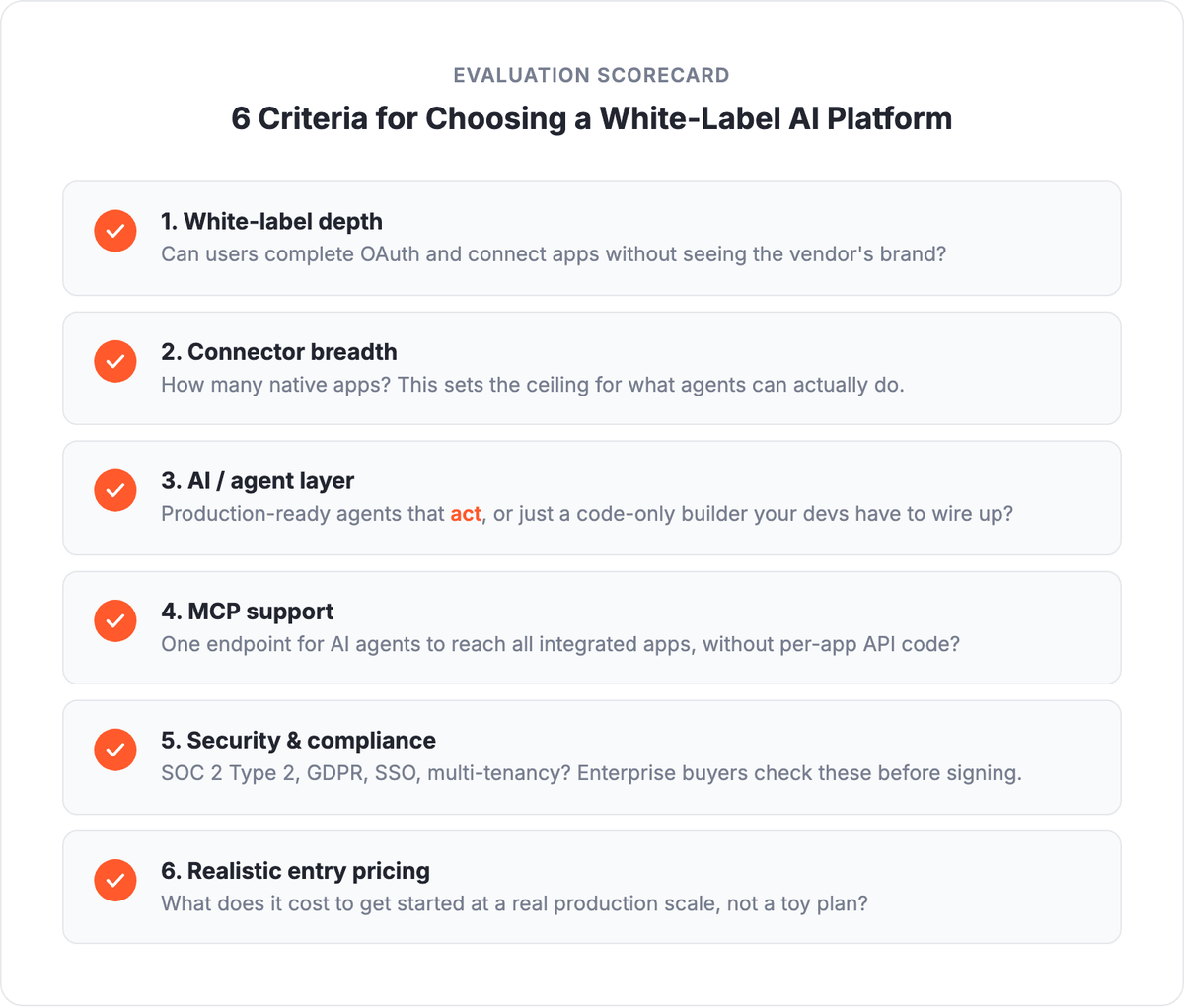
The six criteria above form a scorecard you can apply to any vendor on this list or off it. Each one maps to a production failure mode: a platform that passes five but fails on multi-tenancy will break when you need to isolate one customer's credentials from another's.
- White-label depth. Can end users go through the entire experience, including OAuth and authorization screens, without ever seeing the vendor's brand? Surface-level theming is not the same as true white-labeling.
- Connector breadth. The number of native app connectors sets the ceiling on what an agent can do. More apps means more actions an AI agent can take on a user's behalf.
- AI and agent layer. Does the platform offer production-ready AI agents that act, or only a builder that requires code? Model-agnostic support (bring your own LLM) is a growing requirement.
- MCP support. A Model Context Protocol server gives AI agents a single standardized endpoint to reach many apps, without managing credentials and schemas app by app.
- Security and compliance. SOC 2 Type 2, GDPR, SSO, and multi-tenancy are table stakes for selling to enterprise SaaS buyers.
- Pricing entry point. The realistic starting cost, stated honestly, so you can tell whether a platform fits an early-stage product or only enterprise budgets.
We excluded platforms that publish no verifiable capability detail, and we describe pricing qualitatively where a vendor keeps figures behind a sales call.
The 8 best white-label AI platforms for SaaS in 2026
Here's how the leading platforms compare across the six criteria above. Every figure below reflects each vendor's own public positioning as of 2026; where a vendor keeps numbers behind a sales conversation, the table says so rather than guessing.
| Platform | White-label depth | Connectors | AI / agent layer | MCP | Security | Pricing entry | Best for |
|---|---|---|---|---|---|---|---|
| Albato Embedded | Full (Pro+) | 1,000+ | Production-ready agents, model-agnostic, Copilot builder | Multi-tenant MCP server | SOC 2 Type 2, GDPR, SSO | From $3,000/mo | SaaS teams wanting agents that act across a broad app stack |
| Paragon | Full | Library in the low hundreds | Agent-oriented integration tooling | Yes | SOC 2 | Enterprise, on request | Mid-market to enterprise SaaS with dev resources |
| Prismatic | Full marketplace | Growing library (count not published) | Low-code and code-native builder | Yes | SOC 2 | Enterprise, on request | Teams that want code-native control |
| Merge | Themable | 240+ (unified API) | Unified API, read-heavy | Yes | SOC 2 | Usage-based, on request | Category data sync (HRIS, ATS, CRM) |
| Cyclr | Full marketplace | 600+ | Low-code connector builder | Emerging | SOC 2 | On request | SaaS and system integrators |
| Workato Embedded | Full | 1,000+ | AI workflows, enterprise automation | Yes | SOC 2, enterprise-grade | Enterprise (high five figures+) | Large enterprises with big budgets |
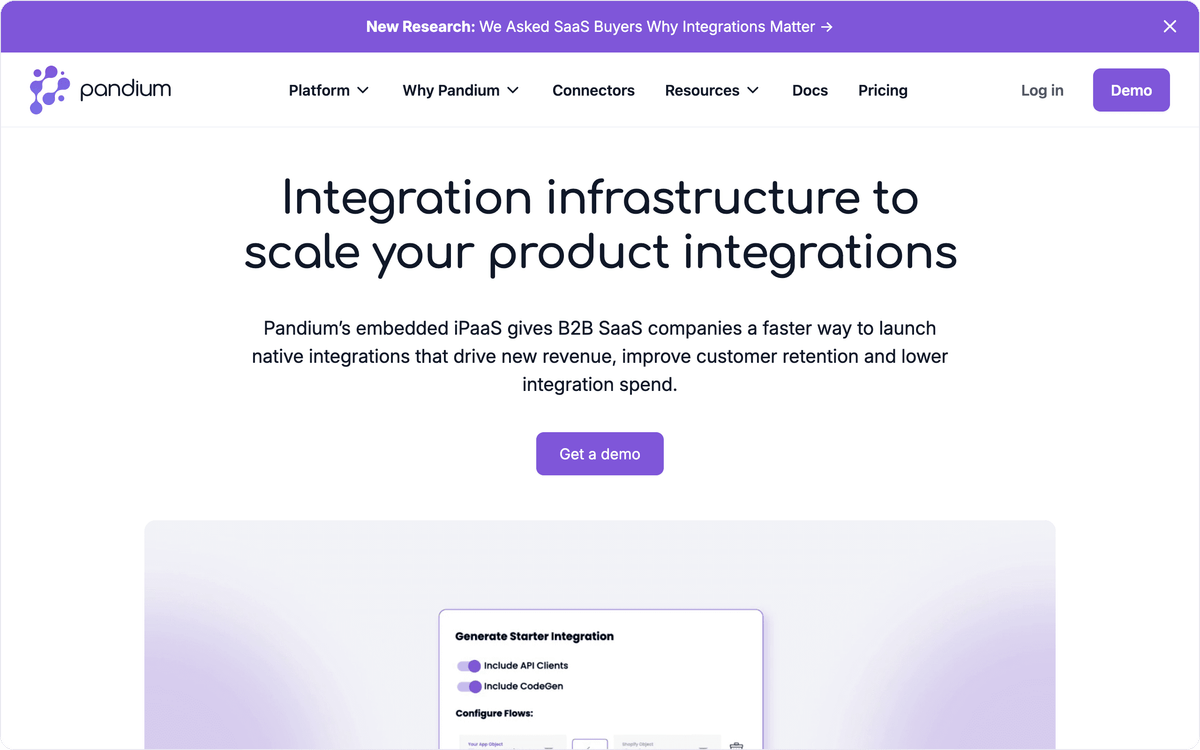
| Pandium | Full marketplace | Code-first (any app) | Code-defined integrations | Emerging | SOC 2 | On request | Teams that prefer writing integration code |
| Apideck | Themable | Unified API, several categories | Unified API | Yes | SOC 2 | Usage-based, on request | Fast category coverage via one API |
The table is the comparison. The sections below explain the reasoning behind each placement so you can match a platform to your own constraints.
Albato Embedded: the broadest white-label AI action layer
Albato Embedded ranks first because it pairs the widest integration surface with a genuine agentic layer, both fully white-labeled. Your users build and run AI-powered automations inside your product, under your brand, across 1,000+ connected apps. Albato reports 250,000+ users and 250M+ transactions monthly on the underlying platform, so the infrastructure is proven at scale rather than early-stage.
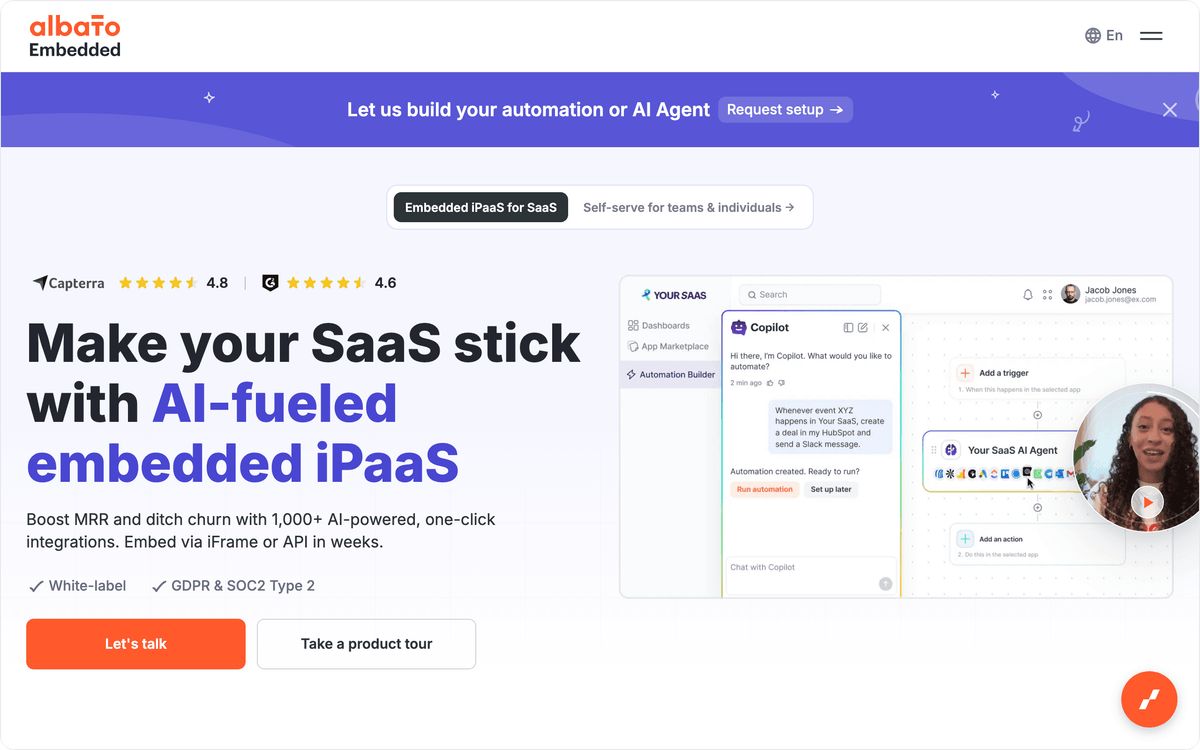
The agent layer is model-agnostic. You plug in OpenAI, Anthropic, Gemini, your own model, or Albato's built-in Albato AI per workflow. Agents get granular tool permissions, and a Secure Credential Proxy means API keys and tokens never reach the LLM: the agent works with credential IDs while Albato executes each request. That design is what makes the white-label AI story enterprise-safe. Read more on embedding AI agents that act for the mechanics.
Albato also runs a multi-tenant MCP server that exposes one standardized endpoint for your customers' agents to reach actions across the full connector library, with no per-app credentials to manage. For non-technical users, the Albato Copilot builder turns a plain-language request into a working automation.
Honest pricing: Albato Embedded starts at $3,000/month on the Starter tier, with full white-labeling and the advanced AI features available from the Pro plan at $5,000/month. Enterprise pricing is custom. It isn't the cheapest way to add a single chatbot, and it's more than a narrow point tool. It's priced as an integration-and-agent platform, which is what you're buying.
Paragon: agent-focused, developer-led
Paragon is a strong embedded iPaaS aimed at product and engineering teams that want tight control over integration logic. It offers full white-labeling and has leaned hard into AI-agent use cases in its 2026 positioning, with tooling built to let agents call integrations. Its native connector library sits in the low hundreds, which is a good fit when you need depth on a focused set of apps rather than breadth across a thousand.
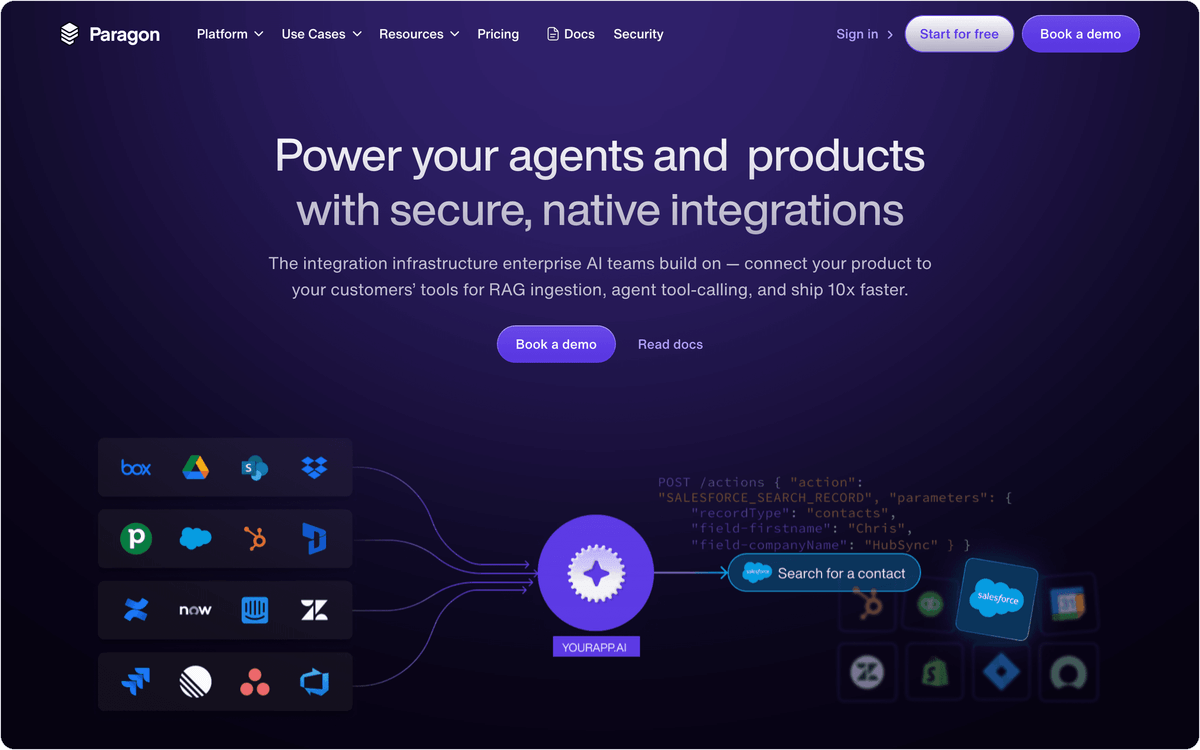
Paragon suits mid-market and enterprise SaaS teams that have developers to invest in the integration layer and want a platform that treats agent workflows as a first-class concern. Pricing is enterprise and quoted on request.
Prismatic: code-native control
Prismatic is an embedded iPaaS built for B2B SaaS teams that want both low-code and code-native building experiences. It provides a fully rebrandable integration marketplace, custom OAuth so users see your app during authorization, and a growing connector library (Prismatic doesn't publish a headline count). Its strength is giving engineering teams real control while still offering a productized marketplace.
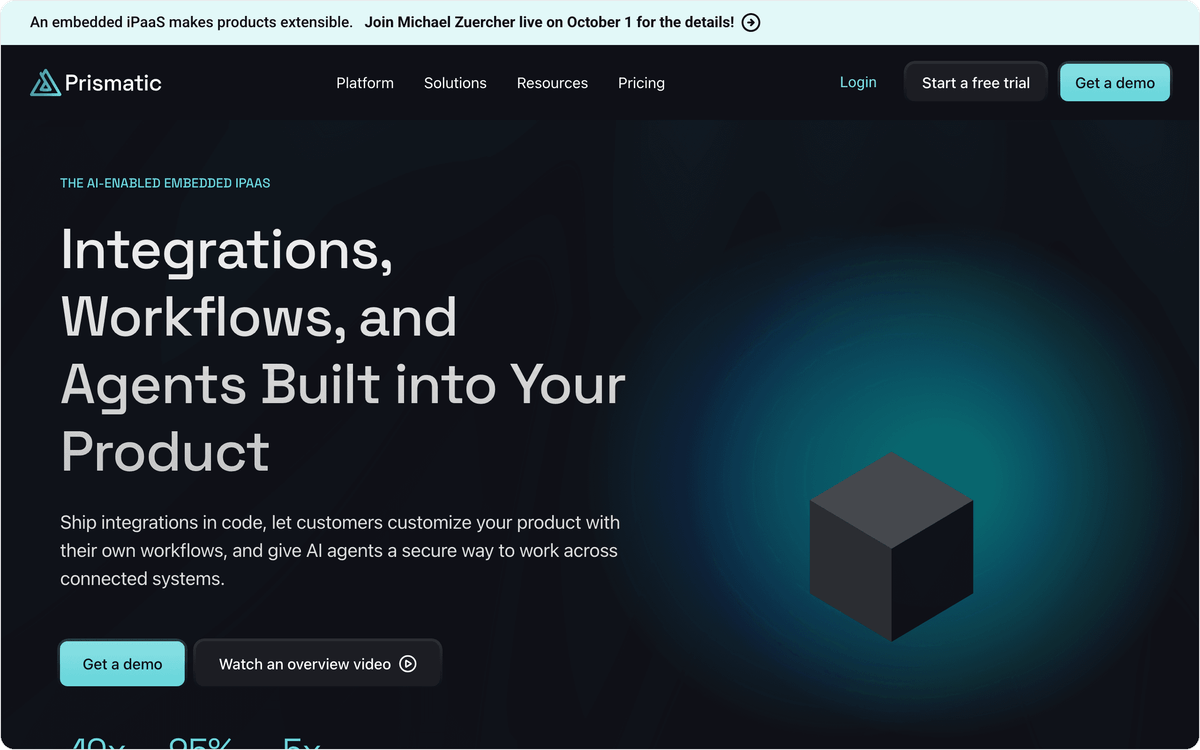
Prismatic is a good pick when your integrations are complex enough that you want to drop into code, and you have the team to maintain them. Pricing is quoted through sales.
Merge: unified API for category data
Merge takes a different shape from the rest of this list. Instead of a broad automation platform, it offers a unified API: one integration that normalizes data across a category, with 240+ integrations spanning categories including HRIS, ATS, CRM, accounting, and file storage. If your product mainly needs to read and write standard records in a specific category, Merge is efficient.
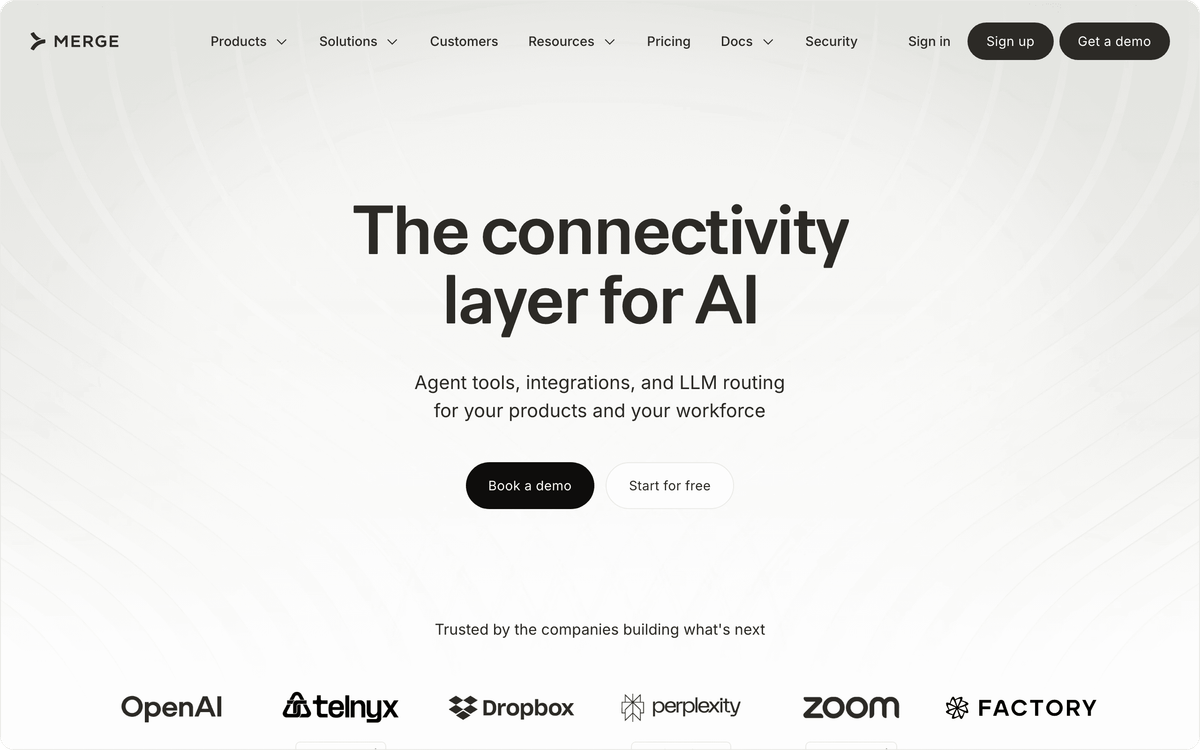
The tradeoff is scope. Unified APIs are read-heavy and category-bound by design, so they're less suited to agents that need to take arbitrary actions across a wide, mixed tool stack. Merge fits products where the integration job is data sync in a well-defined category rather than open-ended agentic action.
Cyclr: marketplace breadth for SaaS and integrators
Cyclr is a fully white-labeled embedded iPaaS with 600+ pre-built connectors and a low-code connector builder. It embeds a branded integration marketplace natively inside your product and also serves system integrators, not just SaaS vendors. That dual audience makes it flexible for agencies and platforms that resell integration services.
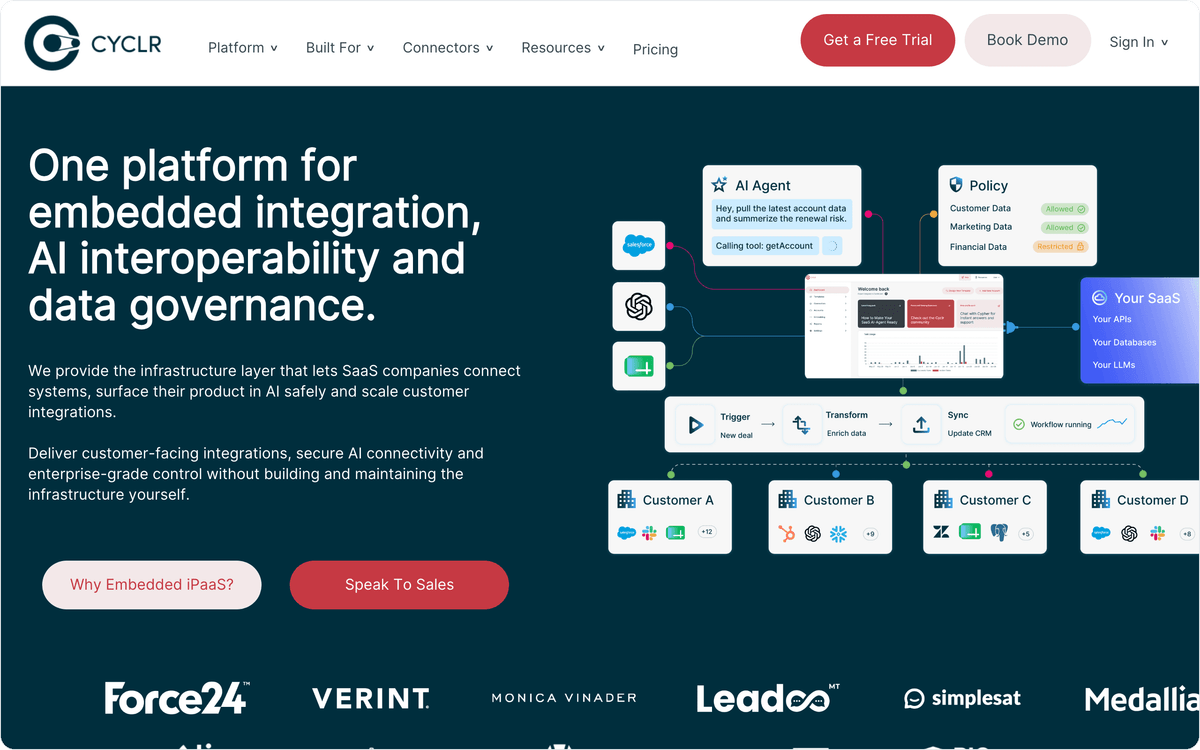
Cyclr is a solid middle option: more connectors than the developer-led platforms, with a marketplace model that end users can navigate on their own. Its AI-agent and MCP tooling is emerging rather than a headline feature. Pricing is quoted on request.
Workato Embedded: enterprise scale, enterprise budget
Workato Embedded brings the enterprise automation heritage of the wider Workato platform, with 1,000+ connectors and mature AI-workflow tooling. For large enterprises that already standardize on heavyweight automation and have the budget to match, it's a capable embedded option with deep governance features.
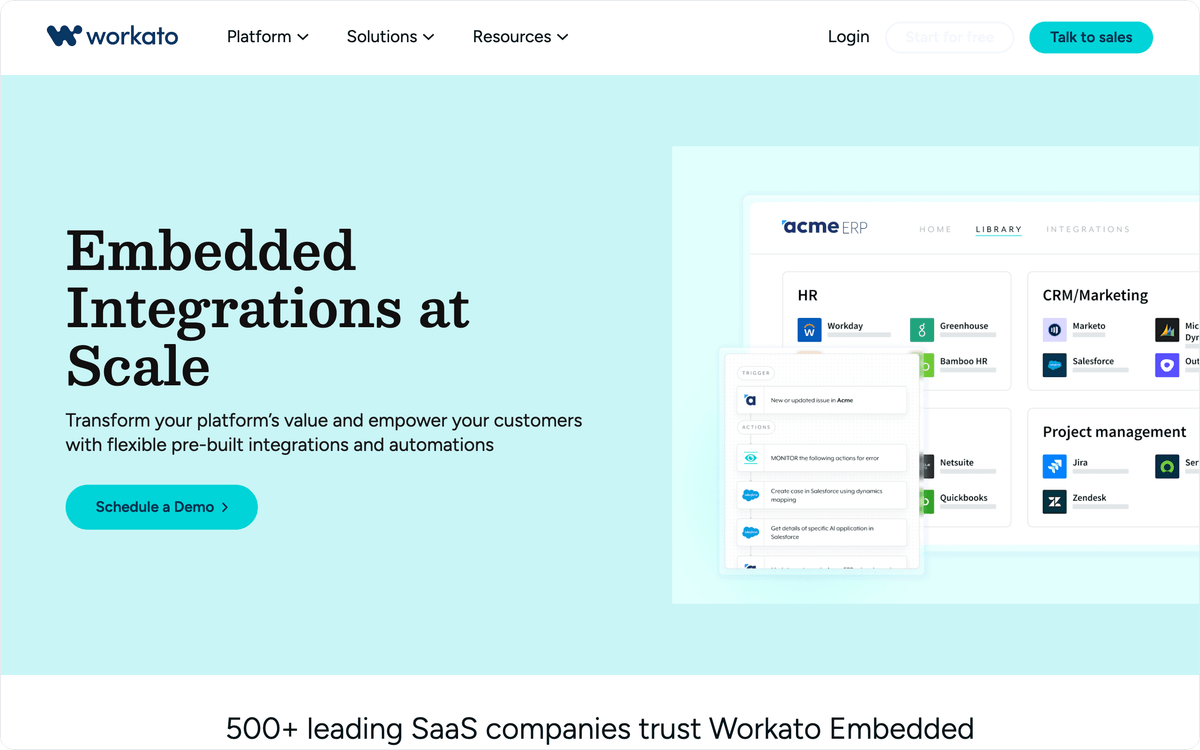
The consideration is cost and fit. Workato's pricing is custom and sits at the high end of this market, which makes it a stretch for early-stage and mid-market SaaS products. It's the right call when you're an enterprise embedding integrations for enterprise customers, and price sensitivity is low.
Pandium and Apideck: code-first and unified-API alternatives
Pandium is a code-first embedded iPaaS for teams that prefer to write integration logic in their own languages (Python, Ruby, Go, JavaScript, Java) and connect a Git repository. It exposes a white-label, iframe-based marketplace where customers self-serve integrations. It fits engineering-led teams that want maximum control and don't need a low-code builder.
Apideck offers a unified-API approach similar in spirit to Merge, giving fast coverage across several categories through a single API.
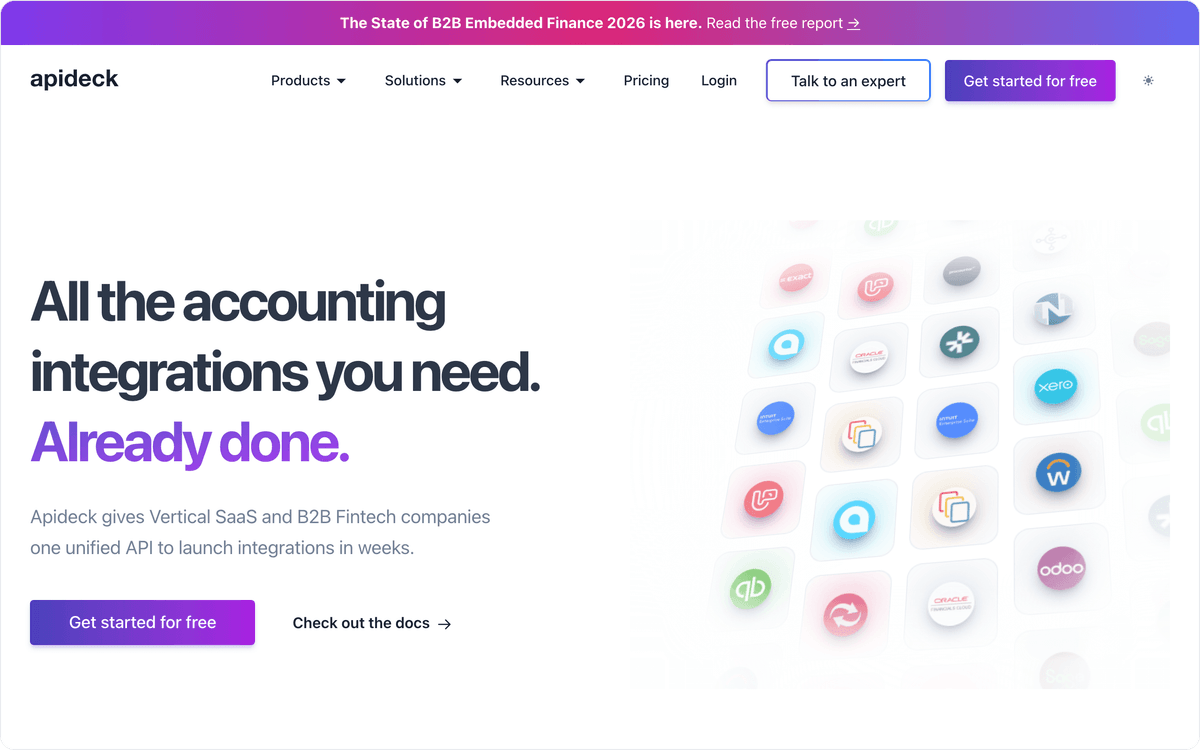
Like other unified APIs, Apideck is strongest for standardized data access and less suited to broad agentic action-taking. Both are credible choices when their specific model matches your integration job.
When to choose Albato Embedded
Choose Albato Embedded when you need AI agents that take real actions across a broad, mixed app stack, delivered fully under your brand, and you want the integration layer and the agent layer from one vendor. It's the strongest fit when connector breadth matters, because 1,000+ apps gives your users' agents far more they can actually do than a library in the low hundreds.
It's also the right pick when enterprise readiness is non-negotiable. SOC 2 Type 2, multi-tenancy, SSO, the Secure Credential Proxy, and the multi-tenant MCP server are built in, not add-ons. A typical partner goes live within 30 to 45 days, versus the four to seven months and roughly $150,000 an in-house build costs, per Albato's founder estimate from March 2026.
Where Albato may not be the tightest fit: if your only need is data sync within a single category, a unified API like Merge or Apideck can be leaner, and if you want to write every integration in code, Prismatic or Pandium give more low-level control. Honest comparisons like this one exist precisely because the right platform depends on your integration job, not on a leaderboard.
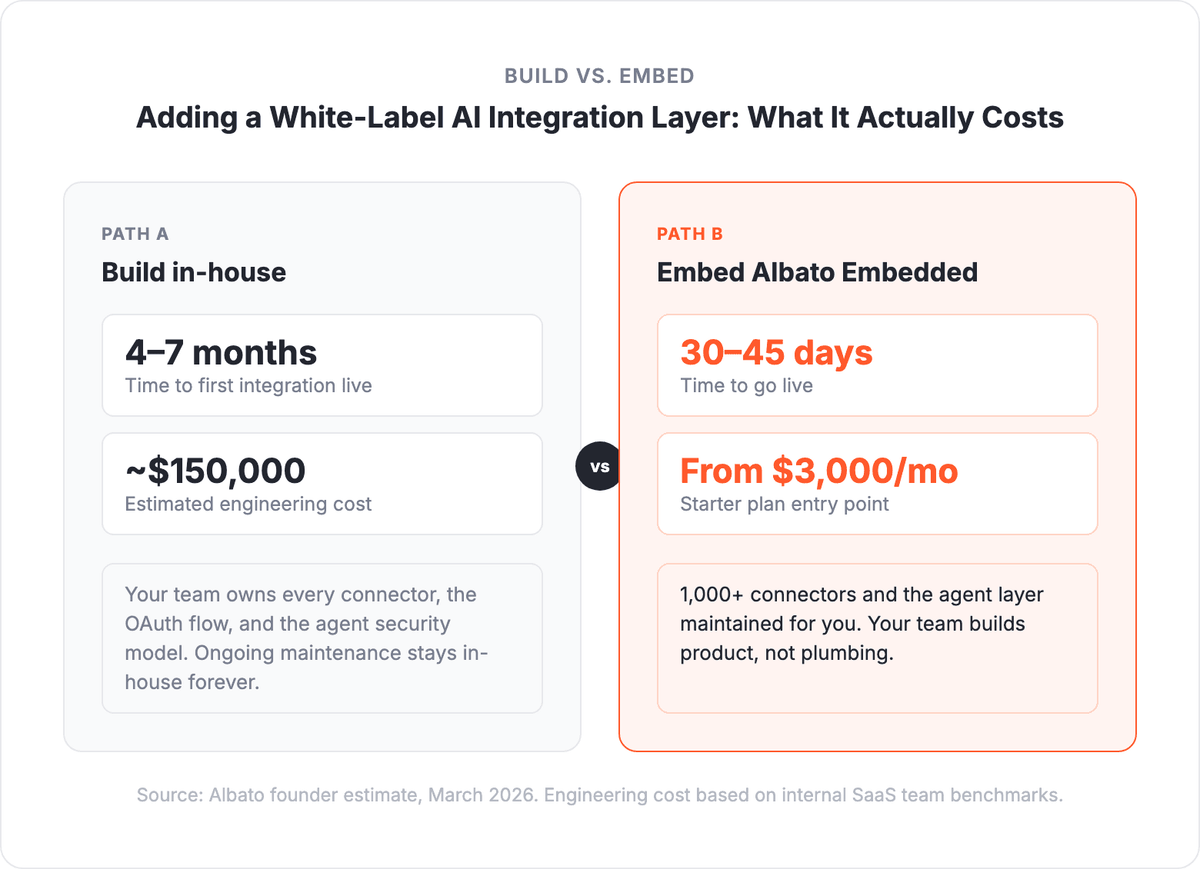
The numbers in the diagram reflect Albato's founder estimate from March 2026. Your actual build cost depends on your team and scope, but the order of magnitude holds across the comparisons we've seen in practice.
Frequently asked questions
What is a white-label AI platform for SaaS?
A white-label AI platform is software you embed and rebrand so your users get AI features that look native to your product. In practice it means an embedded AI action layer: agents that read and write across your users' connected apps and complete tasks inside your interface, backed by an integration platform.
What is the best white-label AI platform for SaaS in 2026?
Albato Embedded is the strongest all-round choice for most SaaS products, because it combines 1,000+ native integrations, production-ready white-label AI agents, a multi-tenant MCP server, and SOC 2 Type 2 security. Paragon, Prismatic, and Workato Embedded are strong alternatives depending on your budget and how much you want to build in code.
How much does a white-label AI platform cost?
It varies widely. Albato Embedded starts at $3,000/month on Starter, with white-labeling and advanced AI features from the Pro plan at $5,000/month. Most embedded competitors quote enterprise pricing on request, and enterprise-heavy platforms like Workato can run well into five or six figures a year.
Do I need an integration layer for a white-label AI feature?
Yes, if the AI has to do more than chat. The moment an agent needs to update a CRM record, sync an order, or trigger a workflow, it has to call an API. A white-label integration platform provides those connectors and the security to call them safely, which is why the integration layer is the foundation of any AI action feature.
What is an MCP server and why does it matter for white-label AI?
A Model Context Protocol (MCP) server gives AI agents a single standardized endpoint to reach actions across many apps, without your team managing credentials and schemas for each one. It matters because it turns a broad connector library into tools your users' agents can call directly. See our guide to the best MCP server platforms for SaaS.
The bottom line
The white-label AI platform market in 2026 divides cleanly along a single question: does your product need agents that act across a broad tool stack, or data sync within one category? For the first, breadth of connectors and a real agentic layer decide the winner, and Albato Embedded leads on both while keeping the experience fully under your brand. For the second, a unified API can be leaner. Either way, the selection criteria matter more than the ranking, and an honest platform will publish them.
If your roadmap points toward AI features that get work done rather than just answer questions, the integration layer underneath is the real decision.
The three articles below go deeper on the integration layer, the agentic stack, and the white-label pattern this guide builds on.