
In this article
Key Takeaways
- Salesforce Revenue Cloud leads for enterprise teams already on Salesforce CRM, with quoting, subscriptions, and billing in one platform from $150/user/month.
- DealHub is the top pick for mid-market B2B SaaS, rated #1 on G2 (4.7/5 across 833 reviews) with no-code RevOps ownership.
- HubSpot Revenue Hub wins for teams already on HubSpot CRM, with CPQ built directly into the deal record from $85/seat/month.
- PandaDoc and Proposify cover quote-to-sign workflows for SMBs that do not need full product configurator complexity.
- Gartner forecasts that more than 60% of B2B sales organizations will use cloud CPQ by end of 2026.
CPQ software helps B2B sales teams configure complex products, apply accurate pricing rules, and generate branded quotes without spreadsheets or manual approvals. The nine tools below cover every segment: enterprise, mid-market, SMB, and manufacturing. Salesforce Revenue Cloud for enterprise-scale organizations, DealHub for mid-market RevOps teams, HubSpot Revenue Hub for existing HubSpot shops, and Proposify for lightweight proposal-focused quoting.
Comparison Table: 9 CPQ Tools at a Glance
Here is the fast version. Pricing reflects each vendor's entry paid tier as listed in September 2026. Verify the current tier on the vendor site before you buy, since these plans change often.
| Tool | Best for | Key feature | Pricing start | Albato integration |
|---|---|---|---|---|
| Salesforce Revenue Cloud | Enterprise / complex revenue | Quote + billing + subscriptions in one | $150/user/month | Yes |
| DealHub | Mid-market B2B SaaS | No-code RevOps, guided selling | Custom (from ~$60/user/month) | No |
| HubSpot Revenue Hub | HubSpot CRM users | CPQ inside deal record | $85/seat/month | Yes |
| PandaDoc | SMB quote-to-sign | Document + CPQ + eSign | Free; Business $49/user/month | Yes |
| Proposify | Proposal-focused SMB | Branded proposals + approval flows | $19/user/month (annual) | No |
| QuoteWerks | IT resellers and MSPs | Concurrent-user licensing | $50/user/month | No |
| Conga CPQ | Salesforce-heavy enterprise | Salesforce-native, contract lifecycle | Custom (from ~$35/user/month) | No |
| Epicor CPQ | Manufacturing / 3D config | 2D and 3D visual product configurator | $150/user/month | No |
| Zuora CPQ | Subscription billing companies | Subscription-native quoting | Custom pricing | No |
The table sorts by segment, not by a single overall winner, because the right CPQ tool depends entirely on your CRM, product complexity, and whether quoting or billing is the harder problem.
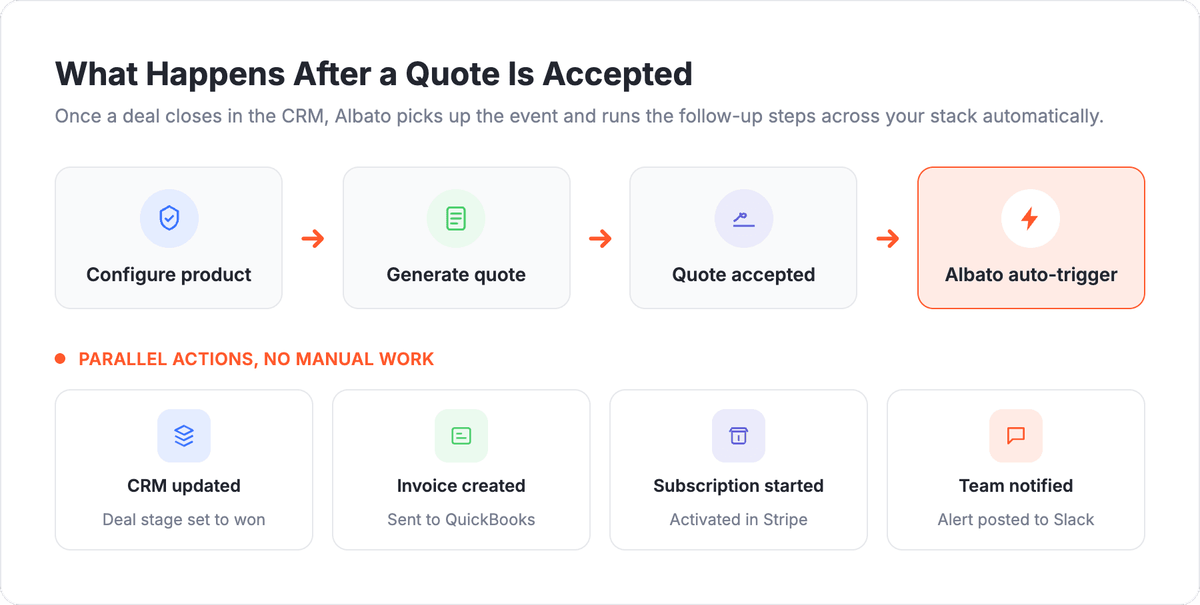
Before the tool breakdowns, here is what happens downstream once a quote is accepted. The chain below is the part most sales teams still run by hand.
Salesforce Revenue Cloud
Salesforce Revenue Cloud is the default enterprise pick for teams whose system of record is already Salesforce. It folds quoting, subscriptions, and billing into the same data model the sales team runs on every day.
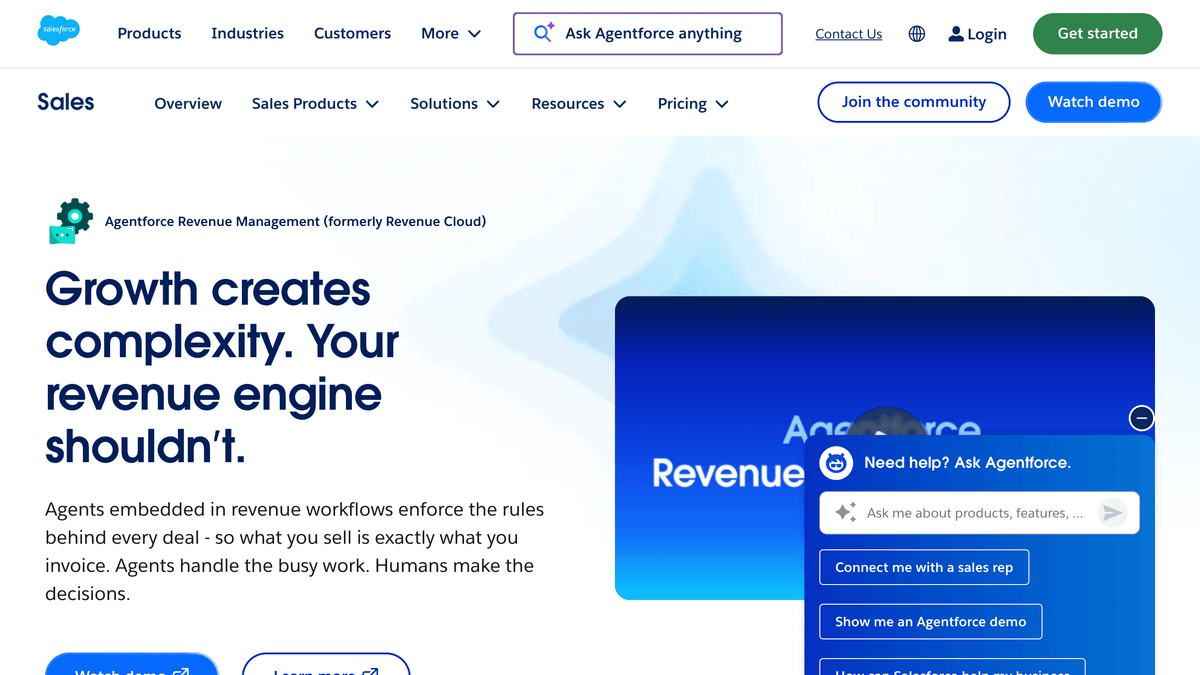
Salesforce Revenue Cloud brings quoting, subscription management, and billing into a single platform built on top of the Sales Cloud data model. It replaced the legacy Salesforce CPQ product in 2025, so new customers now buy Revenue Cloud rather than the older CPQ SKU.
The core strength is data continuity. Because the quote lives on the same object as the opportunity, sales reps never re-enter customer or product data. Complex pricing rules, product bundles, and approval chains are configured in the admin UI without custom code. The Advanced tier adds usage-based consumption billing and an accounting subledger, which matters for SaaS companies that mix subscription and metered revenue.
📊 Stat. The 2026 Gartner Magic Quadrant for Configure, Price and Quote Applications names Oracle, SAP, Tacton, Infor, and Conga as Leaders. Salesforce Revenue Cloud competes in the same enterprise CPQ segment.
Revenue Cloud also connects to Salesforce's broader platform: Slack notifications when a quote is approved, Einstein AI to flag price overrides, and Flow automations that trigger downstream processes the moment a contract is signed.
Albato integration: Albato connects to Salesforce with 9 triggers (including "Opportunity updated" and "Record created") and 23 actions. When a quote moves to "Closed Won" in Revenue Cloud, Albato can auto-create a subscription record in Stripe, post a deal alert to Slack, or push the new customer into QuickBooks for invoicing without any manual steps.
Pricing: Revenue Cloud Growth at $150/user/month, Advanced at $200/user/month (both billed annually). The billing tier is custom pricing.
DealHub
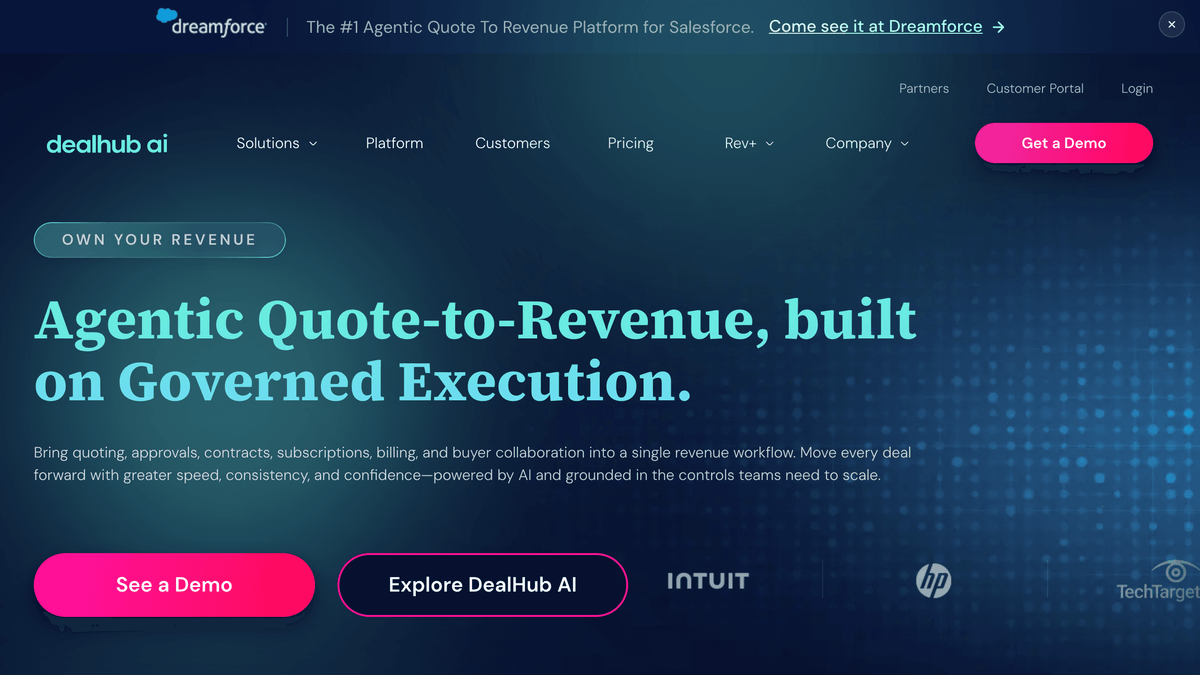
DealHub holds the top-ranked CPQ position on G2 for 2026 with a 4.7/5 score across more than 833 verified reviews. Its design principle is that RevOps teams, not developers, should own the quoting process, so the entire product catalog, pricing rules, and approval workflows are managed in a no-code interface.
The guided selling feature walks sales reps through a questionnaire when building a quote. Based on answers about company size, use case, and contract term, DealHub automatically surfaces the correct product bundle and pricing tier. For mid-market SaaS companies with multiple editions, add-ons, and annual-vs-monthly options, this eliminates the most common quoting errors.
DealHub's DealRoom is a shared digital workspace where buyers and sellers collaborate on the quote, negotiate terms, and sign the contract without switching tools. Deal analytics show which sections prospects spend the most time on, which supports better follow-up conversations.
💡 Tip. DealHub covers CPQ, Contract Lifecycle Management (CLM), Subscription Management, and Billing in one platform. Buying the full suite can reduce total cost compared to stitching separate point solutions together.
Albato does not currently offer a direct DealHub connector, but DealHub integrates natively with Salesforce, HubSpot, and Microsoft Dynamics, which Albato supports. Workflows triggered by a "deal closed" event in those CRMs can still fire downstream automations in billing and notification tools via Albato.
Pricing: Custom quote-based. Typical range for mid-market teams starts around $60-83/user/month based on market data from Vendr and SelectHub. A minimum contract applies.
HubSpot Revenue Hub
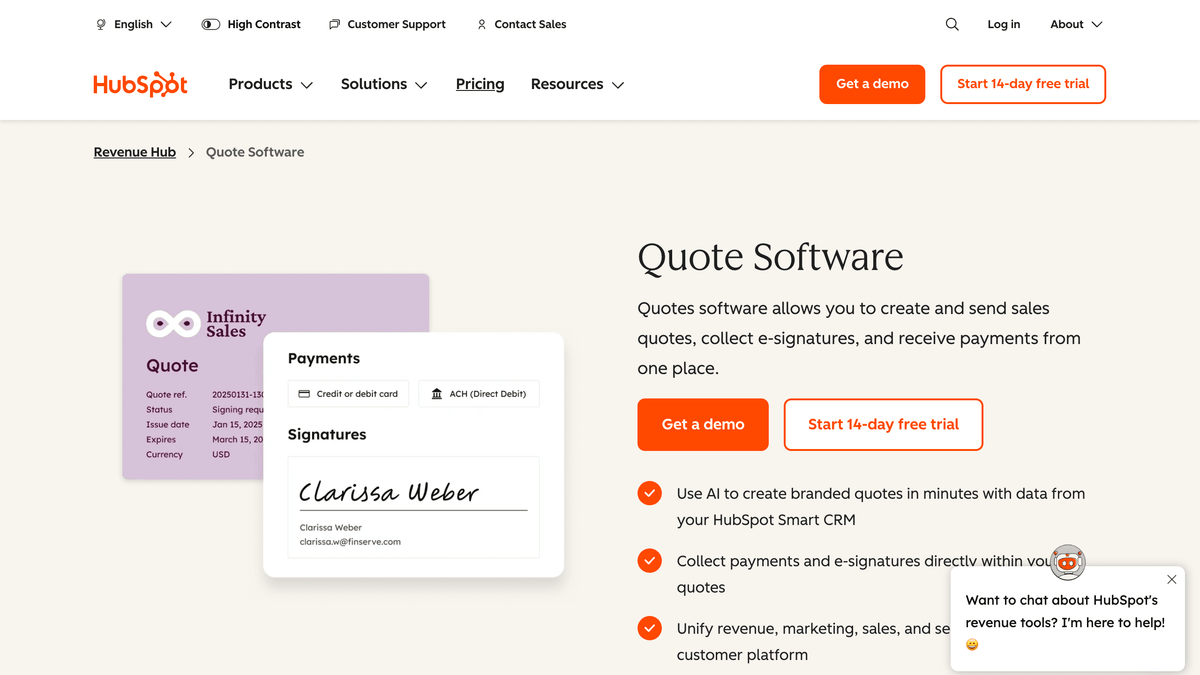
HubSpot Revenue Hub (previously Commerce Hub) adds CPQ directly to the HubSpot Sales Hub deal record. For teams already running pipeline in HubSpot, this is the lowest-friction path to structured quoting because there is no data migration, no separate quoting tool to log into, and no manual sync between systems.
Sales reps configure product lines, apply discounts, and set payment terms from the same page where they manage the deal. The Professional tier supports complex pricing rules and quote approval workflows. Enterprise adds multi-approver chains with up to 10 approvers and 5 sequential approval steps, which covers most mid-market governance requirements.
HubSpot's native payment processing accepts credit cards, ACH, and Stripe payments directly from the quote. Subscriptions created at quote acceptance automatically appear in the HubSpot billing dashboard, so finance sees recurring revenue without a separate spreadsheet.
⚠️ Important. HubSpot Revenue Hub CPQ is deeply tied to the HubSpot CRM data model. Teams running a different CRM as their system of record will find the native quoting experience less useful. In those cases, PandaDoc or DealHub with a CRM integration is a better fit.
Albato integration: Albato connects to HubSpot with 21 triggers and 67 actions. When a quote is accepted in Revenue Hub, Albato can trigger an invoice in QuickBooks, push a new subscription to Chargebee, or notify the finance team in Slack automatically.
Pricing: Revenue Hub Professional at $85/seat/month (annual) or $95/month billed monthly. Enterprise at $140/seat/month (annual).
PandaDoc
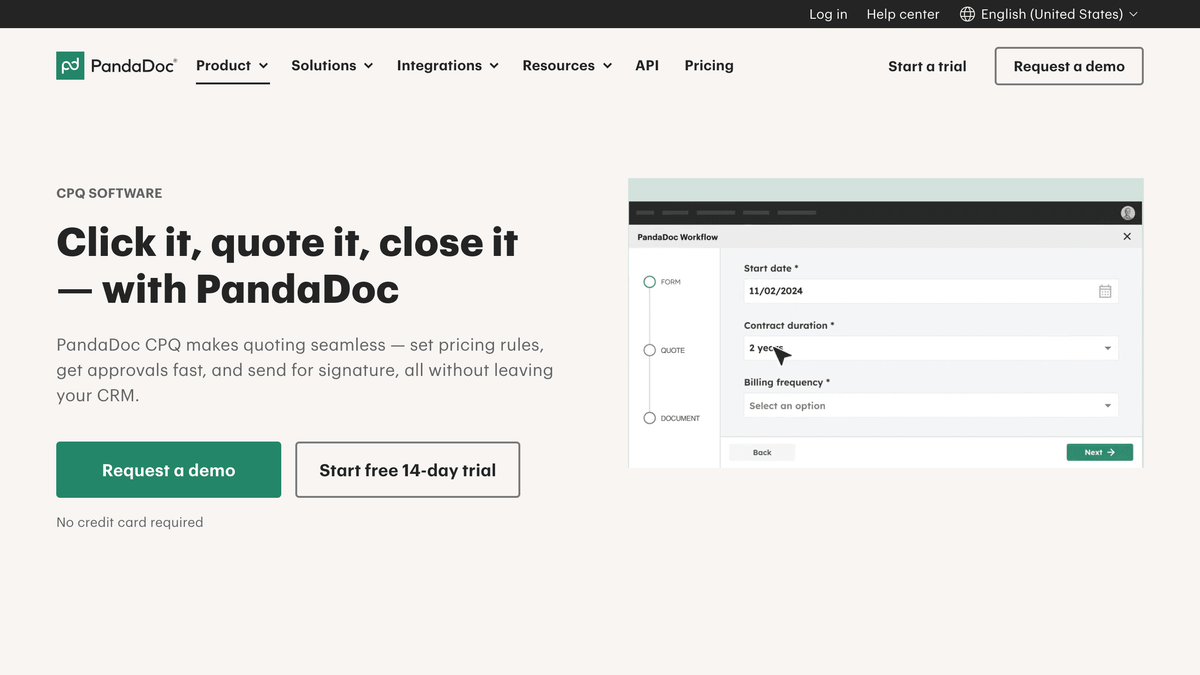
PandaDoc started as a proposal and document tool, and its CPQ layer sits on top of that document-first foundation. The practical result is that quotes look polished without design work. Product tables, pricing rules, discount thresholds, and e-signature blocks all live inside the same document template that marketing approved.
CPQ features in PandaDoc (configure rules, pricing automation, approval workflows, and API access) are available on the Enterprise tier. For teams that primarily need clean proposals with some pricing structure, the Business tier at $49/user/month covers most use cases. Full CPQ with approval chains and API-driven pricing requires the custom-priced Enterprise plan.
PandaDoc connects natively to Salesforce, HubSpot, Pipedrive, and Zoho CRM. When a rep creates a document from a CRM record, contact and deal data populates automatically. When the document is signed, PandaDoc triggers a "Document Paid" or "Document state changed" event.
💡 Tip. PandaDoc is not a substitute for a full product configurator. Teams with hundreds of SKUs, complex bundle logic, or usage-based pricing tiers will find its CPQ capabilities limiting. For straightforward B2B services quotes, however, PandaDoc covers the full cycle from configure to sign to collect.
Albato integration: Albato connects to PandaDoc with 6 triggers including "Document state changed" and "Document Paid," plus 7 actions including "Create document" and "Create Contact." When a PandaDoc proposal is signed, Albato can create a deal in Salesforce, update the HubSpot contact status, or send a payment link via Stripe.
Pricing: Free eSign plan (limited to 5 documents/month). Starter at $19/user/month (annual). Business at $49/user/month (annual). Enterprise on custom pricing.
Proposify
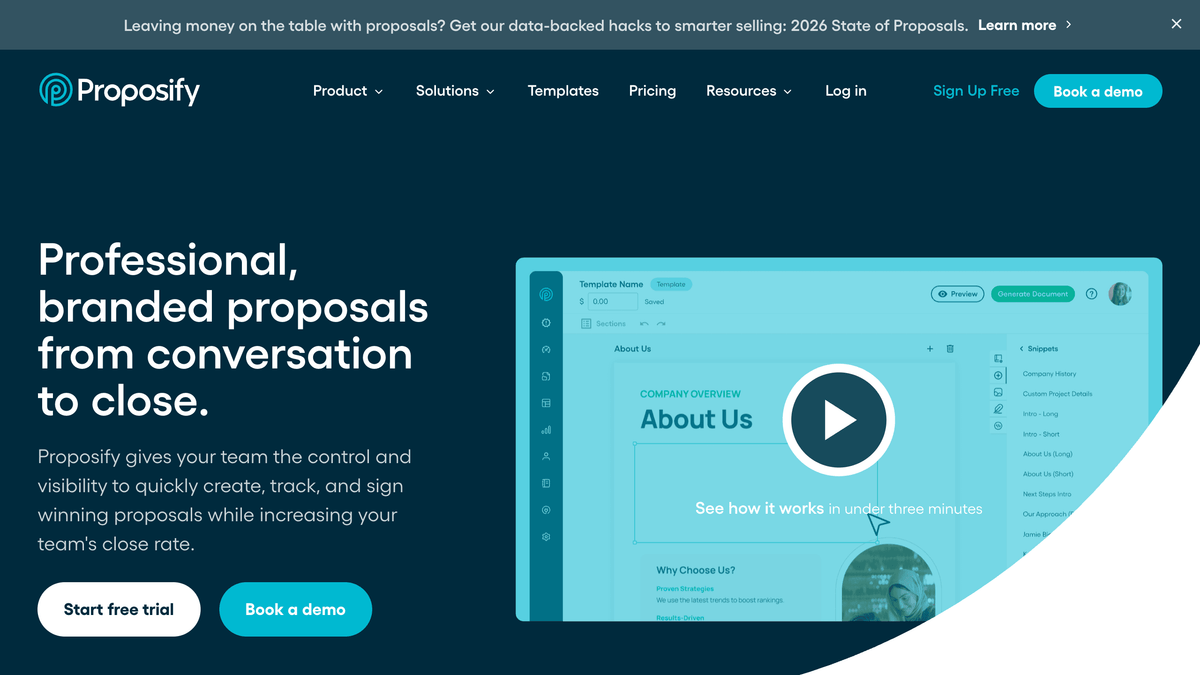
Proposify focuses entirely on the proposal and quote experience rather than trying to be a full revenue platform. Its main advantage is a design-forward editor where sales reps work within templates that match brand guidelines, and the drag-and-drop layout means no dependency on design or marketing for each new proposal.
The analytics dashboard shows prospect engagement: how long they spent on each section, which pricing option they viewed most, and whether they forwarded the document internally. These signals help sales prioritize follow-ups. The Team plan adds CRM sync, so proposal status updates appear in Salesforce or HubSpot without manual logging.
Proposify works well for professional services, agencies, and consulting firms where the proposal presentation is a significant part of winning business. It is less suited for companies with complex product catalogs that need guided selling or nested bundle configuration.
📊 Stat. Proposify's Business plan requires a minimum contract of $3,900/year, which works out to about $325/month for smaller teams. At that floor, it competes directly with mid-market tools on cost.
Albato does not currently offer a direct Proposify connector. Teams using Proposify alongside a CRM that Albato does support can still build trigger-based automations from the CRM's "deal closed" events to downstream billing, ERP, or notification tools.
Pricing: Basic at $19/user/month (annual), Team at $41/user/month (annual), Business at custom pricing from $3,900/year minimum, Enterprise at custom pricing.
QuoteWerks
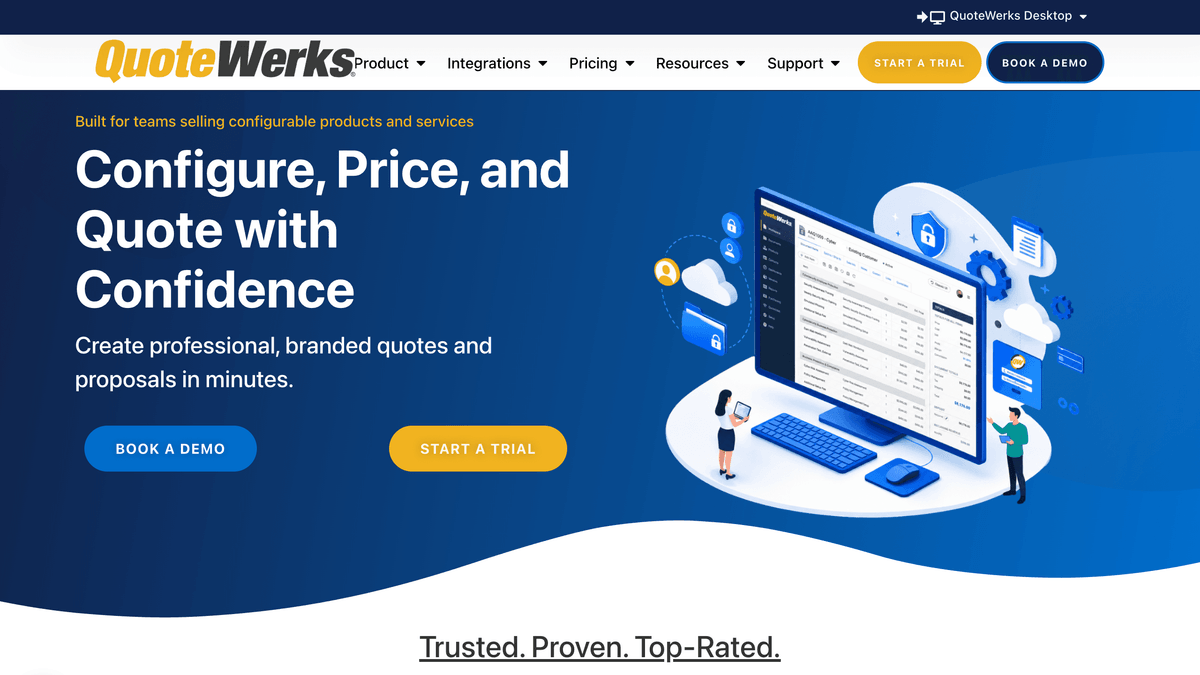
QuoteWerks is a dedicated quoting tool built specifically for IT resellers, managed service providers, and value-added resellers who deal with large product catalogs from distributors like Ingram Micro, TD SYNNEX, and SHI. Its distributor data feed integration is the main reason IT channel teams choose it over more general CPQ tools.
The concurrent-user licensing model is genuinely different from per-seat SaaS: you buy a number of simultaneous users rather than named seats. A team of 20 sales reps who rarely quote at the same time can share 5 concurrent licenses, which cuts licensing costs significantly.
QuoteValet, included with the Balanced and Pinnacle plans, is a digital storefront where customers view their quote, ask questions, accept the proposal, and pay. This covers the same ground as PandaDoc's document experience but stays native inside QuoteWerks.
⚠️ Important. QuoteWerks is a Windows desktop application with a web browser interface option. Teams expecting a modern cloud-native SaaS experience should evaluate DealHub or HubSpot Revenue Hub first.
Albato does not currently offer a direct QuoteWerks connector. Teams can route QuoteWerks output through integrated CRMs (QuoteWerks connects natively to Salesforce, Zoho, and ConnectWise) and pick up automation from those CRM events.
Pricing: Essential at $50/user/month (concurrent), Balanced at $78/user/month, Pinnacle at $102/user/month. Annual billing reduces each tier by about 8-9%.
Conga CPQ
Conga CPQ (formerly Apttus) runs natively inside Salesforce and is positioned for enterprise organizations that need both CPQ and Contract Lifecycle Management in a single Salesforce-integrated workflow. The 2026 Gartner Magic Quadrant for Configure, Price and Quote Applications recognizes Conga as a Leader, alongside Oracle, SAP, Tacton, and Infor.
Where Salesforce Revenue Cloud is Salesforce's own CPQ product, Conga positions itself as a more configurable alternative with stronger contract management capabilities. Teams that have already invested heavily in Salesforce but find Revenue Cloud's CLM capabilities insufficient often evaluate Conga as the next step.
Conga's product catalog can handle thousands of SKUs with nested bundle rules, pricing waterfalls, and territory-based pricing matrices. Approval workflows span multiple departments and enforce governance requirements for deal discounts, contract terms, and payment schedules.
📊 Stat. Conga is named a Leader in the 2026 Gartner Magic Quadrant for CPQ Applications for the fourth consecutive year (2021, 2022, 2025, and 2026), alongside Oracle, SAP, Tacton, and Infor.
Albato does not currently offer a direct Conga connector. Because Conga runs inside Salesforce, teams can use Albato's Salesforce integration to pick up opportunity and contract events and route them to downstream billing, ERP, or notification tools.
Pricing: Starts at approximately $35/user/month, but enterprise contracts typically run significantly higher. Custom pricing, annual contracts, and implementation services quoted separately.
Epicor CPQ
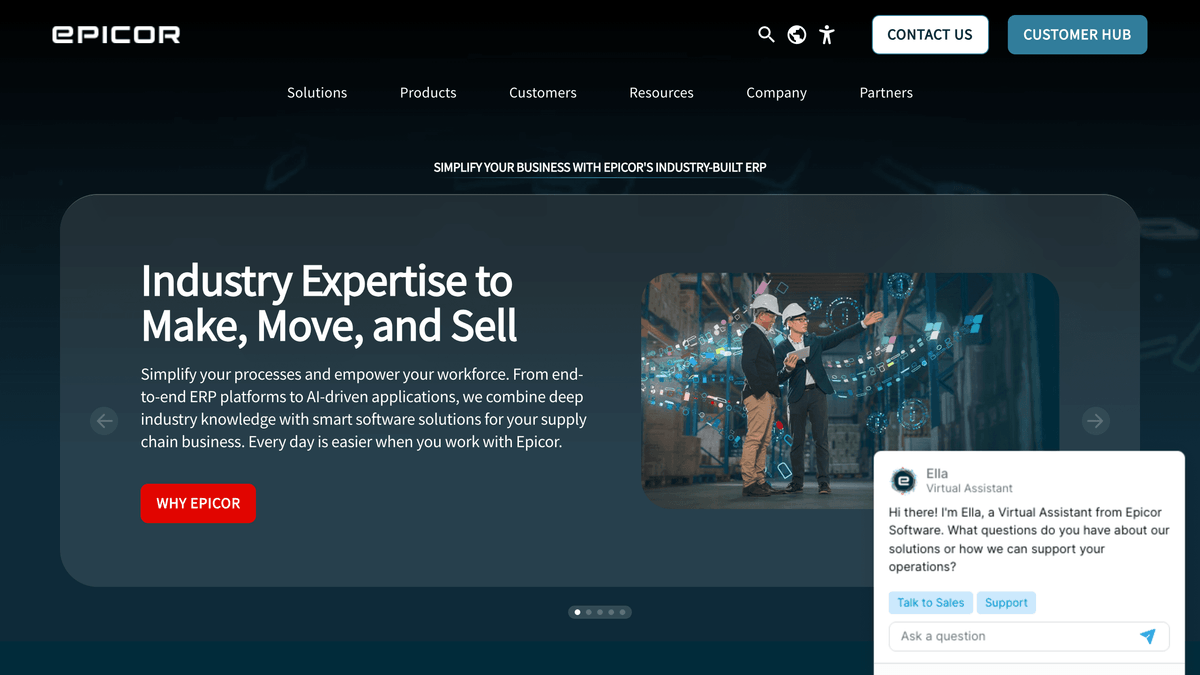
Epicor CPQ (formerly KBMax) is designed for manufacturers and industrial companies that sell configurable physical products. Its defining feature is a 3D visual configurator: as a customer or sales rep selects product options, the quote UI shows a real-time 3D rendering of the configured product alongside an automatically updated price.
This is meaningful for industries like custom furniture, industrial equipment, HVAC systems, and fabricated metal where a visual representation of the configured product reduces errors and supports self-service configuration by distributors or end customers via an embeddable web widget.
Epicor CPQ also generates manufacturing-ready outputs beyond the sales quote: bills of materials (BOMs), CAD drawings, and shop floor instructions derived directly from the configured options. This closes the gap between sales quoting and production without re-entering data.
💡 Tip. Epicor CPQ's 3D configurator and BOM generation set it apart from every other tool on this list. If your product catalog does not involve physical configuration, the added cost and complexity of Epicor CPQ is unnecessary. Evaluate DealHub or HubSpot first.
Albato does not currently offer a direct Epicor CPQ connector. Teams can route quote events from connected ERP or CRM systems through Albato to downstream tools.
Pricing: Starts at $150/user/month for the Standard plan, billed annually. Volume discounts available at 100+ users.
Zuora CPQ
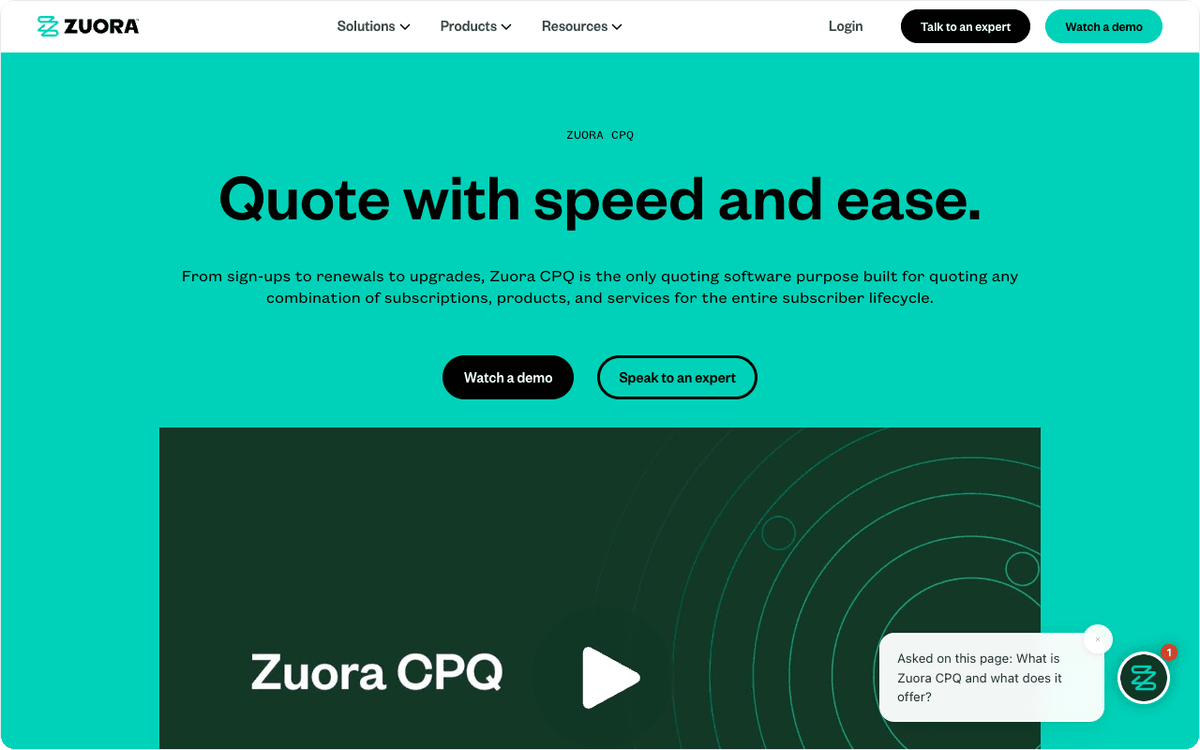
Zuora CPQ serves subscription-first businesses where the product catalog is not physical items but service tiers, usage rates, and contract terms. It is built on Zuora's subscription billing platform, so quoting and billing share the same data model with no translation layer between what the sales team sells and what the finance team invoices.
Subscription-based pricing is Zuora's core domain: metered usage billing, hybrid pricing (flat fee plus per-unit overage), and multi-currency revenue recognition all work out of the box. For SaaS companies with complex pricing models that include annual minimums, overage caps, and mid-contract upgrades, Zuora CPQ ensures that what gets quoted is exactly what gets billed.
Zuora's pricing tiers (Launch, Scale, Enterprise) are structured around subscriber count and billing volume rather than per-user seat counts, which aligns with how subscription companies think about their own pricing.
⚠️ Important. Zuora requires integration with a CRM (Salesforce is the most common) for the quoting experience. It is not a standalone CRM or sales tool. Teams without an existing CRM infrastructure should start with HubSpot Revenue Hub or Salesforce Revenue Cloud instead.
Albato does not currently offer a direct Zuora connector. The Stripe integration on Albato covers a partial overlap for teams that use Stripe Billing alongside Zuora for payment collection.
Pricing: Custom pricing based on subscriber count and billing volume. Three tiers: Launch, Scale, and Enterprise. No publicly listed per-seat cost.
How to Connect Your CPQ Tool to Your CRM and Billing Stack
CPQ tools generate quotes. What happens after a quote is accepted is where most sales teams still do manual work: updating the CRM deal stage, creating an invoice in accounting software, triggering a subscription in a billing platform, and notifying the finance or operations team.
Albato closes that gap without custom code. When a deal closes in Salesforce or HubSpot, or when a document is signed in PandaDoc, Albato picks up the event and triggers a sequence of actions across your stack. Examples:
- Quote accepted in Salesforce Revenue Cloud creates a customer in QuickBooks and activates a subscription in Stripe.
- PandaDoc document signed updates the deal in HubSpot to "Closed Won" and notifies the finance Slack channel.
- HubSpot deal moved to "Won" pushes the new contract data to NetSuite for ERP sync and starts an onboarding workflow in your project management tool.
Albato connects to Salesforce (9 triggers, 23 actions), HubSpot (21 triggers, 67 actions), PandaDoc (6 triggers, 7 actions), and Stripe (18 triggers, 16 actions). For companies whose CPQ tool does not have a direct Albato connector, the workflow triggers at the CRM level where the quote outcome lands.
The integration logic is built in a no-code drag-and-drop editor. Most post-quote automation workflows take under an hour to configure and test.
📊 Stat. According to Gartner, more than 60% of B2B sales organizations will use cloud CPQ by end of 2026. The integration layer connecting CPQ to billing and ERP is the operational gap that most teams address only after the quoting problem is solved.
Wiring the post-quote steps together is usually a one-time setup that pays off on every deal after it. You can build the first workflow on Albato's free plan before committing to a paid tier.
For a wider look at how quoting fits into the full sales document lifecycle, see our comparison of proposal software for sales teams and the companion guide to contract management software that handles what happens after a quote becomes a signed agreement.
How to Choose the Right CPQ Tool
The right CPQ tool depends on four factors: your CRM, your product complexity, your team size, and whether quoting or billing is the harder problem.
Start with your CRM. If your team lives in HubSpot, HubSpot Revenue Hub is the path of least resistance. If you are on Salesforce, you choose between Salesforce Revenue Cloud (Salesforce's own product) and Conga (deeper CLM, more configuration flexibility). Both sit inside the Salesforce data model, so your opportunity and contact data do not need to migrate.
Match product complexity to tool capability. Simple services or software seat pricing works fine in Proposify or PandaDoc. Products with bundles, nested options, discount rules, and territory-based pricing need DealHub or Salesforce Revenue Cloud. Physical products with visual configuration need Epicor CPQ. Subscriptions with usage-based billing need Zuora CPQ.
Factor in who owns the tool. DealHub and HubSpot Revenue Hub are built for RevOps and sales operations teams to own without engineering support. Salesforce Revenue Cloud and Conga CPQ typically require a Salesforce admin or implementation partner to configure properly.
Consider total cost beyond the license. Implementation for enterprise CPQ tools often costs more than the first year of licensing. DealHub and HubSpot Revenue Hub have faster typical implementation timelines than Salesforce Revenue Cloud or Conga for comparable mid-market deployments.
For teams comparing billing and subscription management as a parallel decision, the accounting software guide and customer data platform guide cover the downstream tools CPQ typically feeds.
Have questions about which CPQ tool fits your CRM or how to connect quoting to billing? The FAQ below covers the most common decisions.
FAQ
What does CPQ stand for and what does it do?
CPQ stands for Configure, Price, Quote. CPQ software automates the creation of accurate sales quotes for complex products or services. A sales rep selects product options, the software applies pricing rules and discount thresholds, and outputs a branded quote document ready for customer review and signature. The goal is to eliminate pricing errors, reduce quote turnaround time, and enforce approval governance.
What is the difference between CPQ software and proposal software?
Proposal software (like Proposify or PandaDoc's core offering) focuses on the document presentation, e-signature, and approval workflow. CPQ software adds product catalog management, configuration rules, and pricing logic on top of that. In practice, PandaDoc and Proposify cover both to varying degrees, but pure CPQ tools like Salesforce Revenue Cloud or DealHub handle significantly more complex product and pricing structures.
Which CPQ software works best for small businesses?
PandaDoc's Business plan ($49/user/month) and Proposify's Team plan ($41/user/month annual) are the most accessible starting points for small businesses that need structured quoting without enterprise-level complexity or pricing. Both include CRM integrations, approval workflows, and e-signature in tiers priced for teams under 20 people.
Do CPQ tools replace CRM software?
No. CPQ software works alongside your CRM, not instead of it. Most CPQ tools pull customer and opportunity data from your CRM when a rep starts a quote, and push the completed quote back to the CRM deal record when finished. Salesforce Revenue Cloud and HubSpot Revenue Hub are embedded inside their respective CRMs; DealHub and Conga integrate tightly with Salesforce and HubSpot as well.
How much does CPQ software typically cost?
CPQ pricing ranges widely by tier and complexity. SMB tools like Proposify start at $19/user/month. Mid-market tools like DealHub start around $60-83/user/month based on public market data. Enterprise platforms like Salesforce Revenue Cloud start at $150/user/month. Most enterprise CPQ tools also carry significant implementation costs that can equal or exceed the first year of licensing.