In this article
Key Takeaways
- The contract management software market is projected to reach $5.37 billion in 2026, growing at 15.3% CAGR, with CRM integration becoming the top feature buyers evaluate.
- PandaDoc (from $19/user/month) and Oneflow (from ~$17/user/month) offer the best value for sales teams that need contracts flowing directly into their CRM without enterprise pricing.
- Ironclad and Juro lead in AI-powered contract review, but both require custom quotes that typically start at $18,000/year and up.
Sales teams lose deals when contracts sit in email threads, shared drives, or standalone tools that don't talk to their CRM. When reps have to copy data between systems instead of tracking contract status inside the same pipeline they already use, deals stall at the finish line. The tools below connect contracts directly to your CRM so nothing falls through the cracks.
Quick Comparison: 11 Best Contract Management Software Tools
We evaluated these eleven platforms on four criteria: CRM integration depth (native connectors vs. API-only), AI contract review capabilities, pricing accessibility for mid-market teams, and whether they connect to third-party automation tools like Albato for custom workflows.

The infographic above breaks down each criterion. The table below shows how each platform stacks up across all four dimensions.
Side-by-side overview
| Tool | Best For | Starting Price | CRM Integrations | Albato Connector | G2 Rating |
|---|---|---|---|---|---|
| PandaDoc | Sales-led contract workflows | $19/user/mo | HubSpot, Salesforce, Pipedrive | Yes | 4.7/5 |
| Ironclad | AI-powered legal ops | Custom (~$25K+/yr) | Salesforce, HubSpot | Yes | 4.4/5 |
| DocuSign CLM | Enterprise compliance | Custom (~$10K+/yr) | Salesforce, SAP, Microsoft | No | 4.3/5 |
| Juro | Unlimited-user teams | Custom (~$18K/yr) | HubSpot, Salesforce, Workday | No | 4.6/5 |
| Concord | SMBs wanting full CLM | $499/mo (5 users) | Salesforce, HubSpot, Pipedrive | No | 4.2/5 |
| ContractSafe | Contract repository + search | $450/mo (unlimited users) | Salesforce | No | 4.7/5 |
| LinkSquares | Teams needing agentic AI-powered CLM to close deals faster | Custom enterprise pricing | Salesforce, HubSpot, Microsoft Dynamics 365 | No | 4.7/5 |
| Conga | Salesforce-native CLM | Custom (~$30K+/yr) | Salesforce (native) | No | 4.3/5 |
| SpotDraft | Legal team automation | Custom (~$10K/yr) | Salesforce, HubSpot | No | 4.5/5 |
| Oneflow | Affordable European CLM | From EUR 17/user/mo | HubSpot, Salesforce, Dynamics 365 | No | 4.4/5 |
| Icertis | Enterprise AI intelligence | Custom (~$88K+/yr) | Salesforce, SAP, Oracle | No | 4.2/5 |
1. PandaDoc
PandaDoc combines document creation, e-signatures, and contract tracking under one roof, with strong CRM integrations for HubSpot, Salesforce, and Pipedrive.

PandaDoc started as a proposal tool and grew into a full document automation platform that handles contracts, quotes, and e-signatures in one place. For sales teams already using it for proposals, the contract management layer means zero new tools to learn.
The drag-and-drop editor lets reps build contracts from templates without touching a lawyer, and the approval workflow routes documents to the right people before they go out. Multi-party signing handles complex deals where three or four stakeholders need to sign in a specific order.
💡 Tip. PandaDoc's content library lets you save approved clauses (payment terms, liability caps, SLAs) so sales reps can assemble contracts from pre-approved building blocks without waiting for legal review on every deal.
How PandaDoc connects to your CRM
PandaDoc offers native integrations with HubSpot, Salesforce, and Pipedrive that pull deal data directly into contract templates. When a contact signs, the CRM record updates automatically with the signature date and contract status.
Through Albato's PandaDoc connector, you can extend this further: trigger a Slack notification when a document state changes, push signed contract data into your accounting tool, or create a follow-up task in your project management system when a deal closes. Albato supports 6 PandaDoc triggers and 7 actions, covering everything from document creation to payment tracking.
Pricing
PandaDoc offers five tiers: Free ($0, basic e-signatures with a 60-document annual cap), Launch ($9/user/month, pay-as-you-go), Starter ($19/user/month billed annually), Business ($49/user/month), and Enterprise (custom). The Business plan adds approval workflows, content libraries, and CRM integrations. Monthly billing runs significantly higher than annual, so commit to the year if you can.
One thing to watch: PandaDoc charges $5 per document for API-generated contracts, and you need the Business plan or higher to remove PandaDoc branding from your documents.
2. Ironclad

Ironclad built its reputation on a configurable workflow engine that legal teams actually want to use. The platform stands apart because of its AI capabilities: Ironclad AI Assist reads your contracts, flags risky clauses, extracts key terms, and suggests redlines based on your company's playbook.
Where most CLM tools treat contract creation as a form-filling exercise, Ironclad approaches it as a workflow problem. You define conditional approval paths (if contract value exceeds $50K, route to VP of Sales and legal counsel), and the system handles the routing, reminders, and audit trail.
CRM and integration depth
Ironclad connects natively to Salesforce, HubSpot, Box, Google Drive, Microsoft Teams, and DocuSign. The Salesforce integration is particularly useful: sales reps can launch a contract workflow directly from an opportunity record without leaving the CRM.
Albato's Ironclad connector adds 5 triggers (workflow launched, updated, completed, cancelled, approval status changed) and 3 actions (create workflow, list approver roles, update approval). This lets you build automations like: when an Ironclad workflow completes, update the deal stage in your CRM, send a congratulations message to the sales channel, and log the contract in your finance system.
Before committing to Ironclad, keep one pricing detail in mind.
⚠️ Important. Ironclad's AI modules (AI Assist and AI Copilot) are add-ons that typically increase the base platform cost by 15 to 40%. Factor this into your budget if AI contract review is a priority.
Pricing
Ironclad uses custom pricing with no public rate card. Third-party estimates suggest annual costs ranging from $25,000 to $75,000+ depending on team size and contract volume. Implementation, training, and onboarding fees add to first-year costs. The AI modules (AI Assist, AI Copilot) are sold as add-ons and can increase the base price by 15 to 40%, so budget for those separately if AI contract review is part of your evaluation.
3. DocuSign CLM

DocuSign is the name most people associate with e-signatures, and their CLM product extends that trust into full contract lifecycle management. The platform combines AI-assisted negotiation, automated routing workflows, and a drag-and-drop contract designer with deep enterprise integrations.
The real selling point is familiarity. If your counterparties already use DocuSign for signing (and most do), the entire contract flow stays within a single ecosystem. That reduces friction during the signature phase, which is often where deals stall.
Where DocuSign CLM fits
DocuSign CLM targets organizations managing thousands of contracts across multiple departments. The Salesforce, Microsoft, and SAP integrations are built for complex enterprise environments where contracts touch procurement, legal, finance, and sales simultaneously. The platform's AI-assisted negotiation feature compares contract terms against your standards and suggests changes, reducing legal review cycles.
For teams already on DocuSign eSignature, the upgrade path to CLM keeps all historical signature data intact. That migration path is a genuine advantage: you avoid the re-implementation headaches of switching to an entirely new vendor, and your existing audit trail carries over.
Pricing
DocuSign CLM uses custom pricing. Enterprise deployments typically range from $10,000 to $50,000+/year for teams of 10 to 50 users, with per-user costs of $35 to $75/month at scale. Implementation and onboarding can significantly increase first-year costs, and annual price escalators of 5 to 8% are common in DocuSign CLM contracts. Smaller teams might find that the standard DocuSign Business Pro plan ($40/user/month) covers their contract needs without the full CLM investment.
4. Juro

Juro differentiates on one thing that matters for growing teams: unlimited users on every plan. While competitors charge $30 to $80 per seat per month, Juro's flat pricing means a 50-person team accessing contracts pays the same as a 5-person team. For organizations where sales, procurement, HR, and finance all touch contracts, the savings over per-seat alternatives add up fast.
The platform's browser-native editor (no Word plugins, no downloads) lets anyone create, negotiate, and sign contracts from a web browser. Real-time collaboration works like Google Docs for contracts: multiple stakeholders can review and comment simultaneously.
📊 Stat. The median Juro buyer pays around $31,000 per year, which covers unlimited users and templates. For a 30-person team, that works out to about $86/user/month, but the cost per user drops as you add more people.
CRM integrations and pricing
Juro integrates natively with HubSpot, Salesforce, and Workday. Contracts can be initiated from CRM deal records, and signed contract data flows back into the CRM automatically. The HubSpot integration is particularly smooth: contract fields map to HubSpot properties, so you can build reports and dashboards that include contract status alongside pipeline metrics.
Plans start at roughly $18,000 to $35,000/year for entry-level teams (5 to 10 users, 200 to 500 contracts/year). Pricing scales based on contract volume, AI features (AI Extract, AI Draft, AI Review), and the integrations you need. All plans include unlimited users, workflows, and templates. For a 30-person cross-functional team, the per-user math comes out far cheaper than per-seat alternatives like PandaDoc Business ($49/user/month) or DocuSign CLM.
5. Concord

Concord targets SMBs and mid-market companies managing 200 to 2,000 contracts annually who want genuine CLM capabilities without enterprise complexity or pricing. The platform covers the full contract lifecycle: template-based creation, online negotiation with redlining, unlimited e-signatures, and post-execution tracking with renewal alerts.
What sets Concord apart is that unlimited e-signatures are included in every plan. Competitors like DocuSign charge per envelope or per signature, which adds up fast when you're sending contracts to hundreds of clients. Concord's AI Copilot also speeds up contract reviews by highlighting risks and suggesting improvements.
CRM integration, workflow, and pricing
Concord integrates with Salesforce, HubSpot, and Pipedrive. The platform's Horizon interface organizes work into three stages: draft and review (intake, clause library), sign and store (e-signature, repository, deadline tracking), and analyze and optimize (AI reporting, integrations). For teams that need contract data flowing into tools beyond their CRM, Concord supports Albato through its API, letting you build automations between Concord and 1,000+ other business apps.
Pricing starts at $499/month (billed annually) for 5 users on the Essentials plan, which includes unlimited e-signatures and the core contract lifecycle tools. Business costs $899/month and adds advanced workflows and clause libraries. Enterprise runs $1,299/month with premium integrations and dedicated support. Additional users cost $49 to $89/month depending on the tier. Founded in 2014, Concord serves 1,500+ organizations across North America and Europe.
6. ContractSafe

ContractSafe takes a different approach: instead of trying to manage the entire contract lifecycle, it focuses on being the best contract repository and search engine your team has ever used. If your problem is finding contracts (scattered across email, Google Drive, and that one shared folder nobody remembers the name of), ContractSafe solves it with OCR-powered full-text search, AI-powered tagging, and expiration reminders.
Every plan includes unlimited users and a dedicated customer success manager. The platform doesn't charge per seat, which makes it practical for organizations where dozens of people need read access to contracts but only a few create them.
Integration approach and pricing
ContractSafe connects to Salesforce for two-way contract data sync. The platform's focus on storage and retrieval rather than creation means it often sits alongside a CRM rather than replacing any existing workflow. Teams typically create contracts in their CRM or a tool like PandaDoc, then store executed versions in ContractSafe for compliance, auditing, and renewal tracking.
🔧 How it works. ContractSafe's AI reads every uploaded document and extracts key data points (parties, effective dates, renewal terms, dollar amounts) into structured fields. OCR handles scanned PDFs, so even paper contracts that were photographed years ago become fully searchable.
Three plans are available: Organize ($450/month), Finalize ($660/month, adds e-signatures and approval workflows), and Maximize ($815/month, adds AI review and integrations). All plans include unlimited users, implementation support, and data migration. Pricing scales by features and contract volume, not by user count, which makes ContractSafe one of the more predictable CLM budgets for growing organizations.
7. LinkSquares
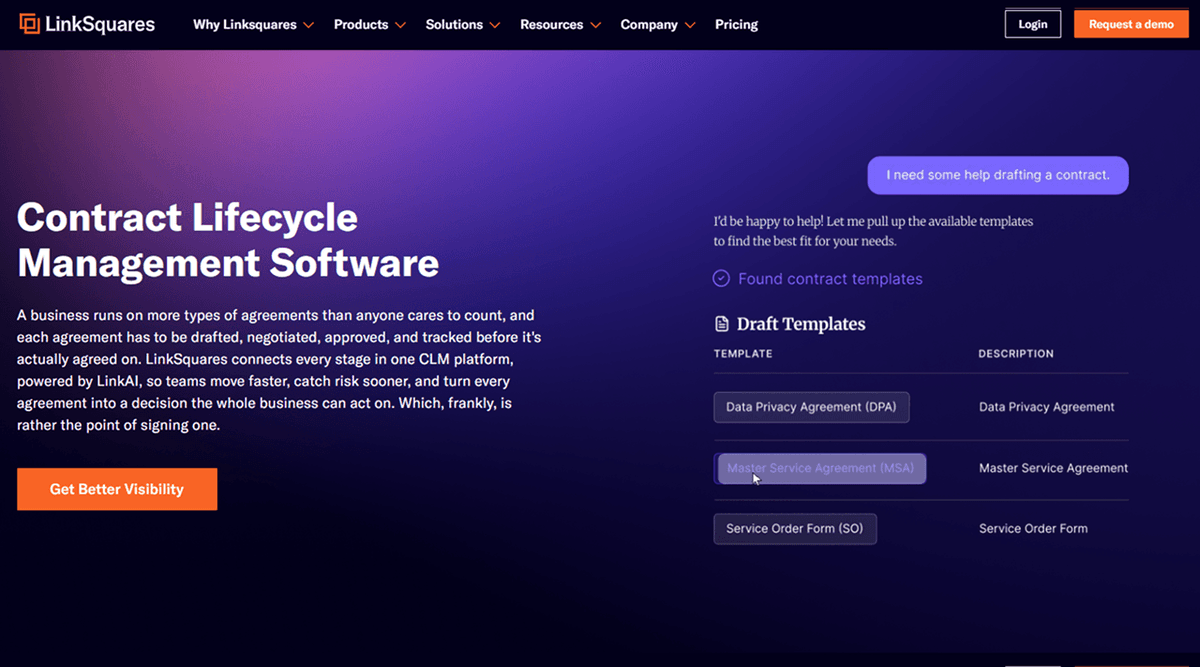
LinkSquares is an agentic AI-powered CLM designed to move contracts from static records to intelligent systems of action, helping teams close deals faster through deep CRM integration.
Unlike legacy CLM platforms that layer AI on top of old architecture, LinkSquares rebuilt its entire platform around an agentic AI engine called LinkAI. This allows the system to understand contracts as structured data, reason across obligations, and autonomously trigger workflows that keep deals moving.
💡 Tip. LinkSquares' proprietary OCR and data extraction capabilities were built over 10 years, meaning it can handle even "messy" contract data that other systems struggle to parse accurately.
How LinkSquares connects to your CRM
LinkSquares offers native integrations with Salesforce, HubSpot, and Microsoft Dynamics 365. For sales teams, the Salesforce integration is particularly powerful, allowing reps to generate accurate order forms and subscription agreements directly from opportunity records using real-time pricing data.
Because LinkSquares acts as a "system of intelligence," it doesn't just store contracts—it connects contract data to your business processes. You can visit LinkSquares to see how their agentic shift reduces contract completion time by up to 7%.
Pricing
LinkSquares uses custom enterprise pricing tailored to team size and contract volume. There is no public rate card, but the platform is positioned as a high-value enterprise solution. Interested teams can request a demo to receive a personalized quote based on their specific legal and sales requirements.
8. Conga

If your organization runs on Salesforce, Conga's CLM deserves serious consideration. Built on Force.com, Conga's contract management integrates more deeply with Salesforce than any other CLM on this list. Contracts live inside your Salesforce environment. You create them from opportunity records, track them in Salesforce dashboards, and manage renewals with Salesforce workflows.
The platform automates contract creation, negotiation, and storage while connecting everything to your existing Salesforce data. AI contract analysis tracks compliance, cycle time, workflow progress, and volume through configurable dashboards and alerts. It provides quick summaries of complex contracts and instant answers to contract-related questions.
Who should consider Conga (and what it costs)
Conga is built for mid-market to enterprise organizations (50+ users) that have already invested heavily in the Salesforce ecosystem. The native integration eliminates the data sync issues that plague third-party CLM tools trying to connect with Salesforce via API. G2 reviewers report an average 2 to 4-month implementation timeline for standard deployments, which is faster than most enterprise CLM competitors.
For teams NOT on Salesforce, Conga offers limited value. The platform's deepest features assume a Salesforce backend, and the pricing reflects enterprise expectations. Conga doesn't publicly disclose pricing. The median annual contract runs about $16,800 across all Conga modules (CLM, document generation, e-signatures), but CLM alone typically costs $30,000 to $100,000+/year depending on team size and contract volume. Implementation and Salesforce configuration add to first-year costs. Teams already paying for Salesforce Enterprise should factor in the total Salesforce + Conga stack cost when comparing against standalone CLM tools that include their own CRM connectors.
9. SpotDraft

SpotDraft built its platform for legal teams first, which shows in how it handles contract review. VerifAI, SpotDraft's AI contract review engine, analyzes incoming contracts against your company's playbook, flags deviations from approved terms, and suggests specific redlines. For legal teams drowning in third-party paper (vendor agreements, partner contracts, customer MSAs), this cuts review time from hours to minutes.
DraftMate AI handles the creation side: it generates contract templates from your existing agreements and learns your preferred language over time. Smart Data Capture pulls metadata (parties, dates, amounts, governing law) from executed contracts into structured fields for reporting.
CRM connections and pricing
SpotDraft integrates with Salesforce, HubSpot, DocuSign, Google Drive, Dropbox, Slack, and Okta. The HubSpot integration lets sales reps request contracts from deal records, and completed contracts sync back to the CRM with extracted terms attached. On the Salesforce side, SpotDraft supports bidirectional data flow: contract metadata (parties, value, renewal dates) maps to custom Salesforce fields, so legal and sales teams share one source of truth without manual re-entry.
SpotDraft uses custom pricing with per-seat licensing. Entry-level deployments typically start around $10,000/year for small legal teams. The VerifAI add-on for AI contract review adds to the base cost. For legal teams evaluating AI review tools, SpotDraft's entry point is significantly lower than Ironclad's ($25,000+) while covering similar use cases: playbook-based redlining, risk flagging, and clause extraction.
10. Oneflow

Oneflow brings European design sensibility and transparent pricing to a market dominated by custom-quote enterprise players. At around $17/user/month (EUR 17) on the Essentials plan, it's one of the most accessible full-lifecycle CLM tools available, and it includes digital contracts, templates, and e-signatures at that price point.
The platform stands out for real-time contract editing. Instead of sending a PDF back and forth with tracked changes (the default workflow in most CLM tools), Oneflow lets both parties edit the same live document. Comments, revisions, and approvals happen in the document itself, not in email threads alongside it.
CRM integrations and pricing
Oneflow integrates with over 20 tools, including HubSpot, Salesforce, Dynamics 365, Upsales CRM, BambooHR, and Microsoft 365. The CRM integrations let you create contracts from deal records and track signing status without leaving your pipeline. The AI Review feature provides instant risk analysis and compliance reports for individual contracts.
Four plans are available: Free (PDF contracts only), Essentials (EUR 17/user/month for digital contracts and templates), Business (EUR 45/user/month with lifecycle management and premium integrations), and Enterprise (custom pricing). European data residency is included by default, which matters for teams bound by GDPR. For small sales teams testing contract management for the first time, Oneflow's Essentials plan is a low-risk starting point that still includes the core CRM sync.
11. Icertis

Icertis operates at the other end of the spectrum from tools like PandaDoc and Oneflow. This is contract intelligence for organizations managing tens of thousands of agreements across multiple countries, business units, and regulatory frameworks. The platform's AI doesn't just review individual contracts; it analyzes your entire portfolio to surface risks, identify commercial opportunities, and enforce compliance across every agreement you hold.
The differentiator is scale and intelligence. Icertis benchmarks your contracts against industry standards and your own historical patterns, identifying where you're leaving money on the table or accepting terms that deviate from your norms. For a Fortune 500 company managing 100,000+ contracts, that kind of portfolio-level insight can recover millions in value leakage.
Integration ecosystem and pricing
Icertis connects with Salesforce, SAP, Oracle, Microsoft Dynamics, and most major ERP systems. The integrations are built for enterprise complexity: multi-entity, multi-currency, multi-language environments where contract data needs to flow through procurement, finance, legal, and compliance systems simultaneously. The platform also offers a developer-friendly API for custom integrations, which matters for organizations running homegrown procurement or compliance systems alongside their commercial stack.
Icertis pricing is not public. The median annual contract runs around $88,000, but first-year costs (licensing, implementation, training) typically range from $100,000 to $300,000 depending on contract volume, modules, and user count. Implementation timelines run 6 to 12+ months for complex global deployments. This is not a tool for teams managing a few hundred contracts per year; it's built for organizations where contracts represent significant financial and operational risk.
How to Connect Your Contract Management Software to the Rest of Your Stack
Most contract management tools offer native integrations with major CRMs, but sales teams rarely stop at just two tools. The typical deal-closing workflow involves a CRM, a contract tool, an e-signature service, a billing system, a project management tool, and at least one communication platform.
Building multi-tool automations with Albato
Albato connects these pieces without code. With connectors for PandaDoc, Ironclad, Salesforce, HubSpot, and 1,000+ other apps, you can build automations like:
- When a PandaDoc contract is signed, create an invoice in QuickBooks and a project in Asana
- When an Ironclad workflow completes, update the deal stage in Salesforce and send a Slack notification
- When a CRM deal reaches "Closed Won," auto-generate a contract in PandaDoc with pre-filled client data
These automations eliminate the manual data transfer that slows down the handoff from "contract signed" to "project started." For a deeper look at building these kinds of multi-tool workflows, see our guide on the complete sales pipeline stack from form to invoice.

Setting up these automations takes minutes, not sprints. Pick the trigger (contract signed, deal closed, approval granted), choose the destination, and map the fields.
Not sure which integrations to build first? A quick audit of your current manual handoffs will reveal the biggest wins.
💡 Tip. Start by mapping the five systems that touch your contracts today (CRM, contract tool, e-sign, billing, PM). Then identify which data transfers you're doing manually. Those manual handoffs are where automation creates the biggest time savings, and where Albato's no-code connector approach makes the most sense.
What to Look for When Choosing Contract Management Software
CRM integration depth
Not all CRM integrations are equal. Some tools offer deep, bidirectional sync (contract fields map to CRM properties, status updates flow both ways), while others provide basic one-way data pushes. Ask specifically: can I create a contract from a CRM deal record? Does the CRM update when the contract is signed? Can I report on contract data inside my CRM dashboards? The contract stage is just one piece of the pipeline; if you're also evaluating how leads get into your CRM in the first place, our roundup of the best form builder software covers tools that feed data directly into HubSpot, Salesforce, and Pipedrive.
AI capabilities
The AI features in contract management software range from basic OCR text extraction to sophisticated clause-level risk analysis. If your team reviews more than 100 third-party contracts per year, AI review tools (like those in Ironclad, SpotDraft, or Juro) can cut review time significantly. If you mainly create your own contracts from templates, AI drafting and auto-fill features matter more than review capabilities.
For teams looking to add AI-powered decision-making to their contract workflows, Albato's AI Agent can serve as an intelligent routing layer. The AI Agent reads incoming data (like a signed contract notification) and decides which action to run: update the CRM, notify the account manager, create a billing record, or escalate to legal based on contract value. Instead of building complex branching logic, you describe the routing rules in plain language and let the agent handle the decision-making.

Pricing model
Contract management software uses three main pricing models: per-user/per-seat (PandaDoc, Oneflow), flat-rate by contract volume (ContractSafe, Concord), and custom enterprise pricing (Ironclad, DocuSign CLM, Icertis). Per-user models penalize cross-functional teams where many people need contract access; a 40-person company at $49/user/month pays $23,520/year before add-ons. Flat-rate models work better when your user count is unpredictable. Custom enterprise pricing often bundles implementation and training, but first-year costs can be 30 to 50% higher than the ongoing annual fee. For more on how sales tools connect and where pricing models affect your overall stack cost, check out our analysis of the best proposal software for sales teams.
Compliance and audit requirements
Regulated industries (healthcare, finance, government contracting) need audit trails, version control, access controls, and sometimes geographic data residency. Enterprise tools like DocuSign CLM, Ironclad, and Icertis are built for these requirements, with SOC 2 Type II compliance, configurable retention policies, and region-specific data storage. Mid-market tools like Concord and ContractSafe also offer audit trails and role-based access, though with less granularity. If your contracts involve PHI (healthcare) or PCI data (payments), confirm the vendor's specific certifications before committing.
FAQ
What is the difference between contract management software and e-signature tools?
E-signature tools (like DocuSign eSignature or Adobe Sign) handle one part of the contract lifecycle: getting documents signed electronically. Contract management software covers the full lifecycle, including creation, negotiation, approval workflows, execution, storage, renewal tracking, and compliance monitoring. Most CLM platforms include e-signature capabilities or integrate with standalone e-signature tools.
Can small businesses benefit from contract management software?
Yes. Tools like PandaDoc (from $19/user/month), Oneflow (from ~$17/user/month), and Concord (from $499/month for 5 users) are built for teams managing dozens to hundreds of contracts. The ROI comes from reduced time spent searching for contracts, fewer missed renewals, and faster deal close times when contracts connect directly to your CRM.
How does contract management software integrate with CRM systems?
Most contract management tools offer native integrations with popular CRMs (Salesforce, HubSpot, Pipedrive, Dynamics 365). These integrations typically let you create contracts from deal records, auto-populate contract fields with CRM data, sync signature status back to the CRM, and include contract data in sales reports. For CRMs or tools without native integrations, platforms like Albato can bridge the gap through API-based automations.
What is the average cost of contract management software?
Costs range widely. Accessible tools like PandaDoc and Oneflow start at $17 to $49/user/month. Mid-market CLM platforms (Concord, ContractSafe, SpotDraft) range from $450 to $815/month or $10,000 to $35,000/year. Enterprise CLM solutions (Ironclad, DocuSign CLM, Conga, Icertis) typically cost $25,000 to $300,000+/year with additional implementation fees. The right budget depends on your contract volume, user count, and compliance requirements.
Do I need a separate contract management tool if my CRM has built-in contract features?
CRM built-in contract features (like Salesforce's contract object or HubSpot's quotes tool) handle basic contract storage and tracking. They work fine for teams managing simple, templated agreements. If you need approval workflows, AI-powered contract review, clause libraries, version control during negotiation, or compliance audit trails, a dedicated CLM tool adds capabilities your CRM wasn't designed to provide.
Looking for more guides on building a connected sales and operations stack? These articles cover adjacent tools that pair well with contract management platforms.