In this article
Key Takeaways
- Gainsight CS is the pick for large enterprise customer success teams that need the deepest feature set, journey orchestration, and AI risk scoring.
- Vitally wins on mid-market and product-led fit with a polished interface and strong health scoring, with unlimited full seats on its top tier; HubSpot Service Hub is the obvious choice if you already run HubSpot.
- Pricing is mostly custom in this category: only HubSpot publishes seat rates ($20 to $150 per seat per month) and keeps a free plan.
Most of these platforms don't ship a native Albato connector, so the practical question isn't just which tool has the best health score. It's how signup, billing, support, and product data actually reach the tool you pick. That decides whether your health scores stay accurate.
How We Compared These Tools
We compared these on target buyer (enterprise, mid-market, or PLG), depth of features like health scoring and journey orchestration, pricing transparency, and how each one fits into a wider data stack. Pricing for most vendors in this category is not published, so we mark those "Custom (contact sales)" and only quote figures a vendor states publicly.

The table below gives a quick side-by-side comparison of each platform.
| Tool | Best for | Key strength | Pricing | Albato integration |
|---|---|---|---|---|
| Gainsight CS | Large enterprise CS orgs | Deepest feature set, Customer 360, AI risk scoring | Custom (contact sales) | Via CRM/support connectors |
| Vitally | Mid-market and PLG | Polished UI, unlimited seats, Vitally AI | Custom (contact sales) | Via CRM/support connectors |
| ChurnZero | Mid-market engagement teams | In-app communications and automation | Custom (contact sales) | Via CRM/support connectors |
| Totango | Teams with many segments | SuccessBLOCs journey modeling | Custom (contact sales) | Via CRM/support connectors |
| Planhat | Teams wanting custom workflows | No-code configurable data model | Custom (contact sales) | Via CRM/support connectors |
| Custify | Small and mid-market SaaS | Lightweight Customer 360 and playbooks | Custom (contact sales) | Via CRM/support connectors |
| HubSpot Service Hub | Existing HubSpot users | Health scores plus ticketing in one workspace | From $20/seat/mo, free tier | Native connector |
Gainsight CS: the enterprise heavyweight
Gainsight CS is built for large customer success organizations that manage hundreds or thousands of accounts and need every lever in one place. Its Customer 360 pulls together usage, support, billing, and relationship data into a single account view, and its health scoring layers in AI risk signals so CSMs can spot an account trending toward churn before renewal season.
Where Gainsight pulls ahead is orchestration. You can design multi-step customer journeys, trigger playbooks automatically, and route tasks across a large CS team without stitching together separate tools. That depth comes with a learning curve, so it rewards teams that have a dedicated CS operations function to configure and maintain it.
⚠️ Important
Gainsight does not publish pricing. Enterprise contracts are quoted by sales and typically sit at the top of this category, so budget for an evaluation cycle rather than a self-serve signup.
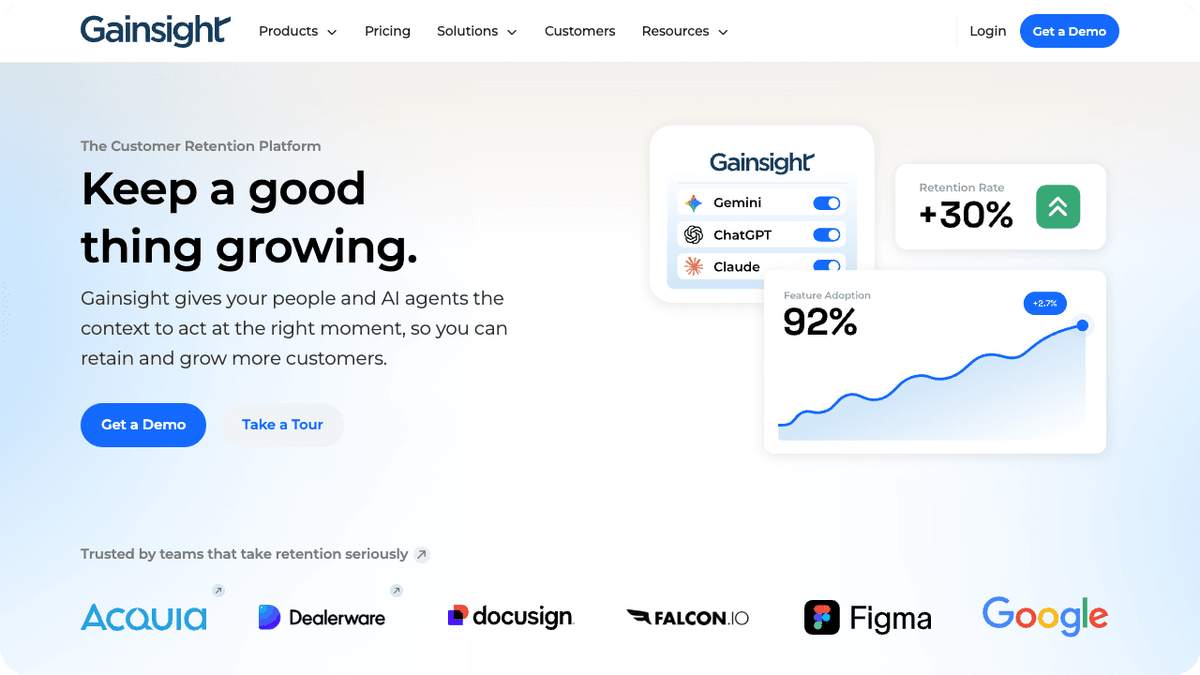
Here's what the Gainsight CS platform looks like in practice.
Vitally: the mid-market and PLG favorite
Vitally targets mid-market and product-led teams that found legacy platforms too heavy. The interface is noticeably cleaner than Gainsight or ChurnZero, which matters when CSMs live in the tool all day and adoption depends on how fast they can find an account and act on it.
Health scoring is a real strength here, and Vitally AI adds summaries and suggested next steps on top of your account data. The High-Touch tier explicitly includes unlimited full seats, which matters when you are scaling a CS team and do not want to ration logins. Vitally sells three tiers (Tech-Touch, Hybrid-Touch, High-Touch) with rates quoted on request, published on the Vitally pricing page.
💡 Tip
Unlimited seats change how you roll a tool out. If a platform charges per seat, some teams limit access to a handful of CSMs and lose the shared visibility that makes health scoring useful across support and product too.
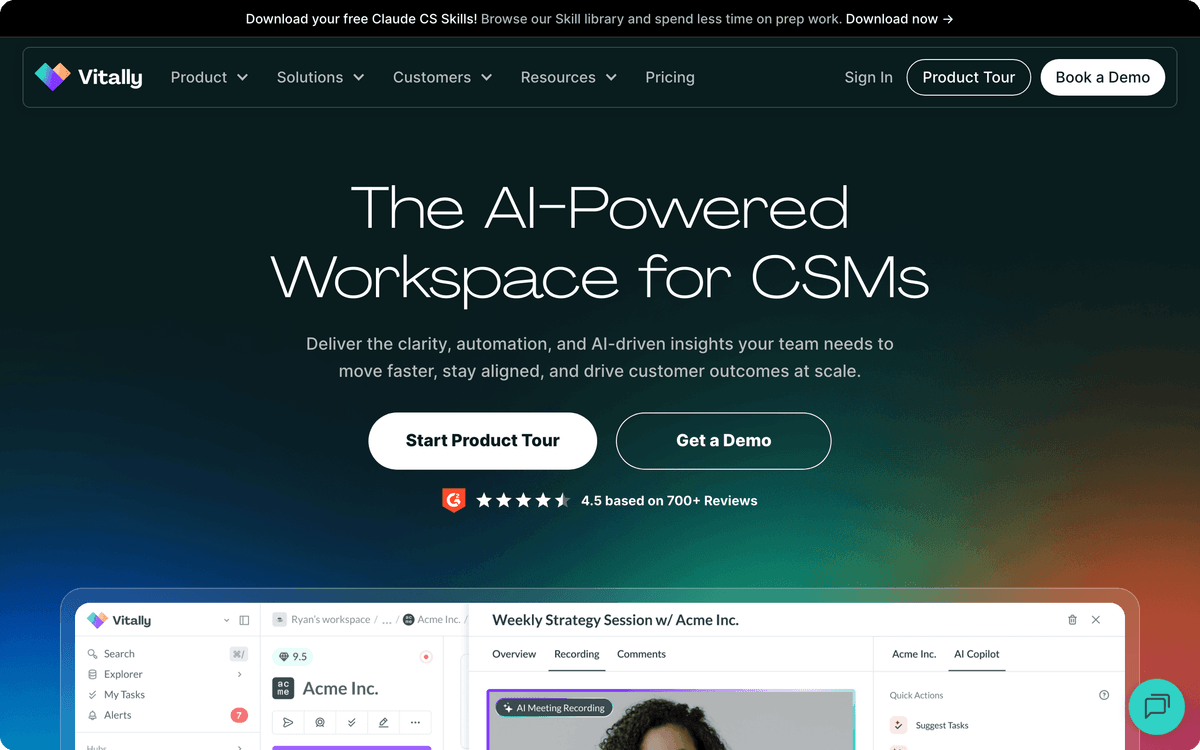
Here's a look at the Vitally homepage to see what you're working with.
ChurnZero: engagement and in-app communication
ChurnZero earns its place with customer engagement automation and in-app messaging, which is a different center of gravity from the account-management focus of Gainsight or Vitally. If your success motion depends on nudging users inside your product, showing walkthroughs, or triggering messages based on behavior, this is where ChurnZero is strong.
It still covers the fundamentals you'd expect: health scores, renewal tracking, and playbooks. But the reason teams shortlist it is the ability to meet customers where they already are, inside the app, rather than only through email and CSM calls. Pricing is not public, so plan on a sales conversation to scope it.
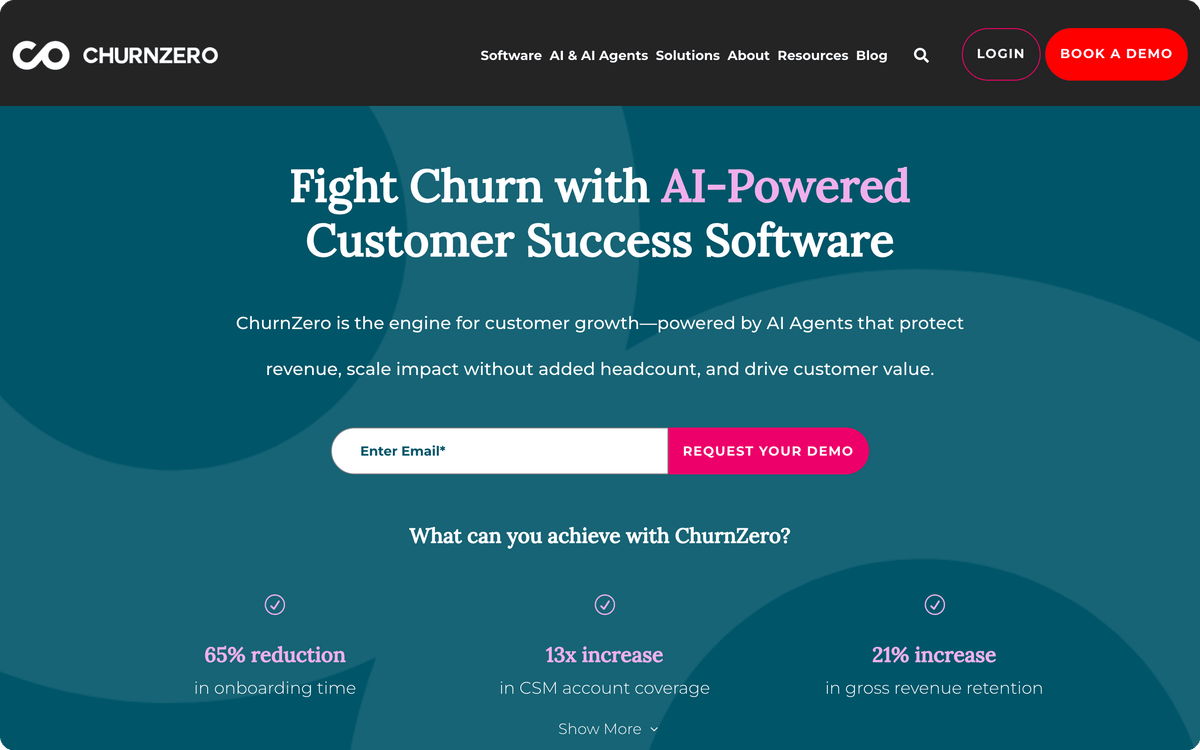
Here's the ChurnZero homepage above the fold.
Totango: journey modeling by segment
Totango is the tool to look at when you serve several distinct customer segments and want to model each one differently. Its SuccessBLOCs are prebuilt journey and playbook modules you can assemble per segment, so an enterprise account and a self-serve account can run on different success motions inside the same platform.
That makes Totango a solid pick for teams juggling heterogeneous bases that don't want one rigid, one-size-fits-all process. Pricing is quoted by sales, so plan on a scoping conversation before you decide.
🔧 How it works
A health score is only as current as the data feeding it. Most CS platforms pull from your CRM and product analytics on a schedule, so if a new deal or a canceled subscription doesn't reach the tool, the score quietly drifts out of date.
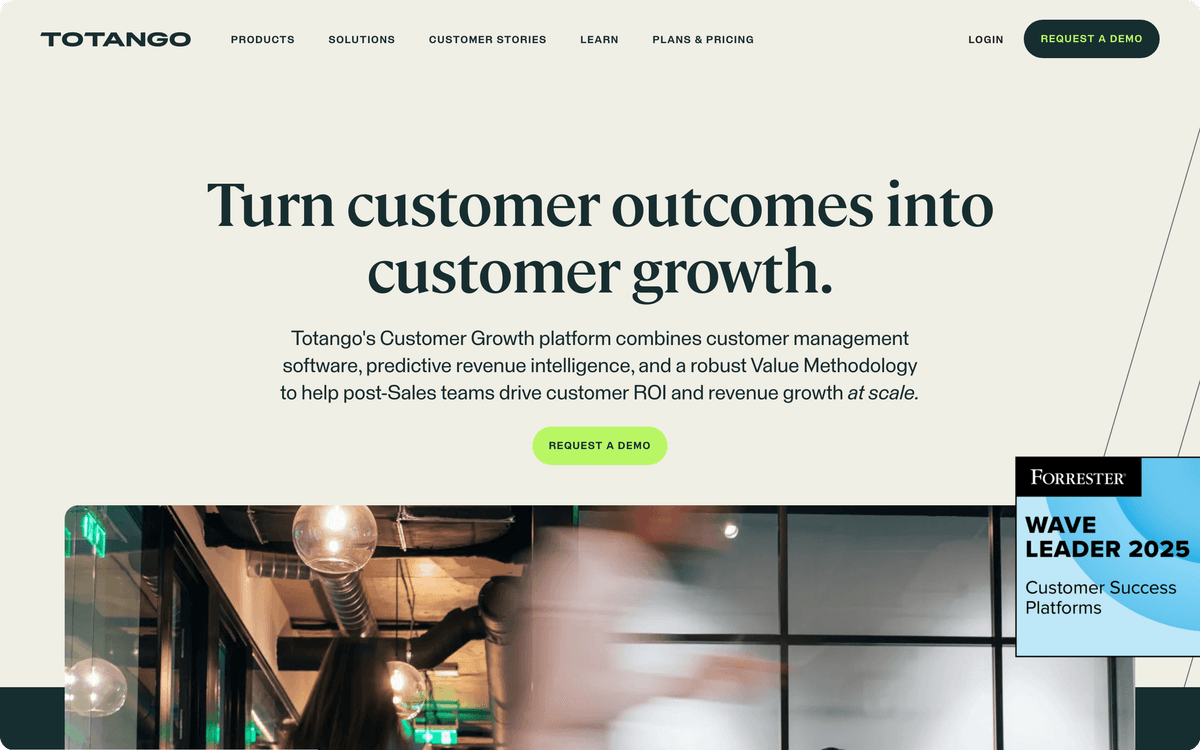
Here's the Totango homepage above the fold, showing the journey-modeling interface.
Planhat: the configurable customer platform
Planhat positions itself as a flexible customer platform rather than a fixed CS tool, and that flexibility is the whole point. You define your own data model, build custom health scores from the signals that matter to your business, and shape workflows without writing code or filing tickets with engineering.
That makes it popular with teams that outgrew rigid, opinionated platforms and want to fit the tool to their process instead of the reverse. The tradeoff is that a blank canvas needs someone to design it well, so Planhat pays off most when you have a clear picture of your customer data and success motions. Pricing is quoted by sales.
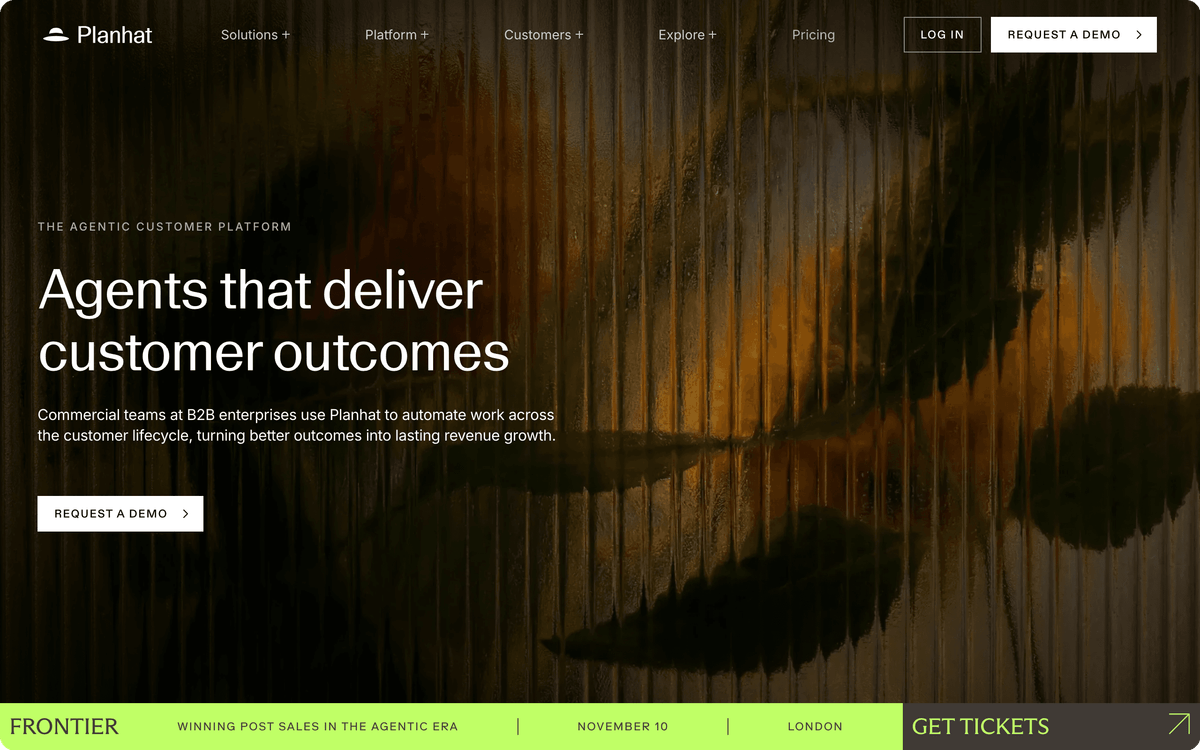
Here's the Planhat homepage to see the interface style and positioning.
Custify: a lighter alternative for smaller SaaS
Custify is aimed at small and mid-market SaaS teams that want a straightforward customer success tool without the weight of enterprise platforms. You get Customer 360 account views, health scoring, playbooks, and CustifyAI for surfacing at-risk accounts, all in a package that's quicker to set up than the legacy options.
The tradeoffs are worth knowing before you commit. Reviewers note more limited customization and fewer advanced integrations than the deeper platforms, so if you need a highly bespoke data model or a long list of native connectors, check that Custify covers your specific tools first. Pricing is not published.
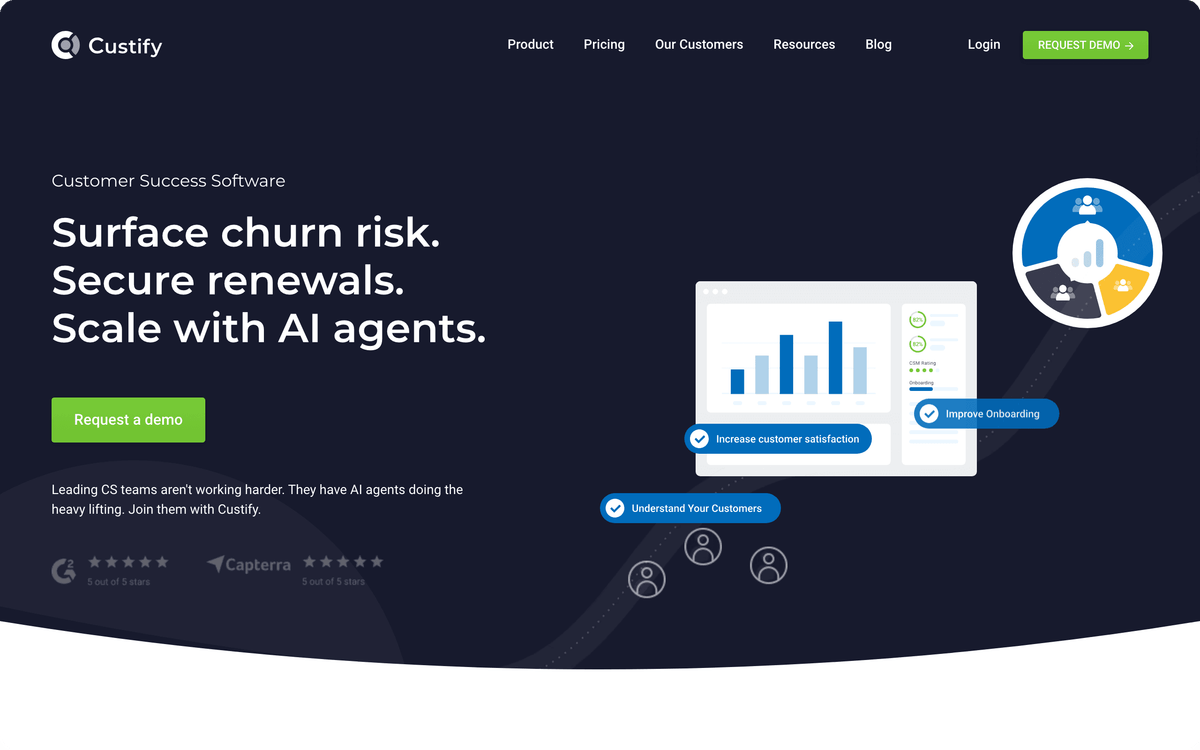
Here's the Custify homepage showing the product positioning for smaller SaaS teams.
Even with a lighter tool, your health scores are only as good as the data feeding them.
HubSpot Service Hub: best if you already run HubSpot
HubSpot Service Hub makes the most sense when your team already lives in HubSpot, because the customer success workspace sits on the same data as your CRM and marketing. You get health scores, NPS and CSAT surveys, ticketing, and a knowledge base in one place, without wiring together a separate CS platform and syncing records back and forth.
Pricing is the clearest in this list. According to HubSpot Service Hub pricing, Starter is $20 per seat per month, Professional is $100 per seat per month, and Enterprise is $150 per seat per month, with a free tier available to start. Service Hub won't match the orchestration depth of Gainsight, but for a team standardized on HubSpot it removes an entire integration problem.
Here's what HubSpot Service Hub looks like above the fold on the product page.

If you're building out the wider customer journey, it's worth reading our guide to the best customer onboarding software alongside this one, since onboarding quality shapes the health scores your CS tool will later report.
Connect your customer success stack with Albato
A customer success tool only works when signup, billing, support, and product-usage signals reach it, and when its insights flow back into your CRM. That's the gap Albato fills. It syncs data across the surrounding stack so your health scores stay current instead of drifting between manual exports.
With Albato you can push new deals and accounts from your CRM into the rest of your tools, route support conversations, and pipe billing events where they need to go. Albato has verified native connectors for HubSpot, Salesforce, and Intercom, which cover the CRM and support side of most customer success setups.
💡 Tip
Decide which system owns the customer record before you connect anything. When your CRM is the source of truth and the CS tool reads from it, you avoid two tools fighting over the same account fields.
Ready to wire your stack together? Albato's free plan covers all the connectors you need to run a proper evaluation.
Here's how that data flow looks in practice across a typical customer success stack.

How to Choose the Right Tool
Start from your company size and your existing stack, not the feature list. A large enterprise with a dedicated CS ops team gets the most from Gainsight's depth, while a lean mid-market team usually moves faster on Vitally or Custify. If HubSpot is already your system of record, Service Hub removes an integration you'd otherwise have to build and maintain.
Then weigh how much you want to customize. Planhat and Totango reward teams that want to model their own journeys and data, while HubSpot Service Hub and Custify favor teams that want something opinionated and quick to run. Whatever you land on, the tool that keeps its health scores accurate is the one wired into clean, current data, which is exactly where your integration layer earns its keep.
For the bigger picture on how these tools fit together across a customer's lifetime, our breakdown of the customer lifecycle stack is a useful companion read.
Here are answers to common questions about customer success software tools and platforms.
FAQ
What is customer success software?
Customer success software helps SaaS and subscription teams track account health, spot churn risk, and run structured playbooks to keep customers renewing and expanding. It pulls together usage, support, and billing data so customer success managers can act on one account view instead of switching between tools.
What is the best customer success software for enterprise teams?
Gainsight CS is generally the strongest fit for large enterprise customer success organizations because it offers the deepest feature set, journey orchestration, and AI risk scoring. It suits teams with a dedicated CS operations function, since configuring and maintaining that depth takes ongoing effort.
Is there free customer success software?
Yes. HubSpot Service Hub has a free plan you can start with before moving to a paid seat. Most other platforms in this list, including the dedicated CS tools, are quoted by sales rather than sold self-serve.
How much does customer success software cost?
Most vendors in this category do not publish pricing and quote it through sales, so expect a custom contract. HubSpot Service Hub is the clear exception at $20 per seat per month for Starter, $100 for Professional, and $150 for Enterprise, with a free tier to start.
Do customer success platforms connect to my CRM automatically?
Some do natively, and others need an integration layer. HubSpot Service Hub sits on HubSpot CRM data directly, while dedicated platforms like Gainsight or Vitally usually rely on connectors, webhooks, or an API. A tool like Albato can keep your CRM, support, and billing data flowing into whichever CS platform you choose.
Shortlist two tools that match your company size and stack, then run a short trial with real accounts to see whether the health scores hold up against your actual data. Before that trial, make sure your CRM, support, and billing signals can reach the tool. You can wire those together on Albato's free plan with no credit card required, so your evaluation reflects live data instead of a stale import.