In this article
No, MCP will not replace your iPaaS. The two solve different problems, and the smart move for most SaaS teams in 2026 is to run them together: MCP as the layer that lets AI agents discover and call your tools, iPaaS as the layer that authenticates, orchestrates, and audits what actually happens. Albato Embedded is a white-label embedded iPaaS that exposes 1,000+ pre-built connectors to AI agents through a single MCP endpoint, so this comparison comes from running both layers in production, not from theory.
The Model Context Protocol gave AI agents a clean way to find and use external tools. That is a real advance, and it made a lot of teams ask whether their integration platform still earns its place. It does. MCP handles discovery and the tool call. Your iPaaS handles the governed execution underneath it: multi-tenant OAuth, orchestration, rate limits, and audit logging that a raw MCP server does not provide.
Key takeaways:
- MCP is a protocol for AI agents to discover and call tools. iPaaS is the platform that runs the integration with auth, orchestration, and governance. They operate at different layers.
- MCP does not replace iPaaS. Gartner projects that by 2026, 50% of iPaaS vendors will add MCP features, which points to convergence rather than displacement.
- The practical pattern is hybrid: MCP for real-time, agent-callable actions, and iPaaS for batch and scheduled workflows plus the governance both need.
- iPaaS provides what raw MCP servers lack: multi-tenant OAuth, orchestration across steps, audit logging, rate limiting, and error handling.
- With Albato Embedded, one MCP endpoint fronts 1,000+ governed connectors, so your iPaaS becomes your MCP layer instead of a thing you choose against it.
MCP vs iPaaS at a glance
MCP (Model Context Protocol) and iPaaS (integration platform as a service) answer different questions. MCP answers "how does an AI agent find and call a tool," using a standard interface so the agent can discover available actions at runtime. iPaaS answers "how does the integration actually run reliably and safely," handling authentication, data mapping, orchestration across steps, and logging. One is a protocol for the conversation between agent and tool. The other is the machinery that carries out the work.
That distinction is why they belong in the same architecture rather than in competition. This is a different question from whether an AI agent should call a raw endpoint directly, which we cover in MCP versus native API integrations. Here the comparison is MCP against the integration platform layer itself.
| Dimension | MCP | iPaaS |
|---|---|---|
| What it is | A protocol for AI agents to discover and call tools | A platform that runs and manages integrations |
| Primary consumer | AI agents and LLMs | Application code, workflows, and end users |
| Core job | Tool discovery and the tool call | Auth, orchestration, execution, logging |
| Auth model | Per-server, often single-tenant | Multi-tenant OAuth, credential management |
| State and orchestration | Single tool call at a time | Multi-step workflows, branching, retries |
| Governance | Minimal in the base spec | Audit logs, rate limits, error handling |
| Best for | Real-time, agent-callable actions | Governed execution, batch and scheduled work |
What MCP actually does (and what it doesn't)
MCP is an open protocol that standardizes how an AI agent discovers external tools and calls them. An agent connected to an MCP server can ask what actions are available, read the parameters for each, and invoke the right one based on the user's request, without a developer hardcoding a client for every service. That standardization is genuinely useful, and it is the reason MCP spread fast across agent platforms.
What MCP does not do is run the integration for you. The base protocol does not manage OAuth tokens for thousands of end users, orchestrate a five-step workflow, throttle against a rate limit, or write an audit trail. It defines only narrow retry rules, such as re-issuing a request whose response stream broke, and leaves workflow-level recovery to the platform underneath. It defines the request and result shapes between agent and tool, and it assumes something underneath handles execution. The 2026-07-28 revision removed the initialize handshake entirely and made the base protocol stateless, which widens that gap rather than closing it. That gap matters most when you scale past a handful of tools, which is where consolidating behind one server helps: why one MCP server beats fifty.
Running many standalone MCP servers also creates a second problem. Each server the agent loads adds tool definitions to the context window, and past a certain count the agent starts picking wrong tools or hallucinating parameters. We break that failure mode down in how too many MCP servers break an AI agent. The fix is not fewer capabilities. It is a single governed endpoint in front of many connectors.
What iPaaS does that MCP can't
An iPaaS handles the parts of an integration that a raw MCP server leaves out: authentication at scale, orchestration across steps, rate limiting, error handling, and audit logging. These are not nice-to-haves for a SaaS product serving thousands of customers. They are the difference between a demo and a system your enterprise buyers will approve.
Take authentication. An MCP server typically handles credentials for one context. A SaaS product needs multi-tenant OAuth, where each of your customers connects their own accounts and their tokens stay isolated from every other tenant. Getting that right is its own discipline, covered in depth in our piece on multi-tenant MCP architecture for SaaS. Orchestration is the next gap: real workflows chain several actions, branch on conditions, and retry on failure, and the base MCP call handles one action at a time.
Governance closes the list. Enterprise buyers ask who did what, when, and with which permissions. An iPaaS records every action, enforces rate limits so one tenant cannot exhaust an API quota shared across your base, and standardizes error handling so a failed call surfaces cleanly instead of breaking a workflow silently. Raw MCP servers rarely ship any of this.
Will MCP replace iPaaS?
No. MCP and iPaaS operate at different layers, so one cannot substitute for the other. MCP standardizes how an AI agent discovers and calls a tool. iPaaS runs the integration underneath: auth, orchestration, execution, and governance. Replacing your iPaaS with MCP would leave you with a discovery protocol and no reliable way to execute at scale, across tenants, with an audit trail. The evidence points to convergence, not displacement.
According to Gartner, by 2026, 75% of API gateway vendors and 50% of iPaaS vendors will have MCP features (Gartner, "Innovation Insight: SaaS-Hosted Remote MCP Servers," 2026, doc 7645729). Read that carefully. It says iPaaS platforms are adding MCP, not that MCP is retiring iPaaS. The protocol becomes a feature of the platform, the agent-facing surface on top of everything the iPaaS already does.
That reframes the whole question. The choice is not MCP or iPaaS. It is whether your iPaaS speaks MCP, so your existing governed connectors become tools your AI agents can call directly.
How MCP and iPaaS work together: the hybrid architecture
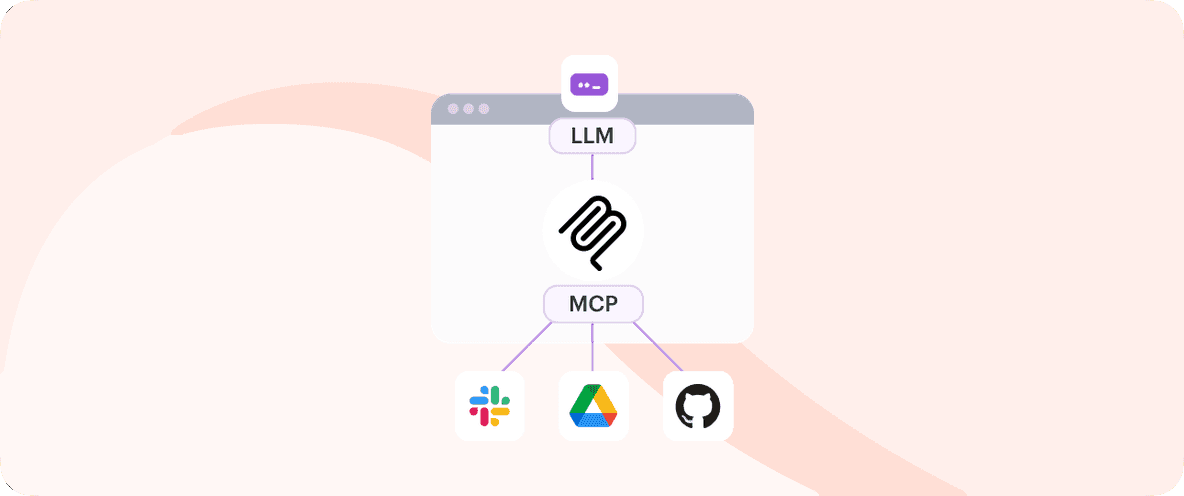
The working pattern in 2026 is hybrid, sometimes called bimodal. MCP sits at the front as the agent-facing interface, and iPaaS sits behind it as the execution and governance engine. An AI agent connects to a single MCP endpoint, discovers the actions it needs, and calls one. The iPaaS then does the real work: it resolves the right tenant's OAuth token, calls the target app, applies rate limits, logs the action, and returns the result. The agent never touches credentials or orchestration logic.
This split lets each layer do what it is good at without forcing a compromise. You get agent-native discovery from MCP and governed, reliable execution from iPaaS, in one architecture.
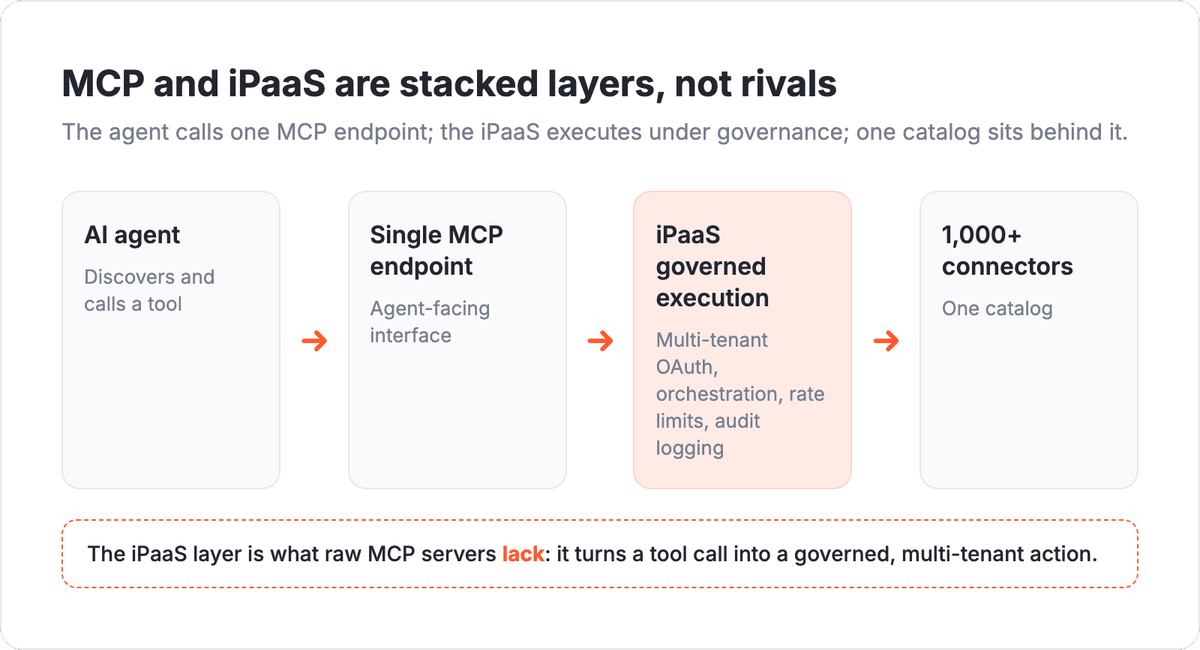
iPaaS as the governed execution layer under MCP
Put concretely, the iPaaS becomes the execution layer beneath the MCP endpoint. When an agent calls a tool, the iPaaS is what runs it: multi-tenant OAuth resolves the correct credentials, orchestration handles any multi-step logic, rate limiting protects shared API quotas, and audit logging records the action for compliance. The MCP server exposes the catalog and receives the call. The iPaaS carries it out. This is why an iPaaS makes a practical MCP foundation rather than a competing choice.
The split: real-time agent-callable actions vs batch and scheduled workflows
The two layers also naturally divide the work by timing. MCP is built for real-time, agent-callable actions: a user asks the agent to update a CRM record or send a message, and the agent calls the tool on the spot. iPaaS keeps handling the batch and scheduled side: nightly data syncs, webhook-triggered pipelines, and multi-step workflows that run without a human or an agent in the loop. Most SaaS products need both. Agent-driven actions and background automation are not competing designs. They are two modes running on the same connector catalog.
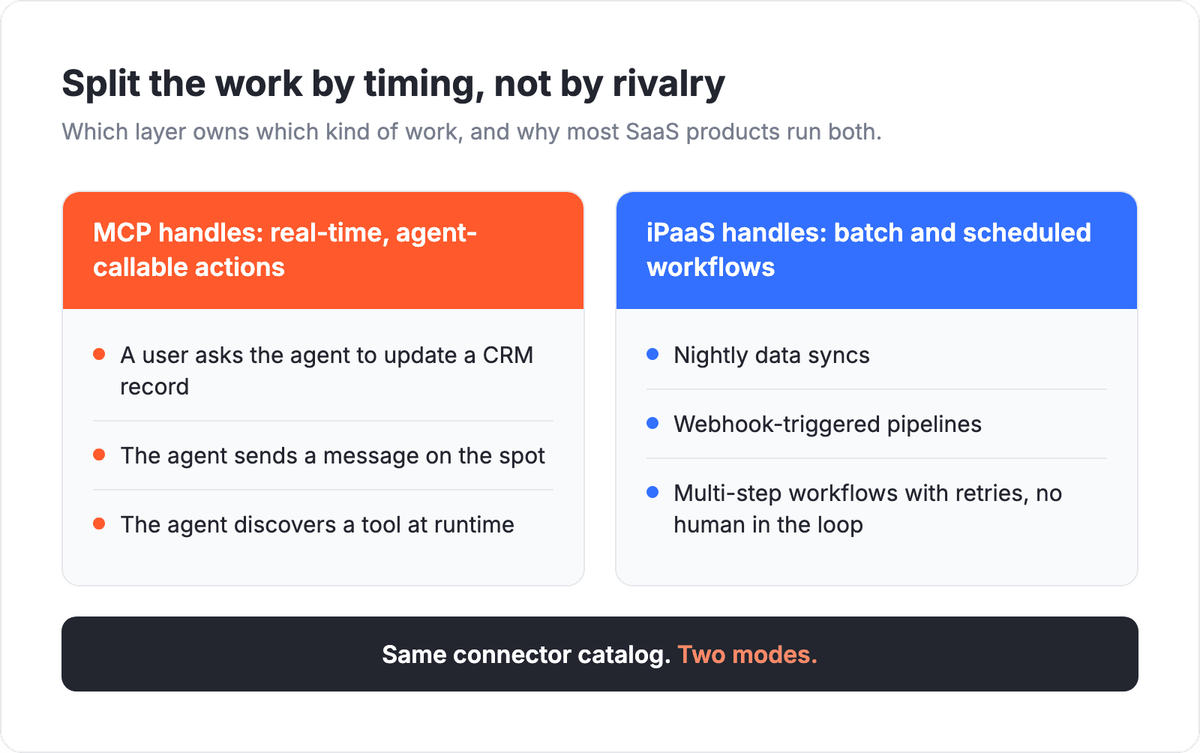
The two timing modes share the same underlying connector catalog, which is what makes the hybrid architecture practical rather than theoretical.
When to use MCP, iPaaS, or both
Match the approach to the job rather than picking a side. Use this framework:
Use MCP when the consumer is an AI agent that selects tools at runtime, the action is real-time and user-triggered, and you want agents to discover capabilities without hardcoded clients. MCP is the right surface for agent-callable actions across multiple tools in one conversation.
Use iPaaS when you need multi-tenant authentication, multi-step orchestration, batch or scheduled workflows, rate limiting, and audit logging. Any integration that has to run reliably for thousands of customers, with compliance-grade records, belongs on an iPaaS.
Use both when you are a SaaS product shipping AI features on top of a real integration catalog. That is most mid-market SaaS teams in 2026. Agents call actions through MCP; the iPaaS executes them under governance. The two are not redundant, because they cover discovery and execution respectively.
The decision framework almost always lands on hybrid for product teams exposing their own app's integrations to AI agents. The only question left is whether you build that hybrid stack yourself or embed a platform that already provides both layers.
How Albato Embedded fits: one MCP endpoint, 1,000+ governed connectors
Albato Embedded is a white-label embedded iPaaS that gives SaaS companies 1,000+ native integrations plus a single MCP endpoint that exposes those connectors to AI agents. Instead of choosing between MCP and iPaaS, your iPaaS becomes your MCP layer. The agent connects to one endpoint and reaches actions across 1,000+ apps through a small, fixed set of tools, using each end user's own connections. Each call runs through Albato's managed execution: multi-tenant OAuth, action logging, and monitoring in one dashboard. Prebuilt multi-step scenarios are available through the same platform when a single action is not enough. The mechanics are detailed in how Albato MCP works.
In this recorded demo, Albato co-founder Leo Goldfarb gives an AI agent a single prompt: summarize a HubSpot deal, post the summary to Slack, and add it as a note on the same deal. The agent completes all three actions through one Albato MCP endpoint, without a separate integration for either app.
That single-endpoint design also avoids the context-bloat trap of wiring an agent to dozens of separate servers. One governed endpoint routes to the whole catalog, so the agent's context stays lean and its tool selection stays accurate.
The platform figures behind this are substantial. Albato reports 20,000+ active embedded users and 1B+ API calls per month at a 99.99% success rate, with SOC 2 Type 2 certification and per-user credential isolation. For a SaaS product, that means your customers get a native integration experience under your brand, and your AI agents get the same 1,000+ connectors through one MCP endpoint, without your team building or maintaining either the connector library or the MCP layer. Full white-labeling and the MCP endpoint are available from the Pro plan.
For SaaS teams that want to ship both native integrations and AI-agent capabilities without building and maintaining the infrastructure for either, that single-endpoint model removes a significant build decision.
Frequently asked questions
What is the difference between MCP and iPaaS?
MCP (Model Context Protocol) is an open protocol that lets AI agents discover and call external tools at runtime. iPaaS (integration platform as a service) is the platform that runs integrations, handling authentication, orchestration, execution, and logging. MCP defines the interface between agent and tool. iPaaS does the governed work underneath it. They sit at different layers of the same stack.
Will MCP replace iPaaS?
No. MCP is a discovery-and-call protocol, not an execution platform. It does not manage multi-tenant OAuth, orchestrate multi-step workflows, enforce rate limits, or keep audit logs, which is exactly what an iPaaS provides. Gartner projects that by 2026, 50% of iPaaS vendors will add MCP features, meaning iPaaS platforms are absorbing MCP as a capability rather than being displaced by it.
Can MCP and iPaaS work together?
Yes, and that is the recommended pattern. MCP acts as the agent-facing interface, and the iPaaS runs execution and governance underneath. An agent discovers and calls a tool through MCP; the iPaaS resolves credentials, runs the workflow, applies rate limits, and logs the action. This hybrid architecture gives you agent-native discovery and governed execution at once.
When should you use MCP vs iPaaS?
Use MCP when an AI agent needs to discover and call tools in real time. Use iPaaS when you need multi-tenant auth, orchestration, batch or scheduled workflows, rate limiting, and audit logs. Most SaaS products shipping AI features need both: MCP for agent-callable actions and iPaaS for governed execution across their integration catalog.
What does iPaaS provide that MCP doesn't?
An iPaaS provides multi-tenant OAuth so each customer's credentials stay isolated, orchestration for multi-step workflows, rate limiting to protect shared API quotas, error handling, and audit logging for compliance. The base MCP spec covers tool discovery and the tool call, and leaves this execution and governance layer to the platform beneath it.
Are iPaaS vendors adopting MCP?
Yes. Gartner projects that by 2026, 75% of API gateway vendors and 50% of iPaaS vendors will have MCP features (Gartner, doc 7645729, 2026). MCP is becoming a standard feature of integration platforms, exposing existing governed connectors as tools that AI agents can call directly.