In this article
MCP vs API is no longer a theoretical debate. Since Anthropic donated the Model Context Protocol to the Agentic AI Foundation in December 2025, and OpenAI, Google, and Microsoft all adopted it, every SaaS CTO faces the same question: keep building native API integrations, switch to MCP, or run both. Albato Embedded is a white-label embedded iPaaS that wraps 1,000+ native API connectors behind a single MCP-compatible endpoint, so this comparison draws on real production experience with both approaches.
The short answer for most SaaS teams in 2026: you need both, managed through an integration layer that handles the complexity of each.
Key takeaways:
- MCP adds an AI-native discovery and tool-call layer on top of existing APIs. It does not replace REST endpoints, and since the 2026-07-28 revision the base protocol is stateless, so it adds no session layer either.
- Native API integrations remain faster for deterministic, app-to-app data flows where AI agents are not involved.
- MCP reduces the integration scaling problem from M x N custom connectors to M + N standardized implementations.
- Most SaaS products shipping AI features in 2026 need both: APIs for core data pipelines and MCP for agent-driven workflows.
- An embedded iPaaS like Albato Embedded handles the complexity of running 1,000+ API connectors and exposing them through a unified MCP server, so your team does not have to build or maintain either layer from scratch.
What is MCP (Model Context Protocol)
MCP is an open protocol, now governed by the Agentic AI Foundation under the Linux Foundation, that standardizes how AI agents discover and use external tools. It uses JSON-RPC 2.0 over HTTP, and since the 2026-07-28 revision it is a stateless protocol: every request carries its own protocol version and client capabilities, and the server processes each request independently instead of relying on hardcoded endpoint configurations or a prior handshake.
The most scalable MCP setup for embedded SaaS integrations is a single multi-tenant MCP server that fronts a shared connector library, rather than one server per app. One endpoint carries every tenant, credentials stay isolated per end user, and adding an app does not add another server for the agent to load.
In practical terms, an AI agent connected to an MCP server can ask "what tools do you have?" and receive a structured list of available actions, parameters, and data types. The agent then selects and calls the right tool based on the user's request, without a developer writing custom glue code for each integration.
MCP reached 97 million monthly SDK downloads by March 2026. Claude, ChatGPT, Gemini, Cursor, Microsoft Copilot, and VS Code all support it natively. OpenAI deprecated its proprietary Assistants API in August 2025 and built MCP support directly into the Responses API that replaced it.
What are native API integrations
Native API integrations are direct, coded connections between two software systems using the target application's REST (or GraphQL) API. A developer reads the API documentation, writes authentication logic, maps data fields, handles errors, and maintains the integration as the API evolves.
This is the model most SaaS products have used for the past decade. It is well understood, widely supported, and backed by extensive tooling. When your product needs to sync contacts from HubSpot or push orders to Shopify, a native API integration is the standard approach.
The cost, however, compounds. Each integration takes 2 to 6 weeks of engineering time for a production-grade build. Maintaining it against API versioning changes, rate limit shifts, and authentication updates adds ongoing overhead. According to Albato's platform data, in-house integration development costs approximately $150,000 over 4 to 7 months for a SaaS team building from scratch.
MCP vs native API integrations: Quick comparison
| Dimension | MCP | Native API integration |
|---|---|---|
| Primary consumer | AI agents and LLMs | Application code (backend services) |
| Communication | JSON-RPC 2.0, one request per HTTP POST, stateless | HTTP REST (stateless request-response) |
| Tool discovery | Dynamic at runtime (agents query available tools) | Static (developer reads docs, writes code) |
| Setup time per integration | 15 to 30 minutes per MCP server | 2 to 6 weeks per API integration |
| Scaling model | M + N (each tool = 1 server, each agent = 1 client) | M x N (each agent-tool pair = custom code) |
| Request state | Stateless since the 2026-07-28 revision (cross-call state passed as an explicit handle) | Stateless (each request is independent) |
| Best for | AI-driven workflows, multi-tool orchestration | Deterministic data pipelines, CRUD operations |
| Maturity | Launched November 2024; five protocol revisions to date, current 2026-07-28 | 15+ years of production use |
When MCP is the right choice
MCP delivers the most value when AI agents need to work across multiple external tools in a single workflow. Three conditions signal that MCP should be part of your integration architecture:
Your product ships AI features that touch external data. If your AI agent needs to pull CRM records, check calendar availability, and draft an email in one conversation, MCP gives the agent a single protocol to discover and call all three tools. Without MCP, you write and maintain separate API clients for each service inside the agent's codebase.
You connect to three or more external services in AI workflows. At the crossover point of roughly 3 to 5 integrations, the M + N efficiency of MCP overtakes the M x N cost of building direct API connections. Five AI agents connecting to ten tools require 50 bespoke integrations with direct APIs, but only 15 MCP implementations.
Your integration catalog needs to grow without proportional engineering cost. Adding a new tool through MCP requires one server implementation. Adding it through native API requires a new integration per agent that needs access to it. For SaaS products planning to offer dozens or hundreds of integrations, MCP fundamentally changes the economics.
The following infographic visualizes the scaling math behind the M x N versus M + N comparison, and shows how an embedded iPaaS reduces the equation even further.

When native API integrations still win
MCP is not a universal replacement. Native API integrations remain the better choice in several common scenarios:
Deterministic, high-throughput data pipelines. Syncing 100,000 order records nightly between your product and an ERP does not benefit from dynamic tool discovery or conversational context. A direct API call with batch processing is faster, more predictable, and easier to monitor.
Operations requiring exact control and compliance. Financial transaction processing, healthcare data exchange, and regulatory reporting need deterministic execution paths. The flexibility that makes MCP powerful for AI agents introduces ambiguity that compliance teams do not want in audit-critical flows.
Single-integration use cases without AI involvement. If your product only needs one integration (say, syncing contacts with Salesforce), building a direct API integration or using a unified API is simpler than deploying an MCP server for a single connection.
Latency-sensitive operations. Every request through an MCP server adds a routing hop. Native API calls go directly to the target service. For real-time operations where milliseconds matter (payment processing, live chat message delivery), direct API connections are still preferable.
The hybrid approach: Why most SaaS teams need both
The practical reality for most SaaS products in 2026 is that MCP and native APIs serve different layers of the same integration architecture. Your core data pipelines (user sync, billing webhooks, order processing) run on direct API integrations because they need deterministic behavior, high throughput, and proven reliability. The same decision seen from the platform side is covered in how MCP fits alongside an iPaaS.
Your AI-powered features (intelligent assistants, automated workflows, agent-driven actions) connect through MCP because they need dynamic tool discovery and the ability to orchestrate across multiple services in a single conversation, with any cross-call context carried by your own layer rather than by the protocol.
Running both layers in-house means maintaining two separate integration stacks. For each of your 1,000+ potential integration targets, you need both a reliable API connector and an MCP-compatible tool definition. The engineering cost of building and maintaining this dual infrastructure is why most SaaS teams turn to an embedded iPaaS that handles both layers through a single platform.
How an embedded iPaaS bridges MCP and API at scale
An embedded iPaaS maintains native API connectors and wraps them in MCP-compatible tool definitions. Instead of your engineering team building each integration twice (once for direct API access, once for MCP), the platform provides both layers out of the box.
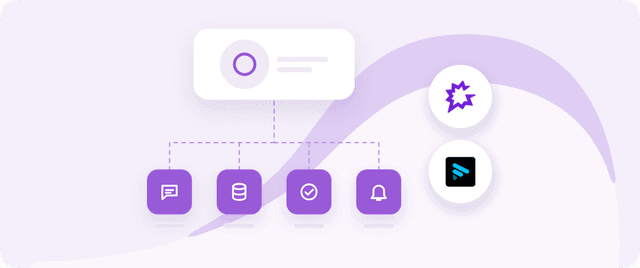
The following diagram shows how an embedded iPaaS sits between your SaaS product and external tools, serving both native API integrations for application code and MCP for AI agents through a single platform.

Albato Embedded, for example, maintains 1,000+ production API connectors and processes over 250 million transactions per month across its platform. When a SaaS product embeds Albato, its users get a fully white-labeled native integration experience, and its AI agents get access to the same connector catalog through a single, unified MCP endpoint.
This approach solves three problems at once:
- No M x N scaling pain. Your team connects once to the embedded iPaaS. The iPaaS maintains all 1,000+ API connectors and their MCP tool definitions.
- No context bloat for AI agents. Instead of loading tool definitions from dozens of individual MCP servers (which burns context window tokens and causes hallucinations), your agent connects to one MCP endpoint that routes to any connector in the catalog.
- No dual maintenance burden. API changes, authentication updates, and rate limit adjustments are handled by the iPaaS vendor, not your team.
RD Station, a marketing automation platform, saved $150,000 in integration development costs and saw 73% higher retention among users with active integrations after embedding Albato's connector library. Chatfuel cut integration delivery time from two months to one week and reduced churn by 25%.
Decision framework: MCP, API, or both
Use this framework to map your integration needs to the right approach:
Step 1: Identify the consumer. If the consumer is application code executing a defined workflow, you need a native API integration. If the consumer is an AI agent that selects tools at runtime, you need MCP.
Step 2: Count the integrations. Fewer than 3 external services in your AI workflow? Direct API wrappers are manageable. Three or more? MCP's M + N model starts saving significant engineering time.
Step 3: Assess your maintenance capacity. Each native API integration carries ongoing maintenance cost (API version changes, auth token rotation, error handling updates). If you plan to offer 50+ integrations, maintaining them in-house is a full-time job for multiple engineers. An embedded iPaaS like Albato Embedded absorbs this cost entirely.
Step 4: Check your AI roadmap. If AI agents are part of your 2026 product roadmap, building MCP readiness now avoids a costly retrofit later. Products that already run on an embedded iPaaS with MCP support can expose their full connector catalog to AI agents without any additional engineering work.
The decision framework below maps each scenario to its recommended integration approach.

The framework consistently points toward a hybrid architecture managed through an integration platform rather than built in-house. This is not because either MCP or native APIs are insufficient on their own. It is because maintaining both at scale requires specialized infrastructure that most SaaS teams should not build themselves.
What MCP adoption means for SaaS products in 2026
MCP is now governed by the Agentic AI Foundation, a vendor-neutral body under the Linux Foundation co-founded by Anthropic, Block, and OpenAI, with platinum support from Google, Microsoft, AWS, Cloudflare, and Bloomberg. This level of industry backing means MCP is not a speculative bet. It is the standard that AI agents will use to interact with external tools.
For SaaS CTOs, this creates a clear strategic imperative: your product needs to be both API-complete (supporting the deterministic integrations your users rely on) and MCP-ready (supporting the agent-driven workflows your users will expect). Products that only offer traditional API integrations will lose deals to competitors whose integrations work with AI agents out of the box.
The fastest path to both is an embedded iPaaS that already maintains the API connector library and the MCP layer. Your engineering team focuses on your core product while Albato Embedded handles the integration infrastructure, and your users get white-labeled, native integrations that work for both human-driven and agent-driven workflows.
Frequently asked questions
What is the difference between MCP and API?
MCP (Model Context Protocol) is an open standard that lets AI agents discover and call external tools at runtime through JSON-RPC 2.0 over HTTP. Since the 2026-07-28 revision both are stateless: MCP carries protocol version and client capabilities in every request, and a traditional API is a direct interface (usually REST) that application code uses to exchange data with a specific service. MCP does not replace APIs. Most MCP servers wrap existing APIs and expose them in a format AI agents can use autonomously.
Should I replace my API integrations with MCP?
No. MCP and native API integrations serve different consumers. Keep your API integrations for deterministic data pipelines, batch processing, and compliance-critical workflows. Add MCP for AI-agent-driven features that need dynamic tool discovery and multi-service orchestration. Most SaaS products in 2026 benefit from running both.
How does MCP reduce integration costs?
MCP turns the M x N integration problem (every agent paired with every tool requires custom code) into M + N (each tool publishes one MCP server, each agent runs one MCP client). For a SaaS product connecting 5 AI agents to 10 external tools, this means 15 implementations instead of 50. An embedded iPaaS like Albato Embedded reduces this further to a single connection: one MCP endpoint that routes to 1,000+ connectors.
Is MCP secure enough for production SaaS?
MCP supports OAuth 2.1 for authentication and can enforce scoped permissions per tool. Security depends on implementation. Running MCP through an embedded iPaaS with SOC 2 Type 2 certification (like Albato Embedded) and multi-tenant isolation adds enterprise-grade access controls that standalone MCP servers typically lack.
What is an embedded iPaaS and how does it relate to MCP?
An embedded iPaaS is a white-label integration platform that SaaS companies embed directly into their product. It provides pre-built API connectors, a visual automation builder, and (in platforms like Albato Embedded) a unified MCP endpoint. Users get native integrations inside the product without leaving to a third-party tool, and AI agents get structured access to the full connector catalog through one MCP server.
Albato Embedded gives SaaS teams a single integration layer that covers both API and MCP access to 1,000+ apps. Teams at RD Station and Chatfuel shipped full integration libraries in weeks, not months, without building or maintaining individual connectors.