
In this article
Key Takeaways
- ReferralCandy is the fastest launch for Shopify and WooCommerce stores, starting at $39/mo plus a success fee. Referral Rock fits mid-market teams that want a flat rate with no per-referral cut, at $250/mo.
- Friendbuy and Talkable are the enterprise picks: quote-based pricing, A/B testing, and consultative program design for retail and DTC brands running high referral volume.
- Yotpo works best when referrals sit inside a broader loyalty and reviews suite, and GrowSurf is the SaaS-first option that prices by participant rather than by store revenue.
- The tool you pick matters less than what it connects to. A referral platform that cannot push new customers into your CRM, email tool, and accounting stack leaves half the value on the table.
Most referral platforms bill in one of two ways: a flat monthly fee, or a base fee plus a percentage of every sale a referral drives. That single choice changes your economics more than any feature on the comparison page. A store doing $80,000 a month in referral revenue pays roughly $8,400 a year on ReferralCandy's 10.5% Basic success fee, but a flat $3,000 a year on Referral Rock. Your revenue volume, not your feature wishlist, should pick the pricing model first.
How we ranked these tools
We ranked these six platforms on four things a referral program actually lives or dies on: pricing model and total cost at real revenue volumes, how fast a non-technical marketer can launch a program, the depth of fraud controls and analytics, and how well the tool moves referral data into the rest of your stack. We pulled every price from the vendor's own pricing page in September 2026 and flagged where pricing is quote-only.
Referral software sells itself on referral mechanics, but the money leaks at the edges. A new referred customer is worth almost nothing if they never land in your CRM, never get tagged for a welcome sequence, and never show up in your revenue reporting. So integration depth carried real weight in this ranking, not as a footnote.
💡 Tip
Before you compare features, estimate your monthly referral revenue and run it against each pricing model. A success-fee plan looks cheap at low volume and expensive at scale. A flat plan is the reverse. The crossover point is usually somewhere between $30,000 and $60,000 in monthly referral revenue.
The six tools at a glance
The table below covers the entry price, the pricing model, the best-fit business type, and whether the tool exposes an API or webhooks for connecting to the rest of your stack. Use it to shortlist two or three, then read the full sections.
| Tool | Entry price | Pricing model | Best for | API / webhooks |
|---|---|---|---|---|
| ReferralCandy | $39/mo + 10.5% fee | Base + success fee | Shopify / WooCommerce stores | Yes (full API) |
| Referral Rock | $250/mo | Flat, unlimited referrals | Mid-market, service teams | Yes |
| Friendbuy | Custom quote | Contract, usage-based | Enterprise retail / DTC | Yes |
| Talkable | Custom quote | Contract, usage-based | Enterprise ecommerce | Yes |
| Yotpo | Custom quote | Suite (loyalty + reviews) | Brands wanting one platform | Yes |
| GrowSurf | $179/mo | Per participant | SaaS and newsletters | Yes |
The split is clean. Two tools publish prices you can start on today, three sit behind a sales call, and one prices on a logic that only makes sense for subscription businesses. That tells you more about who each tool is built for than any feature list.
ReferralCandy: the fastest way to launch on Shopify
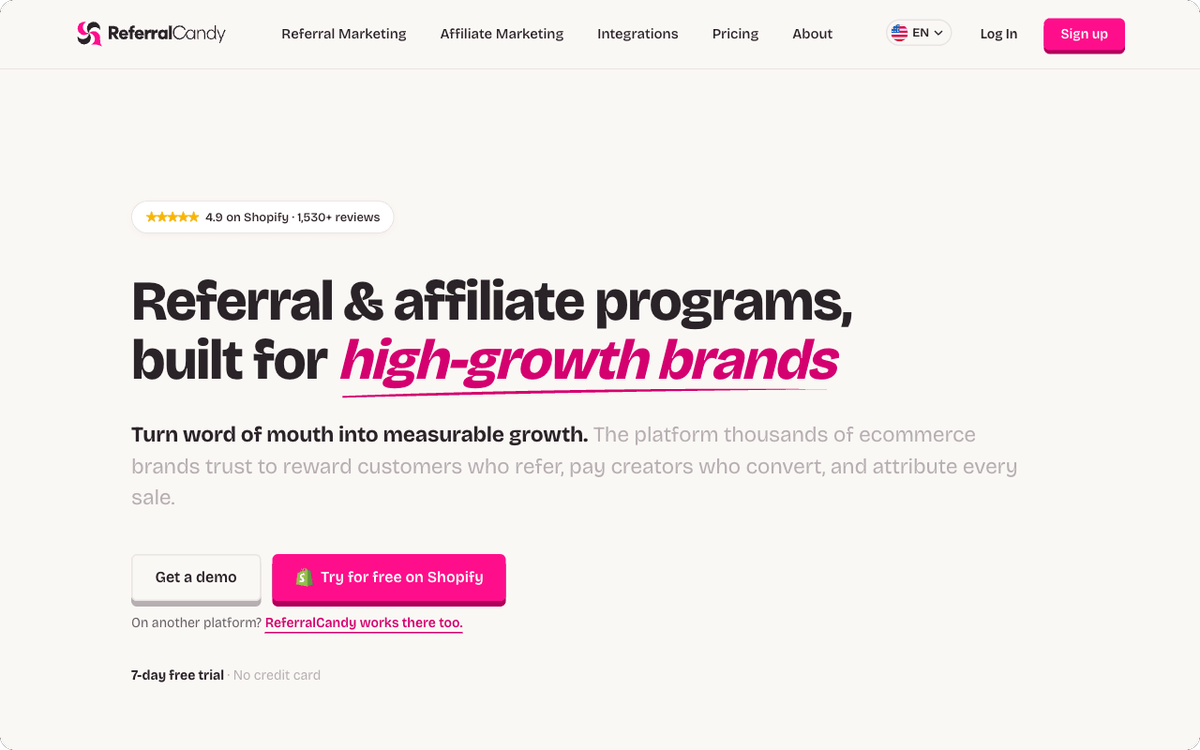
ReferralCandy earns the top spot for one reason: a store owner with no developer can have a working referral program live in under 30 minutes. It plugs directly into Shopify, WooCommerce, and BigCommerce, reads your order data automatically, and starts rewarding customers who refer friends without any manual reconciliation.
Pricing runs on a base-plus-success-fee model. The Basic plan is $39/mo plus a 10.5% fee on referral sales, Grow is $79/mo plus 3.5%, Scale is $249/mo plus 1.5%, and Enterprise is $799/mo plus 0.25%. The pattern rewards volume: as you move up, the fixed fee climbs but the cut on each sale drops sharply. A high-volume store on Scale or Enterprise pays a fraction of the percentage a smaller store pays on Basic.
ReferralCandy exposes a full API and integrates with the tools most stores already run, so a new referred customer can flow into your email platform and CRM instead of sitting in a silo. That matters, because the referral is only the first touch. What you do with that customer afterward is where retention revenue comes from.
The per-sale fee drops by a factor of 42 between the cheapest and most expensive ReferralCandy plan, which tells you exactly how this category is built to scale.
📊 Stat
ReferralCandy's own success-fee schedule drops from 10.5% on Basic to 0.25% on Enterprise. That 42x spread in the per-sale cut is the clearest signal in the market that referral software is priced for scale, not for tire-kickers.
Referral Rock: flat pricing for mid-market teams
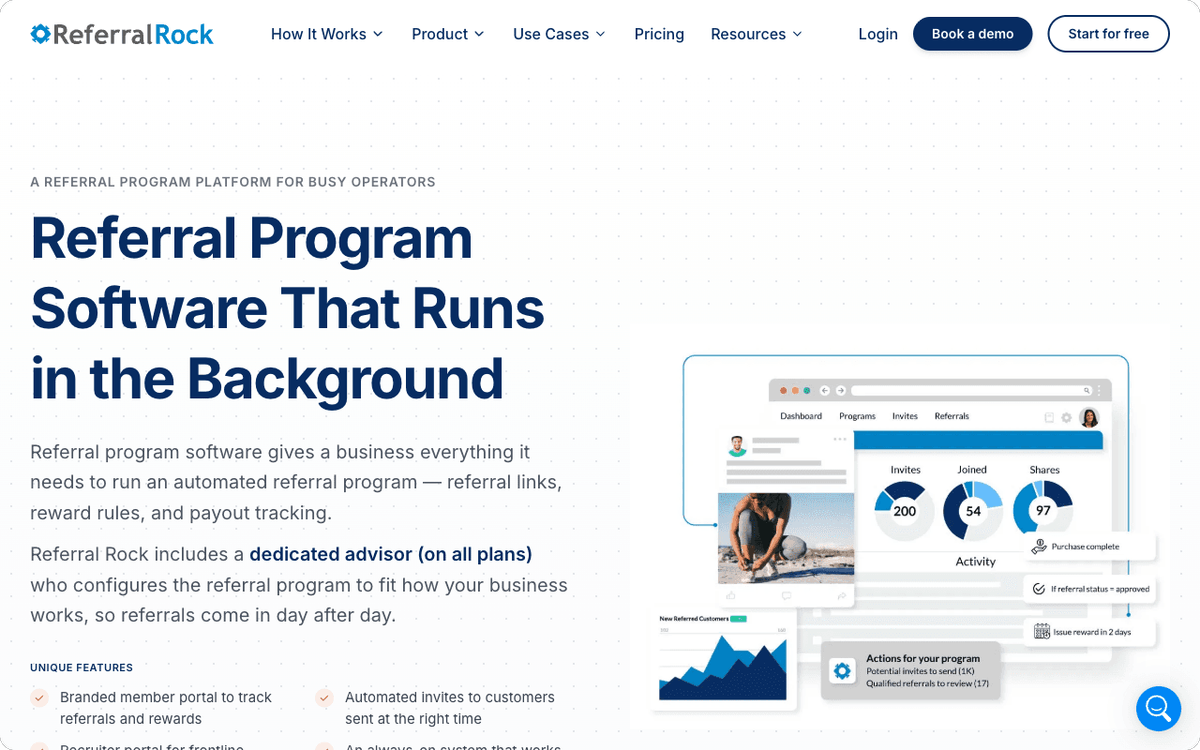
Referral Rock is the pick for teams that hate variable costs. Its Operator plan is a flat $250/mo with unlimited referrals and no overage fees, which means your bill does not spike the month a campaign goes viral. That predictability is rare in this category and it is the main reason mid-market and service businesses gravitate to it.
The base plan includes 10,000 members, a dedicated program advisor, a hosted member portal, sharing tools, automated emails, and ten user seats. You scale by buying blocks: another 10,000 members runs $125/mo, an extra program is $100/mo, and additional seats are $50/mo per ten. The math stays legible, which is the whole point.
Referral Rock leans toward businesses that run referral programs outside pure ecommerce, such as agencies, B2B services, and financial products, where a referred lead needs to enter a sales pipeline rather than trigger an instant coupon. Its integrations and API let you route those leads into a CRM so your sales team picks them up while the intent is fresh.
That predictability is the core reason many mid-market teams keep Referral Rock on their shortlist even when they first look at tools with lower entry prices.
⚠️ Important
A flat plan is only cheaper than a success-fee plan above a certain revenue threshold. If your referral channel is new and driving under $30,000 a month, a percentage-based tool may cost you less in year one. Model both before committing to an annual contract.
Friendbuy: enterprise referral and loyalty combined
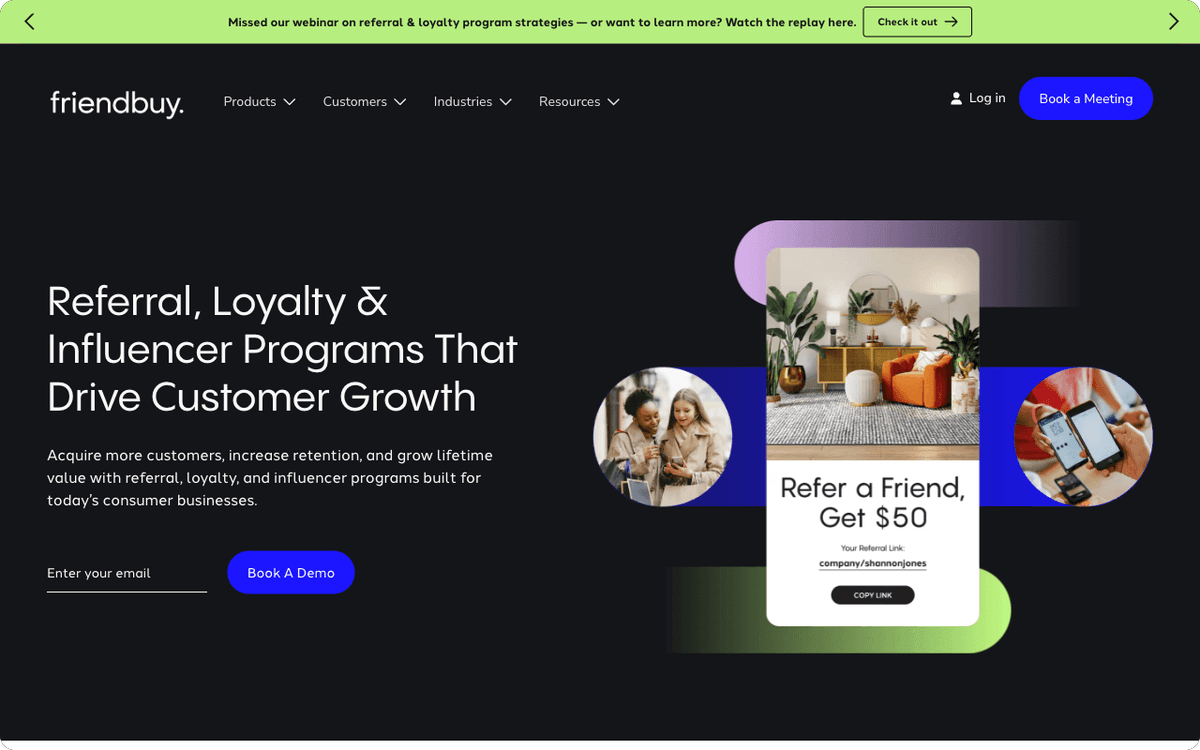
Friendbuy is built for brands that treat referral as a serious acquisition channel, not a growth-hack widget. It is used by established US retail and DTC names and leans on deep analytics, A/B testing, and consultative program design. You do not self-serve your way onto Friendbuy. Pricing is quote-based and tied to a contract, which is standard once a referral program is generating meaningful revenue and needs enterprise controls.
What you buy at this tier is optimization. Friendbuy lets teams test reward structures, referral messaging, and placement, then double down on what converts. For a brand spending real money on paid acquisition, shaving the cost per acquisition through a well-tuned referral loop is where the payback lives.
Friendbuy exposes an API for pushing referral events into your data warehouse, CRM, and marketing automation, which is table stakes at the enterprise level. The referred customers are only useful if they enrich the same profiles your retention and lifecycle teams already work from.
Talkable: campaign testing for large ecommerce
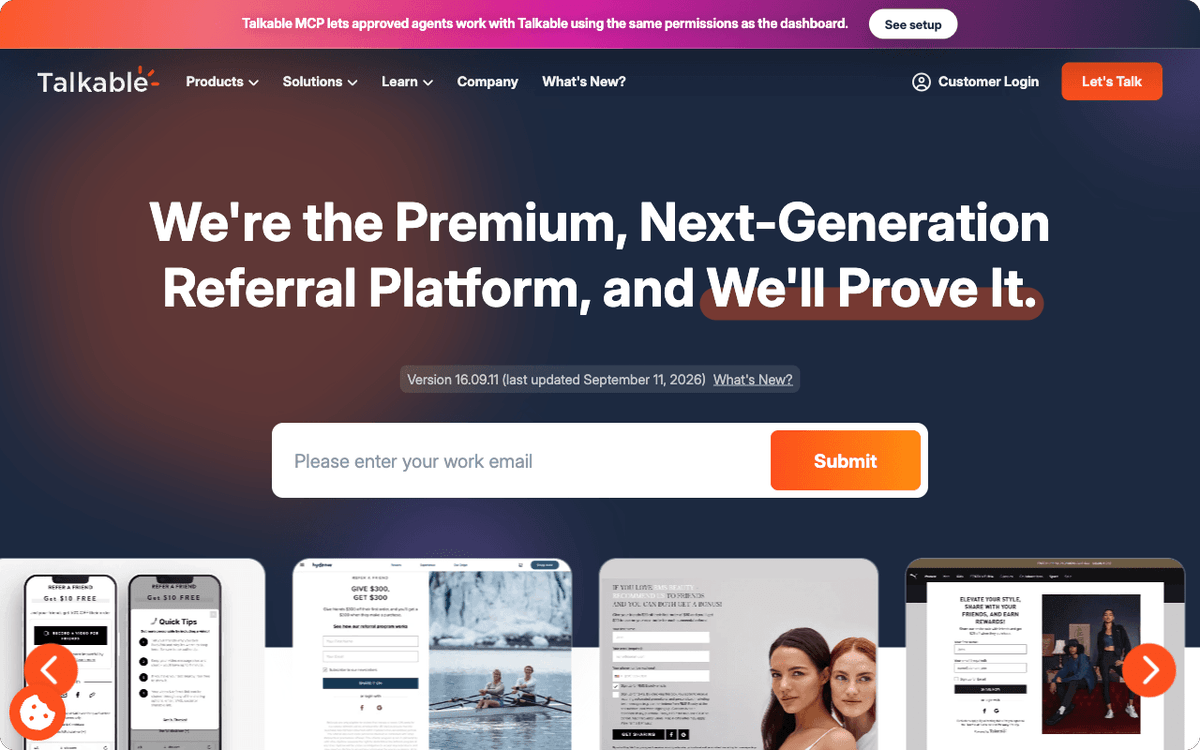
Talkable competes with Friendbuy for the enterprise ecommerce buyer and differentiates on campaign experimentation. It gives marketing teams granular control over referral and advocacy campaigns, with the segmentation and testing tooling a large brand needs to run several offers at once without cannibalizing them.
Pricing is quote-based and gated behind a demo, which fits the buyer. A brand evaluating Talkable is usually comparing it head-to-head with Friendbuy and weighing which platform's account team and testing model fits its calendar of promotions.
Talkable's strength shows up when a brand runs referral alongside other acquisition motions and needs to attribute cleanly. Its integrations let referral data land in the analytics and CRM tools where the rest of that attribution work already happens, so referral does not become an island your finance team cannot reconcile.
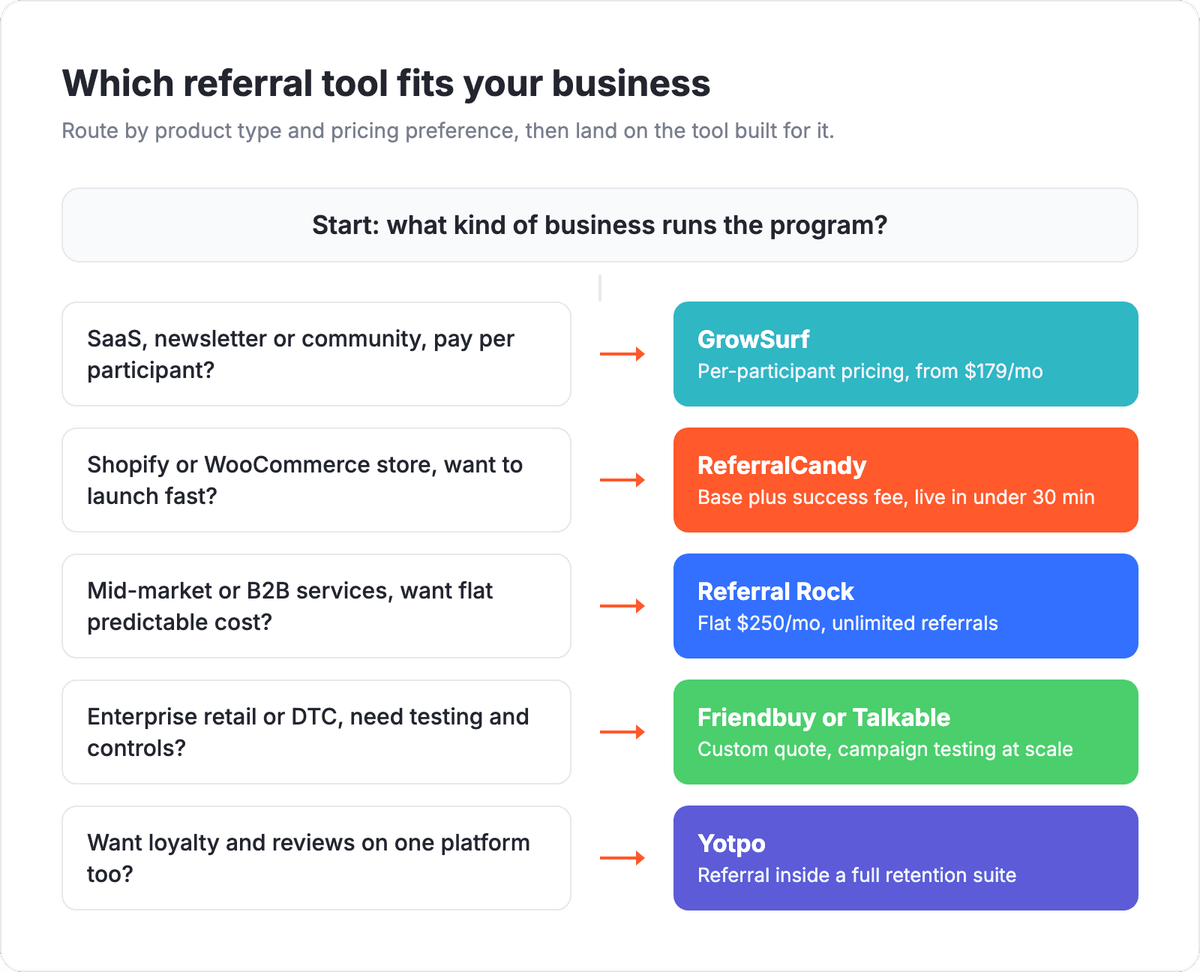
The decision tree above maps the six tools by three dimensions: whether you need self-serve or enterprise onboarding, whether flat or success-fee pricing fits your revenue profile, and whether you are selling products or software. Most teams can shortlist to two options in under two minutes using it.
Yotpo: referrals inside a full retention suite
Yotpo is the pick when you do not want a standalone referral tool at all. Referrals are one module inside its broader ecommerce marketing suite, which also covers reviews, loyalty, SMS, and email. For a brand that wants reviews, loyalty points, and referral running off one customer profile, consolidating on Yotpo removes the integration work of stitching separate tools together.
Pricing is quote-based and depends on which modules you turn on and your order volume. That makes a clean price comparison against a single-purpose tool hard, which is the tradeoff of buying a suite. You are paying for consolidation, not for the referral feature in isolation.
The case for Yotpo is strongest when referral is part of a retention strategy rather than a one-off acquisition play. A customer who refers a friend, leaves a review, and earns loyalty points should be the same record across all three, and Yotpo keeps them unified so your lifecycle messaging can act on the full picture.
🔧 How it works
In a suite like Yotpo, a single customer action can chain across modules. A completed referral can add loyalty points, trigger a review request, and drop the customer into an SMS flow, all without a separate integration between each tool. That chaining is the reason brands accept opaque suite pricing.
GrowSurf: participant-based pricing for SaaS
GrowSurf breaks from the ecommerce pack by pricing on participants rather than store revenue, which makes it the natural fit for SaaS products, newsletters, and community businesses. Its Startup tier runs $179/mo for up to 2,500 participants and $279/mo for up to 5,000, and the Business tier scales from $449/mo at 10,000 participants up to $1,429/mo at 150,000, with custom quotes above that.
Participant-based pricing matters because a SaaS referral program is measured in referrers and referred users, not in gross merchandise value. A newsletter with 20,000 subscribers running a referral loop cares about how many of them participate, not about a percentage of a nonexistent sale. GrowSurf's model maps directly to that reality.
GrowSurf is built to embed inside a product, with an API and JavaScript library for triggering referral prompts at the right moment in a user's journey. For a SaaS team, wiring referral events into the CRM and product analytics stack is where the program becomes measurable, and GrowSurf's developer-facing tooling is designed for exactly that.
What referral software cannot do on its own
A referral platform captures the referral and issues the reward. It does not, on its own, tell your sales team a high-intent lead just arrived, tag that customer for a welcome sequence, or record the new revenue in your accounting system. Those handoffs are where most referral programs quietly lose value, and none of them are the referral tool's job.
This is the gap an integration layer fills. Every tool in this list exposes an API or webhooks, which means a no-code platform like Albato can listen for a new referral event and fan it out across your stack: create the contact in your CRM, add them to the right email flow, notify the sales channel in Slack, and log the sale for finance. The referral tool stays the system of record for the program, and the automation handles everything downstream.
The pattern is the same one that powers other ecommerce automations. If you already run flows like WhatsApp cart recovery and order updates, adding referral events as another trigger is a small extension, not a new project. A referred customer becomes just another event that kicks off the same reliable downstream sequence.
That downstream wiring is the part you never have to build by hand. A no-code platform connects any referral tool to your CRM, email, and accounting stack, and lets each new referral event flow to the systems that convert it, no card required.
Referral is one channel in a larger acquisition mix. If you are building out multiple low-cost acquisition loops, it pairs naturally with content and partner motions like running an affiliate marketing store, where the same downstream automation catches customers from every source and routes them the same way.
💡 Tip
When you evaluate a referral tool, open its integrations or developer docs before its feature tour. A platform with a clean webhook for new referral events is worth more to a connected stack than one with a slightly prettier reward page and no way out of its own silo.
How to choose the right one
Start with your pricing math, not the feature grid. If your referral revenue is high and predictable, a flat plan like Referral Rock protects your margin. If it is early and variable, a success-fee tool like ReferralCandy lets you pay in proportion to results. If you are enterprise and running paid acquisition alongside referral, Friendbuy or Talkable earn their contract through testing and attribution. If you sell software rather than products, GrowSurf's participant pricing is the honest fit. And if you want referral to live inside loyalty and reviews, Yotpo consolidates the stack.
Then check the exit. Whichever tool you pick, confirm it can push referral events out to the systems that actually convert and retain those customers. The best referral program is the one whose data does not stop at the referral.
FAQ
What is the best referral program software for a small Shopify store?
ReferralCandy is the strongest fit for small Shopify and WooCommerce stores. It launches in under 30 minutes, reads order data automatically, and starts at $39/mo plus a success fee, so your cost scales with the revenue the channel drives rather than as a large fixed bill up front.
Is flat pricing or success-fee pricing cheaper for referral software?
It depends on your referral revenue. Success-fee plans like ReferralCandy's are cheaper at low volume because you pay a percentage of actual sales. Flat plans like Referral Rock's $250/mo become cheaper once monthly referral revenue passes roughly $30,000 to $60,000, where a percentage cut would exceed the flat fee.
What referral software works best for SaaS instead of ecommerce?
GrowSurf is built for SaaS because it prices by participant rather than by store revenue, starting at $179/mo for up to 2,500 participants. It offers an API and JavaScript library for embedding referral prompts inside a product, which matches how SaaS referral programs are measured and run.
Can I connect referral software to my CRM and email tools?
Yes. Every major referral platform exposes an API or webhooks. A no-code automation platform such as Albato can listen for new referral events and push them into your CRM, email tool, Slack, and accounting system automatically, so referred customers enter your normal onboarding and reporting flows without manual work.
Which referral tools are enterprise-grade?
Friendbuy and Talkable are the enterprise picks. Both use quote-based, contract pricing and offer A/B testing, advanced segmentation, and consultative program design aimed at large retail and DTC brands running referral as a core acquisition channel alongside paid media.
Want to go deeper? The articles below cover ecommerce automation and acquisition channels that pair well with a referral program.