In this article
Key Takeaways
- Smile.io is the fastest path to a live rewards program for small Shopify stores, with a free plan for up to 200 orders a month and paid tiers from $15/month.
- LoyaltyLion fits DTC e-commerce brands that want tier logic and deep Klaviyo sync; paid plans start at $199/month.
- Yotpo works best when you want loyalty, reviews, and SMS in one suite, starting free for 100 orders and $199/month on Pro.
- Talon.One and Open Loyalty are the enterprise picks: custom-priced, API-first engines for brands that need rules and headless control, not a pre-built widget.
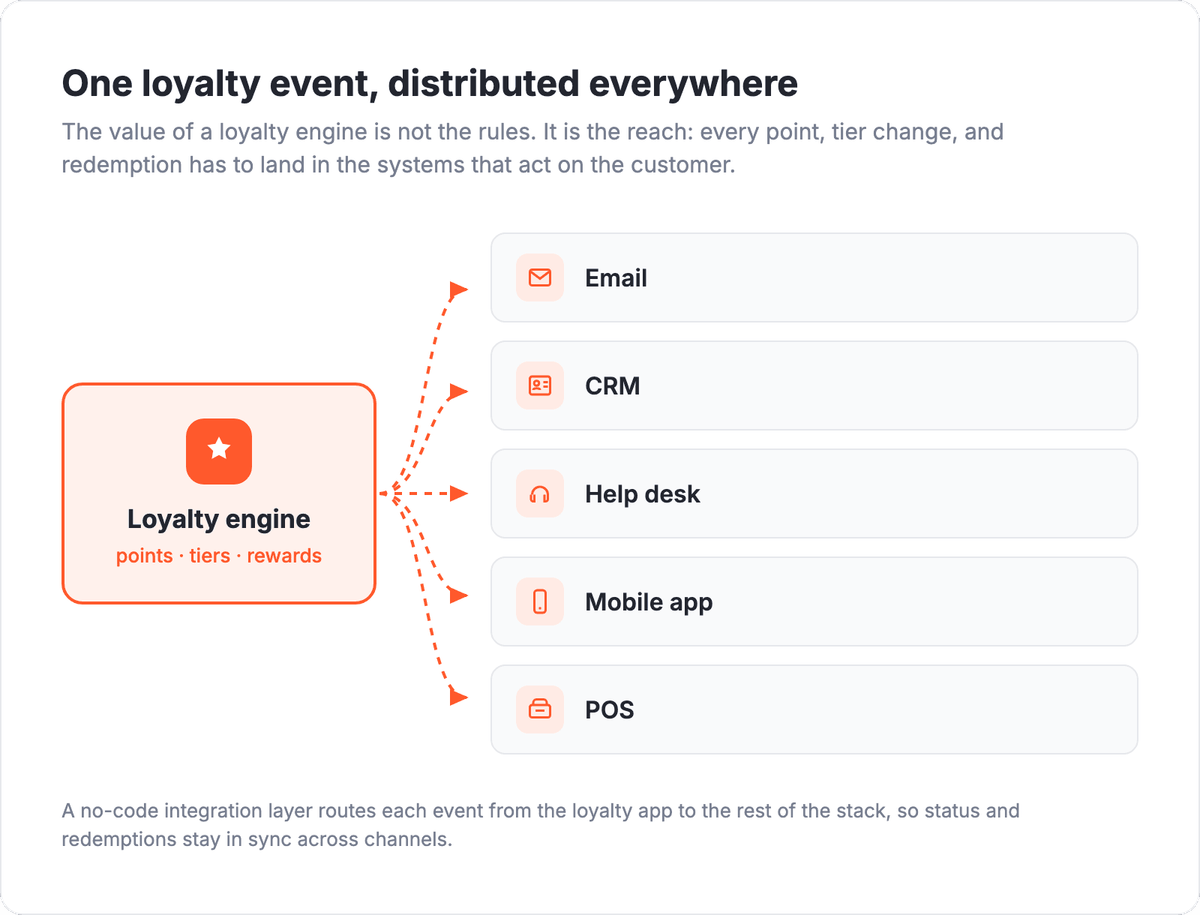
- Your loyalty data only pays off when points, tiers, and redemptions reach your CRM, help desk, and email tool instead of sitting inside one app.
Loyalty software decides who earns points and when, but retention lives downstream, in the systems that actually talk to the customer. A tier upgrade that never reaches your email platform is a tier upgrade nobody acts on, which is why integration depth separates a tool you set up once from one your whole team uses.
The six best customer loyalty platforms at a glance
The right loyalty tool depends on your stage and your stack. A Shopify store doing 300 orders a month needs a different platform than a multi-brand retailer running promotions across 12 markets. The table below maps each tool to the buyer it fits, with verified pricing and the connectors that matter for a full stack.
| Tool | Best for | Starting price | Free plan | Key integration angle |
|---|---|---|---|---|
| Smile.io | Small Shopify stores launching fast | $15/mo (Essential) | Yes, up to 200 orders/mo | Shopify-native, connects out via Klaviyo and email tools |
| LoyaltyLion | DTC brands wanting tiers and VIP logic | $199/mo (Classic) | Yes, up to 400 orders/mo | Deep Shopify and Klaviyo sync |
| Yotpo | Loyalty, reviews, and SMS in one suite | $199/mo (Pro) | Yes, up to 100 orders/mo | Native reviews and SMS, CRM connectors |
| Talon.One | Enterprises needing a promotion rules engine | Custom | No | API-first, feeds any channel |
| Open Loyalty | Headless, API-first loyalty at scale | Custom | No | Full API, active-member pricing |
| Loyverse | Retail and hospitality with a POS | Free (core POS + loyalty) | Yes, core is free | POS-native points, paid add-ons |
Two things decide where you land. First, whether you run on Shopify or a POS, since half these tools are built for one and awkward on the other. Second, whether a pre-built widget covers you or you need an engine you can shape with rules. The sections below walk each tool from its strongest angle, then show how to connect any of them to the rest of your stack.
Smile.io: the fastest way to launch points on Shopify
Smile.io wins on speed. A small Shopify store can have a points-and-rewards program live in under an hour, which is why it dominates the early-stage e-commerce segment. You pick earning rules, set redemption values, drop the widget on your storefront, and you are running. There is no rules engine to configure and no implementation call to book.
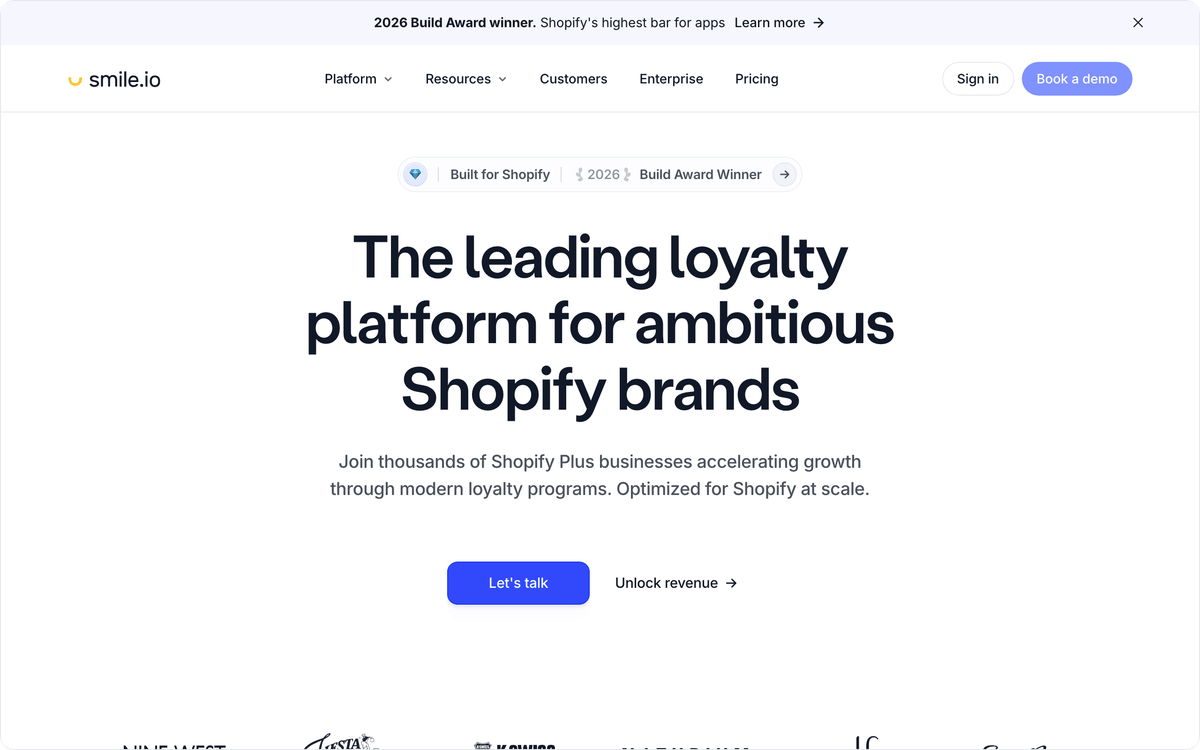
Pricing scales with monthly orders, not features you may never touch. The free plan covers up to 200 orders a month, Essential is $15/month for 500 orders, Standard is $79/month for 1,000, Growth is $199/month for 2,500, and Plus runs $999/month on annual billing for 7,500 orders. Enterprise is custom for retailers past roughly $40M in revenue. That order-based ladder keeps the entry cost genuinely low, which matters for a store still proving that a loyalty program moves repeat purchase rates at all.
💡 Tip. Start with points and a referral program before you add tiers. Tiers add complexity your earliest repeat buyers do not need yet, and you can layer them in once you see which reward types actually drive a second order.
The tradeoff is depth. Smile.io covers the common e-commerce loyalty patterns well, but if you want conditional promotions, market-specific rules, or a program that spans a POS and a webstore, you will hit its ceiling. It is a widget, and a good one, not a platform you extend.
Where Smile.io needs help is downstream. Points and VIP status live in Smile, but your email flows live in Klaviyo or Mailchimp and your support context lives in your help desk. Connecting Smile events to those tools through Shopify order and customer data is what turns a rewards widget into a retention loop your whole team can act on.
LoyaltyLion: tier logic and Klaviyo depth for DTC brands
LoyaltyLion is built for DTC brands that treat loyalty as a retention channel, not a badge. Its strength is tier and VIP logic tied tightly to Shopify and Klaviyo, so a customer who crosses a spend threshold can trigger a segmented email flow the same day. That closes the gap between earning status and acting on it, which is where most loyalty programs quietly leak value.
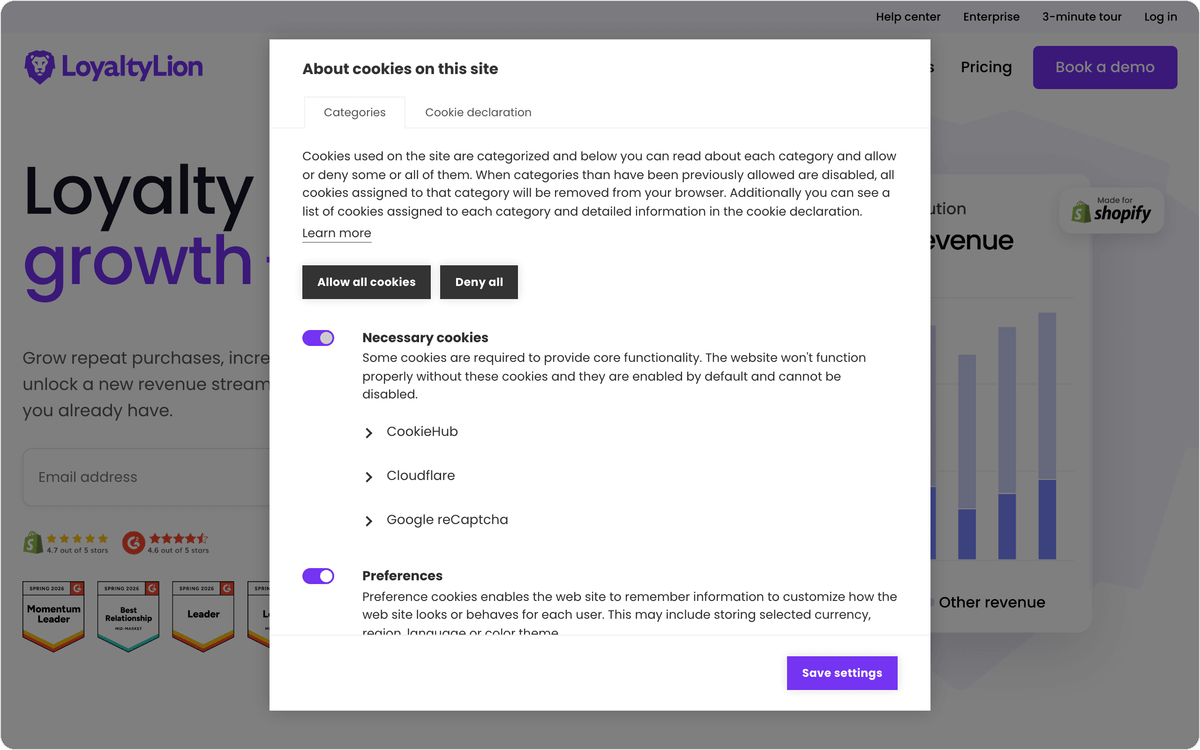
The paid Classic plan starts at $199/month and includes 500 orders, with Advanced and Plus priced custom for brands adding VIP tiers, AI features, and quarterly strategic reviews. A free plan exists through the Shopify App Store for stores under 400 orders a month, and every plan ships with a branded loyalty page and Klaviyo integration. Pricing scales on monthly order volume, which suits brands with seasonal spikes.
📊 Stat. Loyalty pricing splits cleanly by buyer. SMB tools like Smile.io and Yotpo start free or under $199/month, while the enterprise engines (Talon.One, Open Loyalty) drop public pricing entirely and quote custom. Where a tool sits on that ladder tells you who it was built for before you read a single feature.
The catch is that LoyaltyLion assumes a Shopify-plus-Klaviyo world. If your email lives in HubSpot or your store runs on WooCommerce, you can still use it, but you lose the native depth that makes it worth the premium over Smile.io. For a brand already committed to Shopify and Klaviyo, that depth is exactly the point.
Yotpo: loyalty, reviews, and SMS under one login
Yotpo makes sense when you want loyalty as part of a larger retention suite rather than a standalone tool. Reviews, SMS marketing, and loyalty share one platform, so a five-star review can award points and a points milestone can trigger an SMS without stitching three vendors together. For a lean team, one login and one bill is a real operational win.
Loyalty pricing starts free for up to 100 orders a month. The Pro plan starts at $199/month and covers the first 500 orders, with per-order fees beyond that ($0.20 for orders 501 to 1,000, dropping to $0.10 and $0.05 at higher volumes). Premium and Enterprise are custom-quoted and add VIP tiers, analytics, POS support, and a dedicated success manager. Watch the overage math: for a store scaling past 1,000 orders, the per-order fees can quietly outgrow the base subscription.
⚠️ Important. The all-in-one pitch only pays off if you actually use the other modules. If you already run reviews in one tool and SMS in another, Yotpo's suite advantage evaporates, and a focused loyalty tool like LoyaltyLion may serve you better for less.
Yotpo's breadth is also its integration story. Because reviews, SMS, and loyalty already share data internally, the connectors you need externally are usually CRM and email. Pushing Yotpo loyalty events to your CRM and email platform keeps the rest of your stack in sync with the suite.
Talon.One: a promotion engine for enterprises that outgrew widgets
Talon.One is not a loyalty widget. It is an API-first promotion and loyalty engine for enterprises that need to build custom rules across markets, channels, and product lines. Instead of picking from preset earning options, your team writes the logic: spend-based tiers, geo-specific offers, cart conditions, referral mechanics, all as rules the engine evaluates in real time. That flexibility is the reason large retailers choose it over a packaged tool.
Pricing is custom and enterprise-only, with no public tiers and estimates that start in the four-figure-per-month range. That reflects who it serves: brands with developer resources and a business case that justifies building loyalty as infrastructure rather than installing an app. If you are evaluating Talon.One, you are past the point where a Shopify widget covers your model.
The reason it belongs in an integration-depth ranking is that an engine like this only earns its cost when its outputs reach every channel. A tier change or an issued coupon has to land in your email tool, your app, and your support system to matter. That fan-out is a pure integration problem, and it is where a rules engine either pays off or becomes an expensive silo.
Open Loyalty: headless loyalty you shape with an API
Open Loyalty targets teams that want to embed loyalty mechanics directly into their own tech stack. It is API-first with a full admin UI, positioned for enterprise retail, e-commerce, QSR, and even insurance and sports brands that need loyalty logic they control rather than a hosted widget they rent. You apply points, tiers, and gamification through the API and render them wherever your product lives.
Its pricing model is worth understanding because it differs from the order-based tools above. Open Loyalty charges a platform fee plus an allowance fee based on monthly active members, where an active member is anyone who logs at least one loyalty event in a calendar month. You pay for members who actually engage, not for everyone who ever signed up, which aligns cost with real program value. Exact numbers are custom-quoted.
🔧 How it works. Headless loyalty means the engine has no front end of its own. Your website, app, or kiosk calls the API to award points and check balances, and you own the entire customer-facing experience. It is more work to launch than a widget, and far more flexible once you do.
Choosing Open Loyalty over Talon.One usually comes down to model. Both are enterprise, API-first, and custom-priced. Open Loyalty leans toward member-centric loyalty programs with gamification, while Talon.One leans toward a promotion and incentive rules engine. Either way, the integration burden is the same: the API has to feed your whole stack.
Loyverse: free loyalty built into a retail POS
Loyverse is the odd one out here, and the best fit for physical retail and hospitality. Its core POS and loyalty features are genuinely free, so a coffee shop or small store can run points at the counter without a monthly software bill. Loyalty is native to the point of sale, which means the cashier enrolls customers and awards points in the same flow as taking payment, with no separate app to manage.
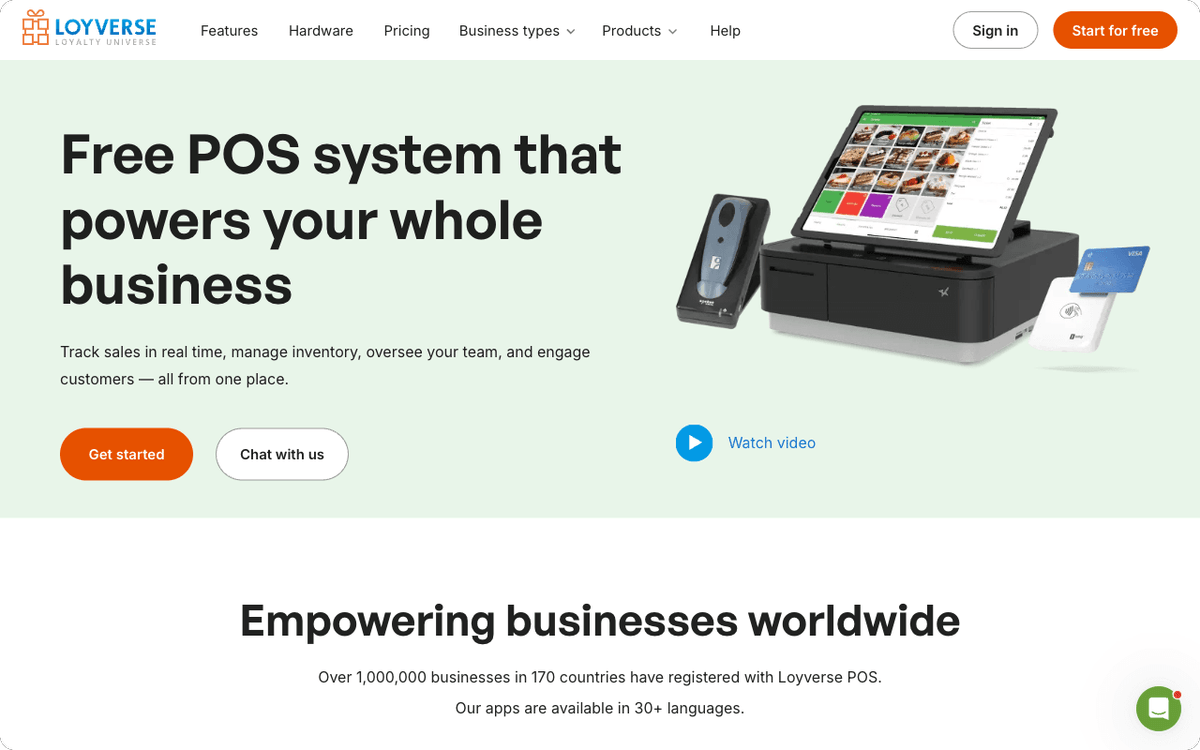
The free tier covers the POS, the loyalty program, dashboard, kitchen display, and customer display. Paid add-ons are per-store or per-employee: unlimited sales history is $5/store per month, employee management is $5/employee per month, and advanced inventory is $25/store per month, each with a 14-day trial. For a small operator, that keeps loyalty effectively free while you pay only for the operational modules you actually need.
The limitation is scope. Loyverse is a retail POS with loyalty attached, not an e-commerce or omnichannel loyalty platform. If you sell online, or you want your in-store points to sync with a webstore and an email program, you will need to move that POS data out to the rest of your stack rather than expecting Loyverse to run the whole program.
How to connect any loyalty tool to the rest of your stack
Every tool above shares one weakness: the loyalty data lives in the loyalty app, and retention happens everywhere else. A new VIP tier is only useful if your email platform knows to send the VIP flow, your support team sees the status in the help desk, and your CRM records the lifetime value. Left unconnected, a loyalty program becomes a scoreboard nobody outside the app can read.
This is where a no-code integration platform earns its place. Albato connects the apps you already use, so a loyalty or e-commerce event can trigger actions across your stack without custom development. The Shopify connector alone exposes 19 triggers and 15 actions, including order created, order paid, and create or update customer, which is enough to route loyalty-relevant events from your store to email, CRM, and support.
A few workflows this makes possible:
- When a customer crosses an order threshold in Shopify, add them to a VIP segment in Klaviyo and start a rewards email flow.
- When a loyalty milestone fires, create or update the contact in HubSpot so sales and support see the customer's status.
- When a redemption happens, log it back to your CRM so lifetime value stays accurate across tools.
💡 Tip. Map your loyalty events before you pick a platform. If you know a "tier upgrade" needs to reach three systems, you can judge each tool on how easily it exposes that event rather than on its widget alone.
The pattern matters more than any single tool. Whether you run Smile.io, LoyaltyLion, or a headless engine, the program only compounds when its events reach the systems that act on them. Building that connective layer with a no-code platform means you can switch or add loyalty tools later without rewiring your entire stack.
How to choose the right loyalty platform
Start with your stack, not the feature list. If you run a small Shopify store, Smile.io gets you live today. If you are a DTC brand on Shopify and Klaviyo that wants tiers, LoyaltyLion's depth justifies the step up. If you want reviews and SMS alongside loyalty, Yotpo's suite consolidates vendors. If you run physical retail, Loyverse gives you POS-native loyalty for free.
Enterprises with developer resources and complex rules should look at Talon.One for a promotion engine or Open Loyalty for headless, member-based loyalty. Both trade the ease of a widget for control, and both only pay off when their events reach every channel. Whatever you choose, weigh integration depth as heavily as the loyalty features themselves, because that is what determines whether the program stays trapped in one app or drives retention across your whole business.
For teams thinking beyond loyalty alone, it helps to see where the program sits in the wider journey. Our guide to the customer lifecycle stack and our roundup of the best customer success software both cover the retention systems your loyalty data should feed into.
FAQ
Common questions buyers ask when they compare loyalty platforms, from pricing to which tool fits a specific stack.
What is the best customer loyalty software for a small Shopify store?
For most small Shopify stores, Smile.io is the fastest to launch, with a free plan for up to 200 orders a month and paid tiers from $15/month. It covers points, referrals, and rewards without a rules engine to configure, so you can be live in under an hour.
How much does customer loyalty software cost in 2026?
SMB-focused tools range from free to about $199/month, mid-market plans run $399 to $999/month, and enterprise platforms like Talon.One and Open Loyalty are custom-quoted. Watch for order-based overage fees and add-on costs, which can push the real bill well above the advertised base price.
What is the difference between a loyalty widget and a loyalty engine?
A widget like Smile.io or LoyaltyLion is a pre-built program you install and configure through presets. An engine like Talon.One or Open Loyalty is API-first and lets your team write custom rules, but it needs developer resources and only pays off when its events feed your whole stack.
Can I connect my loyalty program to my CRM and email tool?
Yes. Most loyalty tools do not sync natively to every CRM or email platform, so a no-code integration platform like Albato connects them for you. Using the Shopify connector's 19 triggers, you can route loyalty and order events to Klaviyo, HubSpot, or your help desk automatically.
Which loyalty software is best for physical retail?
Loyverse is the strongest fit for physical retail and hospitality because its core POS and loyalty features are free and native to the point of sale. Cashiers enroll customers and award points in the same flow as taking payment, with paid add-ons only for operational modules like inventory.
If you want to place loyalty inside the broader retention picture, these guides go deeper on the systems your program should feed.