In this article
Key Takeaways
- Surfer SEO is the best pick for content teams that want live on-page scoring while they write, starting at $49/mo on its Discovery plan.
- Frase is the best value for solo writers and lean teams, starting at $39/mo billed yearly, with built-in AI-visibility tracking across engines like ChatGPT and Perplexity.
- Semrush is the strongest all-in-one suite for teams that need keyword research, audits, and AI search tracking in one place, starting at $117.33/mo billed annually.
- Clearscope is the premium content-grading option at $129/mo, best when editorial quality matters more than price.
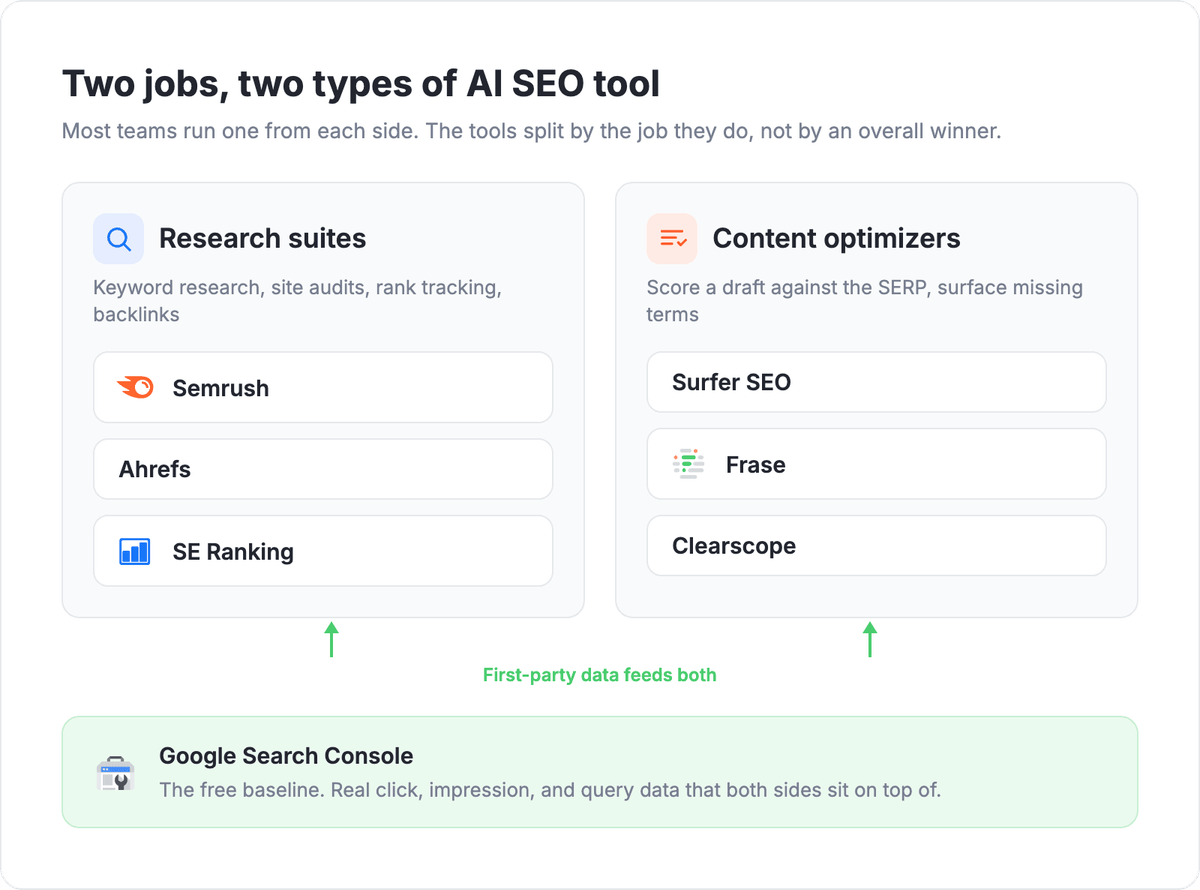
The category split matters more than any ranking: broad suites (Semrush, Ahrefs, SE Ranking) handle research and technical audits, while content optimizers (Surfer, Frase, Clearscope) grade drafts against the SERP. Most teams end up running one of each.

Let us build your automation or AI Agent
Tell us which process eats your time. Certified Albato engineers take it from there, A to Z.
What "AI SEO Tool" Actually Means in 2026
An AI SEO tool uses machine learning to analyze search results, score content, or predict rankings, then turns that analysis into an editing or research action you can take. In 2026 the label covers two very different jobs, and buying the wrong type is the most common mistake teams make.
The first job is research and technical SEO: finding keywords, auditing a site, tracking positions, and now monitoring how often your pages get cited in AI Overviews and chat answers. The second job is content optimization: taking a draft and scoring it against the pages already ranking, then telling you which terms, questions, and entities are missing. A suite like Semrush does the first well. An editor like Surfer or Clearscope does the second well. Very few tools are genuinely excellent at both.
💡 Tip. Before you compare features, decide which job you are hiring the tool for. A content team publishing weekly needs an optimizer first. An in-house SEO managing a large site needs a suite first. Buying the reverse wastes the budget.
Comparison Table: 7 AI SEO Tools at a Glance
Here is the fast version. Prices reflect each vendor's cheapest paid plan on annual billing as listed in September 2026. Verify the current tier on the vendor site before you buy, since these plans change often.
| Tool | Best for | Type | Starting price | Standout feature |
|---|---|---|---|---|
| Surfer SEO | Content teams publishing often | Content optimizer | $49/mo | Live content editor with real-time score |
| Frase | Solo writers, lean teams | Optimizer + briefs | $39/mo | SEO and AI-visibility scoring in one editor |
| Semrush | All-in-one for larger teams | Suite | $117.33/mo | Research, audits, AI search tracking together |
| Clearscope | Editorial-quality content | Content optimizer | $129/mo | Premium content grading and reports |
| Ahrefs | Technical SEO and backlinks | Suite | Verify current | Deep backlink and site audit data |
| SE Ranking | Agencies watching budget | Suite | Verify current | Broad suite at a lower price point |
| Google Search Console | Every site, free baseline | Free data source | Free | First-party click and query data |
The table sorts by job, not by a single overall winner, because the "best" tool depends entirely on whether you are optimizing drafts or running research.
1. Surfer SEO: Best for Content Teams That Publish Often
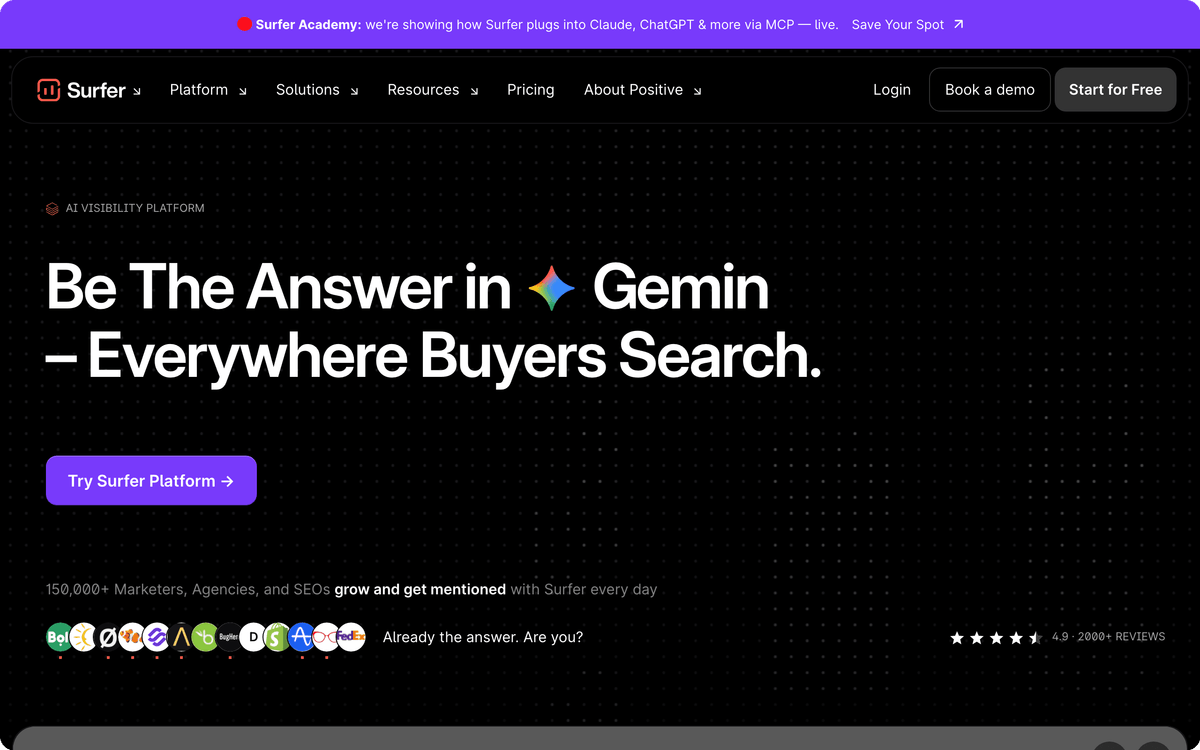
Surfer SEO earns the top spot for teams shipping content on a schedule because its Content Editor scores your draft live as you type, against the pages currently ranking for your target term. You see the target word count, the terms you are missing, and a running score without leaving the editor.
The platform combines SERP analysis, keyword clustering, and an AI writing assistant, so a writer can go from a target keyword to an optimized draft in one workspace. That tight loop is why frequent publishers pick it: the feedback is immediate, not a separate audit you run afterward.
Albato connects to your content workflow tools, so you can route Surfer outputs into your project tracker or CRM automatically. You can try that connection on Albato's free plan.
Pricing: Discovery at $49/mo, Standard at $99/mo, Pro at $182/mo, Peace of Mind at $299/mo, and Enterprise at $999/mo when billed annually, per Surfer's pricing page. There is also a separate AI Search Analytics add-on for tracking visibility in AI answers.
📊 Stat. Surfer's annual billing saves up to 17% versus paying monthly, according to its pricing page. For a team on the Standard plan, that is meaningful over a year.
Where Surfer gets weaker is deep research and technical audits. It is an optimizer, not a full suite. If you also need backlink data and large-scale site crawls, pair it with a research tool rather than expecting one login to cover everything.
2. Frase: Best Value for Solo Writers and Lean Teams
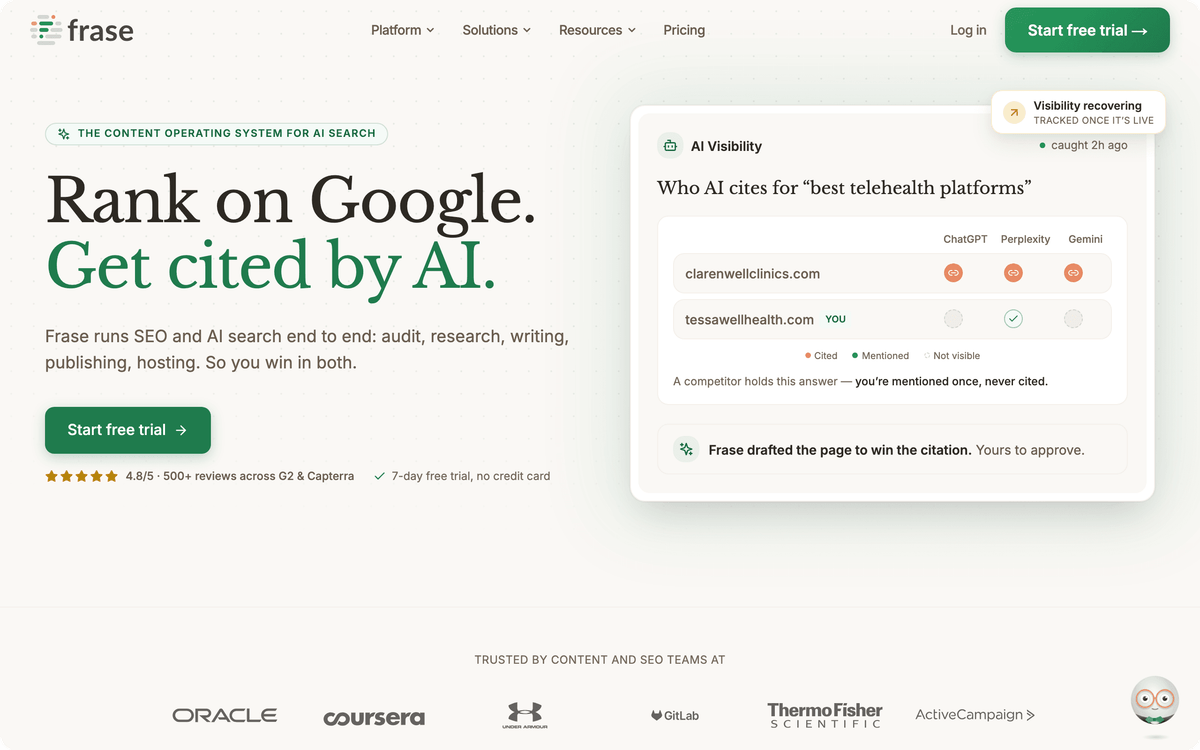
Frase is the best pick when budget is tight and you still want research, briefs, and optimization in one workflow. It generates SERP-based content briefs and outlines, runs an AI writing assistant, and scores drafts, all from a single editor.
Its standout in 2026 is dual scoring. Frase grades content for classic SEO and for AI visibility in the same editor, and it tracks how your pages show up across engines like ChatGPT, Perplexity, Google AI Overviews, Gemini, and Claude. For teams that care about getting cited in AI answers, that is a real differentiator at this price.
Pricing: $39/mo on the Starter plan billed yearly, or $49/mo month-to-month, then Professional at $103/mo yearly and Scale at $239/mo yearly, per Frase's pricing page. The Starter tier is capped at 10 articles and 50 audit pages a month, which suits a solo writer but will feel tight for a busy team.
💡 Tip. Frase caps usage at each plan's monthly limit instead of billing overages, so a surprise invoice is off the table. Good for freelancers who need predictable costs.
The trade-off is depth. Frase is excellent for content work but is not a substitute for a full research suite when you need backlink analysis or enterprise-scale crawls.
3. Semrush: Best All-in-One Suite for Larger Teams
Semrush is the strongest choice when you need keyword research, technical audits, rank tracking, and AI search visibility in one platform instead of stitching together three tools. For an in-house team or an agency managing several sites, that consolidation is the whole point.
The suite covers competitor analysis, site audits, backlink data, and content tools, and in 2026 it added AI search tracking across its tiers so you can see how visible your pages are in AI-driven results. That breadth is why it lands as the default all-rounder rather than a specialist.
Semrush restructured its plans in 2026. The current tiers are SEO at $117.33/mo (regularly $139), Starter at $165.17/mo, Pro+ at $248.17/mo, and Advanced at $455.67/mo when billed annually, per Semrush's pricing page. The older Pro, Guru, and Business names are gone.
Albato has a native Semrush connector that lets you automate audit campaigns and push results to Google Sheets or reporting tools without logging in manually.
The catch is cost and complexity. Semrush is more than a small content team needs, and the learning curve is real. If your only job is scoring drafts, an optimizer does that for a fraction of the price.
4. Clearscope: Best for Editorial-Quality Content
Clearscope is the pick when the quality of the finished page matters more than the price of the tool. It is a premium content-grading platform focused on one thing: telling you how thoroughly your draft covers a topic compared to what already ranks.
Editorial teams and agencies choose it for the clarity of its reports and the simplicity of its grading. There is less sprawl than a full suite, which is the point. You get topic coverage, tracked prompts, and drafts, and not much you will never use.
Pricing: Essentials at $129/mo, then Business at $399/mo, with Enterprise custom, per Clearscope's pricing page. The Essentials plan includes 50 tracked prompts, 50 pages, 20 topic explorations, and 20 drafts a month.
⚠️ Important. Clearscope has no cheap entry tier. If you publish only a few pages a month, the per-article cost can be higher than Surfer or Frase. It earns its price on volume and on teams that treat content grading as non-negotiable.
5. Ahrefs: Best for Technical SEO and Backlinks
Ahrefs is the suite to reach for when backlink analysis and technical site health drive your work. Its crawler and link index are among the deepest in the category, which is why technical SEOs lean on it for audits, competitor link research, and finding what is actually holding rankings back.
It is a research and diagnostics tool first, not a content editor. You will not get a live writing score the way Surfer gives you, but you will get a far clearer picture of your site's structure and link profile. Pricing tiers change often, so confirm the current plan on the Ahrefs site before committing.
The honest positioning: Ahrefs and Semrush overlap heavily. Most teams pick one, not both. Choose Ahrefs when backlinks and crawl depth are your priority, and Semrush when you want broader marketing tooling around the SEO core.
6. SE Ranking: Best Suite for Budget-Conscious Agencies
SE Ranking is the value suite for agencies that need broad SEO coverage without a Semrush-sized bill. It offers rank tracking, audits, keyword research, and reporting at a lower price point, which makes it a common pick for agencies managing many small client sites.
You trade some depth for the savings. The data sets are not as deep as Ahrefs or Semrush, but for routine client reporting and standard SEO work, the coverage is usually enough. One thing to watch: a cheaper base price that caps the number of projects too tightly can end up costing more than a pricier suite with generous project limits. Confirm current pricing and plan limits on the vendor site, since tiers and seat counts vary.
🔧 Agency tip. Check the project count alongside the headline price. For agencies running many small client sites, per-project limits matter as much as the monthly fee.
7. Google Search Console: The Free Baseline Every Stack Needs
Google Search Console gives you the only source of real first-party click, impression, and query data straight from Google, and it costs nothing. It is not an AI tool, but every paid stack on this list runs on top of it.
Every paid tool on this list estimates or models search data. GSC reports what actually happened on your pages. That makes it the foundation the paid tools sit on top of, not a competitor to them. Start here, learn which queries already bring you clicks, then bring in an optimizer or a suite to act on it.
The limit is that GSC gives you data, not recommendations. It will tell you a page is slipping from position 4 to 8, but it will not write the fix. That is the job of the paid tools above.
How These Tools Fit Into the Rest of Your Stack
AI SEO tools do one job well: they help you research and write better-ranking content. The gap most teams hit is what happens to that data afterward. A Semrush audit finding, a rank drop, a new set of target keywords, all of it usually lives inside the SEO tool, disconnected from the CRM, the content calendar, and the reporting dashboard the rest of the team actually watches.
That is where an integration layer helps. Albato is a no-code integration platform that connects your SEO tools to the rest of your stack, so a signal in one app can trigger an action in another without manual copy-paste. It is not an SEO tool and does not compete with the ones above. It sits underneath them and moves their data where it needs to go.
A concrete example: Albato has a native Semrush connector with actions like creating a new site audit campaign and pulling campaign or audit-snapshot information. You can set up a workflow that kicks off a site audit on a schedule, then pushes the results into a Google Sheet or a reporting tool automatically, so your team reviews findings in one place instead of logging into Semrush.
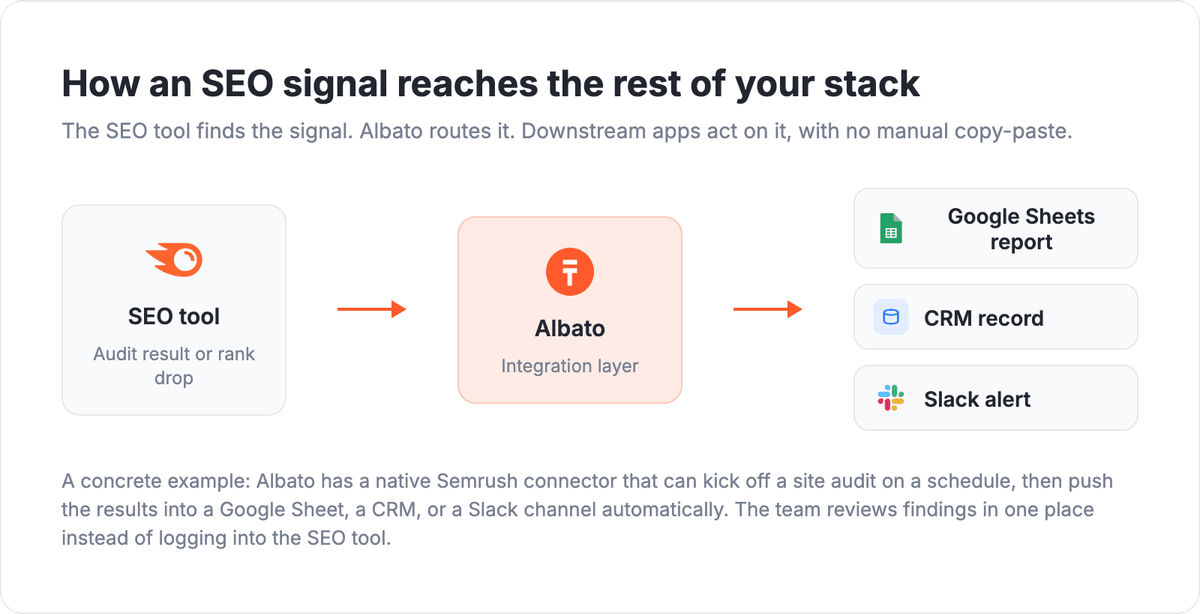
The pattern works beyond audits. Export your keyword targets into the content calendar your writers use, send a Slack alert when a tracked page drops out of the top 10, or log content performance against deals in your CRM. The SEO tool finds the signal; Albato routes it to the people and systems that act on it.
If you already run one of the suites above, connecting it to your reporting stack turns a weekly manual export into an automatic feed. That is the difference between an SEO tool your team logs into occasionally and SEO data that flows into the tools they use every day.
How to Choose the Right AI SEO Tool
Start with the job, not the brand. If your bottleneck is writing content that ranks, buy an optimizer: Surfer if you publish often, Frase if budget is tight, Clearscope if editorial quality is the priority. If your bottleneck is research and technical health, buy a suite: Semrush for breadth, Ahrefs for backlinks, SE Ranking for value. Then set up Google Search Console regardless, because it is free and it is the only source of your true search data.
Most teams that publish seriously end up with two paid tools: one optimizer and one suite. That is normal, not overspending. The mistake is buying two suites, or two optimizers, and discovering they do the same job twice.
For teams building out a wider marketing stack, the same logic that applies to SEO applies across the board. Our guide to the best workflow management tools for teams and our comparison of top generative AI models both start from the same principle: match the tool to the job before you compare feature lists.
Pick your optimizer and your suite, then connect them so their data reaches the rest of your team. You can wire up your first workflow on Albato's free plan, no card required.
Have questions about which tool to pick or how to connect your SEO stack? The FAQ below covers the most common decisions.
FAQ
What is the best AI SEO tool in 2026?
There is no single best tool, because the category splits into content optimizers and research suites. For content teams, Surfer SEO leads at $49/mo. For solo writers, Frase offers the best value at $39/mo. For all-in-one research, Semrush is the strongest suite starting at $117.33/mo billed annually.
What is the difference between an AI SEO suite and a content optimizer?
A suite (Semrush, Ahrefs, SE Ranking) handles keyword research, technical audits, rank tracking, and backlink analysis. A content optimizer (Surfer, Frase, Clearscope) scores your draft against the pages currently ranking and tells you what terms and topics are missing. Most teams need one of each.
Are there free AI SEO tools?
Google Search Console is free and gives you real first-party click, impression, and query data from Google, which no paid tool can replicate. It reports what actually happened rather than modeling estimates. Several paid tools also offer limited free trials, and Frase caps usage at its plan limit rather than billing overages.
How do AI SEO tools connect to my CRM and reporting?
Most SEO tools keep their data inside their own dashboard. A no-code integration platform like Albato bridges that gap: it has a native Semrush connector and can route audit results, keyword targets, or rank alerts into Google Sheets, a CRM, or a Slack channel automatically, so the data reaches the people who act on it.
Should I buy more than one AI SEO tool?
Usually yes, but only one per job. A single optimizer plus a single suite covers most content and research needs. Buying two suites or two optimizers duplicates work. Add Google Search Console for free as the data baseline underneath both.