In this article
Your delivery van probably knows more about your customers' orders than your sales team does. It knows where it is, how much diesel is left, and that the driver hit the brakes a little too hard near the depot this morning. Meanwhile the CRM has the customer's name, the order number and a delivery date someone typed in last Tuesday. That's it. So why do these two systems still barely talk to each other, and what happens when they finally do?
What's Actually Happening on the Road Right Now
Some numbers first, because they're kind of wild. A connected or software-defined car can spit out anywhere from 25 GB to 4 TB of data an hour, mostly from cameras. Nobody in their right mind pushes all of that to a server in real time.
So carmakers let the vehicle crunch a big chunk of it on board and only send out the stuff that matters. DXC Technology, which builds connected and self-driving tech for automakers, has a solid explainer on how automotive edge computing splits the job between the car's own hardware, roadside units and the cloud, and if the architecture side interests you, their write-up goes much deeper than this one can. The bit worth remembering? Processing on the vehicle gets latency down below 10 ms. Going to the cloud and back takes 50 to 200 ms, sometimes more. Doesn't sound like much until you picture a 40-tonne truck deciding whether to brake.
Self-driving trucks are hauling paid loads now
Remember when autonomous trucks were basically a keynote slide with a nice render? That changed faster than most people expected.
- Aurora Innovation started running driverless trucks commercially in Texas back in spring 2025. This May it signed a deal with McLane (yes, the Berkshire Hathaway one) after a pilot where it moved 1,400 loads and didn't miss a single delivery window. Its goal is 200+ driverless trucks by the end of 2026.
- Kodiak AI hauls sand for Atlas Energy Solutions in the Permian Basin without anyone behind the wheel, and Bosch builds its backup hardware.
- Volvo Autonomous Solutions and Waabi run self-driving freight between Dallas and Houston for Warp, whose customers include Walmart and DoorDash.
Here's a detail people tend to skip. In 2025 Aurora also teamed up with McLeod Software, a TMS vendor, because shippers wanted the driverless trucks plugged straight into the software they already use. Even the robots need integrations, apparently.
Trade shows and prototypes
IAA Transportation in Hannover this September (15th to 20th) was pretty much all about AI, electric trucks and software-defined vehicles. There was even a new prototype.club stage for startups that have never built a truck in their life. And if you just wanted to drive something, 17 exhibitors, including Tesla, Volvo Trucks, MAN, and Scania, brought 84 vehicles for test drives.
On the telematics side, Samsara now fits its hardware at the factory for International and IC Bus fleets, so the vehicle arrives already connected. Geotab, Motive and Ford Pro are pushing the same way.
Bottom line, the vehicles are smart enough already. The mess starts after the data leaves the cab.
Where Vehicle Data and the CRM Should Meet
You've probably seen this play out, even if you don't run a fleet. A customer phones in: "Where's my sofa?" Your manager opens the CRM, finds the order, sees "delivery: Thursday." Not much help. So the customer goes on hold while somebody pings dispatch on Slack, dispatch squints at the fleet map and replies a few minutes later. Now do that sixty times a day. That's basically one full-time job spent answering the same question.
The fix is boring, honestly. Pull vehicle data into the CRM so whoever's on the phone sees what dispatch sees. Boring, but it tends to pay for itself way faster than the flashy stuff.
Which data is worth sending
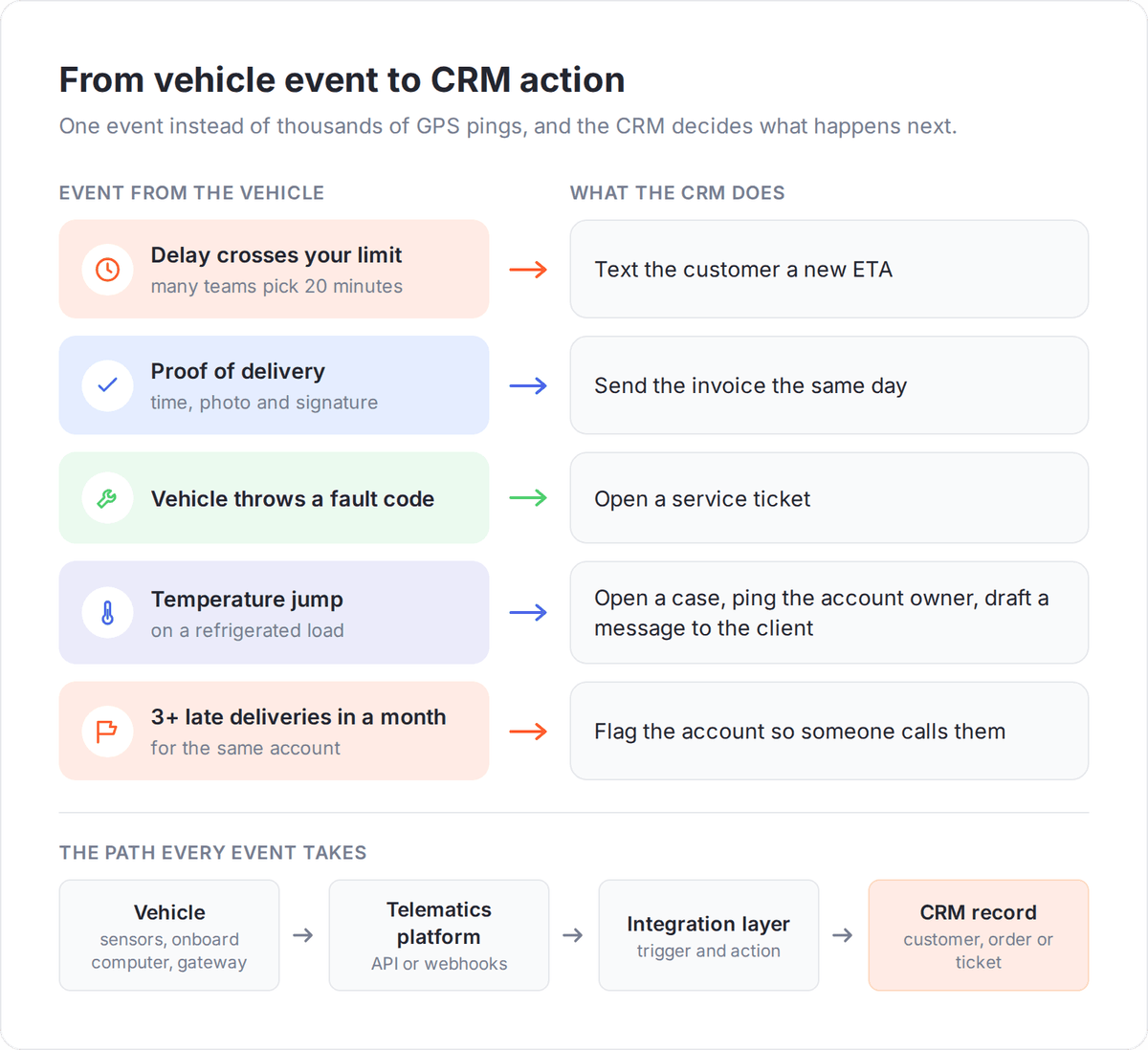
Not everything, please. Pipe a GPS ping every five seconds into your CRM and your team will stop opening it by Friday. What people actually use are events, like these:
- a fresh ETA, plus a heads-up when a delay crosses your limit (lots of teams pick 20 minutes)
- proof of delivery with a time, a photo and a signature
- temperature jumps on refrigerated loads
- unplanned stops, detours and breakdowns
- how many driving hours the driver has left before a mandatory break
And this is where edge processing actually pulls its weight. The truck itself decides a delay is worth flagging, packs it into one event and sends a single message instead of a few thousand raw coordinates. Way easier to work with.
How it looks from the customer's side
Say you distribute vaccines that have to stay between 2 and 8 °C. Somewhere near Lyon the reefer unit logs 9 °C. With the systems connected, a case opens on its own, the account owner gets pinged, and there's a draft message to the client sitting there before their quality team even notices. Without it? Someone probably finds out tomorrow from a very unhappy email.
So which call would you rather make?
How the Integration Works in Practice
Whether you run 15 vans or 500 trucks, the setup usually looks about the same.
The basic layers
At the bottom you've got the vehicle: sensors, an onboard computer, a telematics gateway. That's where raw data gets handled and quick calls get made. One level up, a telematics platform like Samsara, Geotab or Webfleet collects it all and opens it up through an API or webhooks. Then something has to translate those events into CRM records. Bigger companies often throw MuleSoft or Boomi at it. Smaller teams usually go for a no-code integration platform, set up a trigger like "delivery completed in Samsara" and an action like "update deal in HubSpot," and they're done in an afternoon. The CRM (Salesforce, Dynamics 365, HubSpot, Pipedrive, whatever you're on) then attaches each event to the right customer, order or ticket.
The good news for small fleets is how much of this is off the shelf now. Samsara's App Marketplace lists hundreds of ready connectors for TMS, maintenance, payroll and CRM tools. Routing services like NextBillion.ai hook into Samsara, Motive, Geotab and Salesforce all at once. A few years ago you'd need developers and a good six months. Now a mid-size fleet can get a working pilot going in a few weeks, sometimes days.
Picture a regional carrier with 120 trucks. Every telematics event lands in the CRM right on the order record. The account manager opens a client's page and spots a red flag: truck 47 is stuck behind a closed lane on the A4, ETA pushed back 35 minutes. Client asks, client gets an answer. Done.
Automations that free up time
Once events are flowing, you can let the CRM handle the repetitive stuff:
- text the customer a new ETA the second a truck falls behind
- open a service ticket when a vehicle throws a fault code
- flag any account with three or more late deliveries in a month so someone calls them
- send the invoice as soon as proof of delivery comes in
That last one looks small. It's not. Loads of carriers still wait days for paper delivery notes before they can bill anyone. Same-day invoicing means money shows up sooner, and when margins are thin, that's worth more than another pretty dashboard.
Sales can use it too
Funny how often this gets ignored. Say telematics shows one client's volume on a route jumped 30% this quarter. Good excuse for your sales rep to call, right? Or your trucks keep losing two hours at one customer's loading dock every week. Now you've got real numbers for the next pricing talk. With both in the CRM, sales finally sees what ops sees, and that makes a lot of decisions easier.
Common Problems to Prepare For
None of this is free or totally painless. Carriers trip over the same few things again and again:
- Mixed fleets. Three truck brands, two telematics vendors and a couple of leased vans, all sending data their own way. Cleaning that up can eat half the project.
- Too much data. Sync everything and the CRM turns into a junk drawer nobody trusts. Five events to start is plenty, fifty is a disaster.
- Drivers pushing back. Dashcams and nonstop tracking feel like Big Brother to a lot of drivers. Explain why you're doing it and use the data for coaching, not for writing people up, and most of the pushback goes away.
- Privacy rules. GDPR in Europe and a patchwork of state laws in the US limit what location and driver data you can keep and for how long. Doing more processing inside the vehicle helps, because less personal data ever leaves it.
- Dead zones. Tunnels, rural roads, border crossings. The vehicle has to keep working offline and sync up later, which is, again, an edge computing job.
Truth is, the tech usually isn't the hard part. Getting dispatch, sales and finance to agree on what "late" actually means? That can drag on longer than the whole API setup.
Anyone who's sunk a few evenings into Euro Truck Simulator 2 knows that little countdown timer on every delivery. Real life works the same way, just with worse consequences. Miss the window there and you lose a contract, not a couple of in-game points.
Where This Leaves Logistics Teams
Smart vehicles are already a normal part of the job. Driverless trucks are moving freight in Texas, and factory-installed telematics is quickly becoming the default. The carriers that get ahead won't be the ones with the most sensors bolted on. They'll be the ones where whoever answers the phone can see what the trucks see, right now, without chasing dispatch.
Want a place to start? Pick the one question that drives everyone nuts, probably "where's my shipment?", and wire the answer straight into your CRM. Next month add temperature alerts. The month after, automatic invoices. Small steps your customers will actually notice.
Will every fleet be running driverless trucks by 2030? Doubt it. Will every fleet want its customer team to know what's happening on the road? Pretty hard to argue against that one.