
In this article
Key Takeaways
- Chargebee and Recurly are the strongest all-round subscription management platforms, while Stripe Billing fits teams that already collect payments through Stripe.
- Maxio wins for B2B SaaS that needs billing tied to revenue recognition, Cleeng is the pick for streaming, media, sports, and digital subscription brands that need retention tooling and a built-in Merchant of Record, Paddle covers sellers who want a merchant of record, and Zuora serves large enterprises with complex billing.
- The platform you pick matters less than what its data connects to: the best subscription management software pushes every new subscription, renewal, and failed payment into your CRM and accounting tools instead of trapping it in one dashboard.
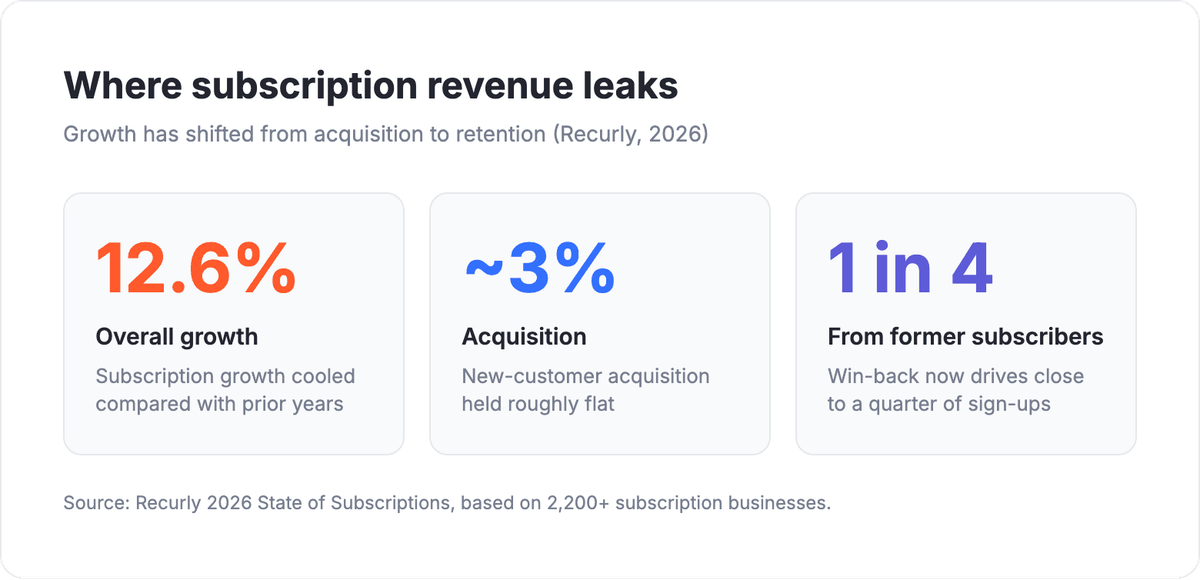
Subscription growth is no longer coming from where it used to. Recurly's 2026 State of Subscriptions report, based on more than 2,200 subscription businesses through the end of 2025, found that overall subscription growth cooled to 12.6% while acquisition held near 3%, and former subscribers now drive nearly 1 in 4 new sign-ups. That shift puts a premium on billing data that actually reaches your retention and finance systems.
The 7 best subscription management tools at a glance
Use this table to match a tool to your situation. Each platform is grouped by who it fits best, its billing model, its one standout strength, and whether it has a native Albato connector for syncing data to the rest of your stack.
| Tool | Best for | Billing model | Standout | Albato connector |
|---|---|---|---|---|
| Chargebee | All-round subscription ops | Recurring + usage | Deep dunning and revenue workflows | Yes |
| Recurly | Retention and win-back | Recurring | Churn and recovery tooling | Yes |
| Stripe Billing | Teams already on Stripe | Recurring + usage | Billing built on the Stripe payments core | Yes |
| Maxio | B2B SaaS finance | Recurring + usage | Billing tied to revenue recognition | Via webhooks or API |
| Cleeng | Streaming, media, sports & digital subscriptions | Recurring, passes, PPV, gifting, seasonal, MoR | Retention analytics + built-in Merchant of Record for digital content brands | Via webhooks or API |
| Paddle | Sellers wanting a merchant of record | Recurring (MoR) | Tax and compliance handled for you | Via webhooks or API |
| Zuora | Large enterprise billing | Recurring + usage | Complex pricing and compliance at scale | Via webhooks or API |
How we picked these tools
We ranked these tools by fit rather than a single score, because "best subscription management software" means one thing to a two-person SaaS startup and something else to an enterprise finance team. Each platform earned its place on four questions: which billing models it supports (flat-rate, usage-based, hybrid), how it handles failed payments and involuntary churn, how cleanly it reports revenue, and how well it connects to the CRM and accounting tools you already run. Pricing figures below are published rates that can change, so confirm on each vendor's page before you commit. Where a platform pairs with your wider finance setup, we point to related picks like the best payment processing software and accounting software for online sellers.
📊 Stat. The same Recurly analysis found former subscribers now drive nearly 1 in 4 new sign-ups. That single finding is why win-back and payment-recovery features, not just billing mechanics, decide which platform earns its keep.
Best all-round subscription management platforms
If you want one platform to run the full subscription lifecycle, from sign-up to dunning to reporting, two names lead the field. Chargebee and Recurly both handle the mechanics well, but they pull in slightly different directions: Chargebee leans toward flexible billing operations, Recurly toward keeping the subscribers you already have.

Let us build your automation or AI Agent
Tell us which process eats your time. Certified Albato engineers take it from there, A to Z.
Chargebee
Chargebee's real strength is the breadth of its billing operations, which is why fast-scaling SaaS companies keep landing on it. It supports recurring and usage-based pricing, coupons, trials, proration, and multi-currency out of the box, and its dunning engine gives you granular control over how failed payments get retried and when a customer gets nudged. That control matters because involuntary churn from failed cards is a quiet drain on recurring revenue, and Chargebee treats recovery as a first-class workflow rather than a checkbox.
Reporting is another reason teams stay. Chargebee tracks MRR, churn, and lifetime value natively, and it connects billing data to revenue recognition when finance needs clean numbers. The trade-off is that all that flexibility takes time to configure, so a solo founder may find it heavier than the job requires.
With Albato, you can connect Chargebee to the rest of your stack, so a new subscription can create a CRM deal, a failed payment can trigger a Slack alert, and a cancellation can update an accounting record without any manual export.
Chargebee offers a free Starter tier for businesses under $250K in annual billing, with paid plans that scale by billing volume. Best for growing SaaS teams that want serious billing flexibility in one place.
Recurly
Recurly earns its spot on retention. Where some platforms treat churn as a reporting metric, Recurly builds recovery into the product: intelligent retry logic that times card retries around bank behavior, account updater to catch expired cards before they fail, and win-back tooling aimed at the exact "former subscriber returns" pattern its own research flagged as a top growth lever in 2026. For a business where keeping subscribers is harder than acquiring them, that focus is the differentiator.
It covers the standard billing surface too, with subscriptions, trials, add-ons, and multi-currency, plus analytics built around subscriber cohorts rather than raw invoice counts. The platform is less about exotic pricing models and more about squeezing more lifetime value from a straightforward recurring plan.
💡 Tip. Before you compare platforms on features, pull your current involuntary churn rate. If a meaningful share of your cancellations are failed payments rather than deliberate quits, a tool with strong retry and account-updater logic pays for itself faster than one with fancier pricing options.
Connect Recurly through Albato to sync paid invoices into your accounting sheet, log new subscribers to a CRM, or flag failed invoices to your revenue team the moment they happen.
Recurly prices as a percentage of subscription revenue with published plans starting in the low hundreds per month. Verdict: the pick when retention, not acquisition, is your growth ceiling.
Best if you already collect payments through Stripe
When your payments already run through Stripe, adding a separate subscription platform can mean reconciling two systems that do not quite agree. Stripe Billing avoids that by sitting directly on top of the Stripe payments core.
Stripe Billing
Stripe Billing's advantage is that it shares the same ledger as the payments you already process. Subscriptions, invoices, proration, and usage-based metering all live in the same account as your charges, so there is no sync lag between "payment collected" and "subscription updated." For teams that chose Stripe as their processor first and needed recurring billing second, that single source of truth removes a whole class of reconciliation headaches.
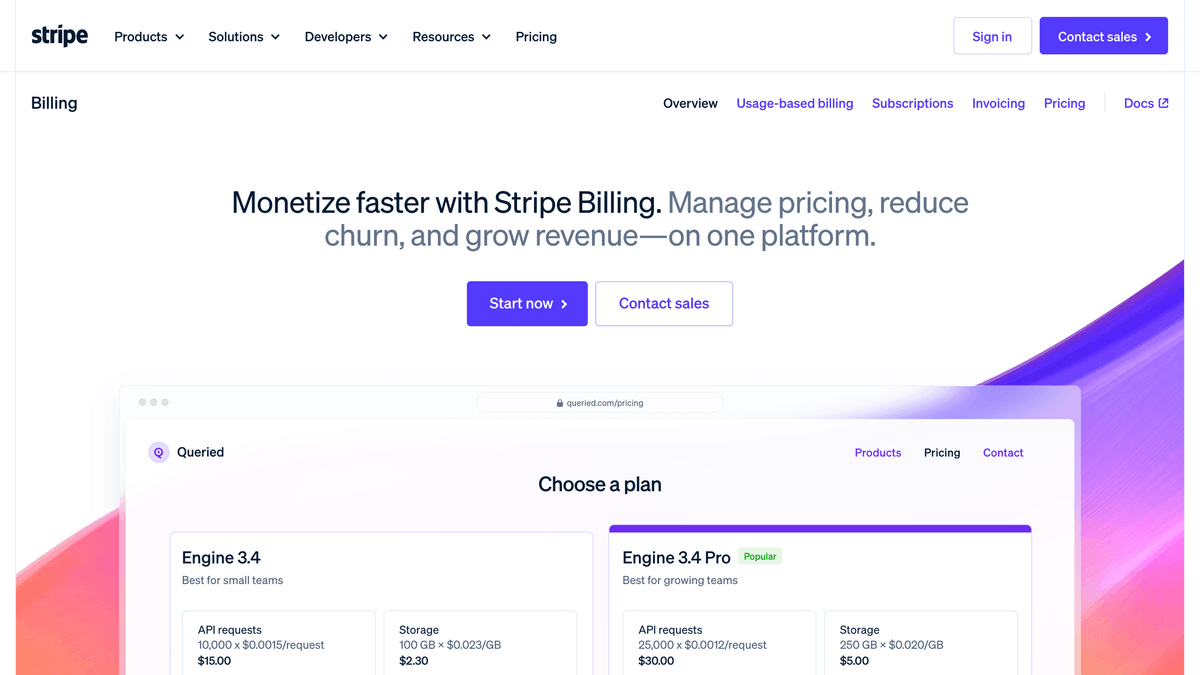
It handles recurring and metered pricing, automatic tax in many regions, and Smart Retries that use Stripe's network data to recover failed payments. The catch is that Stripe Billing is developer-friendly rather than marketer-friendly, so some workflows that are point-and-click elsewhere expect a bit more technical setup here.
Connect Stripe through Albato to turn a new subscription into a CRM record, push a paid invoice into your accounting tool, or alert a channel on a failed payment. Its connector is one of the deepest on this list, with 18 triggers and 15 actions covering customers, payments, subscriptions, and invoices.
Stripe Billing charges a percentage on top of standard Stripe processing fees, billed on recurring revenue you run through it. Best for teams that want subscriptions and payments in one account rather than two systems to reconcile.
Best for B2B SaaS that needs clean revenue recognition
Some subscription businesses do not just need to bill customers, they need their billing to feed accurate revenue numbers for finance and investors. That is a different job, and it is where Maxio focuses.
Maxio
Maxio (the platform formed from Chargify and SaaSOptics) is built for the space where subscription billing meets financial operations. Its distinctive angle is pairing flexible B2B billing, including usage-based and complex contract terms, with GAAP-compliant revenue recognition and SaaS metrics finance teams actually report on. For a scaling B2B SaaS preparing for due diligence or a board that wants trustworthy ARR, that combination is the reason to choose it over a lighter tool.
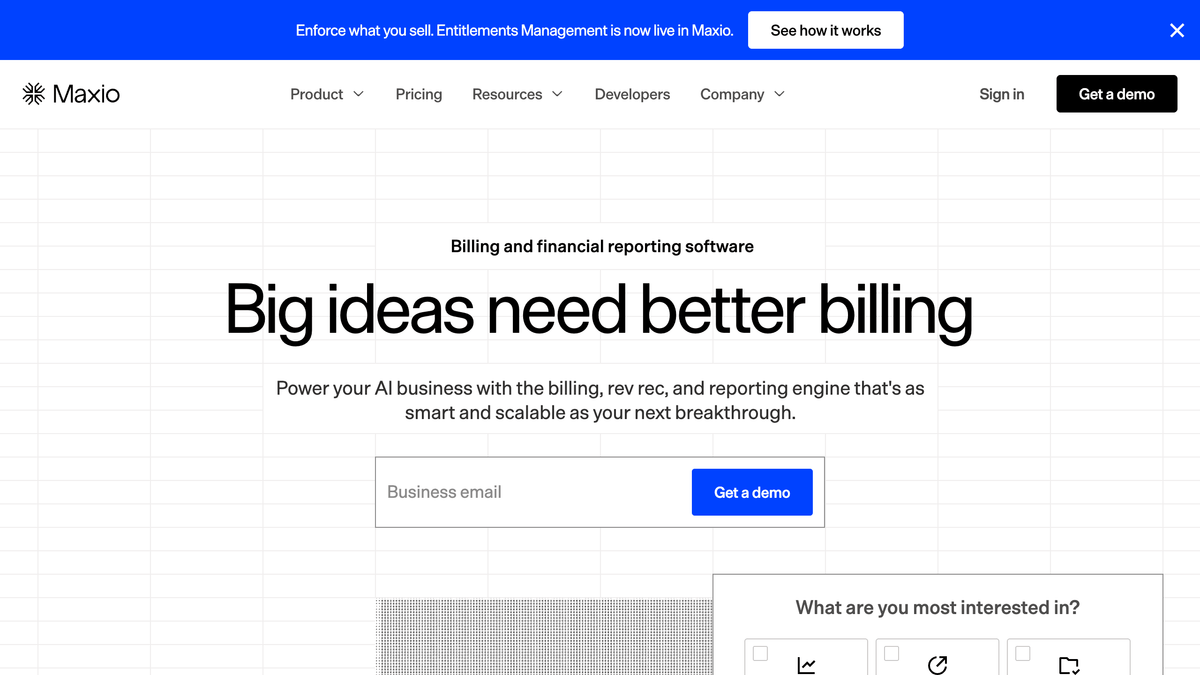
The platform handles the messy parts of B2B contracts well: mid-term upgrades, custom terms, proration, and invoicing that finance can sign off on. The flip side is that Maxio is built for companies with real billing complexity, so a simple flat-rate consumer subscription would be over-served by it.
Maxio does not have a native Albato connector today, but it exposes an API, so it is connectable via webhooks or API when you want contract or invoice events to reach your CRM or invoicing software. Paid plans start in the mid hundreds per month and scale by billing volume. Best for B2B SaaS where finance needs billing and revenue recognition in one system.
Best for streaming, media, sports, and digital content subscriptions
Some subscription businesses are built around content, not SaaS: streaming services, sports broadcasters, digital media brands, and pay-per-view platforms with seasonal and live-event billing. Generic billing tools treat them the same as any other recurring business. Cleeng is purpose-built for this segment.
Cleeng
Cleeng is a subscription management platform and Merchant of Record solution provider built for digital subscription, streaming, and sports brands rather than generic SaaS. Its Subscriber Retention Management (SRM®) layer uses 360-degree subscriber data to flag churn-driving events before they cost a renewal, with intelligent payment retry that recovers up to 35% of failed renewal transactions and a 95% average recurring-payment success rate. For content brands, that retention focus is the differentiator over billing tools that treat churn as a reporting metric rather than something to actively prevent.
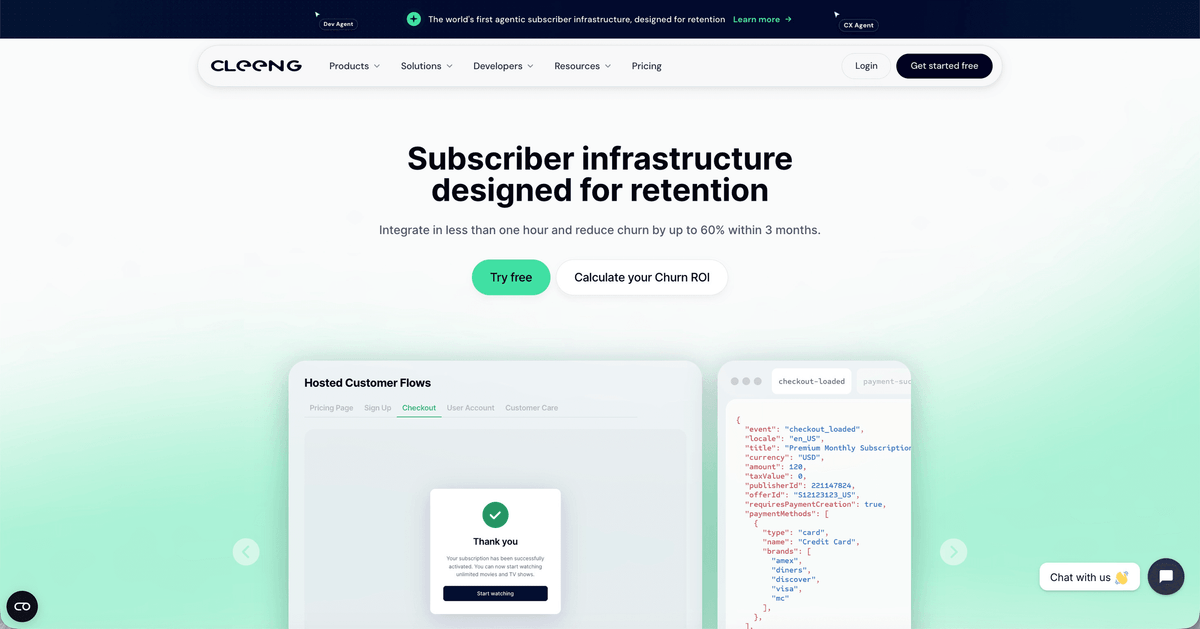
Cleeng bundles a Merchant of Record directly into the platform, covering tax, fraud, and compliance across 13,000+ jurisdictions and 200+ payment methods in 37 currencies, so a streaming or sports brand selling globally does not need to pair a separate billing tool with a separate MoR. It supports recurring subscriptions, seasonal subscriptions, passes, live pay-per-view, and gifting, and it is used by brands including ATP Media, Big Ten Network, beIN SPORTS, and Tennis Channel. The trade-off is fit: Cleeng is purpose-built for digital subscription models, so a non-content SaaS business would find less of its feature set relevant.
Cleeng does not have a native Albato connector today, but it exposes open APIs and webhooks, so subscriber, billing, and churn events can still reach your CRM, accounting, or messaging tools.
Cleeng is free for the first 10,000 subscribers, with Merchant of Record available as an add-on. Best for streaming, media, sports, and digital subscription businesses that want retention tooling and global payment compliance in one platform.
Best if you want a merchant of record
Selling subscriptions across borders drags in sales tax, VAT, and compliance that most teams would rather not own. A merchant of record takes that liability off your plate, and Paddle is the best-known option built around that model.
Paddle
Paddle's whole pitch is that it becomes the seller of record, so it handles sales tax, VAT, and payment compliance in every market you sell to, then pays you out. For a small software company selling globally without a finance team to manage tax registration in dozens of jurisdictions, that is a genuinely different value proposition than a pure billing engine. You trade a higher per-transaction fee for not having to become a global tax expert.

Under the merchant-of-record layer, Paddle handles subscriptions, trials, and checkout, and it bundles fraud protection and chargeback handling into the same fee. The trade-off is cost and control: the all-in rate is higher than a bare processor, and you have less direct say over the checkout and payout mechanics than you would running your own billing.
Paddle does not offer a native Albato connector, but it is connectable via webhooks or API, so a new subscription or transaction can still reach your CRM or analytics. Paddle's published rate is 5% plus 50 cents per transaction, which bundles tax and compliance. Best for software sellers who want global tax handled for them.
Best for large enterprises with complex billing
At the top of the market, subscription billing becomes a finance-system problem: multi-entity, multi-currency, usage-based pricing, and strict revenue-recognition compliance. Zuora is built for that scale, and priced for it too.
Zuora
Zuora is the enterprise standard for companies whose billing is genuinely complicated. Its strength is depth: it models almost any pricing scheme you can invent, supports usage-based and hybrid billing at high volume, and handles the ASC 606 and IFRS 15 revenue-recognition rules that public and pre-IPO companies have to follow. Large organizations with subscription revenue running through multiple products and regions choose Zuora because lighter tools simply cannot express their billing logic.

That power comes with weight. Zuora is quote-based, entry contracts commonly start in the tens of thousands per year, and implementation is a project, not a weekend setup. It is the right call for enterprise finance and the wrong call for a startup that just needs recurring invoices.
Zuora does not have a native Albato connector, but it exposes an API and is connectable via webhooks or API for pushing billing events into downstream systems. Best for large enterprises with high-volume, compliance-heavy subscription billing.
Which subscription management tool fits your business?
Start from your size and billing complexity, and the shortlist narrows fast. For an all-round platform, compare Chargebee and Recurly, and lean toward Recurly if retention is your weak point. If you already process payments on Stripe, Stripe Billing keeps everything in one account. B2B SaaS that needs clean revenue recognition should look at Maxio, streaming and digital content brands that want retention tooling plus a built-in MoR at Cleeng, and global sellers who want tax handled for them at Paddle. Large enterprises with complex, compliance-heavy billing land on Zuora.
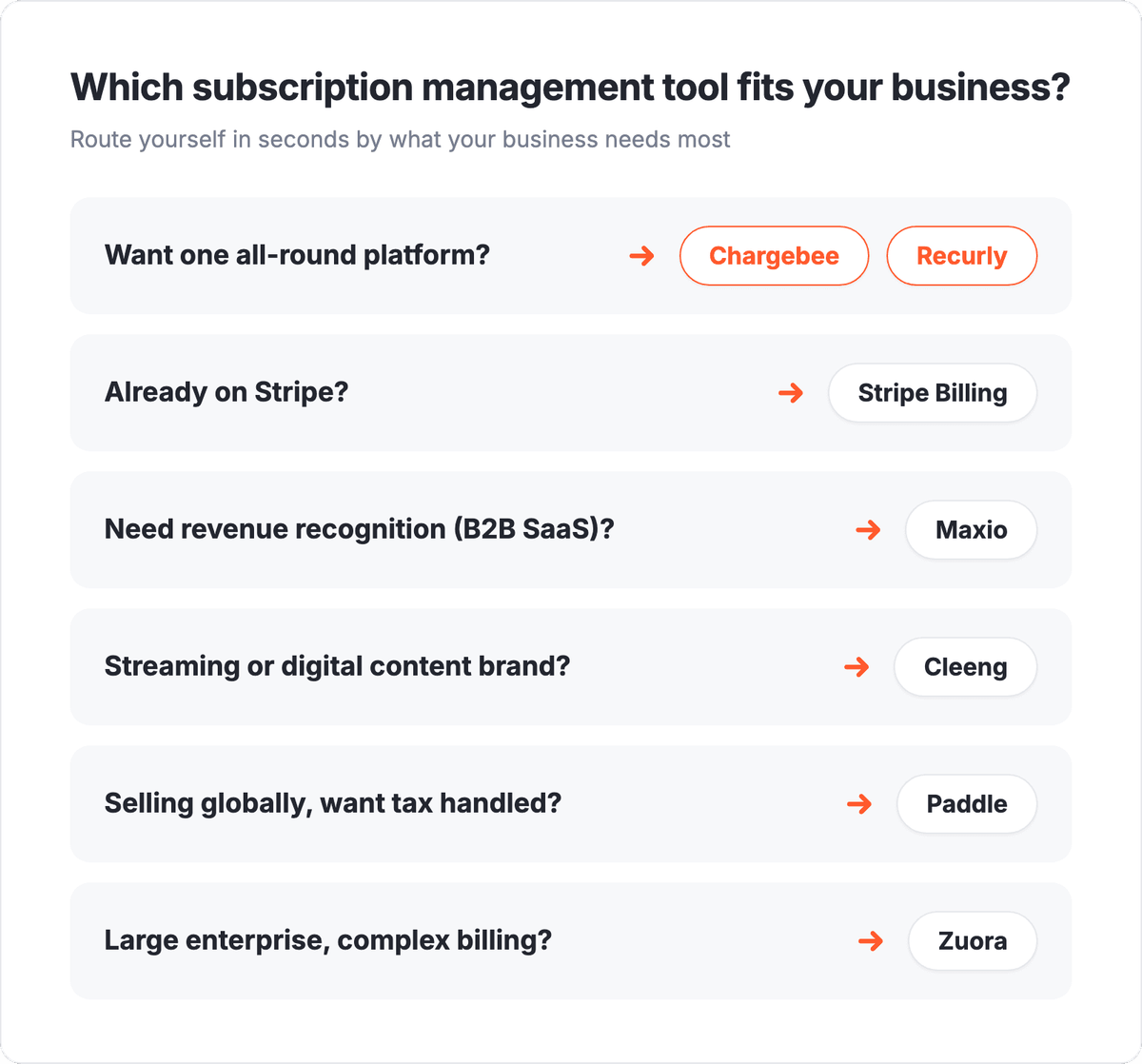
Whichever you choose, the platform is only half the system. A subscription tool that cannot tell your CRM about a new customer or your accounting software about a failed payment leaves your team copy-pasting between tabs. The next section covers how to close that gap. You can also weigh the billing choice against your broader setup with the right ecommerce automation stack and customer data platform.
Connect your subscription billing to your CRM and accounting with Albato
A subscription platform rarely does its job alone. The moment someone subscribes, a card fails, or a plan gets upgraded, that event needs to reach your CRM, your accounting tool, and often your support and messaging apps. Albato is a no-code integration platform with 1,000+ connectors that moves those billing events between your tools automatically, so your subscription data stops living in a single dashboard.
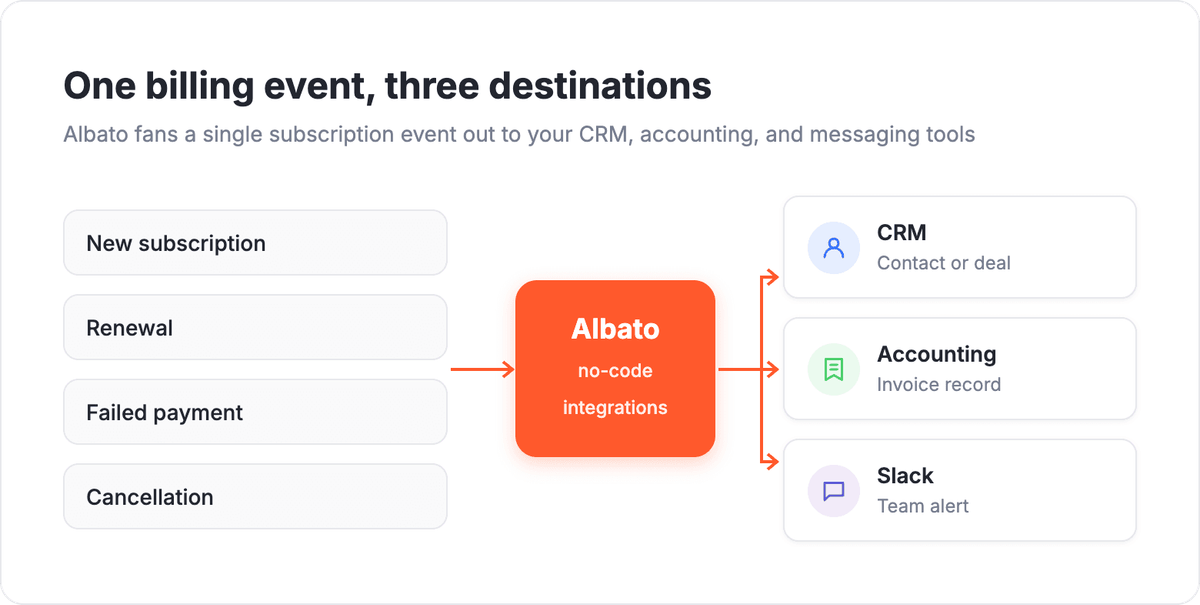
Here are four workflows subscription teams set up most often:
- Create or update a CRM deal automatically when a new subscription starts, so sales and success see revenue as it lands.
- Push every paid invoice into your accounting tool or a spreadsheet so finance reconciles without manual exports.
- Alert a Slack or email channel the instant a payment fails, so someone can act before the subscriber churns.
- Log cancellations and downgrades to a customer record so win-back campaigns fire on the right timing.
Among the tools on this list, several have native Albato connectors you can wire up directly: Chargebee, Recurly, and Stripe. Cleeng, Paddle, and Zuora don't have native connectors yet, but each exposes an API, so they are connectable via webhooks or API. You can explore the full catalog and build your first billing workflow on the Albato platform.
FAQ
Still weighing options? These are the questions teams ask most often before they commit to a subscription management tool.
What is subscription management software?
Subscription management software handles the recurring side of a business: sign-ups, billing cycles, invoices, plan changes, dunning for failed payments, and subscription analytics like MRR and churn. It sits between your payment processor and your finance tools, automating the recurring charges and the reporting around them so you are not tracking renewals in a spreadsheet.
What is the difference between subscription management and a payment processor?
A payment processor moves money for a single transaction, while subscription management software handles the recurring logic around those payments: when to charge, how much, what to do when a card fails, and how to report revenue over time. Many teams use both, with the subscription tool orchestrating the billing and the processor executing each charge. Some platforms, like Stripe Billing, combine the two.
What is the best subscription management software for small businesses?
Stripe Billing is a strong pick for small teams that already collect payments through Stripe, keeping subscriptions and payments in one account. Confirm that whichever tool you choose can connect to your CRM and accounting software, since that is where small teams lose the most time.
Can I connect my subscription platform to my CRM and accounting tools?
Yes. Chargebee, Recurly, and Stripe have native Albato connectors, so you can sync new subscriptions, paid invoices, and failed payments across your stack without code. Platforms without a native connector, such as Maxio, Cleeng, Paddle, and Zuora, usually expose an API and are connectable via webhooks or API through Albato.
How do subscription tools reduce involuntary churn?
They reduce it mainly through dunning: retry logic that reattempts failed charges at smart intervals, account-updater services that catch expired or replaced cards before a charge fails, and automated emails that prompt customers to update payment details. Recurly and Chargebee both treat payment recovery as a core feature, which matters because a large share of subscription cancellations are failed payments rather than deliberate quits.
Want to go deeper on the tools that sit next to your subscription platform? These guides cover the rest of your revenue stack.