In this article
Key Takeaways
- Coupler.io (free plan, paid from $24 a month billed annually) and Windsor.ai (from $19 a month billed annually) are the cheapest ways to get ad data into Google Sheets and Looker Studio. Supermetrics starts at $44 a month billed yearly.
- Funnel (from $300 a month billed annually) is the best marketing data hub for agencies and multi-brand teams.
- Fivetran (free up to 500,000 monthly active rows), Airbyte (from $20 a month) and Dataddo (from $99 a month billed yearly) load data into a warehouse. Hightouch (free for 2 active syncs) sends warehouse audiences back to ad and email platforms.
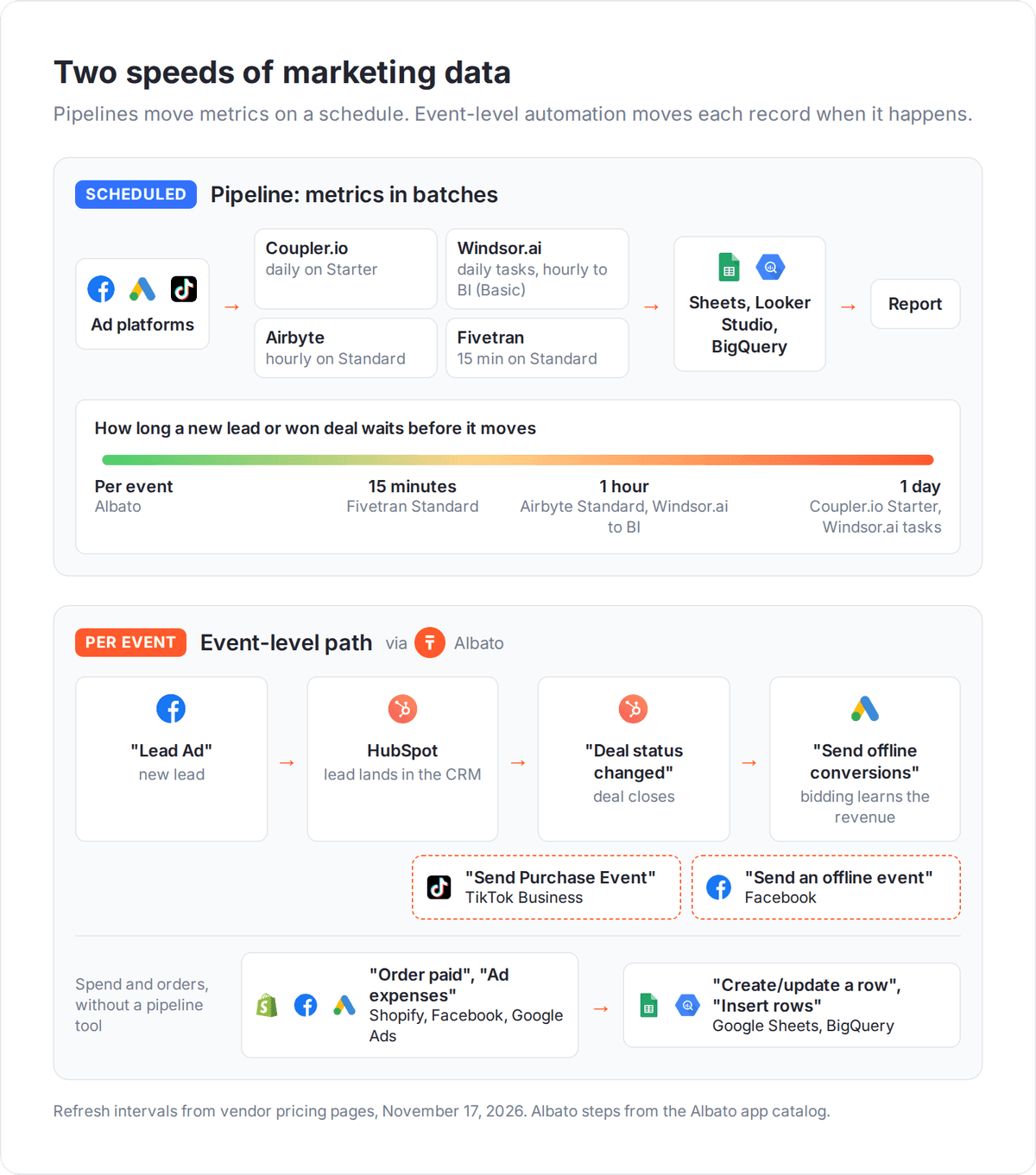
Scheduled pipelines refresh daily on Coupler.io Starter and on Windsor.ai Basic Sheets or BigQuery tasks, and hourly on Airbyte Standard. A new lead or a won deal cannot wait for that run, so Albato moves each one per event. Facebook "Lead Ad" sends the lead to a CRM, and Google Ads "Send offline conversions" returns the closed deal.
How we compared these tools: destination, billing unit, refresh speed
We picked eight tools that move marketing data from ad, analytics, CRM and e-commerce platforms to the place where a team uses it. Dashboards are covered in our marketing reporting tools guide, analysis in our AI data analytics tools roundup, and customer profile platforms in our customer data platform list, so none of these groups is ranked here.
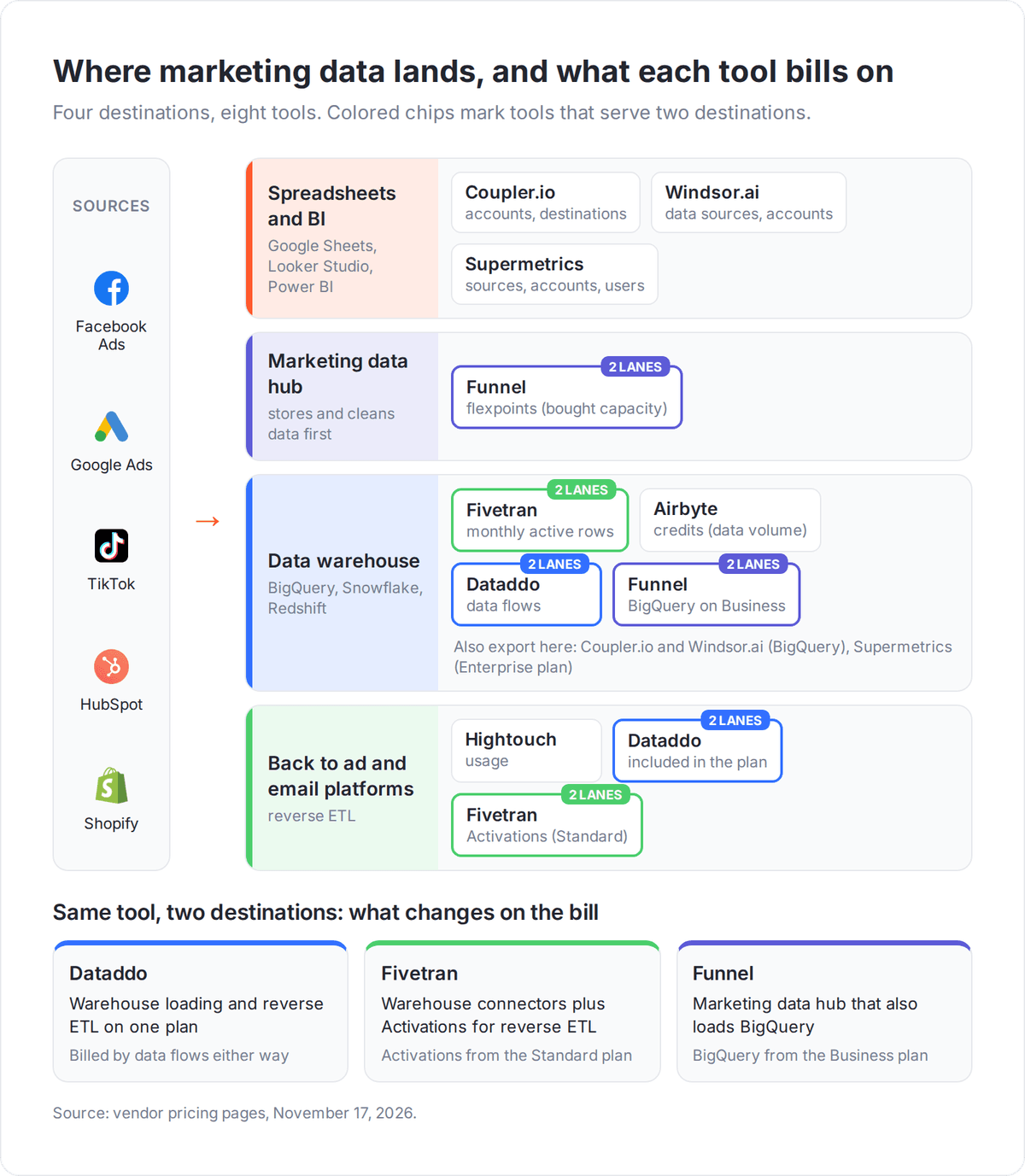
We grouped the tools by destination, because the destination decides who maintains the pipeline and which pricing unit applies:
- Spreadsheets and BI tools (Google Sheets, Looker Studio, Power BI) for marketers who build their own reports.
- A marketing data hub that stores and cleans data before it goes anywhere.
- A data warehouse (BigQuery, Snowflake, Redshift) owned by a data team.
- Back to ad and email platforms, known as reverse ETL.
For each tool we read the pricing page on November 17, 2026, and noted the pricing unit (accounts, sources, rows, credits or flows) and the fastest refresh on the lowest paid plan. We also checked the Albato app catalog for a native connector.
Marketing data integration tools by price, billing unit and sync speed
Prices are entry prices on November 17, 2026.
| Tool | Best for | Main destinations | Entry price | Free option | Pricing unit | Fastest sync on lowest paid plan |
|---|---|---|---|---|---|---|
| Coupler.io | Ad and CRM data in Google Sheets on a budget | Google Sheets, Excel, Looker Studio, Power BI, BigQuery | Starter $24 a month, billed annually | Free plan, 1 source | Accounts and destinations | Daily |
| Windsor.ai | Many ad accounts for a small fee | Looker Studio, Google Sheets, BigQuery, Snowflake | Basic $19 a month, billed annually | Forever Free, 1 source | Data sources and accounts | Daily for destination tasks, hourly to BI tools |
| Supermetrics | Marketers who report in Looker Studio, Sheets or AI chats | Looker Studio, Google Sheets, Excel, Power BI, AI chats | Starter $44 a month, billed yearly | 14-day trial | Sources, accounts, users | Not listed |
| Funnel | Agencies and multi-brand teams | Funnel Dashboards, Sheets, Looker Studio, BigQuery (Business) | Starter $300 a month, billed annually | 14-day trial | Flexpoints (bought capacity) | Daily export |
| Fivetran | Data teams with a warehouse | BigQuery, Snowflake, Redshift and other warehouses | Usage-based | Free up to 500,000 MAR | Monthly active rows | 15 minutes (Standard) |
| Airbyte | Teams that want open source or many niche sources | Warehouses, lakes, databases | Standard from $20 a month | 14-day trial, free self-hosted Core | Credits (data volume) | Hourly |
| Dataddo | Small teams that need ETL and reverse ETL in one tool | Warehouses, BI tools, Google Sheets, CRMs | Data Anywhere $99 a month, billed yearly | Free trial, no credit card | Data flows | Not listed |
| Hightouch | Sending warehouse audiences to ad platforms | Ad, email and CRM platforms (300+ integrations) | Usage-based, on demo | Free Basic Reverse ETL, 2 active syncs | Usage | Not listed |
None of the eight has a native connector in the Albato catalog, so Albato works alongside them with its own steps, such as Shopify "Order paid" and Google BigQuery "Insert rows".
Which tools send ad data to Google Sheets and Looker Studio?
Coupler.io, Windsor.ai and Supermetrics send ad, analytics and CRM data straight into Google Sheets, Looker Studio (labeled Data Studio on some vendor pages), Excel and Power BI. They suit a marketer or an agency analyst who owns the report and does not have a data warehouse. The difference between them is the pricing unit: Coupler.io charges by connected accounts, Windsor.ai by data sources, and Supermetrics by sources, accounts and users together.
1. Coupler.io: the free plan and the lowest paid entry for spreadsheets
Coupler.io connects 400+ data sources, including Facebook Ads, Google Ads, HubSpot, Shopify and QuickBooks, to Google Sheets, Excel, Looker Studio, Power BI and warehouses such as BigQuery, Snowflake and PostgreSQL. Every source is available on every plan, so the plan decides how many accounts you connect and how often data refreshes.
The Free plan covers 1 account, 1 source and 1 destination with manual refresh. Starter costs $24 a month billed annually for 3 accounts, 1 destination, a daily refresh, 1 user and 5,000 rows per run. Active at $99 a month adds 15 accounts, 3 destinations, unlimited users and unlimited data volume, and Pro at $199 a month brings 50 accounts, unlimited destinations and an hourly refresh. Annual billing saves 25%, and a 7-day trial opens every feature.
For agencies, Pro adds team and client workspaces, and the Custom plan brings a 15-minute refresh and single sign-on. An MCP connection also opens the same data to Claude, ChatGPT and Gemini.
2. Windsor.ai: up to 75 ad accounts on the $19 plan
Windsor.ai lists 350+ connectors and prices by data sources, not by accounts, which makes it the cheapest option for an agency running many ad accounts on few platforms. Basic costs $19 a month billed annually ($23 month to month) and includes unlimited users, 3 data sources, 75 accounts, unlimited BI syncs on an hourly or daily schedule, and 5 destination tasks that run daily.
Standard at $99 a month (annual) raises the limit to 7 sources and unlimited destination tasks with hourly syncs. Plus at $249 covers 10 sources and 200 accounts, and Professional at $499 covers 14 sources, 500 accounts and 15-minute syncs. Every plan reaches every source and destination, including Looker Studio, Google Sheets, Power BI, Tableau, BigQuery and Snowflake, and paid plans keep up to 10 years of history.
The free path starts with a 30-day trial of 10 sources and 15 accounts. After it ends, the Forever Free plan keeps 1 user, 1 source and 1 account.
💡 Tip
On Windsor.ai, Facebook Ads, Facebook Pages and Instagram count as three data sources, while each Google Ads client account under one manager account counts as a separate account. Count your sources the vendor's way before picking Basic, because 3 sources fill up fast across Google, Meta and LinkedIn.
3. Supermetrics: marketing data for Looker Studio, Sheets and AI chats
Supermetrics is the pick for marketers whose reports already live in Looker Studio, Google Sheets, Excel or Power BI, or who now ask questions of their ad data in Claude, ChatGPT or Copilot. Each plan includes 1 core destination from that list, and its campaign management feature creates and edits ad campaigns from an AI chat.
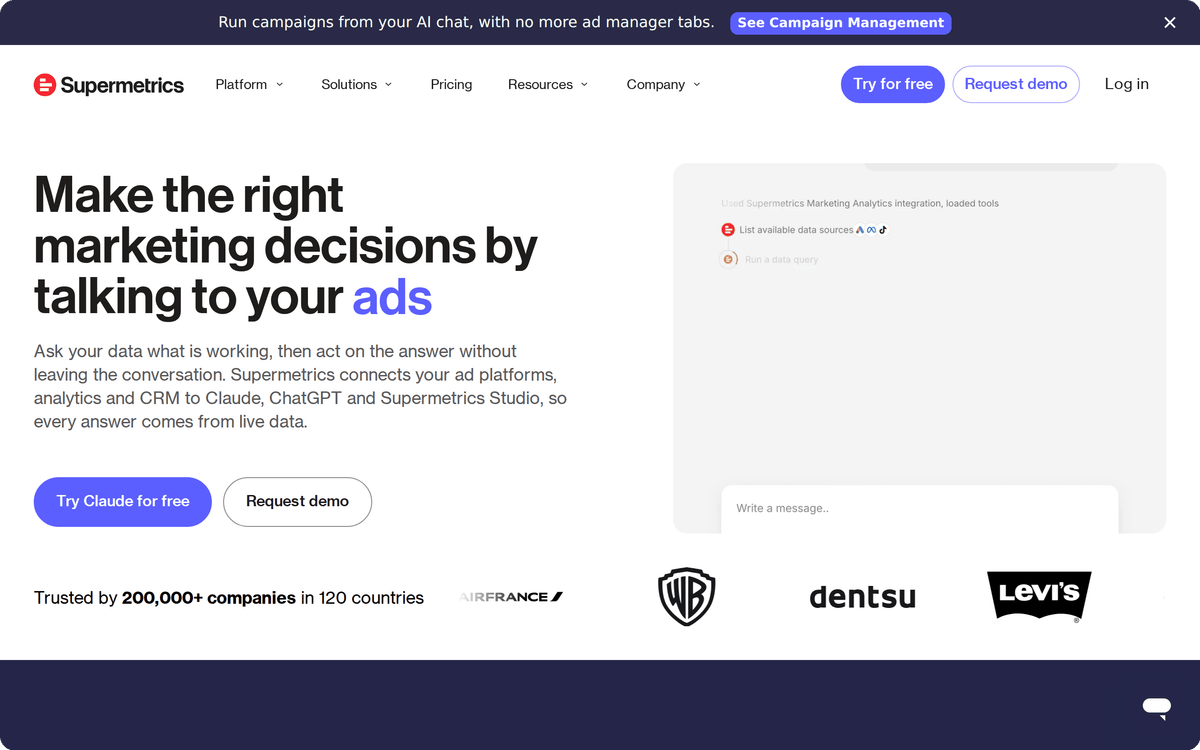
Starter costs from $44 a month billed yearly ($59 month to month) for 2 data sources, 1 user and 2 accounts per source. Growth costs from $177 a month billed yearly ($222 monthly) for 7 sources, 2 users and 7 accounts per source. Extra destinations, data sources and ad accounts are sold as add-ons, starting at $11 a month billed yearly for an extra ad account on Starter, and extra users are available from Growth.
Loading into a warehouse (BigQuery, Snowflake, Amazon Redshift), the Data API, data transformations and Supermetrics Storage sit on the Enterprise plan, priced on quote.
Which tool builds a marketing data hub for agencies and multi-brand teams?
Funnel is the tool for a marketing data hub. It collects and stores data from ad and analytics platforms, maps it to your own naming rules, and sends one consistent dataset to dashboards and warehouses. It suits agencies and brands with several markets, where each ad platform reports the same metric, such as cost or conversions, under its own field name.
4. Funnel: stored, cleaned data with unlimited users
Funnel's Data Hub stores and prepares marketing data before it leaves for any destination, so currency conversion, business rules, budgets and targets are applied in the hub, and every report reads the same prepared numbers. Every plan includes unlimited users and Funnel AI.
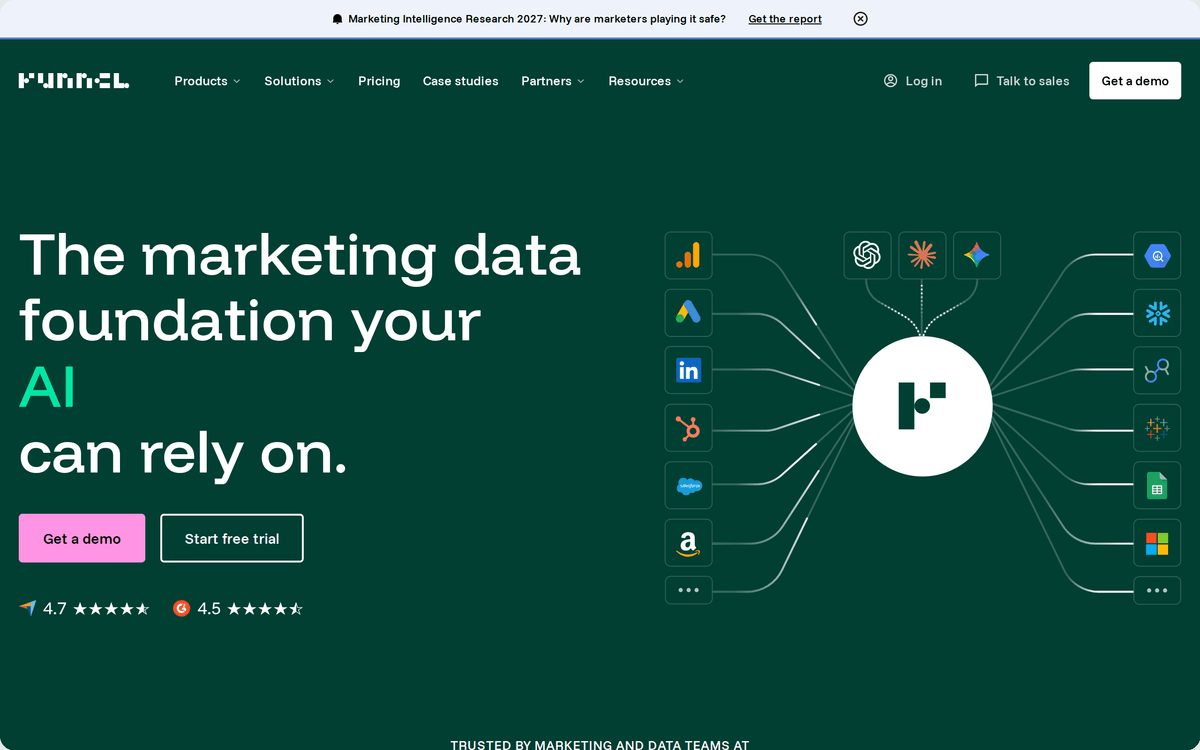
Starter costs from $300 a month billed annually, with 117 connectors, 13 destinations (Funnel Dashboards, Google Sheets, Looker Studio among them) and a daily export. Business costs from $600 a month billed annually and opens 579 connectors, 46 destinations including Power BI, Tableau, BigQuery and Amazon S3, exports every 2 hours and unlimited workspaces. Enterprise is custom and adds Snowflake and SAML single sign-on.
📊 Stat
Funnel prices its Measure add-on (marketing mix modeling) by ad spend: Digital Measurement costs $1,500 a month billed annually for brands spending up to $500K a month on media.
Funnel bills in flexpoints, which is capacity you buy in the contract. The bill does not change with the number of rows or campaigns, only when you buy more flexpoints.
Which tools load marketing data into a data warehouse?
Fivetran, Airbyte and Dataddo load marketing data into a warehouse such as BigQuery, Snowflake or Amazon Redshift, where a data team joins it with CRM, product and finance tables. They are general-purpose ELT tools with marketing connectors, priced on data volume (Fivetran rows, Airbyte credits) or on the number of pipelines (Dataddo flows).
5. Fivetran: managed connectors and a free plan for small volumes
Fivetran is the managed choice for a data team: 700+ fully managed connectors, schema changes handled by the vendor, and dbt Core integration for transformations. Pricing is usage-based on monthly active rows (MAR), the distinct rows inserted, updated or deleted in a month.
The Free plan includes up to 500,000 MAR for connections, 3,500 MAR for activations and 5,000 model runs a month, enough for Facebook Ads and Google Ads at median volume (about 34,000 and 88,000 MAR a month). Standard adds unlimited users, 15-minute syncs, 200+ activation destinations for reverse ETL and access to the Fivetran REST API. Enterprise adds 1-minute syncs and Audience Hub. Each new connection gets a 14-day free trial, and an annual contract saves up to 22%.
Fivetran does not publish a per-row rate. Its pricing page shows median monthly list prices on Standard for a company with 1 to 200 employees instead, such as $22.06 for a Facebook Ads connection and $48.67 for Google Ads. A pricing estimator sizes everything else. For a marketing team without a data engineer, that makes Fivetran harder to budget than Airbyte or Dataddo.
6. Airbyte: open-source connectors and credit-based cloud plans
Airbyte combines 700+ connectors with an open-source core that is free to self-host, and a Connector Builder for sources nobody else supports. It suits teams that already run their own infrastructure, or marketing analysts who need an unusual source such as a regional ad network.
Airbyte Cloud Standard starts at $20 a month with 5 credits, about 1 GB of syncs, and runs syncs as often as every hour. Plus costs $189 a month for 40 credits, adds single sign-on, 15-minute syncs and up to 2 workspaces, and scales to 2,000 credits for $4,999 a month. Pro switches to capacity pricing with a flat annual price and 5-minute syncs.
The 14-day trial gives 400 credits, roughly 100 GB of syncs, with no credit card. Because Standard bills by data synced, a marketing team should test real volume during the trial before committing.
7. Dataddo: ETL and reverse ETL priced by data flow
Dataddo prices by data flow, a connection from one or more sources to one destination: Facebook Ads to Looker Studio counts as one flow. That makes the bill easy to predict for a small team with a fixed set of reports. Data Anywhere starts at $99 a month billed yearly ($129 month to month) for 3 flows, with tiers of 15 and 30 flows.
One plan covers ETL and ELT into warehouses, change data capture, streaming and reverse ETL back to CRMs and marketing platforms. A team can load ad data into BigQuery and send enriched segments back out on the same plan. Dataddo lists 400+ managed connectors and includes an MCP server on every plan, while the REST API is reserved for Enterprise.
A free trial starts without a credit card. A separate Data to AI plan costs $13.99 per seat a month ($10.49 billed annually, 3 seats minimum) and serves governed data to Claude, ChatGPT and other AI tools.
Which tool sends warehouse data back to ad and email platforms?
Hightouch sends customer data from a warehouse back to ad, email and CRM platforms, a pattern called reverse ETL. It suits teams that already load data into Snowflake, BigQuery or Databricks and want audiences built there to reach Google Ads, Meta and their email tool without CSV exports.
8. Hightouch: reverse ETL with a free tier for 2 syncs
Hightouch reads models and audiences from your warehouse and syncs them to 300+ tools across advertising, marketing automation, CRM and customer success. The free Basic Reverse ETL plan includes up to 2 active syncs, unlimited destinations and unlimited user seats, which is enough to prove one audience sync before buying.
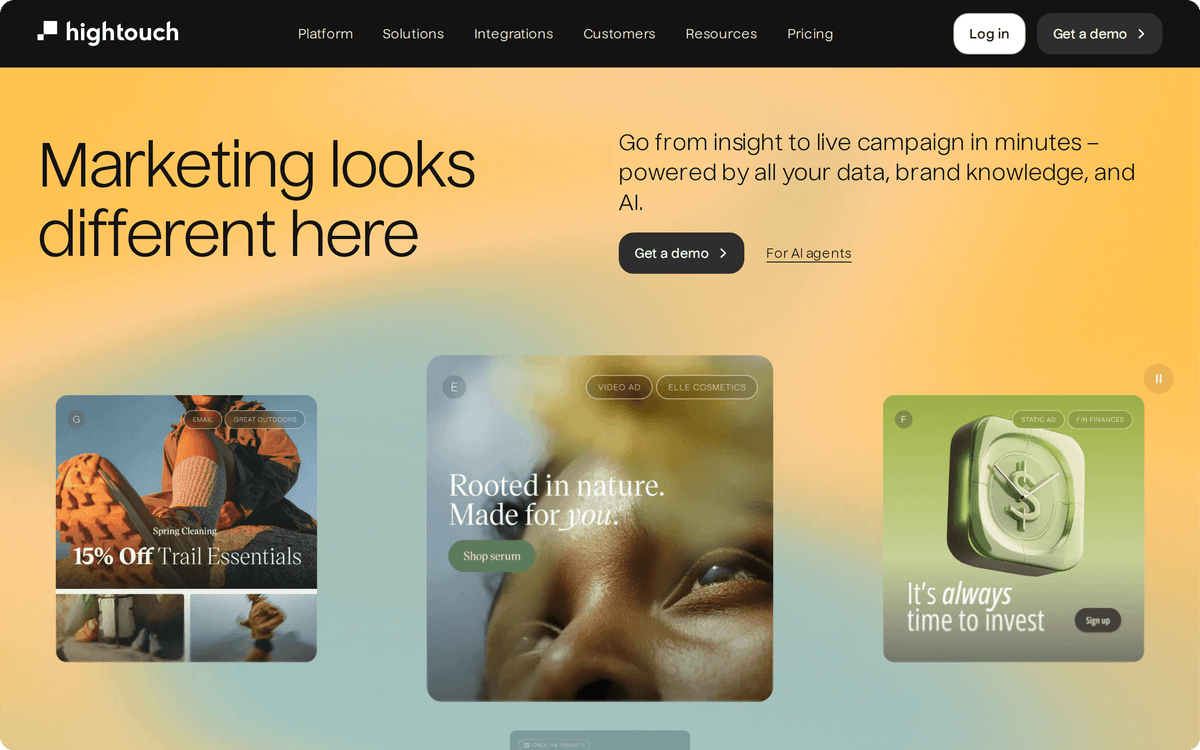
Paid plans are usage-based and sold through a demo, with no limits on monthly tracked users, sources, destinations or seats. Above Reverse ETL, Hightouch sells a Composable CDP (events, identity resolution, Customer Studio for marketers) and an Agentic Marketing Platform with AI Decisioning and an Ad Studio.
Hightouch does not collect ad platform data into the warehouse. Teams pair it with Fivetran, Airbyte or Dataddo for loading, and with a warehouse that holds the customer records Hightouch sends out.
How does Albato move marketing records one event at a time?
Albato moves single records between marketing apps when an event happens: a new lead, a paid order, a deal marked won. Coupler.io, Windsor.ai, Fivetran and the other pipelines move batches of metrics on a schedule. In Albato, the record-level path is built from native triggers and actions, with no warehouse or SQL involved.
How do leads and conversions move without waiting for the next sync?
Leads and conversions move per record through native Albato steps. The Facebook "Lead Ad" trigger sends each new lead to HubSpot or another CRM within the same scenario, while a scheduled pipeline would only show the lead count in tomorrow's report. When the deal closes, HubSpot's "Deal status changed" trigger runs Google Ads "Send offline conversions", so the bidding algorithm learns which clicks became revenue. The same HubSpot trigger can also run TikTok Business "Send Purchase Event" and Facebook "Send an offline event", so all three ad platforms receive the closed deal in one scenario. Our help article on Google Ads offline conversions covers the setup in detail.
How do you get ad spend and orders into Sheets or BigQuery without a pipeline tool?
A small team can log ad spend and orders with Albato alone. The Facebook and Google Ads "Ad expenses" triggers and TikTok Business "Advertising expenses (Beta)" feed Google Sheets "Create/update a row" or Google BigQuery "Insert rows". Shopify "Order paid" can write each order to the same table, which puts spend and revenue side by side. Our walkthrough on sharing data with BigQuery shows the BigQuery side.
Years of history, dozens of accounts or modeled tables call for a bulk loader such as Windsor.ai, which keeps up to 10 years of history on every paid plan, or Fivetran with its managed warehouse connectors. A team that stays on spreadsheets gets hourly refresh on Coupler.io Pro at $199 a month or on Windsor.ai Standard at $99 a month, both billed annually.
Which marketing data integration tool should you choose?
Pick by destination first, then by the unit the tool bills on.
⚠️ Important
Compare tools on the unit they bill. Ten ad accounts on two platforms fit Windsor.ai Basic (3 sources, 75 accounts) but exceed Coupler.io Starter (3 accounts). A single high-volume source can use up Airbyte credits faster than the account count suggests.
- Ten or more ad accounts on two or three platforms: Windsor.ai Basic, billed by source with 75 accounts included.
- One spreadsheet fed by a handful of accounts: Coupler.io, billed by account, with a free plan for a single source.
- Reports in Looker Studio plus questions in an AI chat: Supermetrics, where one core destination can be Claude, ChatGPT or Copilot.
- Several brands that need one naming scheme: Funnel, billed in flexpoints that do not grow with rows.
- A warehouse owned by a data team: Fivetran, billed by monthly active rows, or Airbyte, billed by credits, with a self-hosted core.
- A fixed set of pipelines in both directions: Dataddo, billed per data flow (Fivetran bundles both directions on usage pricing).
- Warehouse audiences for Google Ads and Meta: Hightouch, starting with 2 free active syncs.
Supermetrics, Funnel, Airbyte and Dataddo start without a credit card, and Coupler.io, Windsor.ai, Fivetran and Hightouch have free plans, so you can run the same source through two tools before paying.
FAQ
What is the best marketing data integration tool in 2026?
Coupler.io and Windsor.ai are the best low-cost tools for loading ad data into Google Sheets and Looker Studio, from $24 and $19 a month billed annually. Funnel is the best marketing data hub for agencies, from $300 a month billed annually. Fivetran is the best managed option for warehouse teams, with a free plan up to 500,000 monthly active rows.
What is the difference between ETL and reverse ETL for marketing?
ETL (or ELT) loads data from ad, analytics and CRM platforms into a warehouse or report. Reverse ETL sends data from the warehouse back to ad, email and CRM platforms, for example an audience of high-value customers to Google Ads. Airbyte does the first, Hightouch does the second, and Fivetran (through Fivetran Activations) and Dataddo do both.
What does "monthly active rows" mean in Fivetran pricing?
Monthly active rows (MAR) are the distinct rows Fivetran inserts, updates or deletes in a month. The Free plan covers up to 500,000 MAR for connections. On Standard, the pricing page lists median monthly prices for a company with 1 to 200 employees, such as $22.06 for a Facebook Ads connection and $48.67 for Google Ads.
Do I need a data warehouse for marketing data integration?
No. Coupler.io, Windsor.ai and Supermetrics send data straight to Google Sheets, Looker Studio, Excel and Power BI. A warehouse becomes useful when you join marketing data with CRM, product or finance data, or keep years of history.
Can Albato replace a marketing data pipeline?
Albato moves records when events happen: Facebook leads to a CRM, closed HubSpot deals to Google Ads offline conversions, ad spend and Shopify orders to Google Sheets or BigQuery rows. For bulk historical loads across many accounts, teams use a pipeline tool and keep Albato for the event-level flows.