In this article
Key Takeaways
- User Interviews is the best tool for finding participants, at $49 per completed session on Pay As You Go. Lyssna and Maze, both with free plans, are the best picks for unmoderated usability tests.
- Great Question ($129 per seat a month) runs research with your own customers, and Lookback records moderated sessions from $299 a year.
- Optimal covers card sorting from $199 a month billed annually, Dovetail analyzes transcripts from $4,800 a year, and UserTesting sells on quote.
None of the eight tools has a native Albato connector, but the apps around a study do: the Calendly booking, the Zoom recording, the HubSpot list of customers to invite and the Jira issue a finding becomes. User Interviews, Great Question and Dovetail also accept data through an API that Albato's HTTP Request action can call.
How we ranked these tools: methods, entry price, participant source, data path
We ranked eight tools that run or support a research study with real people: recruiting participants, moderated interviews, unmoderated usability tests, information architecture tests and analysis of the results. Survey and feedback platforms are covered in our guides to survey tools and customer feedback tools, so they are not ranked here.
We compared each tool on four points:
- The research methods it covers, from live interviews to card sorting.
- Its entry price in USD, read from each vendor's pricing page on November 12, 2026, including what one "session" or "study" means in its billing.
- Where participants come from: the vendor's own panel, an outside panel, or your customer list.
- How data reaches your product stack, checked against the Albato app catalog.
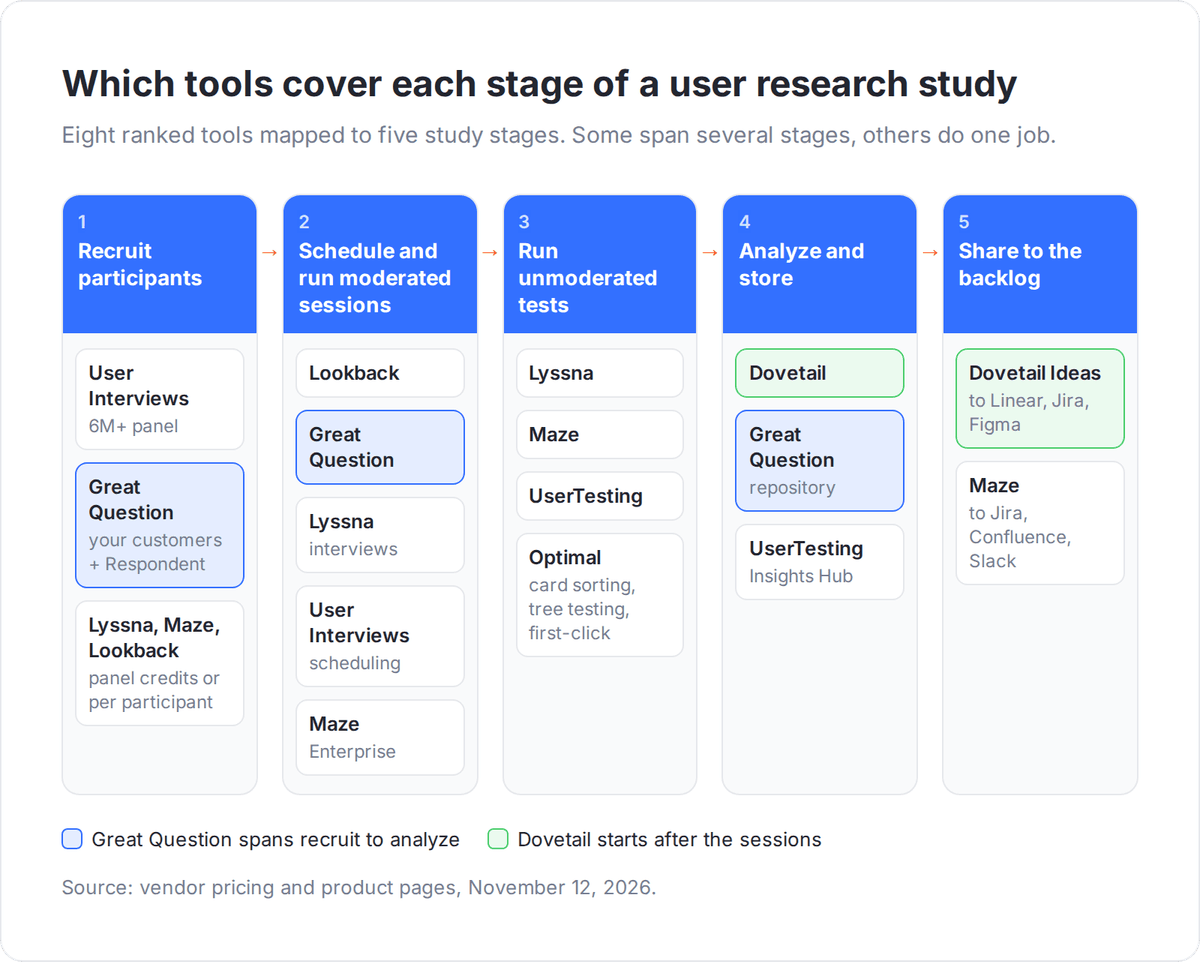
User research tools side by side: price, methods and participants
Prices are entry prices in USD on November 12, 2026. Panel recruitment and participant incentives usually cost extra on top of the plan price.
| Tool | Best for | Methods | Entry price | Free option | Participants | Albato path |
|---|---|---|---|---|---|---|
| User Interviews | Recruiting participants | Recruiting for interviews, tests, surveys | $49 per completed session, pay as you go | Sign-up free, pay per session | 6M+ panel or your own users | HubSpot list → HTTP Request (Hub API) |
| Lyssna | Quick unmoderated tests | Tests, surveys, interviews | Growth $166 a month, billed annually | Free plan, 3 seats | Paid panel credits or your own users | Google Calendar → Slack, Google Sheets |
| Maze | Prototype testing in Figma | Prototype tests, surveys, interviews | Enterprise on quote | Free plan, 1 study a month | Pay-per-use panel or your own users | HubSpot form → Google Sheets tester list |
| Great Question | Research with your own customers | Interviews, surveys, prototype tests, repository | $129 per seat a month | 14-day trial | Your customers, Respondent panel | HubSpot deal → HTTP Request (API) |
| Lookback | Recorded moderated sessions | Moderated and unmoderated sessions | Freelance $299 a year | 5-session trial | Your own users or $49 panel participant | Calendly → Google Calendar, Slack |
| Optimal | Card sorting and tree testing | Card sorting, tree tests, first-click, surveys | Starter $199 a month, annual | 7-day free trial | Your own users or panel | Google Sheets → HubSpot contact update |
| Dovetail | Analysis of calls and transcripts | Analysis, repository, AI chat | $4,800 a year, up to 5 users | Free trial | Data you import | Jotform → HTTP Request (API on Gold plan) |
| UserTesting | Enterprise testing programs | Unmoderated tests, live conversations, card sorts | Quote only | One free test, trial on request | Panel in 60+ countries | Jira issue → Productboard note |
Dovetail's API needs its Gold plan, and all three API tools (User Interviews, Great Question and Dovetail) take data from Albato's HTTP Request action. The other five tools link through the scheduling, CRM, spreadsheet and issue-tracker apps that sit around a study.
1. User Interviews: participant recruiting billed per completed session
User Interviews is the best user research tool for finding participants, because recruiting is its whole product: a panel of more than 6 million people, screener surveys, scheduling and incentive payouts. You bring the study tool, and User Interviews fills it with people who match your screener.
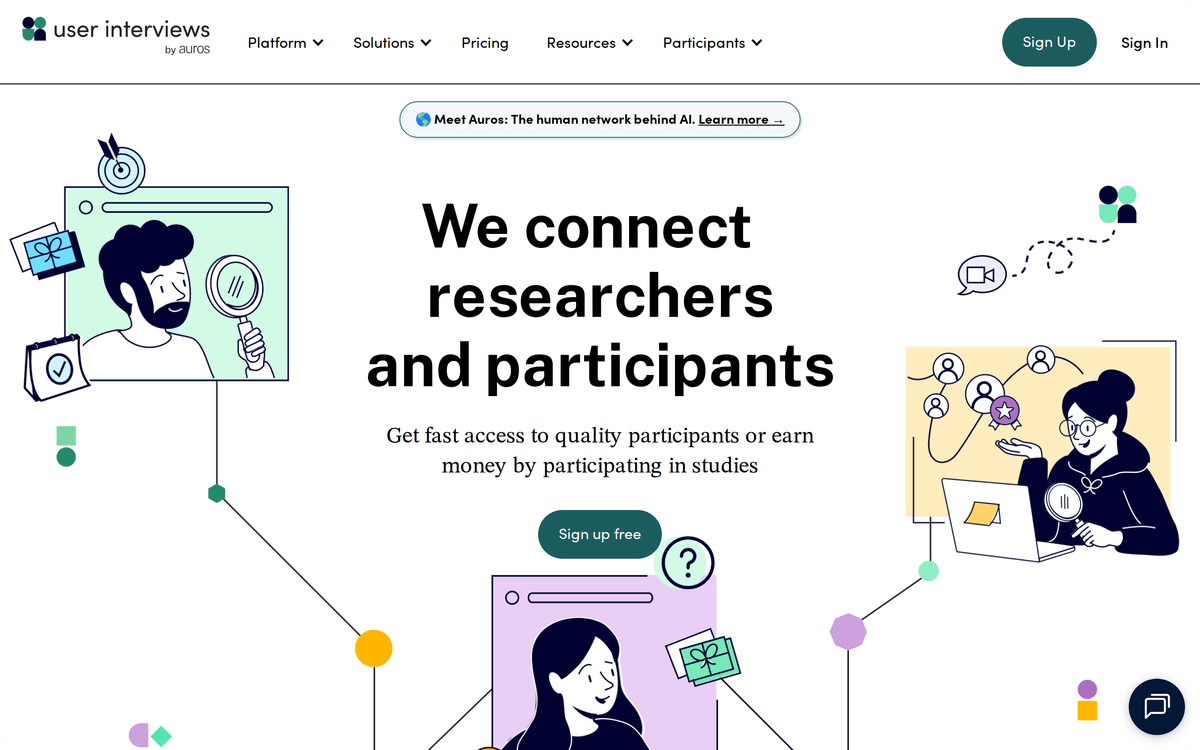
A session is one completed interview or task with one participant, so a focus group of six counts as six sessions. User Interviews lists integrations with Zoom, Google Calendar, Microsoft Teams, Lookback, Lyssna, Maze, Optimal, Typeform and UserTesting. The company is now part of UserTesting, Inc., and its panel also supplies participants inside Lookback.
Research Hub manages a panel built from your own users, and its Participant API accepts new contacts. An Albato flow on HubSpot's "Contact in list created" trigger sends each customer who joins a research list to that API through HTTP Request.
Pay As You Go starts at $49 per completed session with unlimited seats, and advanced B2B targeting costs extra per session. Annual Essential plans cut the per-session rate by 17% to 27%. Incentives are paid on top, with a 3% fee when User Interviews distributes them.
2. Lyssna: unmoderated tests with a free plan
Lyssna (formerly UsabilityHub) is built for fast unmoderated studies: five-second tests, first-click tests, preference tests, prototype tests and surveys. The Free plan keeps unlimited quick studies and 3 seats, but caps responses from participants you recruit yourself at 15.
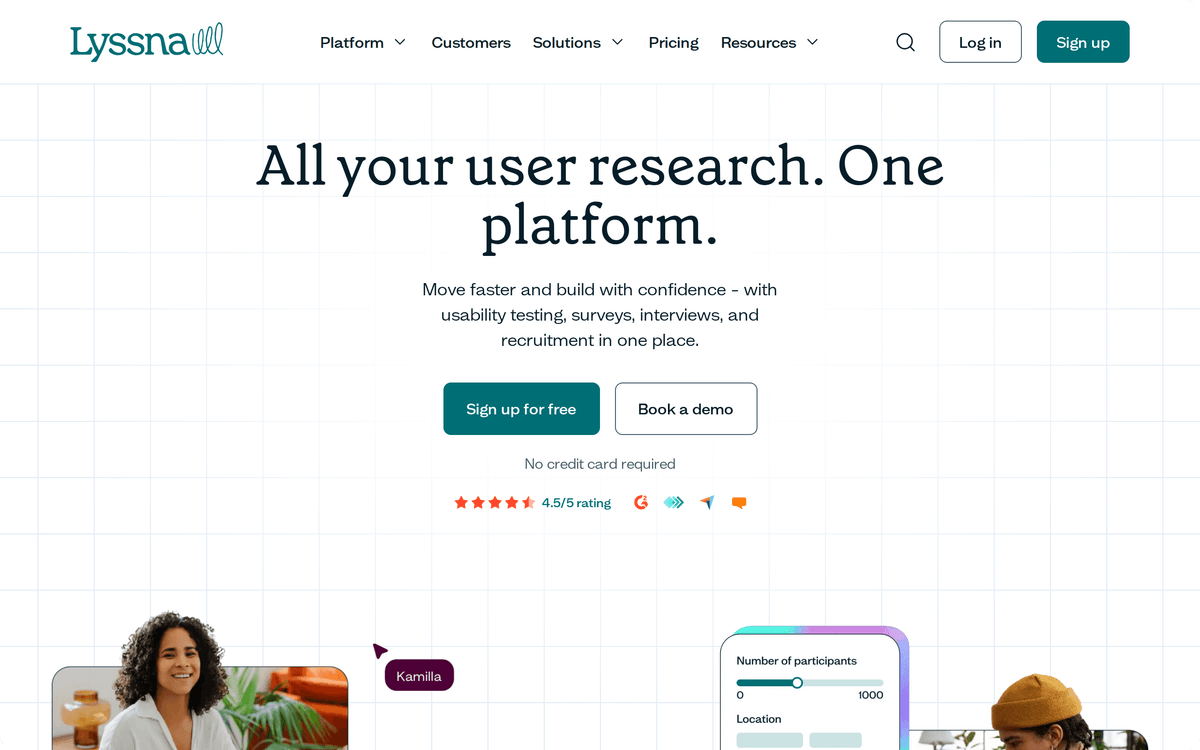
Lyssna books interviews into Google Calendar, and Lyssna itself has no public API. Albato's Google Calendar "Event matching search created" trigger picks up each booked interview. The same flow posts it to a Slack channel and adds a row to a Google Sheets research log.
Growth costs $166 a month billed annually ($199 month to month). It adds 5 in-depth studies a month (60 a year on annual billing), 5 seats, unlimited self-recruited responses, think-aloud recordings, live website and mobile testing, and AI summaries. Panel participants are bought separately as credits that never expire, with discounts on bulk packs, while testing your own users costs nothing.
💡 Tip
On Lyssna, a quick study and an in-depth study draw from different limits. Check which type your test counts as before you launch, because only in-depth studies use up the 5-a-month Growth allowance.
3. Maze: prototype testing for design teams
Maze is the pick for product designers who test Figma prototypes before a single line of code is written. It reports a usability score, misclicks, time on screen and heatmaps for each prototype. The Free plan includes 1 study a month for up to 5 seats, with essential prototype testing, surveys and pay-per-use panel credits.
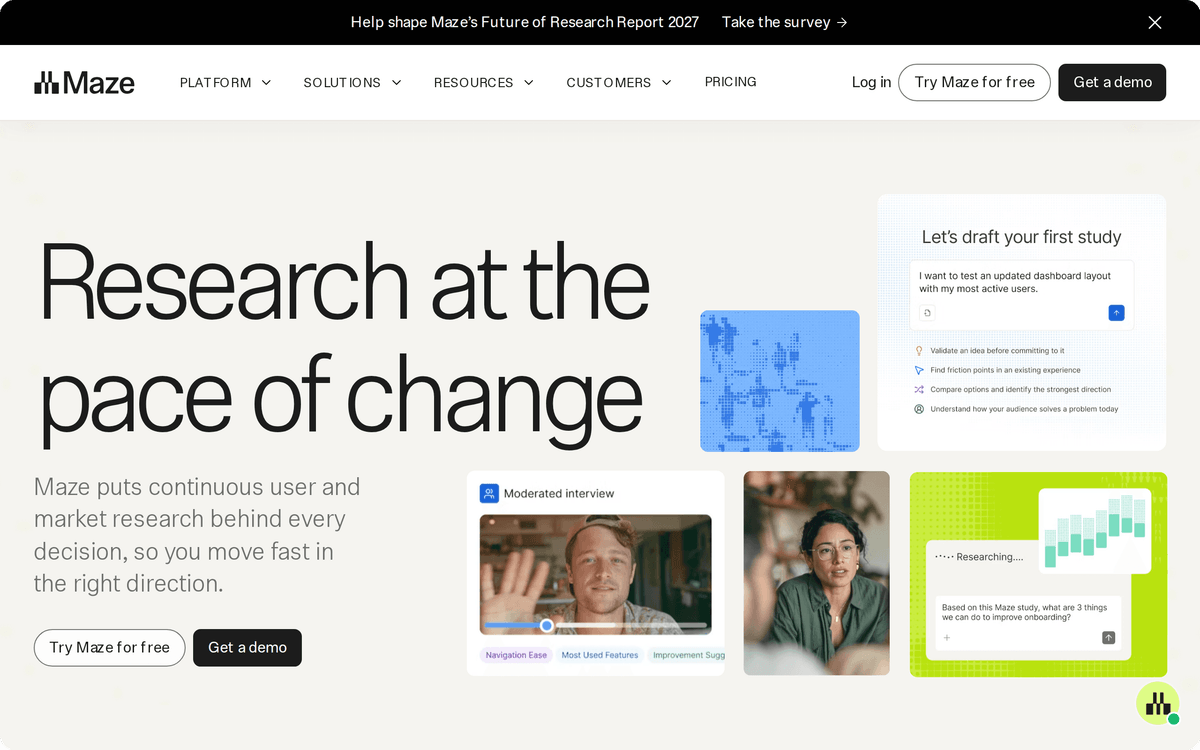
Maze sends results out through its own integrations: Slack notifications for new responses, and Maze reports inside Jira and Confluence. Testers come in through Albato instead. A HubSpot "Form submitted" trigger adds each customer who opts in to testing to a Google Sheets tester list with "Create/update a row", and a designer invites that list to the next Maze study.
The jump from Free goes straight to Enterprise, priced on quote. Enterprise adds unlimited seats, custom study volumes, moderated and AI-moderated interviews, card sorting and tree testing, live website and mobile testing, and access to a global panel of over 7 million participants.
4. Great Question: interviews, tests and a panel of your own customers
Great Question puts recruiting your own customers, scheduling interviews, unmoderated prototype tests, surveys and a research repository in one account. It suits B2B product teams whose best participants are already in the CRM: recruiting your own customers carries no per-participant fee, and observers who only watch sessions do not need a seat.
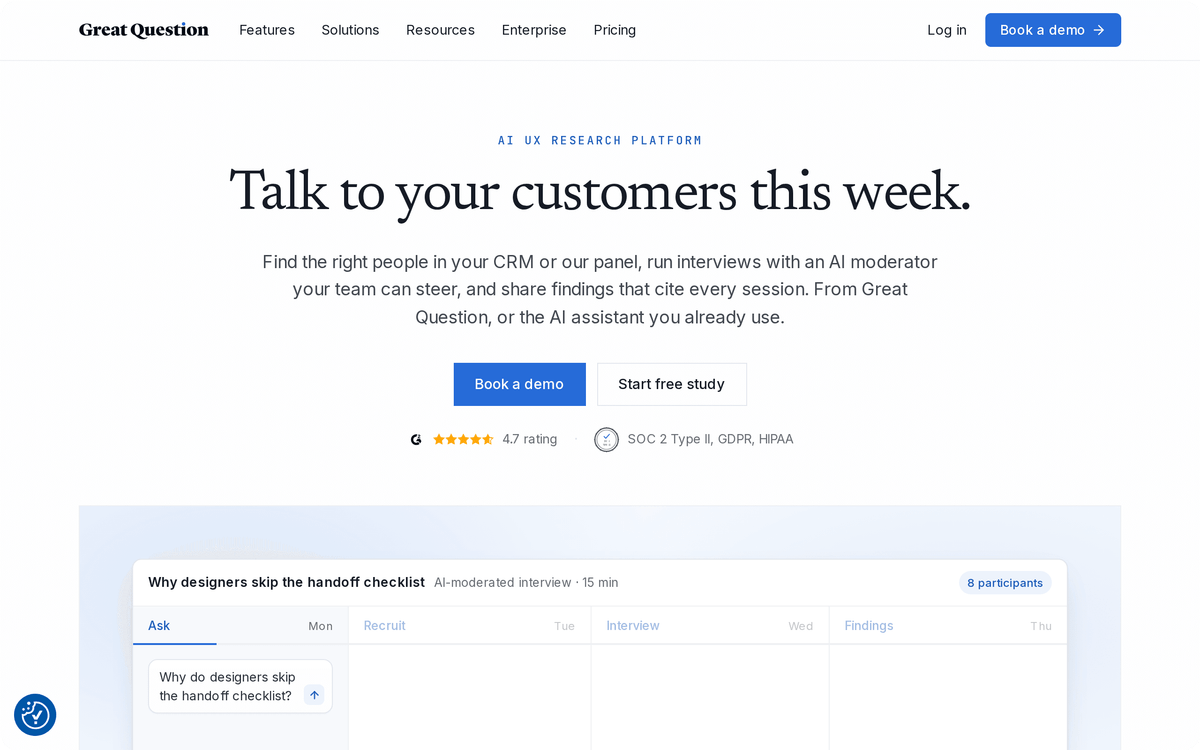
When your customer list runs short, self-serve accounts recruit from Respondent, a panel of 4.3 million B2B and B2C candidates, and incentives go out through Tremendous in 80+ countries. Card sorting, tree testing, focus groups and Salesforce sync are Enterprise features.
Great Question imports customers by CSV or through its API on any paid plan. With HubSpot's "Deal status changed" trigger, Albato can send every newly won customer who agreed to research to that API through HTTP Request.
Self-serve costs $129 per seat a month or $1,290 per seat a year, for up to 5 seats. There is no free plan, only a 14-day trial, and Enterprise pricing is custom.
5. Lookback: recorded moderated sessions on an annual plan
Lookback records moderated interviews and unmoderated sessions on desktop and mobile, with unlimited guests who can watch live. One recording with one participant counts as one session, and sessions expire when the contract ends.
A Calendly booking can put each Lookback interview on the note-taker's calendar and in Slack. On Calendly's "Invitee created" trigger, Albato runs Google Calendar's "Create detailed event" and posts the booking to a Slack channel.
Freelance costs $299 a year for 10 sessions and one seat, and each extra pack of 10 sessions costs another $299. Team costs $1,782 a year for 100 sessions and 10 collaborators, and Insights Hub costs $4,122 a year for 300 sessions and 30 collaborators. Every plan is annual. The trial gives 5 sessions over 60 days, without exports.
Lookback's participant panel is powered by User Interviews. Pay-as-you-go recruits cost $49 each, and Team plans bring the rate to $38 with a minimum purchase of 10. Incentives are extra, with a 6% management fee when Lookback pays them.
6. Optimal: card sorting and tree testing with unlimited seats
Optimal (formerly Optimal Workshop) is the specialist for information architecture: card sorting shows how people group your content, tree testing checks whether they find items in your navigation, and first-click testing shows where they start. It also runs surveys, prototype tests, live site tests and native mobile app tests.
When a researcher adds a participant's email to the study sheet, Google Sheets' "New row created" trigger lets Albato run HubSpot's "Update contact" for that person. The contact record then shows who already did a tree test, and the next invite list can leave them out.
Starter costs $199 a month, billed annually, and allows 5 launched studies a year with unlimited seats and unlimited participant responses per study. That works out to about $478 per launched study with no seat limit, against about $33 per in-depth study on Lyssna Growth. Enterprise adds custom study bundles and is priced on quote.
⚠️ Important
A card sort tells you how people group your content, and a tree test tells you whether they can find it. On Starter each one counts as one of your 5 launched studies a year, so plan both rounds before the first launch.
7. Dovetail: analysis and a repository for what you collect
Dovetail does not run studies. It analyzes them: interview recordings, sales calls, support tickets, documents and survey answers go in. Dovetail One returns tagged themes, AI chat with cited answers, and Ideas you can push to Linear, Jira or Figma with the evidence attached.
Zoom interviews reach Dovetail through its own Zoom connector. Dovetail's public API, available on Silver and Gold only, takes sources that have no native connector, such as Jotform survey answers: Albato sends each new submission to it through HTTP Request when Jotform's "Submission created" trigger fires.
The Bronze plan costs $4,800 a year for up to 5 users, plus AI credits at 15 cents each. Silver (25+ users) is listed as coming soon, and Gold (100+ users) comes with a 30-day free trial. Dovetail lists more than 40 integrations and an MCP server for AI tools.
Dovetail suits teams that already pool sales calls, support tickets and interview recordings from several sources. For a team that only runs its own interviews, Great Question includes a repository at $129 per seat a month, against Dovetail Bronze at $4,800 a year.
8. UserTesting: enterprise testing programs priced on quote
UserTesting is the enterprise choice: 3,000+ enterprise customers, a participant panel in 60+ countries, and three editions (Advanced, Ultimate and Ultimate+). Advanced covers unmoderated tests, think-out-loud recordings and moderated Live Conversation sessions. Ultimate adds AI-generated tests, smart tags, card sorting and tree testing.
UserTesting shares results through its own integrations with Slack, Microsoft Teams, Jira, Figma, FigJam and Miro. Its Jira integration adds UserTesting clips to Jira issues. When the team files findings as issues in a research project, Albato's Jira "Issue created" trigger, filtered to that project, copies each one into Productboard with "Create note".
UserTesting publishes no prices. You buy either a Test-based Consumption plan, paid per test, or a Team-based Unlimited plan with unlimited tests inside an agreed scope. Both include unlimited users, so there is no per-seat charge. For a mid-size product team, the quote-only model is the main obstacle: Lyssna and Maze run the same kind of unmoderated tests with a free plan to start, and Lyssna publishes its paid price.
What does a user research setup cost for three typical product teams?
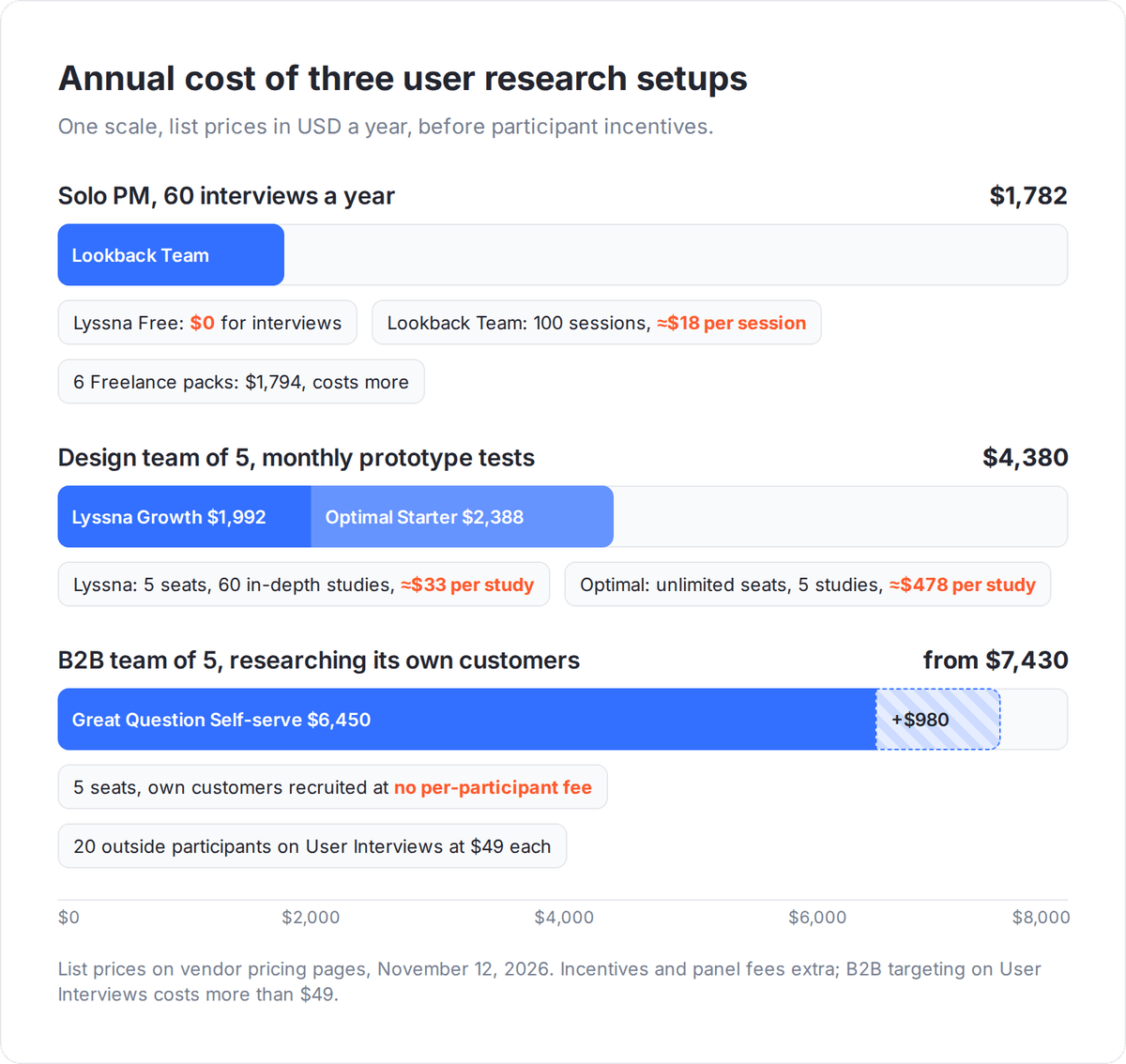
A user research setup costs from $0 for a solo product manager who does not need a dedicated recording tool to about $6,450 a year for a five-person B2B team. These are November 2026 list prices before participant incentives.
A solo product manager running five customer interviews a month
A solo product manager spends $0 on Lyssna Free, or $1,782 a year when every session is recorded and shared on Lookback Team. Lyssna Free includes user interviews and 3 seats, but caps self-recruited test and survey responses at 15, so it covers interviews better than a steady testing habit. Lookback adds recordings with unlimited live guests, which matters when designers and engineers watch along. Five interviews a month come to 60 sessions a year. On Lookback Freelance that means six $299 packs, or $1,794, so Team at $1,782 for 100 sessions costs less and leaves 40 sessions spare. Lookback's trial gives 5 sessions over 60 days, enough for the first month.
A five-person design team testing prototypes every month
A five-person design team fits Lyssna Growth at $166 a month billed annually, or about $1,992 a year for 5 seats and 60 in-depth studies, roughly $33 per study. Optimal Starter costs $2,388 a year for 5 launched studies, about $478 each, but with unlimited seats. The two work as a pair at $4,380 a year combined: Lyssna for the monthly prototype tests, Optimal for the one or two navigation projects a year. Five Lyssna seats cover the whole team, while Optimal's unlimited seats let product managers and engineers join the card sorts without extra cost. Panel credits on Lyssna never expire, so a team that tests with outside participants can buy a bulk pack once and spend it across quarters.
A B2B team researching with its own customers
A B2B product team with five researchers pays $6,450 a year for Great Question Self-serve, and recruiting its own customers adds no per-participant fee. Product managers, designers and engineers who only watch sessions join as observers without a seat. Twenty outside B2B participants on top cost from $980 at User Interviews' $49 rate, before advanced B2B targeting, incentives and the 3% fee when User Interviews pays the incentives. Self-serve accounts in Great Question can also recruit from Respondent's 4.3 million candidates, billed per participant. On annual billing each seat costs $1,290, and incentives can go out through Tremendous in 80+ countries, which covers international customer bases.
Which apps move a study from invite to backlog?
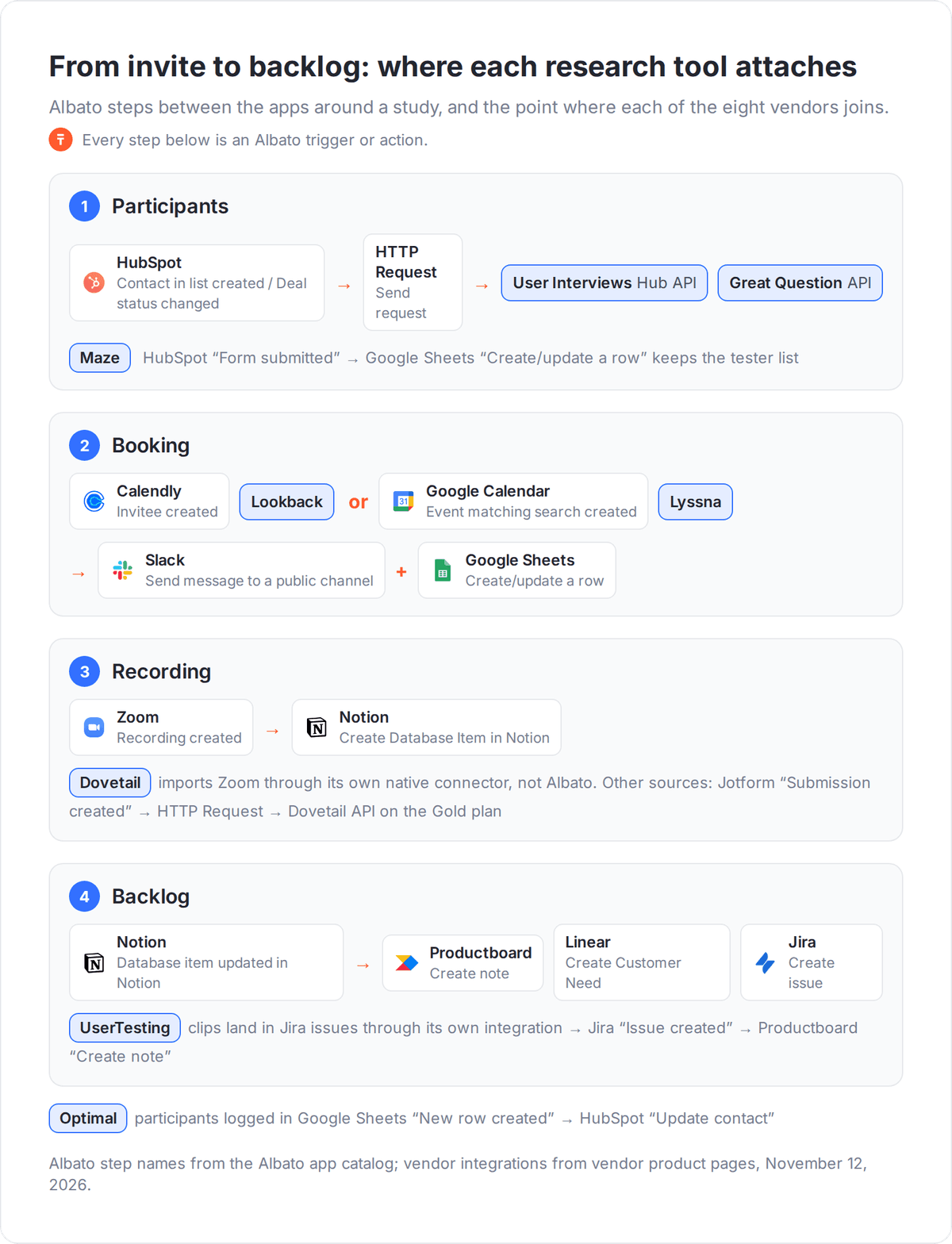
Albato moves a study from invite to backlog through the apps that sit around the research tools: the CRM that holds your participants, the calendar and video apps that run the sessions, and the issue tracker where findings land. In Albato, each of these is a native step.
Which automations bring participants and sessions in?
Three automations fill the study and log it. HubSpot triggers send consenting customers to the Great Question or User Interviews Research Hub panel through HTTP Request. Calendly's "Invitee created" posts each booking to Slack with "Send message to a public channel" and logs it in Google Sheets with "Create/update a row". After the call, Zoom's "Recording created" adds the recording to a Notion research database with "Create Database Item in Notion". Lyssna interviews arrive through Google Calendar's "Event matching search created" trigger rather than Calendly.
For the survey side of the same loop, our guide to turning survey responses into insights covers routing answers by score.
How does a finding reach the backlog?
A finding reaches the backlog when a researcher marks a Notion item as an insight. Albato's Notion "Database item updated in Notion" trigger then creates a note in Productboard with "Create note", a customer need in Linear with "Create Customer Need", or an issue in Jira Software Cloud with "Create issue". When the Notion item stores the recording link, each backlog item carries it, and a product manager can watch the session before prioritizing. UserTesting findings join at the Jira end of the loop through Albato's Jira "Issue created" trigger. Dovetail Ideas push to Linear, Jira or Figma natively, so teams on Dovetail skip the Notion step for those three.
Which tool fixes your research bottleneck?
Start with User Interviews if you have no participants, Lyssna Free if you need design feedback this week, and Lookback if you run live interviews that the team should watch.
- You cannot find participants: User Interviews, $49 per completed session pay as you go, or Great Question if the right people are already your customers.
- You need quick feedback on designs: Lyssna Free or Maze Free, then Lyssna Growth at $166 a month billed annually when one study a month is not enough.
- You run live interviews and need recordings: Lookback, from $299 a year.
- You are redesigning navigation: Optimal for card sorting and tree testing, from $199 a month billed annually.
- You have hundreds of transcripts and no time to read them: Dovetail, from $4,800 a year.
- You run research across a large company: UserTesting on a quote.
Lyssna, Maze, Great Question, Lookback and Optimal all start without a credit card, so you can run the same study on two of them before paying.
FAQ
What is the best user research tool in 2026?
User Interviews is the best user research tool for recruiting participants, at $49 per completed session on Pay As You Go. Lyssna and Maze are the best tools for unmoderated usability tests and both have free plans. Great Question is the best all-in-one tool for research with your own customers at $129 per seat a month.
How much do user research tools cost?
Paid entry prices range from $299 a year for Lookback Freelance to $4,800 a year for Dovetail Bronze, and Lyssna and Maze have free plans. Lyssna Growth costs $166 a month billed annually, Great Question $129 per seat a month, and Optimal $199 a month billed annually, while Maze Enterprise and UserTesting are priced on quote. Participant incentives and panel recruitment usually cost extra.
Is User Interviews part of UserTesting?
Yes. User Interviews is now part of UserTesting, Inc., and its panel also powers participant recruiting inside Lookback. The products are still sold separately: User Interviews charges per completed session, and UserTesting sells enterprise plans on quote.
How do I recruit participants for user research?
You recruit participants from your own customers or from a paid panel. Great Question and Lyssna recruit your own users at no extra cost. User Interviews charges $49 per completed session on Pay As You Go from its 6 million+ panel, and Lookback charges $49 per pay-as-you-go panel participant, with incentives on top in both cases.
Can I automate user research workflows?
Yes. Albato connects the apps around a study: HubSpot to send consenting customers to a research panel, Calendly and Zoom to log bookings and recordings, and Notion, Productboard, Linear or Jira to turn findings into backlog items. Great Question, User Interviews and Dovetail (on its Gold plan) accept data through their APIs and Albato's HTTP Request action.