In this article
Integration maintenance in SaaS is the ongoing work of keeping existing connectors alive after they ship: patching broken auth, adapting to third-party API changes, monitoring for silent failures, and fixing per-customer edge cases. You cut it by consolidating how integrations are built, monitoring failures centrally instead of per connector, and offloading connector upkeep to a platform that maintains them for you. The trap most teams fall into is treating integrations as a one-time build. The invoice for that assumption arrives every quarter, in engineering hours nobody planned for.
A connector that took four weeks to ship does not stop needing attention the day it goes live. A vendor rotates an OAuth scope, a field gets renamed, or an endpoint is deprecated with 30 days of notice if you are lucky. Each event is small on its own, but stacked across 15 or 40 connectors, they turn into a standing tax on your roadmap that grows with every integration you add.
Key takeaways
Before the details, here is the short version of what reduces integration maintenance cost and what does not:
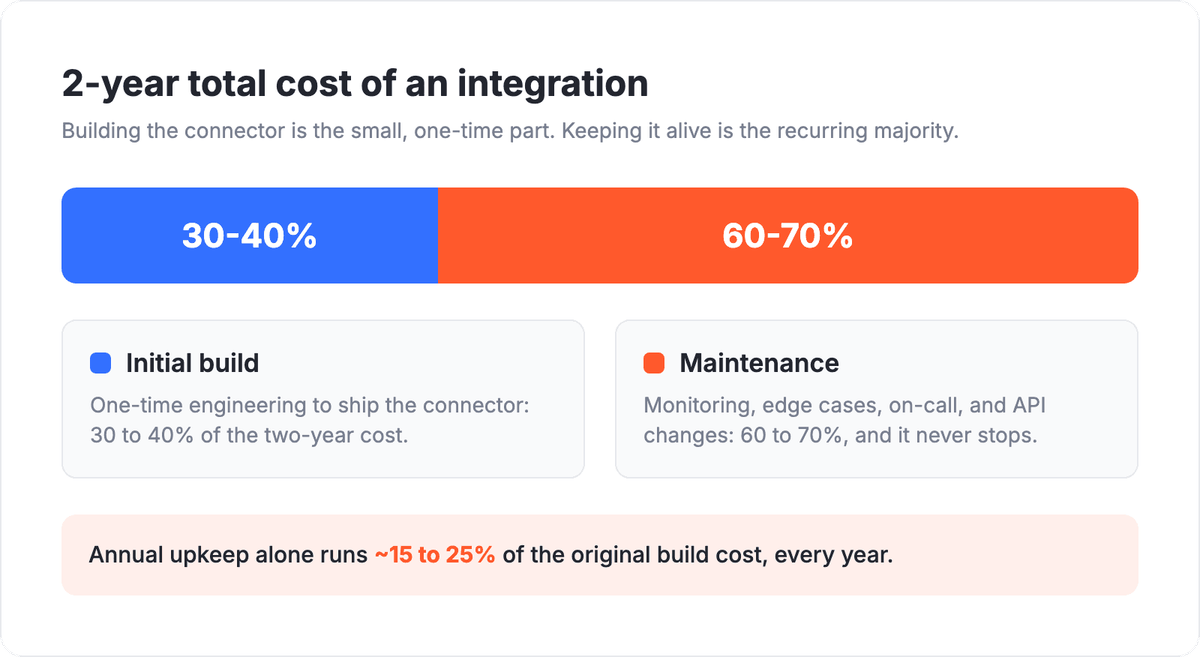
- Maintenance is recurring, not one-time. A long-standing software engineering benchmark puts annual upkeep at roughly 15 to 25% of the original build cost, and it compounds as your integration catalog grows.
- The biggest hidden driver is third-party API change. An academic study of public REST APIs found that 87.3% of breaking changes shipped with no deprecation notice at all, so teams find out when something breaks in production.
- Standardizing how integrations are built, and monitoring them from one place, cuts the per-connector cost far more than hiring another engineer.
- An embedded iPaaS shifts connector maintenance off your team entirely. Platforms like Albato Embedded maintain 1,000+ connectors and push API updates for all of them, so your engineers stop patching other companies' changelogs.
What actually drives integration maintenance costs
Most teams underestimate maintenance because they only price the build. The build is the visible part. The maintenance is where the money quietly goes, and it comes from a handful of predictable sources.
When you break the cost down, four drivers account for most of the spend. Knowing which one is hurting you tells you which fix to reach for.
| Cost driver | What triggers it | Typical impact |
|---|---|---|
| Third-party API changes | Vendors deprecate endpoints, rotate auth scopes, rename fields | Highest and least predictable. Often no advance notice |
| Monitoring and incident response | Silent failures, expired tokens, rate-limit errors | Constant low-level drain, spikes during outages |
| Per-customer edge cases | Custom field mappings, non-standard data, one-off requests | Scales linearly with your customer count |
| Internal knowledge loss | The engineer who built it leaves | Re-learning cost every time ownership changes hands |
The first row is the one teams control the least. Third-party vendors ship breaking changes on their own schedule, and your integration breaks whether or not you were watching the changelog. The academic study on RESTful API deprecation found that among versions introducing breaking changes, only 12.7% included any deprecation notice (Yang et al., ICSME 2020). That means most of the time, your first signal is a failed sync and a support ticket.
The build is only a slice of what an integration costs over its life. The split below shows where the money actually sits once you account for the years after launch.
Why maintenance gets worse as you scale
Maintenance cost does not grow in a straight line with your integration count. It grows faster, because every new connector adds its own failure surface and its own vendor to track.
Ten connectors mean ten changelogs to watch, ten auth flows that can expire, and ten sets of edge cases across your customer base. A single engineer can absorb that. At 40 connectors, the same person is now doing integration triage instead of building product, and keeping the catalog alive can swallow a large share of an engineer's week in perpetual maintenance mode. That is the point where teams either hire a dedicated integrations engineer or start quietly letting connectors rot.
Neither option is good. Hiring adds fixed cost that scales with your catalog. Letting connectors decay shows up as churn, because a broken integration is one of the fastest ways to lose a customer who built their workflow around it. This is the same pressure that fills up a SaaS integration backlog: the team is too busy keeping old connectors alive to ship new ones.
Step 1: Standardize how integrations are built
The single biggest lever on maintenance cost is consistency. When every integration is a bespoke snowflake, every fix is a fresh investigation.
Custom-built connectors tend to each have their own auth handling, their own retry logic, and their own error formats. When one breaks, the engineer has to re-learn how that specific integration works before they can fix it. Multiply that by a catalog of one-off builds and you get the internal knowledge-loss problem: the person who understood it left, and now every fix starts from zero.
Standardizing means one auth pattern, one error-handling approach, and one data-mapping model across all connectors. A fix to the shared layer then fixes every connector that uses it, so you stop paying the re-learning tax on each incident. Albato's own platform data shows teams that consolidate onto a shared integration layer cut development and maintenance cost on API integrations by up to 90%.
Step 2: Monitor failures from one place, not per connector
You cannot cut the cost of something you cannot see. Most integration maintenance spend is reactive, triggered by a failure you discovered late.
Centralized monitoring flips that. Instead of learning about a broken sync from a customer, you catch the failed transaction, the expired token, or the rate-limit error the moment it happens, from a single dashboard that covers every connector. Early detection turns a multi-hour incident into a quick fix, and it stops the same failure from generating a queue of support tickets.
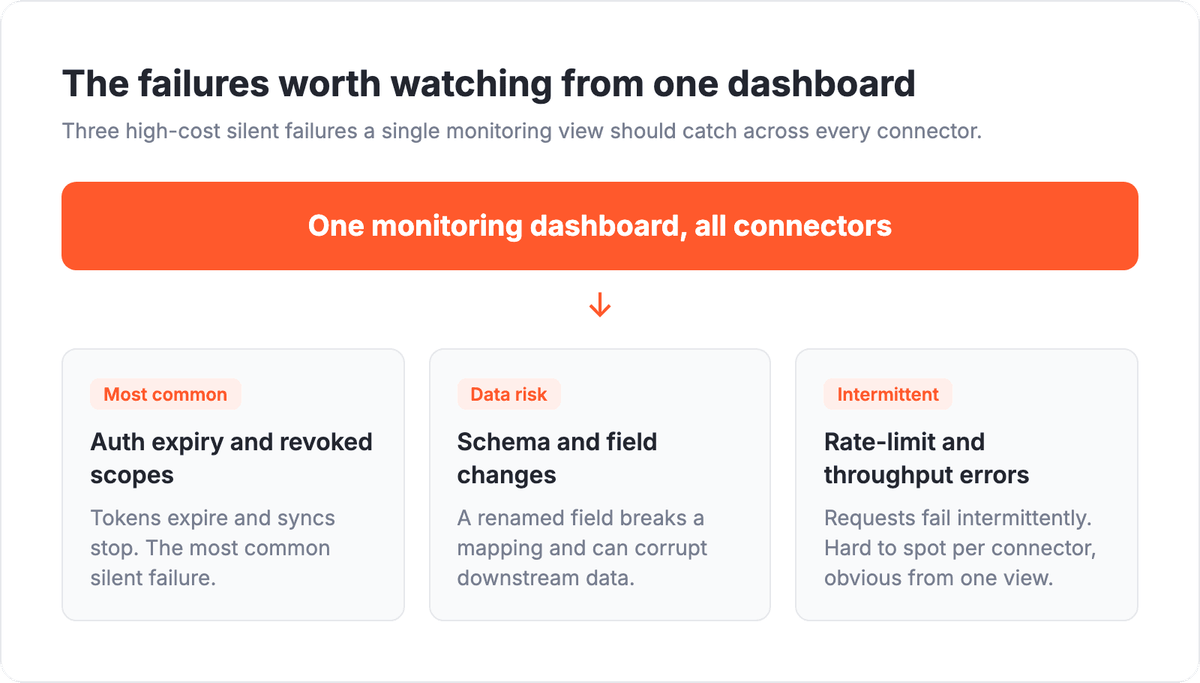
Set your monitoring to watch for the failures that actually cost you:
- Auth expiry and revoked scopes. The most common silent failure. A token expires, syncs stop, and nobody notices until data goes stale.
- Schema or field changes. A renamed field breaks a mapping. Central alerts catch it before it corrupts downstream data.
- Rate-limit and throughput errors. Vendors throttle you, and requests start failing intermittently. Hard to spot per connector, obvious from one dashboard.
The point is not more alerts. It is one place to see all of them, so a single engineer can triage the whole catalog in minutes instead of chasing each connector separately.
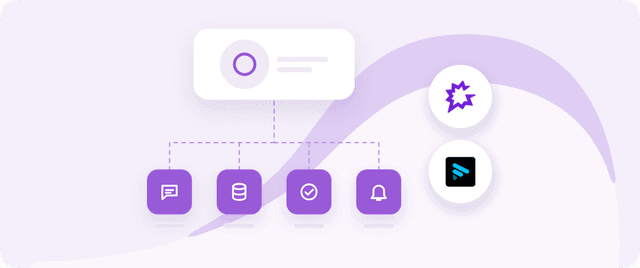
Those three failure types are the ones worth wiring into a single view, which is what the monitoring hub below maps out.
Step 3: Offload connector upkeep to an embedded iPaaS
The steps above reduce maintenance. Offloading it removes the largest chunk from your team's plate entirely. This is where an embedded iPaaS changes the math.
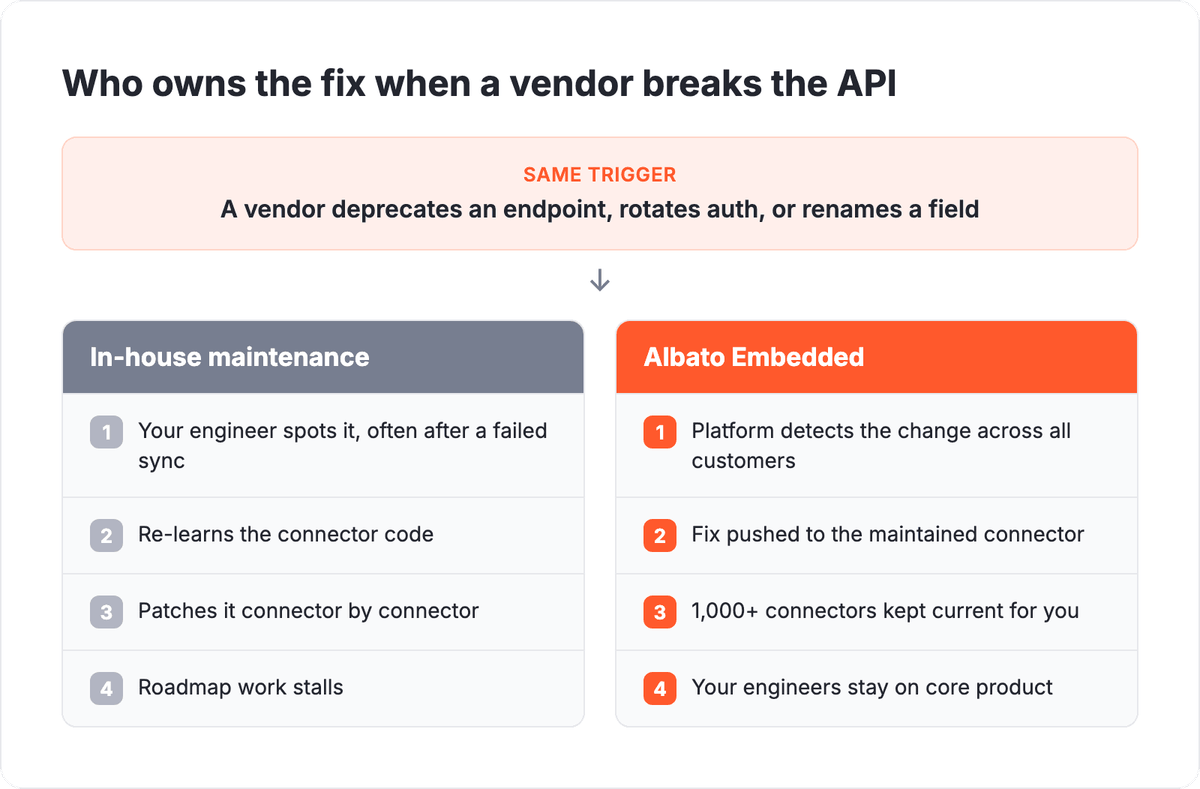
An embedded iPaaS is an integration platform you embed directly inside your own product, so the platform owns connector maintenance while your users get native integrations under your brand. Albato Embedded maintains a library of 1,000+ ready-to-use connectors and ships API updates for all of them, which means when a vendor changes an endpoint, the platform absorbs the fix rather than your engineers. Your team stops tracking other companies' changelogs.
That covers the highest and least predictable cost driver from the table above: third-party API change. Instead of your engineers patching deprecated endpoints connector by connector, connector maintenance, authentication, data mapping, and error recovery all run behind the scenes. This is a core reason teams weigh the build vs buy decision for integrations in the first place: the buy path moves recurring upkeep off your payroll.
The difference is clearest when you follow a single vendor change through both models, as the flow below does.
The savings are concrete, not theoretical. RD Station, one of Latin America's largest marketing platforms, moved its integration layer to Albato Embedded, saved around $150,000 on development, and saw a 73% increase in user retention, without standing up an integrations team to keep those connectors running. Maestra cut delivery time from a month to a week by not rebuilding connectors it could embed instead.
If you want to weigh that trade-off against your own numbers, a walkthrough of how the platform handles connector upkeep is the fastest way to compare.
Step 4: Bill for successful actions, not idle polling
Not all maintenance cost is engineering time. Some of it is infrastructure spend on integrations that run constantly whether or not they do useful work.
Traditional integration setups often charge or consume resources on every API call, including the polling and trigger checks that happen thousands of times a day and mostly return nothing. That cost sits quietly in your cloud bill and grows with usage. A transaction-based model changes it: Albato Embedded only counts a transaction when data is actually moved or modified, and does not charge for polling or trigger steps. On average, one transaction replaces four to five raw API calls, so you pay for outcomes instead of idle checks.
This does not touch the engineering side of maintenance, but it removes a line item most teams never think to question. When you are auditing what integrations cost you, the runtime bill belongs in the total.
Common mistakes that quietly raise maintenance cost
A few habits reliably inflate the maintenance line. They are easy to avoid once you name them.
- Pricing integrations as one-time builds. Across the lifetime of a system, maintenance is widely estimated to consume the majority of total cost of ownership, not the build. Budget for that ongoing share or it comes out of your roadmap by surprise.
- Letting each connector become a snowflake. One-off auth and error handling means every fix starts with re-learning the code. Standardize early.
- Waiting for customers to report failures. If your first signal is a support ticket, you are already paying the expensive version of the incident.
- Adding connectors faster than you can maintain them. Every new integration is a recurring liability, not a one-time asset. Grow the catalog at the rate you can actually keep alive.
Avoiding these four does more for your maintenance budget than any single tool, because they attack the drivers before they compound.
What to expect after you cut maintenance cost
Reducing integration maintenance is not only about spending less. It is about getting engineering time back and stopping the slow churn that broken connectors cause.
Teams that consolidate on a maintained platform typically see two shifts. First, engineers move from integration triage back to core product work, which is where they create value. Second, connector reliability goes up, because a platform maintaining 1,000+ integrations catches and fixes vendor changes across its whole customer base, not one connector at a time. Higher reliability feeds retention directly, and users with more active integrations are measurably harder to lose, which is why embedded integrations lift engagement and retention rather than just adding features.
The end state is simple to describe. Your catalog keeps growing, your maintenance headcount does not, and the connectors your customers depend on stay working without your team living in the changelogs.
Frequently asked questions
What is integration maintenance in SaaS?
Integration maintenance is the ongoing work of keeping existing connectors functional after launch. It includes adapting to third-party API changes, refreshing expired authentication, monitoring for silent failures, and handling per-customer edge cases. Unlike the initial build, it is a recurring cost that continues for the life of every integration.
How much does integration maintenance cost?
A long-standing software engineering benchmark puts annual maintenance at roughly 15 to 25% of the original build cost, and across a system's lifetime maintenance is widely estimated to outweigh the initial build. For integrations specifically, the cost scales with both your catalog size and your customer count, since every connector adds its own vendor to track and its own edge cases to support.
How does an embedded iPaaS reduce maintenance cost?
An embedded iPaaS maintains the connectors for you. Albato Embedded keeps 1,000+ ready-to-use connectors current and pushes API updates across all of them, so when a vendor changes an endpoint, the platform absorbs the fix instead of your engineers. That removes the largest and least predictable maintenance driver, third-party API change, from your team's workload.
Can we reduce maintenance without switching platforms?
Yes, partly. Standardizing how integrations are built and monitoring all connectors from one dashboard cuts the per-connector cost meaningfully. What those steps cannot remove is the underlying work of tracking every vendor's API changes, which is the part an embedded iPaaS offloads entirely.
Stop paying the maintenance tax on every connector
Integration maintenance is the cost that does not show up in the original estimate and never stops arriving. You can shrink it by standardizing your build, monitoring failures centrally, and pricing runtime by successful actions instead of idle polling. You can remove most of it by not owning connector upkeep at all.
Albato Embedded lets SaaS teams embed 1,000+ maintained integrations under their own brand, with API updates handled for every connector. RD Station saved around $150,000 on development and lifted retention 73% this way, and Maestra cut integration delivery from a month to a week. Your engineers stop patching other companies' changelogs and get back to building your product.
Explore related guides on build vs buy, integration backlogs, and how embedded integrations drive retention below.