In this article
Integrations cut time to value in SaaS onboarding by removing the setup work that stands between a new user and their first real result: connect the tools a customer already runs, and their own data flows into your product on day one instead of week three. When first value lands fast, activation climbs and early churn drops. When it stalls behind manual imports and missing connectors, most new accounts quietly leave before they ever see what your product does.
That gap is where a lot of SaaS revenue leaks. A user signs up, hits an empty dashboard, and gets asked to export a CSV from their CRM or wait for an engineer to wire up a connection that does not exist yet. Every extra step pushes the "aha moment" further out, and the data on that delay is not kind.
This piece looks at why time to value decides onboarding outcomes, how integrations shorten it in practice, and what it takes to ship the integrations your onboarding depends on without stalling your product roadmap.
Key takeaways:
- Top B2B products retain 15.6% of users at three months versus a 2.5% median, a 6x gap, and early activation is the strongest predictor of which side you land on (Amplitude 2025 Product Benchmark Report).
- The average B2B SaaS activation rate is 37.5%, so nearly two in three signups never reach core value (Userpilot 2024 benchmark, 62 companies).
- Native integrations shorten time to value by letting a new user's existing data flow into your product during onboarding, instead of after manual setup or a support ticket.
- Building those integrations in-house is the bottleneck: an embedded integration platform like Albato Embedded gives SaaS teams 1,000+ ready connectors to ship in weeks, not quarters.
- Real results back it up: Maestra cut integration delivery from one month to one week, and RD Station saw a 73% retention increase after adding native integrations.
What time to value means in onboarding
Time to value (TTV) is how long it takes a new user to reach the first outcome that made them sign up. In onboarding, that is not the moment they finish a product tour. It is the moment they see their own data doing something useful inside your product: a lead synced, a report populated, a workflow that runs on its own.
TTV matters because the first few days decide retention. Amplitude's 2025 Product Benchmark Report, drawn from more than 2,600 companies, found that top B2B products retain 15.6% of users at the three-month mark while the median product retains just 2.5%, a gap of more than six times. The same report found that 69% of products with strong early activation also ranked among the strongest three-month retention performers. Early value and long-term retention move together.
The activation numbers show how much room there is to lose. Userpilot's 2024 User Activation Rate Benchmark Report, based on 62 B2B SaaS companies, put the average activation rate at 37.5% and the median at 37%. Roughly two in three new signups never reach the core value the product was built to deliver. Most of that drop-off happens early, while the user is still deciding whether the product is worth the effort.
Why integrations are usually the bottleneck
For most B2B products, the first useful outcome depends on data the customer already keeps somewhere else. A CRM holds their contacts. A billing tool holds their revenue. A support platform holds their tickets. Until that data reaches your product, onboarding is a demo with no substance behind it.
When the integration is missing, onboarding turns into homework. The user exports a file, cleans it up, imports it, and hopes the fields line up. Or they file a request and wait for your team to build a one-off connection. Every one of those steps is a chance to lose a user who came to see results, not to do data plumbing. A manual import is the opposite of the frictionless setup that high-activation products invest in.
Native integrations remove that step. When a user can connect HubSpot, Salesforce, or Shopify in a couple of clicks during onboarding, their real data populates your product immediately. The empty-state problem disappears, and the "aha moment" arrives while the user is still paying attention.
How native integrations compress time to value
Integrations shorten onboarding in three concrete ways, each of which pulls first value earlier in the user's journey.
They eliminate manual data entry. Instead of importing a spreadsheet, the user authorizes a connection and their records sync automatically. A project management tool that pulls tasks straight from a connected CRM shows a populated board on the first session, not the fifth.
They automate the first workflow. Onboarding often asks users to set up a workflow by hand before they see any payoff. A native integration can run that workflow on connection: a new deal in the CRM creates a project, a paid invoice triggers a welcome sequence, a support ticket routes to the right queue. The user watches automation happen instead of configuring it.
They remove the wait for engineering. When a customer needs an integration your product does not have, the alternatives are ugly: they wait months for a roadmap slot, or they churn. A ready library of connectors means the integration a customer needs during onboarding is already there.
The timeline below puts both paths on the same onboarding calendar, so you can see exactly where first value lands in each case.
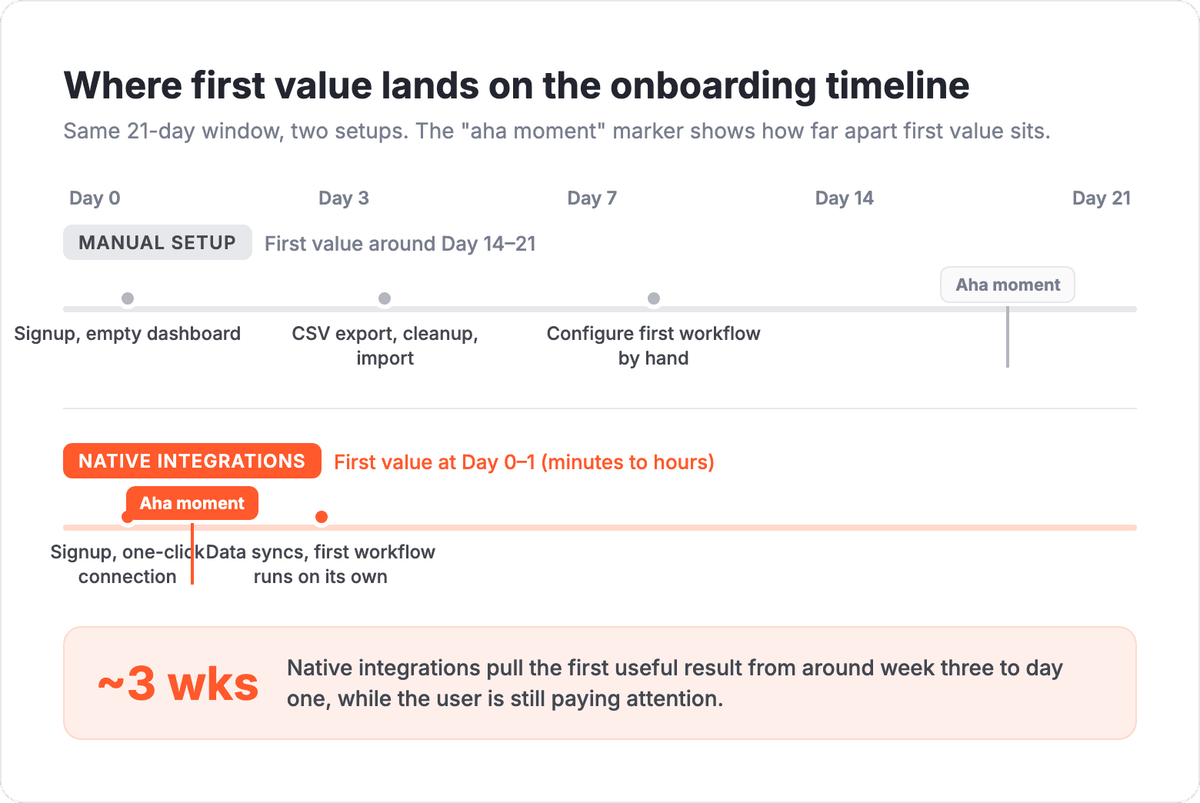
The table breaks the same comparison down step by step, from getting data in to the moment a user reaches first value.
| Onboarding step | Without native integrations | With native integrations |
|---|---|---|
| Getting data in | Manual CSV export, cleanup, and import | One-click connection, automatic sync |
| First workflow | User configures it by hand | Runs automatically on connection |
| Missing connector | Support ticket, wait for engineering | Already in the connector library |
| Time to first value | Days to weeks | Minutes to hours |
The pattern is consistent: every place a manual step used to sit, a connection takes its place, and the user reaches value sooner.
The build-in-house trap
Most product teams know integrations drive activation. The problem is supply. Building and maintaining native integrations in-house is slow, expensive, and never finished, because every connected app has its own API, its own auth, and its own breaking changes.
A single integration can take an engineer weeks to build and then needs ongoing maintenance as the third-party API shifts. Multiply that across the dozens of tools your customers ask for, and integration work becomes a permanent tax on the roadmap. The features that differentiate your product wait behind connector plumbing that every competitor also has to build.
That is the trade most teams get stuck in: spend engineering time on integrations and starve the core product, or protect the roadmap and leave onboarding gaps that cost you activations. Neither option is good, and the second one quietly bleeds new users.
How embedded integration platforms close the gap
An embedded iPaaS lets a SaaS company add native integrations to its product without building each one from scratch. Instead of writing and maintaining connectors, the team embeds a ready library and exposes it inside their own UI, under their own brand.
Albato Embedded is one such platform. It gives SaaS teams a library of 1,000+ ready-to-use connectors with more than 20,000 triggers and actions, all embeddable natively so end users connect their tools without ever leaving the product. According to Albato's platform data, the library covers CRM, marketing, e-commerce, support, and AI categories out of the box, which means the integrations your onboarding depends on usually already exist.
The onboarding payoff is direct. A new user connecting their CRM during setup does not care whether your team built that connector or embedded it. They care that it works in two clicks. For a deeper breakdown of the build-versus-embed decision, see in-house vs unified API vs embedded iPaaS.
If you want to see how an embedded library drops into your own onboarding flow, a short walkthrough is the fastest way to judge the fit.
What faster integrations do for onboarding, in real numbers
The case for integrations is not theoretical. SaaS companies that embedded a ready connector library shipped integrations faster and saw the retention effects downstream.
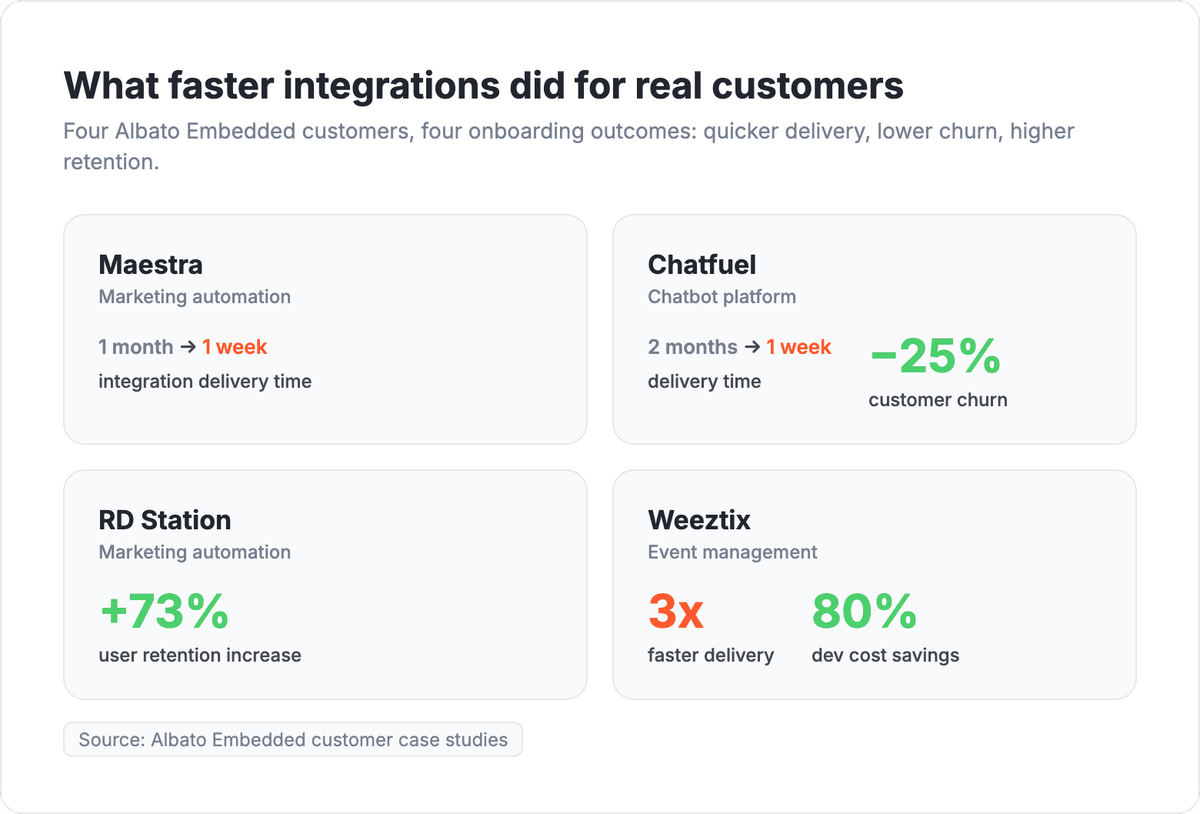
Maestra, a marketing automation platform, cut integration delivery from one month to one week after embedding Albato, with almost no engagement from its R&D team. Chatfuel went from two months to one week per integration and reduced customer churn by 25%. RD Station, which needed native integrations with major e-commerce platforms, reported a 73% increase in user retention after adding them. Weeztix embedded integrations directly into its dashboard and cut development costs by 80% while delivering three times faster.
The chart below groups those four outcomes side by side, so the pattern across delivery speed and retention is easy to read at a glance.
The common thread: faster integration delivery means the connectors customers need are ready when they onboard, so first value arrives sooner and users stick. You can see the same dynamic in how embedded integrations boost retention.
Where to start
Faster time to value does not require rebuilding onboarding from scratch. It starts with one question: what data does a new user need inside your product to reach first value, and where does that data live today?
Map the tools your customers already run, prioritize the connections that unblock the first useful outcome, and make those integrations part of the onboarding flow instead of a task users discover later. If building those connectors would stall your roadmap, an embedded platform gets them into the product without the engineering drag.
Onboarding is the shortest window you have to prove your product's worth. Integrations are how you use it. When a new user's own data shows up working on day one, the "aha moment" stops being something you hope for and becomes something onboarding delivers.
Albato Embedded lets SaaS teams embed 1,000+ integrations without building them, so onboarding can put a customer's real data to work in the first session. Teams at Maestra and RD Station shipped their integration libraries in weeks rather than quarters, and watched retention follow.
Frequently asked questions
What is time to value in SaaS onboarding?
Time to value is how long it takes a new user to reach the first outcome they signed up for, such as a synced lead, a populated report, or a workflow that runs on its own. In onboarding it is the moment the product proves its worth with the user's own data, not the moment a tour ends.
How do integrations reduce time to value?
Integrations let a new user's existing data flow into your product during onboarding instead of after manual setup. A one-click connection replaces CSV exports and support tickets, so the first useful result arrives in minutes rather than days or weeks.
Why does faster time to value matter for retention?
Early activation is the strongest predictor of long-term retention. Amplitude's 2025 benchmark found top B2B products retain users at three months more than six times better than the median, and 69% of products with strong early activation also ranked among the strongest retention performers.
Should we build integrations in-house or use an embedded platform?
Building each connector in-house takes weeks per integration plus ongoing maintenance, which competes directly with core product work. An embedded integration platform like Albato Embedded gives you 1,000+ ready connectors to ship in weeks, so onboarding gets the integrations it needs without stalling the roadmap.
If you want to go deeper, the pieces below build on this guide: what embedded iPaaS is, how embedded integrations lift retention, and the full build-versus-embed trade-off.