In this article
Key Takeaways
- An AI agent can read each inbound lead, score it against your criteria, route it to the right rep or nurture track, and send a first-touch follow-up, all without a human triaging the queue first.
- Speed is the whole game: HBR's audit of 2,241 companies found firms that made contact within an hour were nearly 7 times more likely to qualify a lead than those that waited just one hour longer.
- The setup is three connected jobs: score (is this lead worth pursuing?), route (who or what handles it?), and follow up (first response before it goes cold).
- Unlike a fixed rules engine, an agent handles the messy, unstructured leads that do not fit your form fields, which is where most manual qualification breaks down.
Most teams already have lead scoring rules somewhere. The problem is the leads that do not fit them: a webform note that says "we're a 200-person agency evaluating options for Q3," a reply with a company name but no revenue field, a demo request from a personal Gmail. A rules engine drops those into a generic bucket. An agent reads them.

Let us build your automation or AI Agent
Tell us which process eats your time. Certified Albato engineers take it from there, A to Z.
What "AI agent for lead qualification" actually means
An AI agent for lead qualification is an automation step that reads an incoming lead, decides whether it fits your ideal customer profile, and triggers the right next action on its own, instead of you writing a filter for every possible input. It replaces the manual triage that usually sits between "form submitted" and "rep follows up."
The difference from classic lead scoring is autonomy. A traditional scoring model adds points for known fields: job title, company size, source. It works until a lead arrives in a shape the model did not expect, and then a person has to look at it. An agent reasons about the whole record, including free-text notes, and picks an action, so the unstructured leads that used to wait in a queue get handled in the same run.
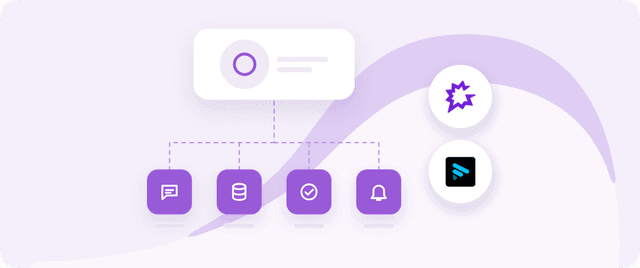
The pipeline below shows how the three jobs chain together, from a single scored lead to a routed destination and a first reply.

One caution before you build it: keep the agent inside the triage lane and out of the deal itself.
💡 Tip. Do not hand the agent your closing logic. Lead qualification is a triage decision, not a sales decision. The agent's job is to sort and route fast; a human still runs discovery and closes.
Why response speed is the case for automating this
The reason to automate qualification is time, not headcount. The value of a lead decays fast, and manual triage is where most of the delay lives, because a rep has to notice the lead, read it, judge it, and decide where it goes before any reply happens.
HBR's study of 2,241 US companies put a number on it: the average response time to a web lead was 42 hours, and 23% of companies never responded at all. An agent collapses that first-touch window to the time it takes a scenario to run, usually seconds, which is the difference between catching a buyer while they are still comparing options and reaching them after a competitor already replied.
The contrast is easier to see side by side than in prose, so the chart below puts the manual average next to an agent's response.

The gap widens the longer you wait, and the same study quantifies exactly how steep the drop-off is.
📊 Stat. In the same HBR audit, firms that contacted a lead within an hour were more than 60 times as likely to qualify it as firms that waited 24 hours or more. The first hour is not a nice-to-have; it is the qualification window.
Step 1: Score the lead against your ICP
Start by defining what "qualified" means in plain language, because that description becomes the agent's instructions. Write down the signals that matter: company size range, industry, role seniority, budget cues, and the disqualifiers (students, competitors, obvious spam). The agent reads each lead against this description and returns a verdict plus a reason.
Feed it everything you have, not just the form fields. The free-text "tell us about your project" box is often the richest signal and the hardest for a rules engine to use. An agent can read "we're switching off a legacy tool next quarter" and treat it as a stronger buying signal than a filled-in revenue dropdown.
Keep the output structured. Ask the agent to return a tier (hot / warm / cold or A / B / C) and a one-line rationale, so the routing step and your reps both have something to act on. A score with no reason is hard to trust; a score with a reason gets used.
Step 2: Route it to the right destination
Routing is where the agent's decision turns into an action in your stack. Based on the tier and the lead's attributes, the agent sends the record to the right place: enterprise leads to an account executive, self-serve leads to a nurture sequence, disqualified leads to a suppression list so nobody wastes a call on them.
This is the step that a fixed workflow handles badly and an agent handles well. Territory splits, product-line ownership, round-robin among available reps, and "this looks like an existing customer, send to the CS team" are all judgment calls that would need a sprawling rule tree. The agent weighs them per lead and calls the matching action: create a CRM deal, assign an owner, add to a list, post an alert. The same pattern extends to AI agents that enrich and route leads for marketing ops, so records land in the right nurture track without manual triage.
Step 3: Send the first follow-up before the lead goes cold
The follow-up step closes the speed gap. As soon as the agent scores and routes, it can trigger a first-touch message tailored to the tier: a booking link for a hot lead, a relevant resource for a warm one, a polite acknowledgment for one that needs manual review. The point is that the lead hears back in seconds, not after the next time a rep checks the queue.
Keep the first touch human and specific. The agent can draft a reply that references the lead's own note ("you mentioned you're evaluating options for Q3") rather than a generic autoresponder, which is what separates a helpful first contact from an obvious bot blast. For a deeper pattern on AI-drafted responses, see our guide on auto-replying to customer emails.
Building the flow with Albato AI Agent
Albato's AI Agent is the practical way to run all three steps in one scenario. It is a step you drop into an automation that starts with a trigger, a new webform submission, a new CRM lead, a new row in a sheet, and it reads that lead, decides the tier and destination, and calls the actions to route and reply.
You give it three things. A model makes the decisions (the built-in Albato AI, which is proprietary and needs no external account, or a connected OpenAI, DeepSeek, or Google Gemini model). Instructions in plain language: your ICP description as the agent instructions, the lead data as the user message, and guardrails like "never auto-reply to leads tagged competitor." Tools are the actions it may call, drawn from around 5,000 actions across connected apps, so it can create the CRM deal, assign the owner, and send the message itself.

The field-level control is what makes it reliable for qualification. For any action field, you can either set the value yourself or turn on "Let the AI agent decide" and add a field-level instruction, so the CRM deal stage is fixed while the deal owner is chosen by the agent per lead. You keep the parts that must be consistent locked and let the agent handle only the judgment.

Each AI Agent run costs 3 transactions, plus a small token-based amount when using the built-in Albato AI model, so the cost maps to volume rather than a per-seat fee. You can build the whole score-route-follow-up flow on the free plan and connect it to the CRM and form tools you already use.
Where to keep a human in the loop
Automating qualification does not mean removing judgment; it means moving it. Set the agent to auto-route and auto-reply on the clear cases, hot and cold, and to flag the ambiguous middle for a human. That way reps spend their attention on the 20% of leads that genuinely need a person, not on triaging the whole inbox.
Guardrails do the enforcing. Tell the agent which actions it may take autonomously and which require a human check: it can book a hot lead straight into a calendar, but it should only suggest a disqualification, not delete the record. As trust builds and you see the agent's rationale holding up, you widen what it is allowed to do on its own.
The fastest way to see whether this fits your pipeline is to wire it to your current form and CRM and let it triage live leads alongside your existing process for a week.
FAQ
Here are the questions teams ask most often before wiring an agent into their lead flow.
How is an AI agent different from lead scoring in my CRM?
CRM lead scoring adds points based on fixed fields and rules you configure. An AI agent reads the whole lead, including unstructured notes, reasons about fit, and then takes the routing and follow-up actions itself. Scoring tells you a number; the agent acts on it.
Will it reply to leads without me checking first?
Only if you let it. Guardrails define what the agent can do autonomously versus what it flags for a human. A common setup is auto-reply on clearly hot and clearly cold leads, and a human review step for the ambiguous middle.
Do I need to connect my CRM for this to work?
Yes, in practice. The agent needs to read the incoming lead and write the result somewhere: create a deal, assign an owner, add to a list. A no-code integration platform connects your form, CRM, and messaging tools so the agent can act across all of them in one run.
What does it cost to run per lead?
With Albato, each AI Agent run is 3 transactions, plus a small token-based charge if you use the built-in model. Cost scales with lead volume, not with the number of sales seats, which is usually cheaper than adding headcount to triage.
Want to go deeper? These guides cover related topics.