In this article
Key Takeaways
- The project management software market will reach an estimated $11.27 billion in 2026, and integration depth is now a primary differentiator between tools that scale and tools that stall.
- Monday.com leads for CRM-heavy teams, ClickUp for broad integration coverage at the lowest price, Jira for agile development toolchains, and Teamwork for client-billing agencies.
- This guide ranks 11 PM tools by their native integrations, third-party connector support (including Albato), pricing, and real G2 ratings to help you pick the right one for your workflow.
The average organization now runs 957 applications, yet only 27% of those apps are connected. For project teams, that gap turns into missed handoffs, duplicate data entry, and status updates that live in five different places. The tools below were selected specifically for how well they connect with CRMs, communication platforms, and the rest of your stack.

Let us build your automation or AI Agent
Tell us which process eats your time. Certified Albato engineers take it from there, A to Z.
How We Selected These Tools
We evaluated over 20 project management platforms and narrowed the list to 11 based on four criteria: native integration count (how many apps the tool connects to out of the box), third-party automation support (compatibility with platforms like Albato, which adds 1,000+ additional connectors), CRM connectivity (because most teams need project data flowing into or out of their CRM), and real user ratings from G2 and Capterra with a minimum of 1,000 reviews. If you're looking for a broader comparison of integration platforms themselves, our iPaaS solutions guide covers the middleware layer in depth.
Every tool on this list supports at least one of these integration models: native marketplace, open API, or third-party automation via Albato. Pricing was verified directly from vendor websites in April 2026.

Quick Comparison: 11 Best Project Management Tools for Integrations
| Tool | Best For | Starting Price | Native Integrations | Albato Connector | G2 Rating |
|---|---|---|---|---|---|
| Monday.com | Visual workflows + CRM sync | $9/seat/mo | 200+ | Yes | 4.7/5 |
| Asana | Cross-functional teams | $10.99/user/mo | 200+ | Yes | 4.5/5 |
| ClickUp | All-in-one workspace | $7/user/mo | 1,000+ | Yes | 4.7/5 |
| Jira | Agile development teams | $7.91/user/mo | 3,000+ (Marketplace) | Yes | 4.3/5 |
| Wrike | Enterprise collaboration | $10/user/mo | 400+ | Yes | 4.2/5 |
| Trello | Kanban-style simplicity | Free (paid from $5/user/mo) | 200+ (Power-Ups) | Yes | 4.4/5 |
| Notion | Docs + databases + projects | $10/user/mo | 100+ | Yes | 4.7/5 |
| Smartsheet | Spreadsheet-native PM | $9/user/mo | 150+ | Yes | 4.4/5 |
| Teamwork | Client-facing agencies | $10.99/user/mo | 80+ | Yes | 4.4/5 |
| Basecamp | Simple team communication | $15/user/mo | 50+ | No | 4.1/5 |
| Tungsten Automation | Large-scale enterprises and teams in regulated industries that need to convert "dark data" into AI-ready intelligence for complex, automated workflows | Custom enterprise pricing | N/A | No | 4.2/5 |
A few patterns stand out from the comparison. Native integration counts vary wildly, from Basecamp’s 50 to Jira’s 3,000+ via the Atlassian Marketplace, but raw counts mean little if the apps you actually use aren’t on the list. Pricing clusters in the $7-$11 per user range across most tools, with Basecamp’s flat-rate Pro plan and Trello’s free tier as the outliers. Nine of the eleven platforms have direct Albato connectors, which is the practical lever for connecting your PM tool to systems outside its native marketplace, like your CRM, helpdesk, accounting stack, or feedback tool.
💡 Tip
The number of triggers and actions in an Albato connector determines how granular your automations can get. Triggers fire workflows when something happens in your PM tool (task created, status changed); actions create or update records in connected apps. Tools with high trigger counts like Teamwork (12) and Monday.com (10) are stronger for event-driven automations. Tools where actions sharply outnumber triggers, like Asana (3 triggers, 14 actions) and Smartsheet (4 triggers, 14 actions), are best when your PM tool is the destination of automations, not the source.
The 11 Best Project Management Tools for Integration-Driven Teams
1. Monday.com: Best for Visual Workflows With CRM Sync

Monday.com gives teams a visual, color-coded workspace where every project board doubles as a live data hub. Unlike tools that treat integrations as an afterthought, Monday.com bakes them into the Standard plan with 250 automations and 250 integration actions per month, jumping to 25,000 each on Pro.
The platform supports over 200 native integrations, including direct connections to Salesforce, HubSpot, Slack, Microsoft Teams, Google Workspace, and Jira. For CRM-heavy teams, Monday.com also offers its own CRM product (Monday CRM) that shares the same data layer, so project updates and deal stages stay in sync without middleware.
Where Monday.com stands out for integration-dependent teams is its automation builder. You can create "when-then" recipes that trigger actions across connected apps: when a deal closes in your CRM, create a project board; when a task status changes, post to Slack; when a due date passes, send a follow-up email. These recipes run natively without external tools.
Through Albato's Monday.com connector (10 triggers, 15 actions), you can push Monday.com data into apps that lack native integration support: sync completed tasks to Google Sheets, create CRM records from board items, or trigger SMS notifications when project milestones hit. This fills the gaps that Monday.com's native marketplace doesn't cover.
Pricing (billed annually):
- Free: up to 2 users, 3 boards
- Basic: $9/seat/mo (no automations or integrations)
- Standard: $12/seat/mo (250 automations + 250 integrations/mo)
- Pro: $19/seat/mo (25,000 automations + 25,000 integrations/mo)
- Enterprise: custom pricing
Minimum 3 seats on all paid plans. Monthly billing adds roughly 18% to annual prices.
Best for: Marketing, operations, and sales teams that need visual project tracking tightly connected to their CRM and communication stack.
⚠️ Important
The Basic plan does not include automations or integrations at all. If connecting Monday.com to your other tools is the reason you're buying it, start with Standard at minimum.
2. Asana: Best for Cross-Functional Teams Coordinating Across Departments

Asana was built for teams where work crosses departmental lines: marketing launches that need design, copy, and development input; product releases that involve engineering, QA, and customer success. Its Workflow Builder lets you create multi-step processes that hand work between teams and trigger actions at each stage.
The platform offers over 200 native integrations through its app directory, covering popular tools like Salesforce, Microsoft Teams, Slack, Google Workspace, Adobe Creative Cloud, and Tableau. The Starter plan includes unlimited automations (most competitors cap this), which makes it unusually accessible for smaller teams that need connected workflows.
Asana's integration strength sits in its portfolio-level visibility. You can build dashboards that pull data from multiple projects, track cross-functional goals, and report progress to stakeholders in real time. When connected to your CRM through native integrations or Albato's Asana connector (3 triggers, 14 actions), project completion data can automatically update deal records or trigger follow-up sequences.
The Albato connector is particularly useful for teams that need to push Asana task data into tools outside Asana's native directory. Creating a new task in Asana can trigger a record in your billing software, update a shared Google Sheet, or notify a channel in a messaging platform that Asana doesn't natively support.
Pricing (billed annually):
- Personal (Free): unlimited tasks and projects, up to 2 users (limited views)
- Starter: $10.99/user/mo (Timeline, Workflow Builder, dashboards, AI, unlimited automations)
- Advanced: $24.99/user/mo (Goals, Portfolios, time tracking, advanced integrations)
- Enterprise: custom pricing
💡 Tip
Asana's Starter plan includes unlimited automations, while most competitors cap automation runs at 250-1,700 per month on comparable tiers. If your team needs heavy cross-departmental automation on a mid-range budget, Asana's pricing structure gives you more headroom than Monday.com Standard or Jira Standard.
Best for: Companies with 20+ people where projects regularly involve multiple departments and handoffs.
3. ClickUp: Best All-in-One Workspace With Deep Integration Coverage

ClickUp packs more functionality into its free plan than most competitors offer at paid tiers: tasks, docs, goals, time tracking, whiteboards, automations, and 15+ project views. For integration-focused teams, the Unlimited plan ($7/user/mo) removes the limits on integrations and storage while keeping the price lower than nearly every competitor.
The platform claims over 1,000 native integrations through its directory and API, including connections to HubSpot, Salesforce, Slack, GitHub, Figma, Zoom, and Google Workspace. ClickUp's native automations let you build "when-then" triggers across these connections, and the Unlimited plan provides enough automation runs for most mid-size teams.
What differentiates ClickUp in the integration space is breadth at a low price point. You get Gantt charts, sprint management, a document editor, and a time tracker alongside your integrations, all in one subscription. For teams tired of paying separately for project management, docs, and time tracking, ClickUp consolidates the stack. Our workflow management software comparison covers how ClickUp stacks up against similar all-in-one platforms.
Albato's ClickUp connector (6 triggers, 12 actions) extends this further by letting you automate data flows between ClickUp and apps outside its native ecosystem. When a task changes status in ClickUp, you can create an invoice in QuickBooks, update a row in Airtable, or send a formatted message to a Telegram channel.
Pricing (billed annually):
- Free Forever: unlimited tasks and members, 60MB storage
- Unlimited: $7/user/mo (unlimited integrations, storage, dashboards)
- Business: $12/user/mo (private docs, sprint reporting, advanced automations)
- Enterprise: custom pricing
ClickUp Brain (AI assistant) costs an additional $9/user/mo.
Best for: Startups and mid-size teams that want a single platform covering tasks, docs, goals, and integrations without paying for multiple tools.
💡 Tip
ClickUp's free plan supports unlimited members but limits storage to 60MB and restricts some views. For serious integration use, the Unlimited plan at $7/user/mo is the practical starting point.
4. Jira: Best for Agile Development Teams With Complex Toolchains

Jira dominates software development project management for a reason: it was purpose-built for agile workflows with native sprint planning, backlog grooming, roadmaps, and release tracking. But its integration story goes beyond dev tools. The Atlassian Marketplace hosts over 3,000 apps and integrations, making Jira one of the most extensible PM platforms available.
For development teams, Jira connects natively to Bitbucket, GitHub, GitLab, Confluence, and other Atlassian products. But it also integrates with Salesforce, Slack, Microsoft Teams, Zendesk, and dozens of CRM and support tools. This makes it practical for organizations where project management spans both engineering and customer-facing teams.
Jira's tiered pricing reduces per-user costs as your team grows. The Standard plan at $7.91/user/mo supports up to 35,000 users and includes 1,700 monthly automations. Premium ($14.54/user/mo) adds cross-project planning, dependency management, and Atlassian Rovo, their AI assistant that provides smart recommendations and search across your workspace.
Albato's Jira connector (8 triggers, 13 actions) is useful for teams that need Jira data flowing into non-Atlassian tools. You can trigger CRM updates when issues close, sync sprint data to Google Sheets for stakeholder reporting, or create tickets in external live chat and customer support tools when bugs reach specific states.
Pricing (billed annually):
- Free: up to 10 users, unlimited projects, 2GB storage
- Standard: $7.91/user/mo (250GB storage, 1,700 automations/mo)
- Premium: $14.54/user/mo (unlimited storage, cross-project planning, AI)
- Enterprise: custom (volume discounts available)
Best for: Software development teams and engineering-driven organizations that need tight version control integration and agile-native workflows.
5. Wrike: Best for Enterprise Teams Needing Cross-Platform Data Flow

Wrike targets larger organizations that need project management tightly coupled with enterprise software ecosystems. Its native integrations include Salesforce, Adobe Creative Cloud, Jira, SAP, ServiceNow, Tableau, Microsoft Teams, and Slack. For creative teams specifically, Wrike Proof allows designers to manage visual feedback through multiple review cycles and invite external reviewers directly into the platform.
The platform's automation engine runs on its Business plan and above, supporting custom workflows that trigger actions across connected systems. Wrike's reporting suite can pull data from integrated tools into unified dashboards, giving project managers a single view of progress across platforms.
Where Wrike earns its place on this list is in regulated and complex environments. The Pinnacle tier includes advanced analytics, resource management, and compliance features that enterprise buyers typically need. The tradeoff is price: Business starts at $25/user/mo with a 5-seat minimum, making it significantly more expensive than ClickUp or Monday.com at similar feature levels.
Albato's Wrike connector currently supports 6 actions (including create task, create comment, create subfolder, and custom API requests) but no triggers. This means you can push data into Wrike from other systems through Albato, but pulling data out requires Wrike's native integrations or API.
Pricing (billed annually):
- Free: up to 5 users
- Team: $10/user/mo
- Business: $25/user/mo (5-seat minimum, automations, integrations)
- Pinnacle: ~$50/user/mo (advanced analytics, resource management)
🔧 How it works
Wrike's request forms can capture intake from external sources and automatically convert submissions into structured projects with assigned tasks, deadlines, and connected data. This is especially useful for agencies and IT teams managing internal requests from multiple departments.
Best for: Enterprise teams (50+ people) in regulated industries or creative organizations that need proofing, resource management, and deep Salesforce/Adobe integration.
6. Trello: Best for Kanban-Style Simplicity With Plug-and-Play Connectors

Trello keeps things simple. If your team thinks in boards, lists, and cards, Trello delivers that model with minimal friction. Its Power-Up system provides over 200 integrations, including Slack, Google Drive, Jira, Salesforce, and Confluence. Free accounts get unlimited Power-Ups (Trello removed the one-Power-Up limit in 2022), which means even non-paying teams can connect their boards to external tools.
Trello's automation layer, Butler, is built into every plan. Butler lets you create rules, card buttons, board buttons, and scheduled commands that trigger actions when cards move, due dates arrive, or labels change. Combined with Power-Ups, this gives small teams a surprisingly capable automation setup without paying for a higher tier.
The limitation is depth. Trello lacks native Gantt charts, resource management, and advanced reporting. For teams running complex, multi-phase projects with dependencies, Trello's simplicity becomes a constraint. But for marketing teams managing content calendars, support teams tracking requests, or sales teams running pipeline boards, Trello's board model is fast and intuitive.
Albato's Trello connector (9 triggers, 7 actions) makes up for some of those gaps. You can trigger workflows when cards move between lists, create CRM records from new cards, or sync Trello board data into reporting tools that give you the analytics Trello doesn't offer natively.
Pricing (billed annually):
- Free: unlimited cards, up to 10 boards/workspace, unlimited Power-Ups
- Standard: $5/user/mo (unlimited boards, custom fields, advanced checklists)
- Premium: $10/user/mo (Timeline, Dashboard, Calendar views)
- Enterprise: $17.50/user/mo (organization-wide permissions, unlimited workspaces)
Best for: Small teams, freelancers, and departments that prefer kanban-style task management and need quick, low-friction integrations.
7. Notion: Best for Teams That Build Custom Workflows Around Databases

Notion blurs the line between project management, documentation, and database software. Its flexible database system lets teams build custom project trackers, wikis, CRM-like systems, and editorial calendars from scratch. While this means more setup time than a dedicated PM tool, it also means Notion adapts to almost any workflow shape.
Notion's integration directory includes over 100 connections, covering Slack, Google Drive, Figma, GitHub, Linear, and Loom. Its API is well-documented and actively maintained, which has made it a popular choice for teams that build custom automations. The platform also connects to external databases and supports embeds from dozens of services.
For teams that value documentation alongside task management, Notion is hard to beat. Every project can live alongside its specs, meeting notes, and reference materials in the same workspace. The database views (table, board, timeline, calendar, gallery) give you multiple ways to visualize the same data without duplicating it.
Albato's Notion connector (6 triggers, 10 actions) helps teams automate the data flow between Notion databases and external systems. When a database item updates in Notion, Albato can push that change to your CRM, trigger an email sequence, or update a row in Google Sheets. This turns Notion from a standalone workspace into a connected node in your broader stack.
Pricing (billed annually):
- Free: unlimited pages for individuals
- Plus: $10/user/mo (unlimited file uploads, 30-day version history)
- Business: $15/user/mo (private teamspaces, bulk export, advanced permissions)
- Enterprise: custom pricing
Best for: Startups, product teams, and knowledge-heavy organizations that want to combine project management with internal documentation and custom databases.
8. Smartsheet: Best for Spreadsheet-Native Teams Moving Into Project Management

Smartsheet approaches project management from a spreadsheet-first perspective. If your team already lives in Excel or Google Sheets, Smartsheet's interface feels immediately familiar while adding Gantt charts, automations, resource management, and approval workflows on top. This makes it a practical upgrade path for organizations that have outgrown spreadsheet-based project tracking.
The platform offers over 150 native integrations, including Microsoft 365, Google Workspace, Salesforce, ServiceNow, Jira, Slack, and Tableau. Smartsheet's connector framework also supports bi-directional sync with several enterprise tools, meaning changes in either system update both automatically.
Smartsheet's Control Center feature lets enterprise teams standardize project templates and launch new projects with pre-configured integrations, automations, and dashboards. This is especially valuable for organizations running repeatable processes (client onboarding, product launches, regulatory compliance) where consistency matters more than flexibility.
Albato's Smartsheet connector (4 triggers, 14 actions) supports row-level operations: add, update, copy, and move rows across sheets. Combined with Smartsheet's native automations, this gives teams a complete data pipeline between their project sheets and external systems like CRMs, billing platforms, and helpdesks.
Pricing (billed annually):
- Pro: $9/user/mo (sheets, Gantt, card view, basic automations)
- Business: $19/user/mo (unlimited automations, resource management, document builder)
- Enterprise: custom pricing (advanced security, governance, Control Center)
Best for: Finance, operations, and PMO teams that think in rows and columns and need enterprise-grade project management layered on a spreadsheet foundation.
💡 Tip
Many teams move into dedicated project management software straight from spreadsheets, which is why tools like Smartsheet that preserve the familiar grid interface tend to have smooth adoption curves. If your team already lives in rows and columns, a grid-native tool shortens the learning curve.
9. Teamwork: Best for Client-Facing Agencies That Bill by the Hour

Teamwork was built for agencies, consultancies, and professional services firms where project management includes time tracking, client billing, and external collaboration. Unlike general-purpose PM tools, Teamwork bundles invoicing, budgeting, and profitability tracking directly into the project management layer.
The platform offers 80+ native integrations, including HubSpot, Slack, Microsoft Teams, QuickBooks, Xero, and Google Workspace. For agencies, the time tracking and invoicing integrations are especially relevant: tracked hours can flow directly into accounting software without manual export.
Teamwork's client portal feature lets external stakeholders view project progress, approve deliverables, and communicate with your team without needing a full account. This reduces the email back-and-forth that slows down client projects and keeps approvals inside the project management system.
Albato's Teamwork connector (12 triggers, 13 actions) is one of the deepest on this list, covering projects, tasks, users, invoices, expenses, milestones, and events. This makes it practical to build automations that span the full client lifecycle: when a CRM deal closes (often kicked off from a signed proposal in your sales stack), create a Teamwork project; when a milestone completes, trigger an invoice in your billing tool; when an expense is logged, update your accounting system.
Pricing (billed annually):
- Free: up to 5 users
- Deliver: $10.99/user/mo (time tracking, budgets, client access)
- Grow: $19.99/user/mo (profitability reporting, resource scheduling, advanced automation)
- Scale: custom pricing
Best for: Agencies, consultancies, and professional services firms that need project management, time tracking, and client billing in one platform.
10. Basecamp: Best for Simple Team Communication Without the Complexity

Basecamp takes a deliberately opinionated approach to project management. Instead of offering every feature and view imaginable, it focuses on to-do lists, message boards, schedules, file sharing, and group chat. Every project gets the same set of tools, and there are no Gantt charts, custom fields, or sprint boards. For teams that find tools like Monday.com or ClickUp overwhelming, Basecamp's simplicity is the selling point.
The platform offers around 50 native integrations, mostly through Basecamp's API and third-party bridges. Direct connections exist for Slack, Google Calendar, iCalendar, and a handful of productivity tools. Compared to the other tools on this list, Basecamp's integration ecosystem is limited.
Basecamp currently does not have an Albato connector, which limits your automation options. If connecting Basecamp to your CRM, helpdesk, or billing stack is critical, you'll need to rely on Basecamp's API directly or use alternative automation platforms.
Pricing:
- Basecamp Personal (Free): 1 project, 1GB storage, up to 20 users
- Basecamp Plus: $15/user/mo
- Pro Unlimited: $299/mo flat (unlimited users, projects, 5TB storage)
The Pro Unlimited plan is unusual in project management software: a single flat fee regardless of team size. For teams of 20 or more, the per-user cost drops below $15/mo and keeps decreasing.
Best for: Small teams that value simplicity over feature depth and prefer structured communication (message boards, scheduled check-ins) over traditional task management.
11. Tungsten Automation: Best for AI-Powered Document Workflow Orchestration
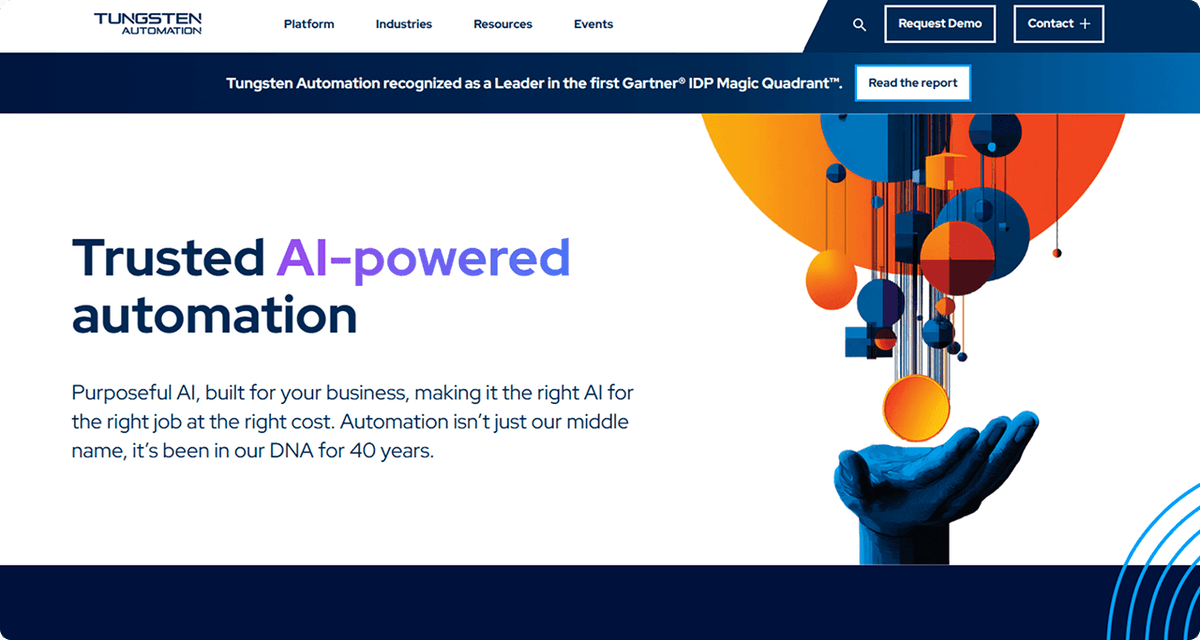
Tungsten Automation provides the critical link between unstructured document data and the agentic workflows that drive modern project management. While most PM tools focus on organizing tasks, Tungsten addresses "AI readiness" by transforming invoices, contracts, and handwritten records into structured, trusted data. By eliminating the "dark data" trap, it ensures that your automated systems have the high-quality information they need to function effectively.
In the era of IDP 2.0, Tungsten moves beyond simple data capture to full AI transformation and understanding. It enriches raw content with governance and compliance, making it ideal for large-scale projects in highly regulated industries. For teams managing complex project lifecycles, Tungsten orchestrates the flow of document-based intelligence across the business, routing it from ingestion to the right automated process without manual intervention.
Pricing (billed annually):
- Custom enterprise pricing; quotes provided upon request based on volume and required modules.
- Contact the Tungsten sales team for a demo and personalized solution breakdown.
Best for: Large-scale enterprises and teams in regulated industries that need to convert "dark data" into AI-ready intelligence for complex, automated workflows.
How Albato Extends Your Project Management Integrations
Most project management tools offer their own native integrations, and many of them cover the obvious connections: Slack, Google Workspace, Salesforce. But teams rarely stop at the obvious. You might need your PM tool talking to a niche CRM, a regional payment processor, an industry-specific helpdesk, or an internal tool that nobody else uses.
That's where Albato adds value. With connectors for 9 out of 11 tools on this list and access to over 1,000 apps total, Albato fills the integration gaps that native marketplaces leave open. Teams that have already connected their email marketing or analytics platforms through Albato can add their PM tool to the same connected ecosystem. The platform uses a trigger-action model: an event in your PM tool (task created, status changed, item updated) triggers an action in another app (create CRM record, send notification, update spreadsheet).
Setting up a connection takes minutes, not days. You select your trigger app, choose an event, connect your action app, map the data fields, and activate. No code, no API documentation, no developer time.
For teams evaluating PM software, Albato's connector depth is worth checking during your evaluation. A tool with fewer native integrations but strong Albato support might actually connect to more of your stack than a tool with a larger native marketplace that misses the specific apps you need.
You can explore the full connector catalog and test automations with a free trial.
If you're new to no-code integration platforms, the trigger-action model is what makes Albato extensible without engineering work. Here's how it maps to a typical PM workflow.
🔧 How it works
Albato's trigger-action model means you don't need to write API calls or maintain webhook endpoints. Select the event in your PM tool, pick the action in your target app, map the fields, and activate. The automation runs in the background without ongoing maintenance.
How to Choose the Right PM Tool for Your Integration Needs
Picking the right project management software depends on where your team's data needs to flow. Here's a practical framework:
If your main integration need is CRM sync (Salesforce, HubSpot, Pipedrive): Monday.com, Asana, and ClickUp all offer direct CRM connectors plus strong Albato support for custom workflows. Monday.com's own CRM product is a bonus if you want to consolidate.
If you're a development team with complex toolchains (GitHub, GitLab, CI/CD, monitoring): Jira's Atlassian Marketplace with 3,000+ apps is hard to match. ClickUp is a lighter alternative with good GitHub and Bitbucket coverage.
If you're an agency billing hours to clients (QuickBooks, Xero, client portals): Teamwork is purpose-built for this workflow. Smartsheet works if your billing team prefers spreadsheet-based tracking.
If you want maximum integration breadth at the lowest price: ClickUp at $7/user/mo with Albato's connector gives you one of the widest integration networks available for under $10/user.
If you value simplicity and your integration needs are basic: Trello or Basecamp. Trello edges ahead with Albato support and free unlimited Power-Ups.
Check which of your current tools have Albato connectors before committing to a PM platform. The tool with the most native integrations isn't always the best fit; the tool that connects specifically to your stack is.
FAQ
What is the best project management software for integrations?
The best choice depends on your specific stack. Monday.com, ClickUp, and Asana offer the strongest combination of native integrations and third-party automation support through platforms like Albato. Monday.com leads for CRM-heavy teams, ClickUp for budget-conscious teams needing broad coverage, and Asana for cross-functional organizations.
Can I connect project management tools to my CRM without coding?
Yes. Most modern PM tools offer native CRM integrations for popular platforms like Salesforce and HubSpot. For CRM systems outside the native marketplace, Albato provides no-code connectors that let you sync project data with your CRM using a visual trigger-action builder. Nine of the ten tools in this guide have Albato connectors.
How many integrations does a good PM tool need?
The raw number matters less than whether the tool connects to your specific apps. A platform with 200 integrations that includes your CRM, communication tool, and billing software beats one with 3,000 integrations that misses your core stack. Check both native integrations and third-party automation support (like Albato) before deciding.
Is ClickUp or Monday.com better for integrations?
Both are strong. ClickUp offers more native integrations (1,000+ vs 200+) at a lower starting price ($7 vs $9/seat/mo). Monday.com provides deeper CRM integration through its own CRM product and more polished native automations starting at the Standard plan. ClickUp wins on breadth and price; Monday.com wins on CRM depth and automation polish.
What is Albato and how does it help with project management integrations?
Albato is a no-code integration platform with 1,000+ connectors that lets you automate data flows between your project management tool and other business apps. For a full breakdown of how an iPaaS fits into your business tool stack, see our iPaaS business stack guide. It works alongside your PM tool's native integrations to fill gaps: connecting niche CRMs, regional payment tools, or industry-specific software that your PM platform doesn't support natively. You can test it with a free trial.
If integration depth is your decision criterion, the next step is comparing how PM tools fit alongside the rest of your stack: workflow management platforms, iPaaS middleware, and email marketing systems all share connector territory with PM software. The articles below cover the adjacent categories.