In this article
Key Takeaways
- AI architecture questions now show up in enterprise procurement checklists alongside SOC 2, SSO, and encryption. Security teams want to see how your AI reads, writes, and routes data, not just whether the product is "secure."
- Clear data flow diagrams, scoped access, and visible guardrails close deals faster than generic trust-us language. The same assets that satisfy a CISO also give your AEs a better story.
- SaaS vendors face AI scrutiny from buyers and must apply the same diligence to their own stack: model providers, integration layers, and embedded iPaaS all sit inside the blast radius.
A quiet shift is happening in B2B buying cycles. Security and procurement reviewers are joining discovery calls earlier, and they bring AI-specific questions that legal never asked last year. Vendors who answer in plain language close faster; the ones who hand over a SOC 2 badge and hope for the best stall in review.
The New Reality: AI Security Questions Enterprise Buyers Ask in 2026
The checklist has changed. Two years ago, a tight security review meant SSO, MFA, encryption at rest and in transit, SOC 2 Type 2, and a signed DPA. That baseline still matters. It is no longer enough.
Enterprise buyers now add a second layer of questions, all of them tied to AI:
- Where does our data go when your AI feature runs, and who processes it along the way.
- Is customer data used to train any model, yours or a third-party's.
- What can your AI actually read from our systems, what can it write, and under what conditions.
- How do we audit what the AI did on a specific day for a specific customer.
- What controls do our admins get at the tenant level: toggles, policies, approvals, opt-outs.
These questions are not coming only from the CISO. Privacy counsel, procurement, and the internal champion all want answers, because each of them is accountable if the integration misbehaves after signature. The burden of proof sits with the vendor.
"It's not enough to say we're secure. You need to be understandable." Natalia Botti, VP Channels & Alliances, ApexaiQ
The shift is simple to describe and hard to execute. Enterprise AI security in 2026 is about specifics, not posture. A badge on a trust page answers the wrong question. Buyers want to see the shape of your data flow and the scope of your AI's reach.
💡 Tip
Put your AI architecture summary on your trust page next to your compliance badges. One paragraph covering inputs, outputs, training use, and customer controls saves hours of back-and-forth during procurement.
Why AI Workflows Create Hidden Risk
The risk rarely lives in the model itself; it lives in the workflow around it. Deploying integrated SaaS security solutions allows technical teams to trace data pathways across the entire application workflow.
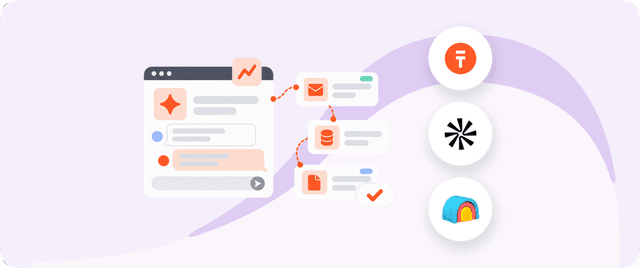
A typical AI feature in a SaaS product looks like a chain: your product captures a user action, calls an internal API, passes data through an integration layer, reaches a model provider, then writes results back into CRM, ticketing, billing, or identity systems. Every arrow in that chain is a place where scope can be wrong, tokens can be too broad, or audit trails can go missing.

Four mistakes keep showing up in security reviews:
- Too much data pushed "just in case." Teams ship a feature that reads the entire contact record when it only needs an email and a job title. The extra data adds no product value and a lot of review friction.
- API keys that are broad and long-lived. A single token with write access to everything, valid for a year, is easy to implement and hard to defend. Scoped tokens with short lifetimes take more work and survive more reviews.
- Thin audit trails. If you cannot reconstruct what the AI saw, decided, and triggered on a given Tuesday, you cannot answer the question a customer will eventually ask.
- Unclear responsibility split. When a model provider, an integration provider, and your own product share the pipeline, customers want to know who owns each segment. Pointing at another vendor is not an answer procurement will accept.
This is why "we use a reputable model provider" falls flat as an answer. The model provider is only one link. The integration layer, the prompt construction, the data trimming, and the action execution all belong to you.
⚠️ Important
If you cannot sketch your AI flow on a whiteboard in two minutes, showing what is read versus write and what can trigger actions, you cannot defend it in a security review either. The inability to draw the diagram is the finding.
A clear picture of inputs, outputs, and authority lines is the entry ticket. Without it, the procurement team has no way to say yes.
Turning Architecture Transparency Into a Sales Asset
Here is the reframe that changes how marketing and sales think about AI security. The details a CISO wants are the same details a buyer's internal champion uses to sell the purchase internally. Your governance story is a GTM asset, not a legal PDF.
Think about five concrete signals your AEs, SEs, and partners can carry into every deal:

- A clear workflow story. What goes in, what touches the data, what comes out, and where it writes. Two sentences, not a 20-page document.
- Crisp data boundaries. What stays inside the customer's environment, what leaves it, under which contractual terms, and whether it is ever used for model training. The answer should be unambiguous.
- Scoped access, not god-mode. Read-only by default, write access only where the product needs it, and documented conditions for each.
- Real guardrails. Suggestions versus human-approved actions versus automatic execution, plus rate limits that stop a bad prompt from causing a bulk mistake.
- Auditability. Per-tenant logs that let both your team and the customer walk through what the AI saw, decided, and triggered.
Most SaaS companies already have answers to these. The answers just live in three different documents, two Slack threads, and one engineer's head. Pulling them into a single page moves deals.
"If your AE and your CISO can both explain this in a couple of minutes, you're in good shape." Natalia Botti, VP Channels & Alliances, ApexaiQ
When the AE and the CISO tell the same story, procurement moves fast. When they do not, the deal stalls while internal teams align, and stalling is what kills quarterly forecasts. The architecture summary becomes a sales script, a security answer, and a trust signal at the same time.
If your team is packaging an AI feature for enterprise buyers, Albato Embedded gives you a governance story you can show, not just describe: scoped tokens, per-tenant isolation, audit logs, and a white-label integration layer built for SaaS products.
The Integration Layer Decides the AI Blast Radius
AI does not run in a slide. It runs on integrations. That fact changes how you evaluate your own stack.
When an AI feature needs to read a deal record, update a ticket, or post to a channel, it goes through an integration layer. Three options are common: an embedded iPaaS inside your product, your own in-house API surface, or partner or MSP tooling that bridges systems. Each choice moves the blast radius up or down.
The integration layer decides three things:
- What the AI can see. Field-level scoping, per-tenant boundaries, and explicit connection paths limit exposure. Wide service-account access does the opposite.
- What the AI can change. Write permissions, approval workflows, and action allowlists keep the surface small and defensible.
- How big the blast radius is when something goes wrong. Per-tenant isolation means one customer's AI mistake never touches another customer's data.
When you select or design an integration layer for AI features, a short list of questions helps:
- Does it provide per-tenant isolation by default, or is that something you have to build.
- Are connection paths explicit and auditable, or does the AI reach through a shared service account.
- Can admins approve or block specific actions, and can they see a log afterward.
- How are tokens scoped: read-only by default, short-lived, revocable per tenant.
Albato Embedded was built for this pattern. It gives SaaS products a white-label integration layer with explicit connection paths, SOC 2 Type 2 certification, GDPR-compliant data processing, AES-256 encryption at rest, and TLS 1.2/1.3 in transit. Automation logs are retained for 60 days, and data passing through integrations is never analyzed or used to train models. Full security page: albato.com/embedded/security.
Want the full picture of how Albato Embedded handles AI data flow, scoped access, and per-tenant isolation? The security page covers certifications, encryption, log retention, and model-training policy in one place.
A 5-Question Security Checklist for Your Own AI Features
Before you answer these for a buyer, answer them internally. If the answers are shaky in-house, they will be shaky on a sales call.

- Can we explain the full flow in under two minutes? Inputs, processors, outputs, training use, and customer controls. Two minutes, no slides.
- Do we know the minimum data this feature actually needs, and are we limiting it? If a draft-generation feature needs only a subject line and three deal fields, the prompt should see only those.
- Can we list exactly which systems it can change, and under what conditions? "Update contact, create note, never delete" beats "write access to HubSpot." Precision is a trust signal.
- If something goes wrong across vendors, can we say this part was on us and show logs? Shared responsibility only works when each party can produce evidence for their segment.
- What controls does the customer actually get: toggles, policies, approvals, opt-outs? The default answer for enterprise buyers is now "yes, per feature, per tenant."
A transparent integration layer answers four of these five on your behalf. Per-tenant isolation gives you the boundary story. Scoped tokens give you the minimum-access story. Audit logs give you the evidence story. Admin approval flows give you the customer-control story. Your product team still owns question two, because only you know which data the feature actually needs.
💡 Tip
Run this checklist with your AE and your CISO in the same room. If they give different answers, your customers are going to see the same inconsistency during the security review. Align internally before you align with the buyer.
Where AI Governance in SaaS Is Heading
The direction of travel is visible now, and it matches patterns from every other governance wave that hit SaaS. Expect three changes over the next 12 to 18 months.
From one-time reviews to ongoing monitoring. Security teams will stop treating a signed questionnaire as the finish line. They will ask for continuous evidence: dashboards, access reviews, change logs, and periodic attestations tied to specific AI features.
Beyond compliance monitoring, organizations can also use AI for threat detection to analyze system activity, identify unusual behavior, and detect potential security threats across connected applications. This adds another layer of protection to SaaS environments where AI-driven workflows handle sensitive business data.
From hidden architecture docs to in-product data-flow views. The trust page will link to a product surface where admins can see, for their own tenant, which AI features are active, what data they touch, and which actions they can trigger. Static PDFs will feel dated next to a live view.
From "just trust us" to real controls customers can see and adjust. Expect AI capability inventories, treated like asset inventories: ownership, policies, telemetry. Expect per-feature switches for data usage, automation level, and approval thresholds. Expect audit trails accessible to both auditors and product teams without a support ticket.
"If unseen assets are unmanaged risk, then invisible AI is unmanaged risk. The companies that treat AI like an asset, with inventory, ownership, policies, and telemetry, will be the ones that turn AI security into a real advantage in SaaS." Natalia Botti, VP Channels & Alliances, ApexaiQ
The companies that get there first set the expectation for everyone else. Late movers will spend the next two years answering questions early movers already baked into their product UI. The good news: most of the raw material exists inside your current stack. The work is pulling it together into a story a buyer can read in two minutes and a CISO can trust in five. For a deeper look at the full conversation this article draws from, watch the webinar recording with Wenddy Dias and Natalia Botti.
If your team is preparing for an AI security review this quarter, start with the five questions above and write a short, specific answer to each one. Buyers respond to answers that name the control, not the promise.
FAQ
What is AI governance for SaaS?
AI governance for SaaS is the set of policies, controls, and visible mechanisms that define how an AI feature handles customer data, what systems it can read or change, how its actions are logged, and what controls the customer has over it. It covers the full workflow, not just the model. Strong governance is documented, auditable, and mapped to specific product behaviors rather than stated in generic trust language.
What AI security questions are enterprise buyers asking in 2026?
Enterprise buyers ask where their data goes when an AI feature runs, whether it is used to train any model, what the AI can read and write in connected systems, how to audit specific AI actions after the fact, and what controls are available at the tenant and feature level. They also ask how the responsibility splits between the SaaS vendor, the model provider, and any integration layer. These questions now appear alongside SOC 2, SSO, and encryption in procurement checklists.
How does integration infrastructure affect AI security?
The integration layer decides what an AI feature can see, what it can change, and how big the blast radius is when something goes wrong. Choices like per-tenant isolation, scoped tokens, explicit connection paths, approval workflows, and audit logs directly shape the risk profile. A transparent integration layer lets a SaaS vendor answer most governance questions with product evidence instead of written assertions, which shortens security reviews and accelerates deal cycles.
Is SOC 2 enough for AI features?
No. SOC 2 Type 2 remains a baseline for enterprise SaaS, but it does not answer AI-specific questions on its own. Buyers now expect additional controls: a clear data flow diagram for AI features, confirmation that customer data is not used to train models, scoped read and write permissions, per-tenant audit logs, admin-level approval and opt-out controls, and documented responsibility splits across model providers and integration vendors. SOC 2 earns you the meeting. The AI-specific controls earn you the contract.
Read more: